
SLIDE 1
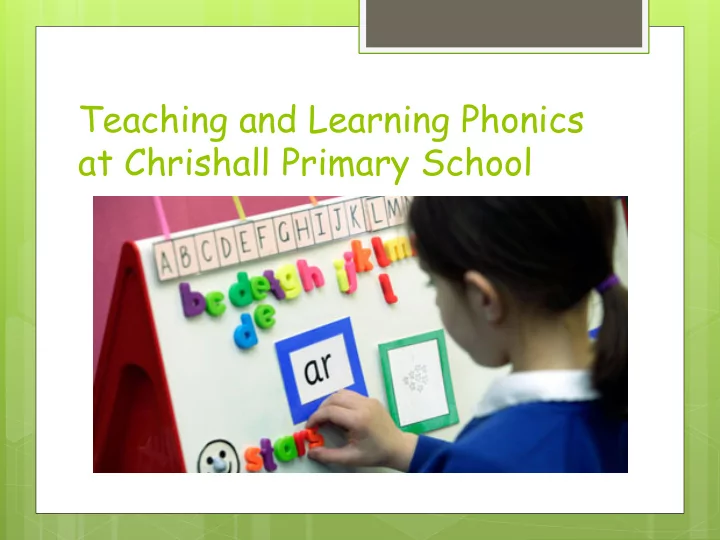
Teaching and Learning Phonics at Chrishall Primary School Aims To - - PowerPoint PPT Presentation
Teaching and Learning Phonics at Chrishall Primary School Aims To share how phonics is taught. To develop parents confidence in helping their children with phonics and reading. To teach the basics of phonics and some useful
To share how phonics is taught. To develop parents confidence in helping their
children with phonics and reading.
To teach the basics of phonics and some useful
phonics terms.
To outline the different stages in phonic
development.
To show examples of activities and resources we
use to teach phonics.
To give parents an opportunity to ask questions.
sessions of phonics.
writing activities, games and rhymes.
document, Phonics Play and Jolly Phonics to support the teaching of phonics.
children work through at their own pace.
daily phonic sessions.
Phonemes: The smallest units of sound that are found
within a word
Grapheme: The spelling of the sound e.g. th Digraph: Two letters that make one sound when read Trigraphs: Three letters that make one sound CVC: Stands for consonant, vowel, consonant. Segmenting is breaking up a word into its sounds. Blending: Putting the sounds together to read a word Tricky words: Words that cannot easily be decoded.
1.Tuning into sounds 2.Listening and remembering sounds 3.Talking about sounds Music and movement Rhythm and rhyme Sound effects Speaking and listening skills
Children will learn their first 19 phonemes:
Set 1: s a t p Set 2: i n m d Set 3: g o c k Set 4: ck (as in duck) e u r Set 5: h b l f ff (as in puff) ll (as in hill) ss (as in hiss)
They will use these phonemes to read and spell
simple “consonant-vowel-consonant” (CVC) words: sat, tap, dig, duck, rug, puff, hill, hiss All these words contain 3 phonemes.
Sounds should be articulated clearly and precisely. http://mrthorne.com http://www.focusonphonics.co.uk/sound.htm https://www.youtube.com/watch?v=5J2Ddf_0Om8
Your children will learn to use the term:
Children need to be able to hear the separate
sounds in a word and then blend them together to say the whole word.
Your children will learn to use the term:
Children need to be able to hear a whole
word and say every sound that they hear .
Children need to practise hearing a series of spoken sounds and merging them together to make a word. For example, you say ‘b-u-s’, and your child says ‘bus’. “What’s in the box?” is a great game for practising this skill.
Your children will learn to use the term:
Phonemes are sounds that can be heard in words e.g. c-a-t
Your children will learn to use the term:
grapheme
This is how a phoneme is written down
Your children will learn to use the term:
digraph
This means that the phoneme comprises of two letters e.g. ll, ff, ck, ss
Phoneme frame and sound buttons
There are many words that cannot be blended
Children will enter phase 3 once they know
the first 19 phonemes and can blend and segment to read and spell CVC words.
They will learn another 26 phonemes: j, v, w, x, y, z, zz, qu ch, sh, th, ng, ai, ee, igh, oa, oo, ar, or,
ur, ow, oi, ear, air, ure, er
They will use these phonemes (and the ones from
Phase 2) to read and spell words:
chip, shop, thin, ring, pain, feet, night,
boat, boot, look, farm, fork, burn, town, coin, dear, fair, sure
Your children will learn to use the term:
Phase 4: Introducing consonant clusters: reading and spelling words with four or more phonemes
Children move into phase 4 when they know all the
phonemes from phases 2 and 3 and can use them to read and spell simple words (blending to read and segmenting to spell).
Phase 4 doesn’t introduce any new phonemes. It focuses on reading and spelling longer words with
the phonemes they already know.
These words have consonant clusters at the
beginning: spot, trip, clap, green, clown …or at the end: tent, mend, damp, burnt …or at the beginning and end! trust, spend,twist
Teach new graphemes for reading ay, ou, ie, ea, oy, ir, ue, aw, wh, ph,
ew, oe, au, a-e, e-e, i-e, o-e, u-e
Learn alternative pronunciations of
graphemes (the same grapheme can represent more than one phoneme): Fin/find, hot/cold, cat/cent, got/ giant, but/put, cow/blow, tie/field, eat/bread, farmer/her, hat/what, yes/ by/very, chin/school/chef, out/ shoulder/could/you.
Learning that the same phoneme can be represented in more than
burn first term heard work
meat bread he bed bear hear cow low
Learning that the same grapheme can represent more than one phoneme:
Learning all the variations!
tie time toe tone cue cube
Phase 6 focuses on spellings and learning rules for
spelling alternatives. Children look at syllables, base words, analogy and mnemonics.
Children might learn about past tense, rules for
adding ‘ing’ and irregular verbs
‘tion’ and ‘sion’ words
The phonics screening check is designed to confirm
whether pupils have learnt phonic decoding to an appropriate standard. It will identify pupils who need extra help to improve their decoding skills.
The check consists of 20 real words and 20 pseudo-
words that a pupil reads aloud to the teacher.
All year one children take the test and if the test is
not passed, the child retakes it when in year two.
Phonics Leaflet Mr Thorne Does Phonics School Phonics Blog
Technology Blog: Phonic Apps
Phonic Awareness App Jolly Phonics Starfall/Oxford Owl websites for phonic eBooks
http://resources.woodlands-
junior.kent.sch.uk/interactive/literacy.html#7
Hangman –
http://www.lancsngfl.ac.uk/curriculum/ literacyresources/files/alpha/alpha.htm
Look, Cover, Write and Check –
http://www.amblesideprimary.com/ ambleweb/lookcover/lookcover.html
Mnemomics Spelling Tips –
http://primarygamesarena.com/Play/ SpellingLetter-patterns-games-1072