Food Stamp Food Stamp Simple and easy prepared media for detection - - PowerPoint PPT Presentation

food stamp food stamp
SMART_READER_LITE
LIVE PREVIEW

Food Stamp Food Stamp Simple and easy prepared media for detection - - PowerPoint PPT Presentation

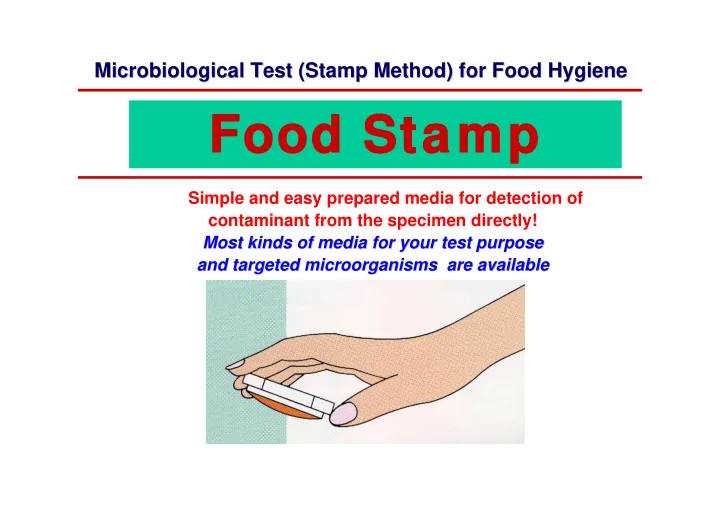
Microbiological Test (Stamp Method) for Food Hygiene Microbiological Test (Stamp Method) for Food Hygiene Food Stamp Food Stamp Simple and easy prepared media for detection of contaminant from the specimen directly! Most kinds of media for


slide-1
SLIDE 1

Microbiological Test (Stamp Method) for Food Hygiene Microbiological Test (Stamp Method) for Food Hygiene

Simple and easy prepared media for detection of contaminant from the specimen directly! Most kinds of media for your test purpose Most kinds of media for your test purpose and targeted microorganisms are available and targeted microorganisms are available

Food Stamp Food Stamp

slide-2
SLIDE 2

What is What is “ “Food Stamp Food Stamp” ”? ?

For keeping quality and safety of the products, and also prevent food borne accident.

Best solution for your routine test!

You can start food hygiene test anytime, even you have never experienced microbiology!

It is simple prepared culture media that can be handled by anyone.

slide-3
SLIDE 3

Intended Use, Food Stamp Intended Use, Food Stamp

It is useful for “Self Hygiene Control” at all kinds of food related industries.

① Test for Food Manufacturing Environment: Hygiene control for manufacturing apparatus, Kitchen apparatus (food processor, cutting board, etc.) and manufacturing environment (wall, production line, working surface, etc.). ② Test for confirmation of cleanliness, disinfection: Confirm cleanliness and disinfection. ③ Hygiene education for employees Hygiene education and enlightenment

slide-4
SLIDE 4

You can select the medium by purpose and use! You can select the medium by purpose and use! There are 10 kinds of media are prepared. There are 10 kinds of media are prepared.

① Standard method (Total viable count) ② Desoxycholate (Coliform) ③X-GAL (Coliform) ④ XM-G (Coliform/E. coli) ⑤ TCBS (V. parahaemolyticus) ⑥ TGSE (S. aureus) ⑦ MLCB (Salmonella) ⑧ Cereus (B. cereus) ⑨Sabouraud (Yeast and Mold) ⑩ Potato Dextrose with CP (Food poisoning Yeast and Mold)

Various kinds of Food Stamp Various kinds of Food Stamp

slide-5
SLIDE 5

Potato Dextrose agar with CP Hygiene control for Meats and manufacturing environment. Sabouraud agar Yeast and Mold Hygiene control for Grains / Meats / Vegetables and manufacturing environment. Cereus agar

  • B. cereus

Hygiene control for Egg / Meat and manufacturing environment. MLCB agar Salmonella Hygiene control for Meat / Environment and Employees. TGSE agar

  • S. aureus

Test for sea food and hygiene control for its processing environment. TCBS agar

  • V. parahaemolyticus

XM-G agar Coliform / E. coli X-GAL agar Hygiene control for food and manufacturing environment. Control for fecal pollution by coliform isolation. Desoxycholate agar Coliform Hygiene control for food and manufacturing environment. Standard method agar Total viable count Purpose of test Name of medium Target bacteria

Food Stamp and test purposes Food Stamp and test purposes

slide-6
SLIDE 6

Operation of Food Stamp Operation of Food Stamp

Cut off a side of bag, and take out Food Stamp from the bag. Hold the cap of Food Stamp and cut off each plate by bending. Take off the cap of Food Stamp plate and gently press the medium against the surface of specimen immediately. The surface of medium / agar is elastic enough to be pressed firmly against the specimen. Caution: 1. Wash or clean up the place of specimen where Food Stamp used. 2. Press against the different parts of the specimen when several kinds of Food Stamps use simultaneously. Put the cap again immediately after pressing. Write necessity information (date/name of Specimen etc.) on the cap with oil felt pen. Caution: Do not write any information inside of the

  • cap. It may hindrance to read surface of

the medium. Put the Food Stamp plate into the incubator. In case of the incubator was not available, It may be possible to keep plates at room Temperature for 1.5 – 2 times longer time. Incubation Temp.: Incubation Time: Fungi 20-25 ℃ 2 – 3 days (Sabouraud and PDA) Others 35-37 ℃ 1 – 2 days XM-G 35℃ 20±2hours. All colonies grown on the medium surface shall be counted. A piece of Food Stamp has a medium surface of 10 cm2. And it may be recommended to use the square imprinted

  • n the back of container. (1 cm2 / square)
slide-7
SLIDE 7

Blue colonies (E. coli) / Red colonies (Coliforms)

④ XM-G agar Blue Green-Blue colonies (Coliforms) ③ X-GAL agar Red colonies (Coliforms) ② Desoxycholate agar Count all colonies grown on the surface. ① Standard Method agar Interpretation Name of medium

① Standard Method agar (Total viable count) ② Desoxycholate (Coliform) ③X-GAL (Coliform) ④ XM-G (Coliform/E. coli)

Mainly used for controlling of fecal pollution by coliform isolation.

Interpretation of Food Stamp (1) Interpretation of Food Stamp (1)

slide-8
SLIDE 8

Interpretation Name of medium

White, slightly thick colonies with an irregular rim

⑧ Cereus agar

Black and/or black center colonies (Salmonella) Note2

⑦ MLCB agar

Black colonies with an opaque ring around these colonies (S. aureus)

⑥ TGSE agar Green colonies (V. parahaemolyticus) Note1 ⑤ TCBS agar

Note1: V. alginolyticus is not pathogenic, their existence, if too many yellow colonies present, implies a risk of contamination by V. parahaemolyticus. Note2: Citrobacter or other organisms may also develop black colonies just like Salmonella. It is recommended that certain identification tests should be performed simultaneously. ⑤ TCBS (V. parahaemolyticus) ⑥ TGSE (S. aureus) ⑦ MLCB (Salmonella ) ⑧ Cereus (B. cereus)

Food poisoning bacteria (basically it should not be presented in the products)

Interpretation of Food Stamp (2) Interpretation of Food Stamp (2)
slide-9
SLIDE 9

Interpretation Name of medium Count all fungi grown on the surface (bacteria inhibit growth) ⑩ Potato Dextrose agar with CP Count all fungi grown on the surface ⑨ Sabouraud agar

⑨Sabouraud (Fungi) ⑩ Potato Dextrose with CP (Food poisoning Yeast and Mold)

Mold Yeast

Use these plates to detect fungi as contaminant

Interpretation of Food Stamp (3) Interpretation of Food Stamp (3)

slide-10
SLIDE 10

Either one of two egg yolk reactions is positive, Identify those colonies are Staphylococcus aureus.

Lecithinase Reaction Lecithinase Reaction

It is observed “Turbid” inside of medium around colonies from top surface. It is observed “Pearly luster” on the surface of medium around colonies from sidelong glance.

Egg Yolk Reaction of Egg Yolk Reaction of Staphylococcus aureus Staphylococcus aureus

Lipase Reaction Lipase Reaction

slide-11
SLIDE 11

×

+++ Severe contamination

Over 100 ◎

- or ±

Negative / less contamination

0 ~ 9 〇

+ Slight contamination

10 ~ 29 △

++

Moderate contamination

30 ~ 99

Cleanliness

Mark Judgment Colonies/plate

Judgment of Cleanliness by the number of colonies isolated Judgment of Cleanliness by the number of colonies isolated

  • Quantitative test: Judged by the number of colonies isolated

(Contaminants)

① Standard method (Total viable count) ② Sabouraud (Yeast and Mold) ③ Potato Dextrose with CP (Food poisoning Yeast and Mold)

  • Qualitative test: Judged by (Food poisoning bacteria)

① Desoxycholate (Coliform) ② X-GAL (Coliform) ③ XM-G (Coliform/E. coli) ④ TCBS (V. parahaemolyticus) ⑤ MLCB (Salmonella) ) ⑥ TGSE (S. aureus) ⑦ Cereus (B. cereus)

slide-12
SLIDE 12

Example of use, Food Stamp (1) Example of use, Food Stamp (1)

Hygiene check (kitchen apparatus)

Total Viable Count Coliforms

  • S. aureus

Cutting board Kitchen Knife Cooking table Dishcloth Sponge

slide-13
SLIDE 13

Check for cleaning, sterilization

Total Viable Count Coliforms

  • S. aureus

Before washing After washing by water After washing by Detergent After spraying of Ethanol

Cooking table

Example of use, Food Stamp (2) Example of use, Food Stamp (2)

slide-14
SLIDE 14

Hand Washing

Total Viable Count

Before

Coliforms

  • S. aureus

After After Before

  • Ms. TS
  • Mr. MR

Example of use, Food Stamp (3) Example of use, Food Stamp (3)

Check for Hand washing (for employees education)

slide-15
SLIDE 15

Hygiene control for food / material (Sea Food)

Example of use, Food Stamp (4) Example of use, Food Stamp (4) -

  • 1

1

Total Viable Count Coliforms

Tuna

Vibrio parahaemolyticus

Scallop Ark shell Prawn Garnish (Radish)

Food Stamp application for Sea Food

slide-16
SLIDE 16

Example of use, Food Stamp (4) Example of use, Food Stamp (4) -

  • 1

1

Hygiene control for food / material (Daily dishes)

Total Viable Count Coliforms

  • S. aureus

Sandwich (Lettuce) Rice Ball (Rice) Sandwich (Ham) Tofu (soybean curd ) Salad

Food Stamp application for Daily Dishes

slide-17
SLIDE 17

Total Viable Count Coliforms

  • S. aureus

Top shelf

Refrigerator

Second shelf Internal Surface Doorknob

Direction for Use (1) Direction for Use (1)

Isolation data will be changed where the places stamped.

slide-18
SLIDE 18

Cooking table

Total Viable Count Coliforms

  • S. aureus

Before work During work

After washing

Direction for Use (2) Direction for Use (2)

Isolation data will be changed when Food Stamp used.

slide-19
SLIDE 19

Adaptable test objects, Non adaptable Adaptable test objects, Non adaptable

  • bjects for Food Stamp
  • bjects for Food Stamp

1) Adaptable objects: ・ Kitchen apparatus (cutting board / kitchen knife / dish cloth, etc.) ・ Cooking table, Work bench, Wall, Floor ・ Instruments (Slicer / Refrigerator, etc.) ・ Employee’s Hands ・ Other (include foods that can be stamped) 2) Non adaptable objects: ・ Liquid surface ・ Not smooth and irregular surfaces ・ Acquire lots of oil on the surface (thin film of oil will not be the problem)

slide-20
SLIDE 20

Advantages and application of Food Stamp Advantages and application of Food Stamp

Easy and simple stamp media that anyone can be used for food microbiology test!

Simple Operation is one of the major advantages! Applicable for “Self Hygiene Control”.

1) Test for Manufacturing Environment

Hygiene control for the manufacturing apparatus / kitchen apparatus and manufacturing environment.

2) Confirmation of Cleanliness and Sterilization

Confirmation of washing and effect of disinfection (before and after)

3) For the employees hygiene education

Education and hygiene control for your Employees