SLIDE 1 Bounds on the Largest Eigenvalue a
Natalie Denny
Advisor: John Caughman Second Reader: Derek Garton
SLIDE 2 Overview
- “On the Largest Eigenvalue of the Distance Matrix
- f a Connected Graph” by Bo Zhou and Nenad
Trinajstic
- Application to Chemistry/Chemical Graph Theory
- The Distance Matrix of a Graph
- Bounds on the Largest Eigenvalue
- Nordhaus-Gaddum type result
SLIDE 3 Application to Chemistry
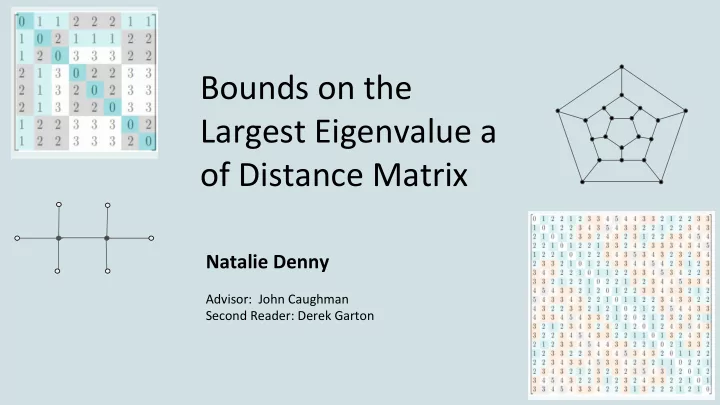
C2H6 (Ethane) C20 Fullerene
Eigenvalues of distance matrices are used in chemical QSAR (Quantitative Structure-Activity Relationship) and QSPR (Quantitative Structure-Property Relationship) modeling.
SLIDE 4 The Wiener Index
- Named for Harry Wiener (Chemist,
Medical Doctor, Pharmaceutical Executive, Psychiatry Researcher)
- The First Topological Index (1947):
- riginally called “The Path Number”
- Was the seed to further molecular
descriptors such as using eigenvalues of distance matrices (Bonchev & Trinajstic, 1977)
SLIDE 5 C2H6
v1 v2 v3 v4 v8 v7 v6 v5 v1 v2 v3 v4 v5 v6 v7 v8 v1
v2
v3 v4 v5 v6 v7 v8 1 1 1 1 1 1 1 1 1 1 1 1 1 1 2 2 2 2 2 2 2 2 2 2 2 2 3 3 3 3 3 3 2 2 2 2 2 2 2 2 3 3 3 3 2 3 3 3 3 2 3 3 3 3 2 2
Graph E
DE =
SLIDE 6 DE =
The Distance Matrix
- Real
- Symmetric
- Non-Negative
- Irreducible
Also uniquely determines a graph up to isomorphism!
SLIDE 7
The Wiener Index
DE =
⇒ W(E) = 58
SLIDE 8
S(G)
DE =
⇒ S(E) = 136
SLIDE 9
The Wiener Index & S(G) limitations
The Wiener index & S(G) do not uniquely determine a graph (and hence the underlying structure of the molecule). For example, consider the two graphs below. W(G1) = 8 S(G1) = 12 W(G2) = 8 S(G2) = 12
SLIDE 10
Bounds on the Largest Eigenvalue
λmax 0 <
Since distance matrices are real and non-negative, then by the Perron-Frobenius theorem we know that the largest eigenvalue is unique and positive. It is called the Perron root or the Perron-Frobenius eigenvalue. Let Dmin and Dmax be the minimum and maximum row sum of the distance matrix respectively.
≤ Dmax
Perron-Frobenius also gives us that λmax is bounded by the minimum and maximum row sum.
Dmin ≤
SLIDE 11
Bounds on the Largest Eigenvalue
𝚳(G) ≤ Dmax
DE =
⇒ 10 ≤ 𝚳(E) ≤ 16
Dmin ≤
SLIDE 12 Bounds on the Largest Eigenvalue
𝚳(G) ≤ Dmax
What about that maximum row sum? DG =
⇒ DM ≤ n(n-1)/2
0 1 2 3
. . .
n-1
≤ n(n-1)/2 Dmin ≤
SLIDE 13
Bounds on the Largest Eigenvalue
𝚳(G) ≤ n(n-1)/2
DM(E) ≤ 1 + 2 + (8-3)(3) = 18 And we saw that actually, DM(E) = 16.
Dmin ≤
SLIDE 14 Bounds on the Largest Eigenvalue
𝚳(G) ≤ n(n-1)/2 Dmin ≤
DG =
0 1 2 3
. . .
n-1
1 0 1 2
. . .
n-2
3
SLIDE 15 Bounds on the Largest Eigenvalue
𝚳(G) < n(n-1)/2 Dmin ≤
DG =
0 1 2 3
. . .
n-1
1 0 1 2
. . .
n-2
3
Using the Rayleigh Quotient, we can deduce that the upper bound is
- nly equal to the largest row sum when the row sums are
- equivalent. So for n ≥ 3, you have a strict less than n(n-1)/2.
SLIDE 16
Bounds on the Largest Eigenvalue
𝚳(G) < n(n-1)/2 Dmin ≤ 2W(G)/n ≤
Previously, 10 ≤ 𝚳(E) < 16. Now by Lemma 5.3, 14.5 ≤ 𝚳(E) < 16.
Wiener Index for the win!
SLIDE 17
Bounds on the Largest Eigenvalue
𝚳(G) < n(n-1)/2 2W(G)/n ≤
Previously, 14.5 ≤ 𝚳(E) < 16. By Lemma 5.4, 12.25 ≤ 𝚳(E).
This lower bound is always at most 2W(G)/n. But gives a way to express the lower bound in terms of edges of the graph.
Wiener Index still wins!
SLIDE 18 Another Example: C20
Graph C: DC=
C is distance-regular with diameter 5 and valency 3
SLIDE 19
Another Example: C20
Distance-Regular gives us Equal Row Sums (Di = 50 for all i) So, W(C) =½ (20)(50) = 500 So by the Perron-Frobenius theorem, 𝚳(C) = 50.
SLIDE 20 Bounds on the Largest Eigenvalue
The previous two examples also belong to a special class of graphs that have exactly one positive eigenvalue for the distance matrix. We denote this class with G. G includes:
- Infinite families such as:
○ Trees, Cn (cycles), Johnson, Hamming, Cocktail Party, Double Half Cubes
- Dodecahedron & Icosahedron
- Petersen graph
SLIDE 21 Bounds on the Largest Eigenvalue
SLIDE 22 𝚳(G) < n(n-1)/2 2W(G)/n ≤
Previously, 14.5 ≤ 𝚳(E) < 16. By Thm 6.2, 14.5 ≤ 𝚳(E) < 15.427.
Bounds on the Largest Eigenvalue
≤ √[2(n-1)S(G)/n]
Compare to 𝚳(C) = 50. Thm 6.2 gives 𝚳(C) < 54.093.
SLIDE 23
Nordhaus-Gaddum Type Results
Conjecture?
SLIDE 24
Questions
(as long as they aren’t about chemistry :)
Thank you to John Caughman and Derek Garton for the support on this incredible journey!
SLIDE 25