Bony and Fascial Origins Bony and Fascial Origins Forearm flexors - - PDF document

bony and fascial origins bony and fascial origins
SMART_READER_LITE
LIVE PREVIEW

Bony and Fascial Origins Bony and Fascial Origins Forearm flexors - - PDF document

6/25/2020 Biceps Two heads Unique Features Coracoid process of Superior Upper Extremity labrum/glenoid Muscle/Tendon Anatomy Inserts radial tuberosity and Mark Elzik, MD lacertus fibrosis Mission Viejo, CA Biceps Palmaris


slide-1
SLIDE 1

6/25/2020 1 Unique Features

  • f

Upper Extremity Muscle/Tendon Anatomy

Mark Elzik, MD Mission Viejo, CA

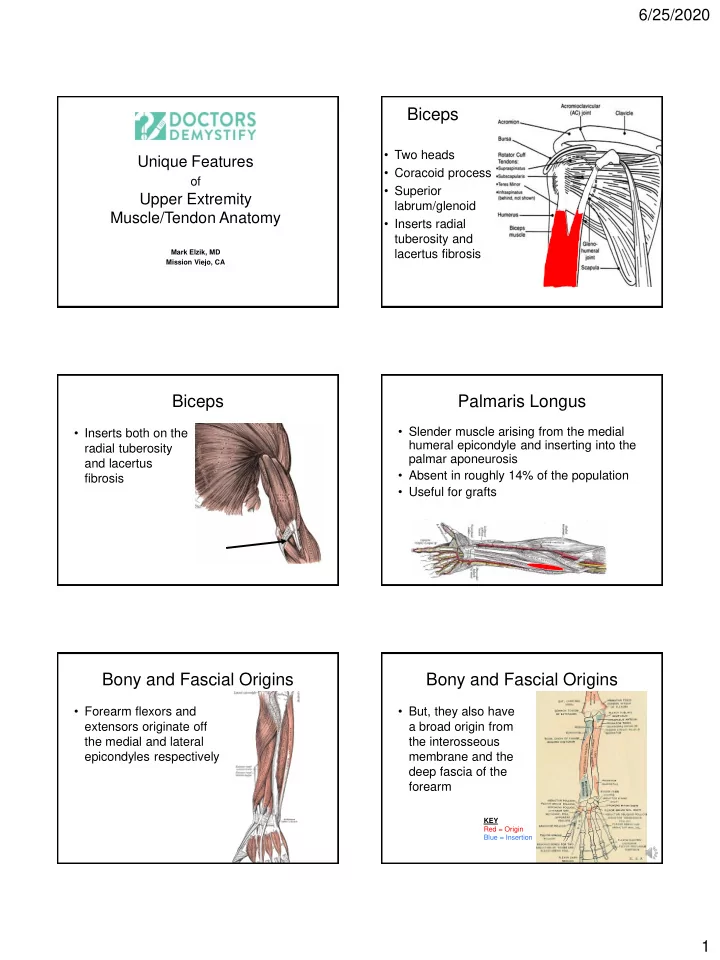
Biceps

  • Two heads
  • Coracoid process
  • Superior

labrum/glenoid

  • Inserts radial

tuberosity and lacertus fibrosis

Biceps

  • Inserts both on the

radial tuberosity and lacertus fibrosis

Palmaris Longus

  • Slender muscle arising from the medial

humeral epicondyle and inserting into the palmar aponeurosis

  • Absent in roughly 14% of the population
  • Useful for grafts

Bony and Fascial Origins

  • Forearm flexors and

extensors originate off the medial and lateral epicondyles respectively

Bony and Fascial Origins

  • But, they also have

a broad origin from the interosseous membrane and the deep fascia of the forearm

KEY Red = Origin Blue = Insertion

slide-2
SLIDE 2

6/25/2020 2

Bony and Fascial Origins

  • These broad muscular origins allow

the muscle to maintain resting length and function when their bony attachments are released –Medial epicondylectomy for cubital tunnel –Lateral release for tennis elbow

Lumbricals

  • Origin – FDP

tendon

  • Insertion –

Extensor Expansion

  • Fascinating

muscle as it has NO bony origin

  • r insertion

Interosseous Muscles (Palmar)

  • 3 palmar

interosseous muscles

  • Originate from

metacarpals & insert

  • nto proximal phalanx

bases

  • Responsible for

adduction of the fingers aka “PAD”

Interosseous Muscles (Dorsal)

  • 4 dorsal interosseous

muscles

  • Originate from

metacarpals & insert

  • nto proximal phalanx

bases/extensor expansion

  • Responsible for

abduction of the fingers aka “DAB”

Camper’s Chiasm

  • FDS begins superficial/volar to FDP
  • FDS splits just proximal to the PIP, rotates

180 degrees and inserts on the MP deep to the FDP

Horst: Training for Climbing

Annular (A) pulleys generally located mid-bone and do the heavy lifting Cruciate (C) pulleys generally over the joints and can collapse during digital flexion

Collateral ligament FDP tendon

Proximal phalanx Middle phalanx Distal phalanx

slide-3
SLIDE 3

6/25/2020 3

thanks for listening surgeons providing excellence in education for OTs and PTs since 1990

bibliography on following slides

References

  • Gray H. Anatomy of the Human Body.

Philadelphia: Lea & Febiger, 1918.

  • Susman RS, Nyati L, Jassal M.

Observations on the Pollical Palmar Interosseous Muscle (of Henle). Anat Rec 1999;254:159–165.

  • Snell RS. Clinical Anatomy 6th Ed. 2000.
  • Tan ST, Smith PJ. Anomalous Extensor

Muscles of the Hand: A Review. J Hand Surg 1999; 24A:449–455.

Muscle Physiology and Mechanics

Stewart Brown, M.D.

Muscle Physiology and Mechanics

  • Muscle Fibers - Types and Conditioning
  • Physiology of Muscle Contraction
  • Basic Biomechanics of Joint Motion

Slow Twitch Muscles Fibers

  • Distance runners

–Aerobic –Contraction – slow –Fatigue resistance –high

Fast Twitch Muscle Fibers

  • Sprinters

–Anaerobic –Contraction - fast –Fatigue resistance – low

slide-4
SLIDE 4

6/25/2020 4

Muscle Strengthening

Muscle cell hypertrophy = Protein synthesis –Diet –Exercise –Hormones

Blood Flow Restriction BFR

  • 60% arterial occlusion

pressure gives maximum effect

  • Lower cuff

pressure is less painful

Blood Flow Restriction BFR

  • 40% 1Repetition

maximum instead

  • f 70% effective
  • 2 Cochrane

registered prospective studies ongoing

Patterson et al, Blood Flow Restriction Exercise: Considerations of Methodology, Application, and Safety https://www.frontiersin.org/article/10 .3389/fphys.2019.00533

Muscle Atrophy

Trauma, Immobilization, Nerve injury, … Protein synthesis Number of muscle nuclei normal Recovery Potential Good Thenar Atrophy in Carpal Tunnel Syndrome

Muscle Ischemia

Loss of perfusion of the muscle Cell death Fibrous scar Recovery Potential Muscle necrosis after Compartment syndrome

Skeletal Muscle

Striated Muscle

Multinucleated cells

Myofibrils

Myosin dark bands Actin light bands

slide-5
SLIDE 5

6/25/2020 5

Ca++

Striated Muscle Contraction

Actin Actin Myosin Ca++

Striated Muscle Relaxation

Actin Actin Myosin Which arrangement of sarcomeres has a stronger excursion? Which has a longer excursion?

Arrangements of Sarcomeres

series parallel Maximum tension is proportional to the muscle’s cross-section lumbrical adm

Active Contraction Muscle produces its highest

tension (strongest contraction) at its resting length It produces less tension when it is shorter or longer. Length Tension

Active Contraction

  • Strongest at resting length

(greatest actin-myosin contact) Length (strain) Tension (stress)

slide-6
SLIDE 6

6/25/2020 6

Who is the Jamar set up for? What’s happening here? Equals the perpendicular distance between the joint’s center of rotation and the crossing tendon

Moment Arm Quiz!

A2 pulley rupture. How does this affect the function

  • f the finger?

Reading

Brand P, Hollister, A: Clinical Mechanics of the Hand.

  • Ed. 3, St. Louis, Mosby, 1999

Gonzalez et al. Biomechanics of the Digit. JASSH, 2005. Little J, Phillips S:Resistance exercise and nutrition to counteract muscle wasting.Appl Physiol Nutr Metab. 2009 34:817-28 Rassier: Molecular basis of force development by skeletal muscles during and after stretch. Mol Cell

  • Biomech. 2009 6:229-41.

Escamilla R, et al: Shoulder muscle activity and function in common shoulder rehabilitation exercises. Sports Med. 2009;39:663-85

Surgeons providing excellence in education for OTs and PTs since 1990 pro

Tendon Biology

Paul Garheeb, MD

slide-7
SLIDE 7

6/25/2020 7

Tendon Healing

  • Tendons appear inert but nutritional pathways

must be maintained or restored for healing to

  • ccur
  • Tendon capillaries come from

– musculotendinous junction – bone insertion – vincula

  • Synovial fluid nutrition occurs within the tendon

sheath – volar and dorsal wrist – digital flexor tendon sheath

Tendon Vascularity

  • Vincula supply

capillaries to dorsal 2/3 of flexor tendons within digital sheath avascular zone volarly

Tendon Vascularity

  • Blood supply to

tendon leaves avascular zones between vincula fds fdp avascular zones

Tendon Vascularity

  • Significant areas of

zone 2 tendons have no blood supply and rely on synovial diffusion for nutrition

Intrinsic/ExtrinsicTendon Healing

  • Extrinsic healing:

tendons do not have capacity for self- healing, rely on granulation tissue from surrounding areas to invade injury site

Intrinsic/Extrinsic Tendon Healing

  • Intrinsic healing: tenocytes within

tendon can heal injury without granulation from surrounding tissues

slide-8
SLIDE 8

6/25/2020 8

Tendon Healing

  • Experimentally, tendons can clearly

heal by intrinsic means

  • Clinically, tendons likely heal by

combination of intrinsic and extrinsic means

Phases of Wound Healing

collagen accumulation days

  • IV. maturation
  • III. proliferation
  • I. hemostasis
  • II. inflammation

3 10 100 30 300

Goal of Tendon Healing

  • To allow tendon healing while avoiding

tendon-sheath adhesions –strong suture, strong technique, strong knot –minimal interference of vascularity

  • Mechanical barriers
  • Artificial materials
  • Sheath closure
  • Pharmacological agents
  • Anti-inflammatories
  • Chemical barriers
  • Collagen degraders

The Dream

Prevention of Adhesions

*Ineffective *Obstructive

The Facts

*Nonselective

Prevention of Adhesions--The Reality

1 wound, 1 scar.

sheath tendon bone

1 wound, 2-3 scars early motion

scar

immobilized tendon repair mobilized tendon repair

Tendon Gliding

  • Accelerates development of tensile

strength

  • Reduces restrictive adhesions
  • Forces must be kept below level of

suture disruption

slide-9
SLIDE 9

6/25/2020 9 How much force is generated in a tendon?

  • Passive finger motion generates 9 Newtons
  • Active unresisted flexion generates 35 N
  • 8 pounds of pinch (40 N) generates 120 N

Most repair techniques withstand 20-30 N What is a Newton? (Not a fig newton)

How many medium sized apples in a pound?

Fact: ~5 Newtons in a pound Fact: ~5 apples in a pound

1 N =

1 N ~ .2 pound A Multitude of Tendon Repair Techniques

  • Suture selection:
  • Size: 3-0 vs 4-0
  • Type: braided vs. monofilament
  • Material: nylon vs. many others
  • Suture technique: 2-strand vs. 4, 6, 8-strand
  • Tendon grasping maneuvers

Tendon Grafting

Conventional donor sites extrasynovial tendons

palmaris longus plantaris (adjacent to Achilles tendon Experimental donor sites intrasynovial tendons FDP, FDS in zone 2 digital flexors/extensors under wrist retinacula

Tendon Grafting

  • Intrasynovial donor

tendons (experimental) –fewer adhesions (more intrinsic healing) –less friction around annular ligaments –result: less force required to achieve gliding rough surface of grafted

extrasynovial donor tendon smooth surface of grafted intrasynovial donor tendon

Tendon Healing: Key Points

  • Tendons have low metabolic demands
  • Tendons have low metabolic supply
  • Tendons generally heal by combination of

intrinsic/extrinsic healing

  • Differential gliding of tissues only current

way to modulate adhesion formation

  • Ask surgeon how strong the repair is during

early therapy

slide-10
SLIDE 10

6/25/2020 10

thanks for listening surgeons providing excellence in education for OTs and PTs since 1990

bibliography on following slides

Reading List

  • 1. Legrand A, Kaufman Y, Long C, Fox PM.

Molecular biology of flexor tendon healing in relation to reduction of tendon adhesions. J Hand Surg. 2017;42(9):722-726

  • 2. Wong R, Alam N, McGrouther AD, Wong JK.

Tendon grafts: their natural history, biology and future development. J Hand Surg Eur Vol. 2015;40(7):669-681

Mark Elzik, MD

Flexor Tendon Injury and Tenolysis

FLEXOR TENDONS

EXAMINATION

  • Resting posture of digit
  • Loss of normal cascade
  • Active flexion at PIP and DIP joints

FLEXOR TENDONS

EXAMINATION

  • Individual testing of

FDS and FDP tendons

  • FDS - active flexion

at PIP joint with other fingers extended

  • FDP - active flexion

at DIP joint with blocking of PIP joint

FLEXOR TENDON REPAIR

TIMING

  • Primary repair (<2 weeks)
  • Delayed primary repair (2-5 weeks)
  • Secondary: tendon graft (>5 weeks)
slide-11
SLIDE 11

6/25/2020 11 FLEXOR TENDONS

  • Kleinart & Verdan’s zones
  • “No-man’s land” - Zone II
  • A2 and A4 pulleys,

traditionally sacrosanct

Core Suture

  • The strength of a flexor tendon repair is

roughly proportional the number of suture strands that cross the repair site Suture bulk Technical difficulty Strength Gliding

Number of core suture strands Repair site volume/bulk

FLEXOR TENDON REPAIR

CORE SUTURE

  • 4/0 monofilament nylon
  • r braided polyester
  • Modified Kessler
  • Palmar placement to avoid

dorsal vascular supply

  • Knot placed internally at repair

site or buried

CORE SUTURE TECHNIQUES

2 - STRAND

  • Bunnell
  • Kessler
  • Modified Kessler
  • Tsuge

CORE SUTURE TECHNIQUES

4/6 - STRAND

  • Double/Triple Kessler
  • Locked Cruciate
  • Augmented Becker

Double Kessler

4 or 6 strand Locked Cruciate

EPITENDINOUS SUTURE

  • Tidies the repair
  • Improves gliding
  • Increases strength 21%

<- scanning electron micrograph of running epitendinous suture

slide-12
SLIDE 12

6/25/2020 12

Current Principles

  • 4- or 6-strand repair
  • Partial or complete release

("venting") of “critical” annular pulleys (particularly A3 and A4)

  • Ensure slight bunching ~20-30% of

diameter to prevent gapping

  • Perform a digital extension-flexion

test to check quality of repair

  • Early partial range active motion

Slight Bunching

Immediate Active Flexion Protocol

*Requirement: 4 strand repair with cross locking

Spaghetti Wrist Spaghetti Wrist

  • Dorsal blocking orthosis & composite passive

flexion-extension each finger until week 3

  • Then AROM initiated & blocking exercises
  • If ulnar nerve repair

–Block RF/SF MCP from hyperextension

  • If median nerve repair

–Night time first web spacer

  • If both nerves repaired

– MCP joint block should include all digits

Flexor Tenolysis

  • FDS, FDP held in tight

association

  • To function properly:

–Move smoothly under skin –Glide through tight pulley systems –Move unhindered over bones and joints

Phalanx

Flexor Tendons

Integrity of pulley systems

  • If critical pulleys are

–Severely attenuated –Destroyed –Tenolysis has poor prognosis

  • Proceed with pulley

reconstruction

slide-13
SLIDE 13

6/25/2020 13

Post operative management

  • Adequate pain control is key

–Oral analgesics –Pts with low pain thresholds or extensive operations

  • Transcutanous catheters can be

placed intraoperatively

  • Administration of local anesthetic

Postoperative Hand Therapy and Edema Reduction

  • Universally recognized as a crucial

component of tenolysis surgery

  • Closely monitored therapy program is

begun immediately

  • Treatment should be dictated by intra-
  • perative findings

Postoperative Hand Therapy

  • Poor quality tendons with decreased caliber:

–Significant rupture possibility –“Frayed tendon program”- place and hold exercises

  • Good quality tendons

–Proceed immediately with more vigorous activities –Active tendon acceleration exercises

Tenolysis Summary

  • Challenging procedure
  • Valuable clinical utility
  • Keys to success:

–Appropriate patient selection –Meticulous operation –Closely monitored hand therapy program

thanks for listening surgeons providing excellence in education for OTs and PTs since 1990

bibliography on following slides

Reading I

  • Azari, Meals: Flexor tenolysis. Hand Clinics. 2005

21(2):211

  • Cannon, Strickland: Therapy following flexor tendon
  • surgery. Hand Clinics. 1985, 1:47
  • Eggli et al: Tenolysis after combined digital injuries

in zone II. Annals Plastic Surgery. 2005, 55:266

  • Jupiter, Pess, Bour: Results of flexor tendon

tenolysis after replantation in the hand. J Hand

  • Surgery. 1989, 14A:35
slide-14
SLIDE 14

6/25/2020 14

Reading II

  • Feldscher, Schneider: Flexor tenolysis. Hand Surgery,

2002, 7:61

  • Schwartz, Chafetz: Continuous passive motion after

tenolysis in hand therapy patients: a retrospective

  • study. J Hand Therapy. 2008, 21:261
  • Strickland: Delayed treatment of flexor tendon

injuries including grafting. Hand Clinics. 2005, 21:219

  • Yamazaki et al: Results of tenolysis for flexor tendon

adhesion after phalangeal fracture. J Hand Surgery. 2008, 33E:557

Reading III

  • Tang JB Flexor Tendon Injuries: Clin Plast Surg.

2019 Jul;46(3):295-306.

  • Klifto et al. Postsurgical Rehabilitation of

Flexor Tendon Injuries. J Hand Surg Am. 2019 Aug;44(8):680-686.

  • Woythal et al. Splints, with or without wrist

immobilization, following surgical repair of flexor tendon lesions of the hand: A systematic review. Hand Surg Rehabil. 2019 Sep;38(4):217-222.

Rehabilitation After Tendon Repair and Reconstruction

Ali Ghiassi, MD

Rehabilitation After Tendon Repair and Reconstruction

A three-part problem

  • It is the defining achievement of hand surgery

and hand therapy

  • Nowhere is active communication between

patient/therapist/surgeon more critical Problem, Part I: anatomy, wound healing

  • Getting a mechanically restrained, poorly healing,

supple structure to glide and resist tensile forces

  • Scar modeling—the primary achievement behind

hand surgery and hand therapy

  • Flexor Zone II repair more difficult than

– Tendon repair in other areas – Grafting – Transfer – Tenolysis

Problem, Part II: clear thinking, communication

slide-15
SLIDE 15

6/25/2020 15

surgery therapy Most hand surgeries

“The treatment is half over at the end of surgery.”T

therapy surgery Tendonrepair surgeries

“The treatment is just starting at the end of surgery.”T

Problem, Part III: the patient

painful clueless pre-occupied “Here’s my hand, fix it.”

Upper Extremity Tendon Repair/Rehab

Specific Diagnosis and

  • Rotator cuff
  • Labral repairs
  • Biceps Tenodesis
  • Distal biceps
  • Triceps
  • Epicondylitis
  • 8 extensor zones
  • 5 flexor zones

Available Treatments

  • Combined injuries

– Nerve, tendon, bone, flexor, extensor

  • Variety techniques

– Open, arthroscopic, # and type suture

  • Surgeon skill/experience
  • Therapist skill/experience
  • Acute, sub-acute, chronic

Confusion! Major Disconnect Between

  • If you understand tendon rehab for zone II, you can

comfortably extrapolate for – tendon repairs in other areas:

  • Rotator cuff, biceps reattachment, extensors

– Tendon grafts, transfers – Tenolysis

Solace!

Goals

  • To expand your global understanding

– Melding knowledge from mechanics, physiology, anatomy, psychology, wound healing

  • Then individually, apply this information to the

various rehab protocols ANATOMY IS KING KNOWLEDGE OF ANATOMY IS FIRST STEP TO SUCCESSFUL OUTCOME BIOLOGY IS QUEEN!! KNOWLEDGE OF BIOLOGY IS PARAMOUNT FOR SUCCESSFUL OUTCOME

slide-16
SLIDE 16

6/25/2020 16

Classical Stress-Strain Curve for any material

Strain

TENDON HEALING

TIME TENSILE STRENGTH

INFLAMMATORY PHASE HEALED TENDON 4 WEEKS 3 MONTHS PROLIFERATIVE PHASE REMODELING PHASE Tendon repair is weakest 4-9 days

STRAIN STRESS

REPAIRED TENDON Never as strong as normal tendon NORMAL TENDON

STRAIN STRESS

REPAIRED TENDON NORMAL TENDON RUPTURE! MAX STRESS DURING HEALING to prevent rupture Margin of safety

  • Early motion (first 4 weeks) contributes to gap

formation at the repair site

– Gaps >3 mm

  • increased adhesion formation
  • lengthen (weaken) muscle-tendon unit
  • Poor clinical result

Passive motion first few weeks?

GAP FORMATION

TIME TENSILE STRENGTH

GAP FORMATION HEALED TENDON 4 WEEKS 3 MONTHS

slide-17
SLIDE 17

6/25/2020 17

IS TENSION IN LIFE BAD? TENSION

  • Lack of mechanical stimulus on the tendon will

cause proliferation of adhesions

  • Early post-repair motion provides a more rapid

recovery of tensile strength

  • Less adhesions = improved tendon excursion

# STRANDS VS STRENGTH

STRENGTH TIME 6 4 2

Post-Op Resistance to Gliding

FORCE TIME PASSIVE LIGHT ACTIVE STRONG GRIP Swelling, Adhesions RESISTANCE TO GLIDING TIME PASSIVE LIGHT ACTIVE STRONG GRIP 6 4 2

Repair strands

RESISTANCE TO GLIDING TIME PASSIVE LIGHT ACTIVE STRONG GRIP 6 4 2

Repair strands

slide-18
SLIDE 18

6/25/2020 18

Rehab Protocol: Active Extension/Passive Flexion 1970-2010 Tendon excursion: Kleinert splint -> Kleinert splint with palmar pulley

Two-strand repairs (weak by current standards) Resting in pip joint flexion risks pip joint contractures Duran/Hauser: added passive extension

Rehab Protocol: Controlled Active Motion (Trumble, 2010)

  • Trend toward active digital motion (Zone II)
  • “Place and hold”

– Passively flexing digits, wrist extended – Patient holds flexed position of digit for 5 sec.

Controlled Active Motion vs. Active Extension/Passive Flexion (Starr, 2013: Systematic Review of 34 papers) more motion, more ruptures vs. less motion, fewer ruptures

Rehab Protocol: Active Protocol (Osada, 2006)

  • 6-strand repair
  • Protected active flexed started at two days
  • Under therapist or surgeon supervision, in hospital

for 4 weeks!

  • Good results, no ruptures

Changes in Flexor Tendon Rehab

1980s, 1990s 2020 Anesthesia regional/general WALANT Trim pulleys? A2/A4: sacrosanct trim/release pulleys aggressively Wrist protected in flexion, stressed choice: mild flexion to mild extension Start motion w/in 4 days common not necessary, motion no better Active flexion weeks 1-3 not popular popular Avoid complete finger flxn none key to ensure safety of active flexion Place-and-hold motion popular neither useful nor efficient Out-of-splint exercises none advised for reliable patients Tang, JB: Flexor tendon injuries. Clin Plastic Surg 2019; 46:295-306.

Early Rupture

  • Look for patients at risk

– Patient factors – Surgical factors – Injury type

Early Rupture of Repair

  • Consider re-operation in first 10 -14 days.
  • Immediately refer back to surgeon
  • Easier than a two stage reconstruction
  • Healed, scarred tendon better than ruptured tendon

and supple joint

slide-19
SLIDE 19

6/25/2020 19

Tenolysis

  • Consider if

– Motivated patient – Significant loss of function – Soft tissue equilibrium – Pain under control

  • Intra-operative

– WALANT: show patient newly gained motion – Take videoclip to show patient later

  • 1st, 2nd therapy visit: consider digital block if doc is nearby

Two-Stage Reconstruction

Consider when

  • Presentation is late
  • Trauma is severe, multiple tissues injured
  • Flexor sheath inadequate

Two-Stage Reconstruction

  • Goal is to maintain passive motion
  • Treat any joint contractures
  • Can use dynamic splint
  • Second stage usually at 3 months (tissue equilibrium)
  • Rehab similar to primary repair during second stage

Three/four/five stage reconstruction!

  • Infection is a disaster
  • Tenolysis not uncommon

The Future

To improve the results of tendon repair, this complex process will require an enhanced healing response

  • growth factors
  • mechanical stimulation
  • tissue engineering
  • gene therapy?

Keys

  • Apply biomechanical principles
  • Individualize rehab protocol
  • Educate the patient, again and again

Best current articles Clifro C et al: Postsurgical rehabilitation of flexor tendon

  • injuries. J Hand Surgery Am, 2019; 44: 680-686

Tang, JB: Flexor tendon injuries. Clin Plastic Surg 2019; 46:295-306

slide-20
SLIDE 20

6/25/2020 20

thanks for listening surgeons providing excellence in education for OTs and PTs since 1990

bibliography on following slides

Background Reading

  • Osada D et al: Flexor tendon repair in zone II with 6-strand

techniques and early active immobilization. J Hand Surg Am 2006; 31:987-992

  • Trumble T et al: Zone-II flexor tendon repair: a randomized

prospective trial of active place-and-hold therapy compared with passive motion therapy. J Bone Joint Surg Am. 2010; 92:1381-9

  • Starr HM et al: Flexor Tendon Repair Rehabilitation Protocols: A

Systematic Review. JHSA 2013; 38A: 1712-1717

TENODESIS

(opening the door on tendon excursions across multiple joints) Roy A. Meals, MD This presentation is narrated and animated. Press Alt + V + W to start the program.

Program Objectives

On program completion, the learner will be able to

  • 1. Define tenodesis and describe the long/short limits
  • f motor unit excursion
  • 2. Define, describe and demonstrate FDP quadriga,

physiologic and pathologic

  • 3. Test for FDS independence in small finger and for

the presence of a Linburg Comstock tether

  • 4. Explain the lack of the ring finger’s independent

MP extension

  • 5. Demonstrate Elson’s test for boutonniere deformity
  • 6. Demonstrate the presence of Landsmeer’s oblique

retinacular ligament

  • 7. Explain the mechanics behind Bunnell’s test for

intrinsic tightness and the lumbrical plus finger

When a motor unit crosses TWO OR MORE joints, this “no more stretch” phenomenon becomes really interesting Tenodesis: tendon + Greek “desis”, a binding

slide-21
SLIDE 21

6/25/2020 21

Photo with permission א(Aleph), http://commons.wikimedia.org

FDP tethered at DIP FDP tethered at MP, IPs FDP tethered at wrist, MP, IPs FDP tethered at both IPs

slide-22
SLIDE 22

6/25/2020 22

Clinical example: Frayed FDP laceration that is trimmed (shortened) and repaired Clinical examples? Trigger finger locked in extension Tendon adhesions s/p laceration Flexor tenosynovitis

A A B A B B A A B A B B SMALL RING SMALL RING

slide-23
SLIDE 23

6/25/2020 23

FDPi FPL Linburg Comstock Tenodesis FDPi FPL FDPi FPL FDPi FPL Linburg Comstock Tenodesis FDPi FPL

A B C S R M S R M S R M S R M S R M I

slide-24
SLIDE 24

6/25/2020 24

Elson’s test for acute boutonniere injury

Fasciodesis

Landsmeer’s Oblique Retinacular Ligament

  • r

= center of rotation

The Bunnell Test for Moderate Intrinsic Tightness

slide-25
SLIDE 25

6/25/2020 25

The Bunnell Test for Moderate Intrinsic Tightness

A Paradox

  • Ring finger injury, FDS and FDP destroyed
  • A tendon graft for FDP is in place
  • Joints are entirely supple
  • FDP pull through is present when MP and

PIP are blocked in extension

  • With unrestricted active flexion, the MP

joint flexes, but the IP joints extend rather than flex

  • What is happening?

Lumbrical Plus Finger

IP Flexion FDP DIP PIP MP IP Extension Lumbrical Flexion Extension Flexion Extension

Extension Extension Now on program completion, the learner should be able to

  • 1. Define tenodesis and describe the long/short limits
  • f motor unit excursion
  • 2. Define, describe and demonstrate FDP quadriga,

physiologic and pathologic

  • 3. Test for FDS independence in small finger and for

the presence of a Linburg Comstock tether

  • 4. Explain the lack of the ring finger’s independent

MP extension

  • 5. Demonstrate Elson’s test for boutonniere deformity
  • 6. Demonstrate the presence of Landsmeer’s oblique

retinacular ligament

  • 7. Explain the mechanics behind Bunnell’s test for

intrinsic tightness and the lumbrical plus finger

Summary References

  • Austin, Leslie and Ruby: Variations of the flexor digitorum

superficialis of the small finger. J Hand Surg 1989, 14A:262-267

  • Elson: Rupture of the central slip of the extensor hood of the finger.

A test for early diagnosis. J Bone Joint Surg 1986, 68B:229-232

  • Landsmeer: The coordination of finger joint motions. J Bone Joint

Surg 1963, 45A:1654-1662

  • Lindburg and Comstock: Anomalous tendon slips from the flexor

pollicis longus to the flexor digitorum profundus. J Hand Surg 1979, 4:79-83.

slide-26
SLIDE 26

6/25/2020 26 Tendon Grafts and Tendon Graft Substitutes

Stephen Zoller, MD

Outline

  • What is tendon reconstruction
  • History
  • Single stage vs. 2-stage reconstruction
  • Graft choices
  • Special circumstances
  • Where are we currently
  • Where are going

Tendon Grafting

  • Replacement of a damaged tendon with an

autologous tendon segment –Tendon Transfer: Donor tendon remains attached to native origin or insertion. –Tendon Graft: Donor tendon transferred as free segment.

  • Flexor versus extensor tendon reconstruction

Tendon Reconstruction: Treatment Options

  • Advancement and

primary repair –Flexor tendons up to 1 to 1.5 cm –Extensor tendons < 1 cm

  • Tendon transfers
  • Joint arthrodesis
  • 1- or 2-stage tendon graft

Seal et al. World J Surg Oncol 2005 3:41

Zone 2: No Man’s Land

  • Historically, Zone II flexor tendon injuries not

repaired –“It is better to remove the tendons entirely from the finger and graft in new tendons smooth throughout its length.” Sterling Bunnell. Surg Gynecol Obstet. 1918.

  • Tendon grafting was standard treatment for

zone II injuries –Repair techniques have improved in recent decades

Surgical Indications

  • Injuries not amenable to primary repair

–Delayed presentation or neglected injuries –Failure of primary repair –Loss of tendon substance > 1.5 cm –Contaminated wounds –Associated soft tissue injury –Extensive damage to pulley system

  • Patients MUST be able to comply with

extensive rehabilitation

slide-27
SLIDE 27

6/25/2020 27

Flexor tendon grafting

  • Principle: Tendon grafting

places repair sites outside of the digital flexor sheath –Converts zone II injuries into zone III (or V) repairs – Minimizes adhesions – Allows for stronger but bulkier repairs

Adapted from Freilich AM. JHS 2007;32A(9):1438.

Single stage versus two-stage reconstruction

  • Single stage:

–Replacement of damaged tendons with tendon graft during same surgical setting.

  • Two-stage reconstruction:

–Places silicone implant into the digital sheath between stages. –Creates a new gliding sheath for later tendon graft.

Single stage grafting requires:

  • Adequate passive motion of all joints
  • Healed wound without excessive scarring
  • Neurovascularly intact digit
  • Intact flexor retinacular pulley system
  • Absence of significant scarring in the flexor

tendon bed

Pulvertaft RG. Indications for tendon grafting. AAOS symposium on tendon surgery in the hand. Philadelphia: Mosby; 1975. p123-131

Single Stage Tendon Grafting Technique

  • Native tendons excised
  • Graft passed through

pulley system

  • Multiple methods for

fixation of graft ends

Adapted from Bates S. emedicine.medscape.com/article/124523 6

Single Stage Tendon Grafting

Distal fixation Proximal fixation End-to-end Pulvertaft weave Button Suture anchor Repair

Graft Tensioning

  • Critical to successful outcome
  • Aim to restore normal resting finger

cascade –Tenodesis –Err towards slight over-tensioning

  • Graft too long  lumbrical plus finger
  • Graft too short  quadrigia effect
slide-28
SLIDE 28

6/25/2020 28

Postoperative therapy

  • Historically: immobilized for 3+ weeks
  • Current: protocols similar to primary tendon

repairs with immediate motion –Passive flexion and active extension (Kleinert) –Controlled passive motion (Duran) –Combined –Early active motion

  • Strengthening delayed
  • Full use 4 months postop

Chesney et al. Systematic review of flexor tendon rehabilitation protocols in zone II

  • f the hand. Plast Reconstr Surg. 2011

Apr;127(4):1583-92.

Two Stage Reconstruction

  • Involves temporary placement of silicone rod

to functionally recreate the flexor tendon sheath

  • Indications

–Scarring within flexor tendon sheath –Incompetence of pulleys requiring reconstruction - bowstringing –Extensive soft tissue wounds –Joint contractures requiring release

Seal et al. World Journal of Surgical Oncology 2005 3:41 Seal et al. World Journal of Surgical Oncology 2005 3:41

Reconstruction Sequence

  • Stage I

–Reconstruction of pulley and sheath system –Implantation of temporary silicone rod

  • 3 + month interval

–Guided rehabilitation to regain maximal passive ROM

  • Stage II

–Rod removal and tendon graft placement

Silicone Rod Implant

Stimulates formation of pseudosheath

  • Sterile foreign body
  • Bursal equivalent develops
  • Smooth gliding surface
  • Synovial-like fluid

Maintains retinacular pulley system

Hunter AJS 1965

slide-29
SLIDE 29

6/25/2020 29

Two Stage Reconstruction

Stage 1

  • Exploration of tendon sheath

– Excision of all scar tissue and tendon remnants

  • Release of joint contractures
  • Implant placement
  • Pulley reconstruction

Courtesy of Prosper Benhaim M.D. Clark TA, Skeete K, Amadio PC: Flexor pulley

  • reconstruction. J Hand Surg Am 2010;35[10]:1685-

1689

Implant placement

  • Implant length: palm versus distal forearm
  • Secure implant distally
  • Proximal implant left free
  • Reconstruct pulleys if implant bowstrings

Active versus Passive Tendon Implants

Rehabilitation, after Stage I

  • Goal is maximal passive motion
  • 3 months to allow formation of pseudosheath

around silicone implant

  • Scar maturation
  • Tissue equilibrium

– Before stage 2 joints should be supple, and wounds soft

Second Stage Reconstruction

  • Replacement of silicone

implant with tendon graft

  • Minimal incision approach
  • Ideally pseudosheath left

intact

  • Graft fixed either in the

palm or distal forearm

  • Motor options

Graft Options Extrasynovial vs Intrasynovial

  • Palmaris, Plantaris,

Long toe extensors

  • Easily accessible,

low morbidity

  • Healby peripheral

neovascularization = adhesions

  • Toe flexors
  • Greater morbidity
  • Intrinsic healing =

less adhesions

  • ? Increased motion

and decreased need for tenolysis The jury is still out!

slide-30
SLIDE 30

6/25/2020 30 2-stage flexor tendon grafting: Results

  • 25 %: flexion is complete
  • 50 %: pulp within ½” of distal palmar crease
  • Other reports, 33% only reach 12% of TPM

28% of patients would not proceed with a two- stage tendon reconstruction if they had a choice to do it again!

  • Boyes. Flexor tendon grafts in the fingers and thumb. J. Bone

Joint Surg., 53 - A : 1332-1342,1971 Strickland JW. Results of flexor tendon surgery in zone II. Hand Clin 1985;1:167–179. Finsen V: Two-stage grafting of digital flexor tendons: A review

  • f 43 patients after 3 to 15 years. Scand J Plast Reconstr Surg

Hand Surg 2003;37(3):159-162.

Key to success: surgery + therapy together!

Special Circumstance Tendon grafting through intact FDS

  • Chronic FDP avulsion injuries
  • Treatment controversial
  • May compromise FDS gliding

and impair PIP motion

  • Typically reserved for

younger individuals

Courtesy of Prosper Benhaim, MD

Extensor Tendon Grafting

  • Secondary reconstruction less

commonly required

  • Single stage grafting
  • Tendon transfers reliable

alternative

Chu et al. Journal of Orthopaedic Surgery and Research 2008 3:16

How are we doing in 2020?

  • Challenging problem but can

re-establish active motion

  • Outcomes for

reconstruction are typically inferior to primary flexor tendon repair

  • Complications are common:

– Wound issues, tenorrhaphy rupture, bowstringing, intrinsic tightness, inappropriate tension…

Samora and Klinefelter. Flexor Tendon

  • Reconstruction. JAAOS. 2016; 24:28-36

Where are we going?

  • Wide awake approach to flexor

tendon reconstruction (WALANT)

  • Human flexor tendon allograft

and biologic modifications to reduce adhesions

  • Adjunctive cellular therapy to

promote tenocyte growth

  • Tissue engineering and

decellularized graft

Lui et al. Tissue Engineering in Hand Surgery: A Technology Update. JHS 2017.

thanks for listening surgeons providing excellence in education for OTs and PTs since 1990

bibliography on following slides

slide-31
SLIDE 31

6/25/2020 31 References

  • Goldfarb CA et al. Flexor tendon reconstruction: current concepts and techniques. Journal of

the American Society for Surgery of the Hand. 2005;5(2):123-130.

  • Hunter JM and Salisbury RE. Flexor-Tendon Reconstruction in Severely Damaged Hands: A

two-stage procedure using a silicone-dacron reinforced gliding prosthesis prior to tendon

  • grafting. JBJS (Am). 1971; 53:829-858.
  • Freilich AM and Chhabra AB. Secondary Flexor Tendon Reconstruction, A Review. J Hand
  • Surg. 2007; 32A:1436-42.
  • Hunter JM. Artificial Tendons: Early Development and Application. AJS. 1965; Vol 109:325-

338.

  • Strickland JW. Results of flexor tendon surgery in zone II. Hand Clin 1985;1:167–179.
  • Samora and Klinefelter. Flexor Tendon Reconstruction. Journal of the American Academy of

Orthopedic Surgeons. 2016; 24:28-36.

  • Leversedge et al. Flexor Tendon Grafting to the Hand: An Assessment of the Intrasynovial

Tendon – A preliminary Single Cohort Study. Journal of Hand Surgery 2000. 721 – 730.

  • Paneva-Holevich E: Two-stage tenoplasty in injury of the flexor tendons of the hand. J Bone

Joint Surg 1969;51(1):21-32.

  • Clark TA, Skeete K, Amadio PC: Flexor pulley reconstruction. J Hand Surg Am

2010;35[10]:1685-1689

  • Chesney et al. Systematic review of flexor tendon rehabilitation protocols in zone II of the
  • hand. Plast Reconstr Surg. 2011 Apr;127(4):1583-92.
  • Lui et al. Tissue Engineering in Hand Surgery: A Technology Update. JHS 2017

TENDON TRANSFERS

MUSCLE TRANSFERS

Prosper Benhaim, M.D.

TENDON TRANSFER

Definition

  • Functioning muscle + tendon unit
  • origin/insertion/both divided
  • transferred into another tendon or

bone

  • Nerve and blood supply preserved

TENDON TRANSFERS

General Indications: restore motion or balance

  • Tendon ruptures/muscle injuries
  • Nerve injuries: BP, radial, median, ulnar
  • Head injuries
  • Neurologic diseases
  • Compression neuropathies
  • Cerebral palsy

Affected joints must be passively supple

  • Hand therapy/splinting
  • Preliminary surgery if necessary

–MCP/PIP joint capsulotomies –Flexor/extensor tenolysis –Release thumb web space contracture

THE DONOR MUSCLE-TENDON UNIT MUST BE:

  • Expendable
  • Comparable force to the antagonist muscle
  • Sufficient amplitude to restore lost function

– Capitalize on wrist tenodesis to enhance amplitude:

  • eg, wrist flexor (amplitude 33 mm) inadequate to restore

edc deficit (amplitude 50 mm)

slide-32
SLIDE 32

6/25/2020 32

TENDON TRANSFERS: Timing

EARLY Simultaneously with nerve repair or before expected re-innervation, particularly for radial nerve (“internal splint”) With severe muscle and/or nerve damage, or proximal (“high”) nerve injury. CONVENTIONAL - After nerve regeneration fails to occur within the calculated time interval LATE - Secondary reconstruction

Example of “EARLY” TENDON TRANSFER radial nerve palsy when nerve might eventually recover

  • Wrist extensors unable to stabilize the wrist
  • Loss of power grip

PT  ECRB

PT

Paralysis of: Need to restore: Use: BR, ECRL,B, ECU Wrist Ext PT EDC, EIP, EDQ Finger Ext FCR, FCU or FDS APL, EPB, EPL Thumb ext/abd PL or FDS RADIAL NERVE PALSY Example of Transfers for Forearm Muscle Paralysis Transfers for Radial Nerve Palsy

Example of Tendon Transfer for Intrinsic Muscle Palsy

SEVERE CTS withThenar Atrophy PL → APB or EIP → APB

TENDON TRANSFERS Postoperative Care

  • Immobilize x 3-4 weeks, then begin active

ROM

  • Protective splinting x 3-6 additional weeks
  • Progressive strengthening and functional use
slide-33
SLIDE 33

6/25/2020 33

MUSCLE FLAP for COVERAGE and/or FUNCTION Indications

  • Poorly vascularized tissue bed
  • Exposed bone, cartilage or tendon
  • Wound w/ high infection risk (i.e. major open fracture)
  • Radiated tissue bed
  • Major soft tissue defect – bulk required
  • Restore active muscle contraction

Several brief examples:

Example of Muscle Transfer for Coverage (Latissimus Dorsi) Example of Muscle Transfer for Coverage

Infected ulna nonunion: Release FCU distally, fold back over defect, skin graft

Example of Intrinsic Muscle Transfer for Coverage

Median nerve irritability after carpal tunnel release: pad with ADM

Example of Muscle Transfer for Function Pectoralis Major -> Biceps Example of Muscle Transfer for Function

Congenital absence of thenar muscles ADM -> APB

slide-34
SLIDE 34

6/25/2020 34

thanks for listening surgeons providing excellence in education for OTs and PTs since 1990

bibliography on following slides

References

  • Seiler JG 3rd, Desai MJ, Payne SH. Tendon transfers for radial,

median, and ulnar nerve palsy. J Am Acad Orthop Surg. 2013 Nov;21(11):675-84. PMID: 24187037.

  • Gao LL, Chang J. Wide Awake Secondary Tendon Reconstruction.

Hand Clin. 2019 Feb;35(1):35-41.PMID: 30470329

  • Garcia RM, Ruch DS. Free Flap Functional Muscle Transfers. Hand
  • Clin. 2016 Aug;32(3):397-405. PMID: 27387083
  • Loewenstein SN, Adkinson JM. Tendon Transfers for Peripheral

Nerve Palsies. Clin Plast Surg. 2019 Jul;46(3):307-315. PMID: 31103075

  • Wilbur D, Hammert WC. Principles of Tendon Transfer. Hand Clin.

2016 Aug;32(3):283-9. PMID: 27387072

References

  • Giuffre JL, Bishop AT, Spinner RJ, Shin AY. The best of tendon and

nerve transfers in the upper extremity. Plast Reconstr Surg. 2015 Mar;135(3):617e-630e. PMID: 25719726

  • Chadderdon RC, Gaston RG. Low Median Nerve Transfers

(Opponensplasty). Hand Clin. 2016 Aug;32(3):349-59. PMID: 27387078

  • Isaacs J, Ugwu-Oju O. High Median Nerve Injuries. Hand Clin. 2016

Aug;32(3):339-48. PMID: 27387077

  • Cheah AE, Etcheson J, Yao J. Radial Nerve Tendon Transfers. Hand
  • Clin. 2016 Aug;32(3):323-38. PMID: 27387076
  • Cook S, Gaston RG, Lourie GM. Ulnar Nerve Tendon Transfers for
  • Pinch. Hand Clin. 2016 Aug;32(3):369-76. PMID: 27387080

Originally prepared by Paul Celestre, MD Updated for 2020 by Roy A. Meals, MD

Tendinopathy Tendinopathy

(failed healing response) Tendin itis Tendin osis Teno synovitis Teno vaginitis Enthes opathy = inflammation = any functional disorder = inflammation w/in tendon sheath = entrapment w/in a sheath = disorder of ligament/muscle attachment

Rotator Cuff (insertion of SSIT muscles)

Sleeve of muscles that compress the humeral head into the glenoid

Supraspinatus Infraspinatus Teres Minor Not Shown: Subscapularis

slide-35
SLIDE 35

6/25/2020 35 Rotator Cuff Impingement

Patients > 40 years old

  • Chronic anterior/lateral shoulder

pain with overhead activities.

  • No specific injury.
  • Younger athletes w/overhead

activities Pain when sleeping on affected side Physical exam

  • Neer’s: Sign: Passive forward

elevation of arm > 90 deg with scapula stabilized.

  • Hawkin’s Sign: Internal rotation of

shoulder with arm abducted 90 deg.

Treatment Options

Non-operative NSAIDs. Subacromial corticosteroid injections. Therapy

  • First: Range of motion exercises.
  • Second: Specific focus on internal/external rotation

strengthening with arm adducted.

  • Third: generalized shoulder strengthening.
  • 2/3 of patients have resolution of symptoms with

therapy alone).

Treatment Option: Operative

  • Arthroscopic subacromial decompression

acromion humeral head

Biceps Tendinosis

Long Head Short Head Distal Tendon

  • Flexes elbow.
  • Supinates forearm.
  • Long head: stabilizes of humeral head?

Long Head of Biceps

Primal Pictures

  • Intraarticular but extrasynovial
  • Contained within a tendon sheath
  • Function: Controversial:

Depressor of humeral head?

  • Tendinosis and tenosynovitis?!

Long Head of Biceps

Tendinosis

  • Anterior shoulder pain, at night and with
  • verhead activities.
  • High concurrence with rotator cuff tears.

Tenosynovitis

  • Inflammation of tendon sheath.
  • Younger patients without

rotator cuff pathology.

  • <5% of biceps disorders.
slide-36
SLIDE 36

6/25/2020 36 Long Head of Biceps

  • Physical Examination:
  • Tenderness along bicipital grove.
  • Speed’s test: resisted forward

elevation with shoulder at 90 deg and supination.

  • Yergason’s test: resisted supination

with elbow flexed .

PAIN!

Treatment Options

Non-operative

  • NSAIDs.
  • Subacromial corticosteroid injections
  • Direct injections into tendon sheath
  • Therapy
  • First: Range of motion exercises.
  • Second: Strengthening rotator cuff, deltoid and

peri-scapular muscles. Operative : Debridement, Tenodesis, Tenotomy

Lateral Epicondylitis Lateral Epicondylosis Lateral Epicondyle Enthesopathy

  • “Tennis Elbow.”
  • Men and Women 40-60.
  • Degeneration of Extensor Carpi

Radialis Brevis from repetitive microtrauma.

  • Continues to be a topic of vigorous

debate.

Tennis Elbow

Precipitated by repetitive wrist extension and pro/supination. Resisted wrist extension causes pain. Tender immediately distal to lateral epicondyle

Tennis Elbow

Non-Operative Treatment:

  • Avoid inciting activity
  • Rest, Ice, NSAIDs.
  • Orthoses: wrist splints, counterforce bands.
  • Injections (cortisone, blood, PRP)
  • Therapy: stretching and eccentric contractions.

(Contraction of a muscle while it is lengthening)

  • Dry needling ?
  • Symptoms resolve in 6-12 months

Lateral Epicondylitis

  • Surgical Treatment:
  • Multiple options, 4-8 months for

recovery

  • Non have yet been proved superior.
  • <5 % of patients presenting with lateral

epicondylitis go on to surgery.

slide-37
SLIDE 37

6/25/2020 37 Medial Epicondylitis

  • “Golfer’s Elbow.”
  • 7 times less common than lateral

epicondylitis.

  • Tendinosis of flexor/pronator origin.
  • Pain with resisted pronation and wrist

flexion.

  • Similar non-operative and operative

measures as lateral epicondylitis.

Flexor Carpi Radialis Tendovaginitis

  • Uncommon cause
  • f volar wrist pain

in patients in their 40’s.

  • Women > Men.
  • Stenosing

tendovaginitis of FCR tendon within sheath at the wrist.

  • May be secondary

to irritation from underlying

  • steophyte.

Flexor Carpi Radialis Tendovaginitis

  • Pain produced by resisted wrist flexion and

radial deviation. Tenderness at wrist flexion crease

  • Non-operative treatment:
  • NSAIDs.
  • Therapy and splinting.
  • Ice.
  • Corticosteroid injection.
  • Operative treatment (rarely needed):
  • Release sheath

De Quervain’s Disease

  • “Washerwoman’s Sprain.”
  • Tendovaginitis of 1st extensor

compartment

  • Pain on radial border of wrist.
  • Women >> Men.
  • Pregnant women, new mothers

De Quervain’s Disease

Abductor Pollicis Longus and Extensor Pollicis Brevis

De Quervain’s Disease

Non-operative treatment (>90%)

  • Activity modification.
  • Splinting.
  • Therapy.
  • Corticosteroid injection. (ionto/phonophoresis

unlikely to deliver the goods) Surgical treatment

  • Release of 1st extensor compartment
slide-38
SLIDE 38

6/25/2020 38 Trigger Finger

  • Stenosing tendovaginitis of finger

flexor tendon sheath.

  • Women > Men.
  • Patients typically in their 40’s and

50’s, but can occur in infants’ thumbs

  • Painful catching and popping of

involved finger.

  • Thumb and ring finger most

common.

Trigger Finger Trigger Finger

  • Physical Examination:
  • Tenderness at palmar base of digit.
  • Catching with attempted extension.
  • Locking in flexion.

Trigger Finger

  • Non-operative treatment:
  • NSAIDs.
  • Extension splinting.
  • Corticosteroid injection

(ionto/phonophoresis unlikely to deliver the goods)

  • Operative treatment:
  • Open vs. percutaneous release.

STATINS

SAMS (Statin-Associated Muscle Symptoms) “not uncommon”

New/increased unexplained muscle symptoms

Regional distribution/pattern

  • Symmetric hip flexors/thigh aches

3

  • Symmetric calf aches

2

  • Symmetric upper proximal aches

2

  • Nonspecific, asymmetric, intermittent 1

Time to symptoms after starting a statin

  • <4 weeks

3

  • 4-12 weeks

2

  • >12 weeks

1 Time to relief after stopping statin

  • <2 weeks

2

  • 2-4 weeks

1

  • No relief

Time to recurrent symptoms after resuming statin

  • Same symptoms after <4 weeks

3

  • Same symptoms after 4-12 weeks

1 SAMS? 9-11 points: probable 7-8 points: possible <7 points: unlikely

For reference atorvastatin (Lipitor) fluvastatin (Lescol) lovastatin (Mevacor, Altocor) pravastatin (Pravachol) pitavastatin (Livalo) simvastatin (Zocor) rosuvastatin (Crestor)

STATINS

Cause tendinopathy?

Eliasson P et al, 2019: 52,000 women, 41,000 men 55,000 never users, 37,000 users

never used any statin

Yes, except apparently for male, former users

slide-39
SLIDE 39

6/25/2020 39 STATINS

Cause tendon rupture?

Contractor T et al, 2015

  • 34,749 patients
  • 69,498 controls
  • no difference in the occurrence of tendon ruptures
  • results unchanged after adjustment for age and gender

Thompson PD et al, 2016

  • 800,000 men and women < 65 years
  • no observed relationship between statin use and tendon

rupture

  • “any possible relationship between tendon pathology and

statin use is largely anecdotal and speculative” Cause tendon rupture: not likely

Tendinopathy Summary

  • Many tendon pathologies erroneously

grouped together as tendinitis.

  • Trial of non-operative management almost

always indicated.

  • Hand surgeons will almost always try a

corticosteroid injection

  • Ask about statins

thanks for listening surgeons providing excellence in education for OTs and PTs since 1990

bibliography on following slides

Trigger Point Dry Needling

See Dr. Roy Meals’ review and commentary on these three meta- analyses and systematic reviews: http://www.doctorsdemystify.com/journal-article-review-april-2018/

  • Hall ML et al: Effects of dry needling trigger point therapy in the

shoulder region on patients with upper extremity pain and dysfunction: a systematic review with meta-analysis.

  • Physiotherapy. 2017 Aug 7. pii: S0031-940Effectiveness of Trigger

Point Dry Needling for Musculoskeletal Conditions by Physical Therapists: A Systematic Review and Meta-analysis6(17)30079-2

  • Gattie E et al: The. J Orthop Sports Phys Ther. 2017; 47(3):133-

149.

  • Espejo-Antunez L et al: Dry needling in the management of

myofascial trigger points: A systematic review of randomized controlled trials. Complement Ther Med 2017; 33:46-57

STATINS Thompson PD et al: Statin-Associated Side Effects. J Am Coll

  • Cardiol. 2016; 67:2395-2410.

Contractor T et al: Is Statin Use Associated With Tendon Rupture? A Population-Based Retrospective Cohort Analysis. Am J

  • Ther. 2015;22:377-81

Elisson P et al: Statin treatment increases the clinical risk of tendinopathy through matrix metalloproteinase release - a cohort study design combined with an experimental study. Sci Rep. 2019; 9:17958 General References Loppini, M, Maffullli, N: Conservative management of tendinopathy: an evidence-based approach. Muscles, Ligaments and Tendons Journal 2011; 1:134-137 Mafulli, N et al: Novel Approaches for the management of teninopathy. J Bone Joint Surg 2010; 92:2604-13 Bigliani LU: Subacromial impingement syndrome.” J Bone Joint Surg Am 1997;79:1854-68. Hsu, Miller, Curtis. Long head of biceps tendon pathology: management

  • alternatives. Clinics in Sports Med 2008;27:747-62.

Hobbs MC et al. Distal biceps tendinosis: evidence-based review. J Hand Surg 2009;34A:1224-6. Rineer, Ruch. Elbow tendinopathy and tendon ruptures: epicondylitis, biceps and triceps rutpures. J Hand Surg 2009;34-A:566-76. Bishop, et al. “Flexor carpi radialis tendinitis. Part I: Operative anatomy.” J Bone Joint Surg Am 1994;76:1009-14. Ilyaset al: De Quervain Tenosynovitis. J Am Acad Orthop Surg 2007;15:757- 64. Ryzewicz, Wolf. “Trigger digits: principles, management and complications.” J Hand Surg 2006;31A:135-46.