The Origins of Silicon Valley: Why and How It Happened Paul Wesling, - - PDF document

the origins of silicon valley why and how it happened
SMART_READER_LITE
LIVE PREVIEW

The Origins of Silicon Valley: Why and How It Happened Paul Wesling, - - PDF document

The Origins of Silicon Valley: Why and How It Happened September 25, 2019 Lehigh Valley Section, IEEE at Lehigh University The Origins of Silicon Valley: Why and How It Happened Paul Wesling, H-P (retired), IEEE Life Fellow


slide-1
SLIDE 1

“The Origins of Silicon Valley: Why and How It Happened” Lehigh Valley Section, IEEE at Lehigh University September 25, 2019 1

www.pwesling.com

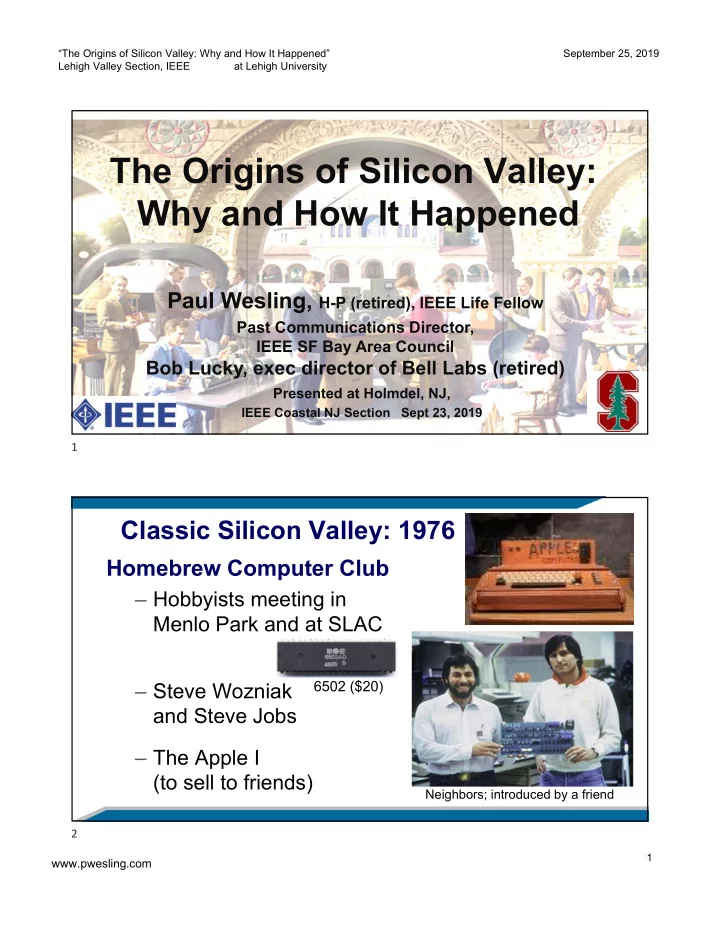
The Origins of Silicon Valley: Why and How It Happened

Paul Wesling, H-P (retired), IEEE Life Fellow

Past Communications Director, IEEE SF Bay Area Council

Bob Lucky, exec director of Bell Labs (retired)

Presented at Holmdel, NJ,

IEEE Coastal NJ Section Sept 23, 2019

Classic Silicon Valley: 1976

Homebrew Computer Club

– Hobbyists meeting in Menlo Park and at SLAC – Steve Wozniak and Steve Jobs – The Apple I (to sell to friends)

6502 ($20)

Neighbors; introduced by a friend 1 2

slide-2
SLIDE 2

“The Origins of Silicon Valley: Why and How It Happened” Lehigh Valley Section, IEEE at Lehigh University September 25, 2019 2

www.pwesling.com

Classic Silicon Valley: 1976

Wozniak-Jobs partnership

– called it “Apple Computer Company” – Started in a garage in Los Altos – Now has largest stock market capitalization – Most valuable brand in the world

How could this happen? Why in the SF Bay Area?

Before 1900 …

“Valley of the Heart’s Delight” The Santa Clara Mission

3 4

slide-3
SLIDE 3

“The Origins of Silicon Valley: Why and How It Happened” Lehigh Valley Section, IEEE at Lehigh University September 25, 2019 3

www.pwesling.com

Before 1900

This was more typical …

Late 1 8 8 0 ’s Prediction

“Some day you will see Palo Alto blooming with nearly all the flowers

  • f the earth and the fruit and shade

trees of every zone.... In the future we shall can this fruit and send it all

  • ver the globe in exchange for

wealth ...”

Senator Leland Stanford … but soon technology was to overtake agriculture.

5 6

slide-4
SLIDE 4

“The Origins of Silicon Valley: Why and How It Happened” Lehigh Valley Section, IEEE at Lehigh University September 25, 2019 4

www.pwesling.com

Let’s Go Back …

Federal Telegraph

– Formed in 1909 in Palo Alto

(by Cyril Elwell, a Stanford grad)

– Lee de Forest invented the audion in 1907

– Invented/patented oscillator, amplifier circuits while working at Federal Telegraph in Palo Alto, 1911-1913 – Pioneered continuous-wave radio

Improved triode Improved Dual-Wing Grid Audion ca1912

Built by Lee De Forest at Federal Telegraph, Palo Alto Collection of Leonard Fuller, Chief Engineer, Federal Telegraph (1912-1919) Property of Clark Canham, San Jose

7 8

slide-5
SLIDE 5

“The Origins of Silicon Valley: Why and How It Happened” Lehigh Valley Section, IEEE at Lehigh University September 25, 2019 5

www.pwesling.com

Federal Telegraph

– Poulsen Arc Transmitter, 1909

  • Demonstrated sending CW, voice

– Raised funds from “angel investors”, including David Starr Jordan, Stanford’s president (plus Marx, Branner) – Demonstrated communication from S.F. to Honolulu in 1912 

–First venture capital –Stanford’s Involvement Federal Telegraph

– By 1920s: three high-power stations that covered much of Pacific Ocean – In support of maritime shipping companies – California Historical Plaque in Palo Alto

9 10

slide-6
SLIDE 6

“The Origins of Silicon Valley: Why and How It Happened” Lehigh Valley Section, IEEE at Lehigh University September 25, 2019 6

www.pwesling.com

Let’s Go Back …

1st regularly scheduled radio broadcast

– Charles “Doc” Herrold

  • Early Stanford engineering student
  • Started a San Jose school near

SJSU to teach radio arts (1909)

– First scheduled broadcast, San Jose,

1909 voice and music: “San Jose Calling”

– FN, then SJN, then KQW, becomes KCBS

740 AM, 106.9 FM (also founded KLIV)

Example: Early Roots of Entrepreneurial Technology

Otis Moorhead

– Early Stanford engineering grad – Radio amateur & vacuum tube entrepreneur – Established Moorhead Laboratories

  • In San Francisco in 1917

– Manufactured “bootleg” receiving tubes for radios – A patent-infringement lawsuit put him out of business in the early 1920s.

Testing tubes, 1919

11 12

slide-7
SLIDE 7

“The Origins of Silicon Valley: Why and How It Happened” Lehigh Valley Section, IEEE at Lehigh University September 25, 2019 7

www.pwesling.com

Defining Events

Independent private wealth,

from California gold rush

Titanic Sinking in 1912 World War I

– Importance of technology

US Navy “push” for ship-to-shore, other communications modes

Economics: desire to replace expensive telegraph lines,

undersea cables with the new “wireless” technology Brought frenzy of activity, funds to S.F. Bay Area

We Now Follow Three Pioneers William Eitel Jack McCullough Charles Litton

Bay Area families with a strong history of entrepreneurship Born/raised here

Charles Litton, 11, Outside his “Wireless House”

13 14

slide-8
SLIDE 8

“The Origins of Silicon Valley: Why and How It Happened” Lehigh Valley Section, IEEE at Lehigh University September 25, 2019 8

www.pwesling.com

William Eitel

Took shop classes at Los Gatos High School Worked in his father’s quarry

– ass’t blacksmith, machine operator

Visited shops of Hall-Scott Motor Car Co.

– Operation of Complex machinery

William Eitel, W6UF 1908 - 1989

Jack McCullough, Charles Litton

Attended California School of Mechanical Arts

James Lick funding -- Now Lick-Wilmerding High School, San Francisco (private)

Opened in 1895; free education for boys, girls One of the best West Coast technical high schools

– Rigorous training in the mechanical trades – Gained "a realistic 'feel' of materials and processes” [Litton]

Jack McCullough, W6CHE 1908 - 1989

15 16

slide-9
SLIDE 9

“The Origins of Silicon Valley: Why and How It Happened” Lehigh Valley Section, IEEE at Lehigh University September 25, 2019 9

www.pwesling.com

Jack McCullough, Charles Litton

McCullough continued at a local junior college Litton enrolled in Stanford's Mechanical Engineering dept:

– Classes with strong practical flavor – Got BS-Mechanical Engineering in 1924 – Grad work in communication engineering – Took Stanford’s first course on communication engineering fundamentals

Eitel, Litton, and McCullough

Introduced to amateur “ham” radio through their families and friends in 1910’s, ’20’s Ham Radio in the SF Bay Area

– Isolated; maritime orientation; major seaport – Shipping companies needed radio operators – Over 1,200 licensed amateurs

  • 10 percent of US total (a bubble)

17 18

slide-10
SLIDE 10

“The Origins of Silicon Valley: Why and How It Happened” Lehigh Valley Section, IEEE at Lehigh University September 25, 2019 10

www.pwesling.com

Ham Radio in SF Bay Area

Active center of radio production in the 1910s, ‘20s Electronics firms:

– Remler - made radio sets – Magnavox - leading manufacturer of loudspeakers – Heintz and Kaufman Designed custom radio equipment – Federal Telegraph Produced radio transmitters in the 1910s

  • up to 1,000,000-watt transmitters in 1920.

– Radio parts available to local hobbyists – Jobs for radio amateurs

Ham Radio Subculture

Camaraderie and intense sociability – A way to make friends – Communicating "over the air" and face to face Egalitarianism and a democratic ideology

– little heed to distinctions of class, education

– Santa Clara County radio club, which Eitel chaired in the mid 1920s, had “farm boys, Stanford students, Federal Telegraph technicians, and retired executives”

19 20

slide-11
SLIDE 11

“The Origins of Silicon Valley: Why and How It Happened” Lehigh Valley Section, IEEE at Lehigh University September 25, 2019 11

www.pwesling.com

Ham Radio Subculture Interest in extending radio technology

– Built personal reputations: innovating new circuitry; clever transmitters; contacts with faraway lands

Mix of competitiveness and collaboration

A lot like Home Brew Computer Club, and today’s Silicon Valley … Another Pioneer: Young Fred Terman

Los Angeles, then Stanford Herbert Hoover rented across the street;

HH Jr; also Roland Marx, George Branner, Jack Franklin

HH Jr: “All three of us [Fred, Jack] were

neighbors, and upon pushing the key

  • f one of our imposing contraptions,

would holler out the window to see if it had been received on the other side

  • f the street.”

Herbert Hoover, Jr, ca 1923

21 22

slide-12
SLIDE 12

“The Origins of Silicon Valley: Why and How It Happened” Lehigh Valley Section, IEEE at Lehigh University September 25, 2019 12

www.pwesling.com

Young Fred Terman

“If you saw a 90 foot pole sticking up somewhere, you’d go and knock on the door and get acquainted with him.” Hung out at Federal Telegraph (a few blocks away), then worked there

  • ne summer

Fred Terman at 17, with his Ham radio

Following our Entrepreneurs …

Eitel, Litton, McCullough, ham friends

– Experimented with vacuum tubes – Built their own parts, equipment

Made notable contributions

– 1924: Litton and the Stanford radio club made first radio contact with Australia, New Zealand – 1928: Eitel pioneered 10-meter waves (30 MHz)

  • transcontinental communication

23 24

slide-13
SLIDE 13

“The Origins of Silicon Valley: Why and How It Happened” Lehigh Valley Section, IEEE at Lehigh University September 25, 2019 13

www.pwesling.com

The Tube Business

General Electric, Westinghouse, AT&T

– All East Coast companies – Developed hi-power transmitting tubes in early 1920s – Difficulties in producing consistent, reliable ones – Required precise machining, glass blowing (Pyrex) – Exotic materials, sophisticated sealing techniques

Following our Entrepreneurs …

Federal Telegraph, at Perham home, 916 Emerson St, Palo Alto (1912)

Litton got local job through a ham friend:

– Research at Federal Telegraph

  • Built up to 60 engineers
  • Became sole supplier of radios to IT&T

Eitel got local job through ham friend:

– Mechanic at Heintz and Kaufman Inc

  • Heintz was a ham -- focus on HF radio equipment

– Recruited McCullough a year later

25 26

slide-14
SLIDE 14

“The Origins of Silicon Valley: Why and How It Happened” Lehigh Valley Section, IEEE at Lehigh University September 25, 2019 14

www.pwesling.com

The Tube Business in the ’20s

Could not buy transmitting tubes on open market – Navy and GE set up RCA to ensure US dominance – RCA, GE, Western Electric, and Westinghouse

  • Exclusive cross-licensing of 2000 radio patents

– Sole producers/distributors of power-grid tubes

– Refused sale to Bay Area firms – Seen as threats to RCA, USA control

So both companies needed to develop triodes – Litton, Eitel headed their tube shops

Tube Shops’ Challenge

Design around ~250 RCA patents

– Enormously difficult task

Hired locally (many were hams)

– Eitel, Litton collaborated with each other (novel!) – Based on friendships over the years

Worked closely with patent attorneys

27 28

slide-15
SLIDE 15

“The Origins of Silicon Valley: Why and How It Happened” Lehigh Valley Section, IEEE at Lehigh University September 25, 2019 15

www.pwesling.com

Tube Shops’ Challenges

Heintz, Eitel, and McCullough engineered a rugged new power tube:

– New materials, manufacturing methods – Tube’s plates of tantalum (avoid patents) – New shock-resistant seals – Create higher vacuums (better reliability)

More reliable, longer life than RCA’s tubes

Didn’t infringe RCA’s patents

Heintz and Kauffman 354 Power Triode Tube

Tube Shops’ Challenge

Litton invented the glass lathe

– For assembly, glass blowing, and sealing – Make complex tubes in large quantities – High repeatability, precision

Built tube shop on parents' property

29 30

slide-16
SLIDE 16

“The Origins of Silicon Valley: Why and How It Happened” Lehigh Valley Section, IEEE at Lehigh University September 25, 2019 16

www.pwesling.com

The US Depression

Formed Eitel-McCullough Inc (Eimac)

– To build high-power, high-frequency tubes

Financing:

– Harrison: real-estate agent in San Bruno – Preddey: ran movie theaters in SF – Eitel and McCullough brought their know-how – Ownership, profits to be shared

Precursor to today’s Menlo Park Venture-Capital Firms

The US Depression

Litton, Eitel, McCullough cooperated closely

– Litton helped set up Eimac vacuum tube shop – Gave castings, engineering blueprints for lathe – Freely exchanged technical, commercial information – This reduced risks, for the two small tube-related businesses

Like Jobs & Wozniak, Homebrew Computer Club

31 32

slide-17
SLIDE 17

“The Origins of Silicon Valley: Why and How It Happened” Lehigh Valley Section, IEEE at Lehigh University September 25, 2019 17

www.pwesling.com

The US Depression

1936: Frederick Terman asked Litton to join Stanford EE dept as lecturer

– Shared knowledge with staff, students – Sperry $1,000 Litton klystron grant: let Terman bring Packard back to campus for grad studies – with Litton, Hewlett, others

Formed Hewlett-Packard

Demonstrates University/Industry cooperation

Threats to Peace

Growing threats from Japan and Germany

– President Roosevelt rebuilt the Army, Navy – New electronic system: RAdio Detection And Ranging (radar)

Needed high-voltage high-frequency transmitting tubes

– Only Eimac’s tubes worked best at the high voltages and frequencies needed

33 34

slide-18
SLIDE 18

“The Origins of Silicon Valley: Why and How It Happened” Lehigh Valley Section, IEEE at Lehigh University September 25, 2019 18

www.pwesling.com

The Klystron

Russell and Sigurd Varian They worried about Germany

– Hoped to use microwaves to detect planes – 1937: Moved to Stanford’s labs to work with Hansen – developed the klystron in 1937

  • Used Litton’s free advice
  • Used Hansen’s theoretical assistance

Rus and Sig, boys in Palo Alto

The Klystron – PA Times, Jan. 30, 1939

35 36

slide-19
SLIDE 19

“The Origins of Silicon Valley: Why and How It Happened” Lehigh Valley Section, IEEE at Lehigh University September 25, 2019 19

www.pwesling.com

Wartime Expansion

SF Bay Area/Stanford was microwave hotbed Developed a Progressive Approach to business

– Egalitarian relations within, between companies

Managerial techniques thwarted unions, kept employees happy, productive

– Profit-sharing, tuition, cafeteria, medical clinics – “HP Way” philosophy Similar to Hewlett-Packard, Fairchild, Intel, Tandem …

Post-War Realignment

RCA, others focused on TV, broadcast (NBC) Eimac developed new line of better tubes

– Designed for higher frequencies

FCC’s surprise shift of FM radio to VHF (88-108 MHz)

– RCA, others’ tubes wouldn’t work at VHF – RCA copied Eimac’s tubes, which did work

37 38

slide-20
SLIDE 20

“The Origins of Silicon Valley: Why and How It Happened” Lehigh Valley Section, IEEE at Lehigh University September 25, 2019 20

www.pwesling.com

Reversal of Fortunes In 1947, Eimac sued RCA and GE

– alleging patent infringement – GE, RCA lost lawsuit, halted production – Eimac transformed them into its own sales force and distribution network – Let them buy Eimac products and resell them under their own names

The “Big Dog” was now Silicon Valley! Charles Litton After the War

Focus on higher-power klystrons

– For physics research, linear accelerators – Scaled from 30 kilowatts to 30 megawatts – Transformed Stanford into a major player

  • 2-mile-long linear accelerator: physics research;

cancer treatment today uses the Litton klystron

– Developed “Recipe" to build a firm: little initial capital; R&D contracts or a new idea; engineering teams, a product line; go into production

39 40

slide-21
SLIDE 21

“The Origins of Silicon Valley: Why and How It Happened” Lehigh Valley Section, IEEE at Lehigh University September 25, 2019 21

www.pwesling.com

Varian Associates

1948: Sold microwave measurement instrument plans to H-P for $20,000 Enabled Hewlett-Packard to enlarge its product line, increase revenues in 1950s Santa Rosa, Santa Clara divisions became Agilent (largest IPO in history), now Keysight

David Packard and Bill Hewlett HP 200A Audio Oscillator Frederick Terman, with schematic, encourages Hewlett and Packard to start a company; client was

Walt Disney, for Fantasia

Philo Farnsworth with first all-electronic TV tube Ralph Heintz, short wave radio pioneer Ernest O. Lawrence, UC-B Cyclotron Charles Litton, inventor of the glass tube lathe Lee de Forest, inventor of audion Leonard Fuller, Cyril Elwell, Federal Telegraph Jack McCullough & Bill Eitel, cutting-edge Eimac vacuum tubes Charles “Doc” Herrold, radio broadcasting

Robert Semans, 9’ x 18’ 3-panel mural; Court House Plaza, Palo Alto, 2002

41 42

slide-22
SLIDE 22

“The Origins of Silicon Valley: Why and How It Happened” Lehigh Valley Section, IEEE at Lehigh University September 25, 2019 22

www.pwesling.com

The Mural in Palo Alto Fast Forward to 1950’s

William Shockley

Raised in Palo Alto; went to Caltech, MIT

Invented transistor while at Bell Labs Developed to replace vacuum tubes

1948: William Shockley (seated), John Bardeen, and Walter Brattain

Bill Shockley, 8, in front

  • f home in Palo Alto

43 44

slide-23
SLIDE 23

“The Origins of Silicon Valley: Why and How It Happened” Lehigh Valley Section, IEEE at Lehigh University September 25, 2019 23

www.pwesling.com

Fast Forward to 1950’s

William Shockley left the East Coast, returned to Caltech

– Funding from Arnold Beckman – His mother, graduate of Stanford, lived in Palo Alto – 1955: Shockley Transistor, Mt View – “Traitorous 8” left him in 1957 to form Fairchild, with first real venture capital funding

The Planar Process

Needed, for diffused transistors Required a special infrastructure:

– High-vacuum technology – Precise furnaces – Glass/quartz capability and machinists – Ultra-pure gasses/water

Process control; continuous improvement

Built on top of all of the capabilities developed here during the ’20’s, 30’s, ’40’s

45 46

slide-24
SLIDE 24

“The Origins of Silicon Valley: Why and How It Happened” Lehigh Valley Section, IEEE at Lehigh University September 25, 2019 24

www.pwesling.com

The Planar Process

It all happened here …

At original Fairchild Semiconductor plant on Charleston Road, Palo Alto

The Planar Process

Isaac Asimov said this was

"the most important moment since man emerged as a life form"

… perhaps with a bit of exaggeration.

47 48

slide-25
SLIDE 25

“The Origins of Silicon Valley: Why and How It Happened” Lehigh Valley Section, IEEE at Lehigh University September 25, 2019 25

www.pwesling.com

The Fairchildren: Formation of Intel

Gordon Moore and Bob Noyce

– Left Fairchild in 1968 to form Intel – To focus on memory ICs – Venture capital (Arthur Rock) – First microprocessor in 1971 – See my Nov 2014 interview with Ted Hoff (empl #12) www.SiliconValleyHistory.org

At the end … (1960’s)

Situation had changed dramatically Peninsula, Valley were major electronics centers Dev’t, production of tubes, Semiconductors, ICs

– Half of the microwave tubes – In every advanced weapons, space system – In a wide range of industrial goods (broadcast, TV, microwave ovens)

SV was central to the US defense effort and to the US manufacturing economy

Why?

49 50

slide-26
SLIDE 26

“The Origins of Silicon Valley: Why and How It Happened” Lehigh Valley Section, IEEE at Lehigh University September 25, 2019 26

www.pwesling.com

Silicon Valley Business Climate

East’s large, vertically integrated firms

– Focus: protecting current products, markets – Slow to adjust to technology, market changes

SV: highly fragmented, decentralized structure

– Specialized firms, nimble/flexible, engineering-driven – Dense regional network of small & medium-size firms that

support each other; draw from common work force – California (since1870s) doesn’t enforce non-compete clauses

– Adapt more rapidly to change -- thrived in the new environment

Special Culture of Innovation

Silicon Valley Uniqueness

Practices, skills, and competencies:

– Developed over 100+ years – Communities of hobbyists; collaboration/sharing – Analog digital SW biotech mobile Big Data Deep Learning VR self-driving …

– Large number of cutting-edge entrepreneurs – Supported by Engineers and venture capitalists – Local universities, research, development – Supporting industries; Role models, expectations

51 52

slide-27
SLIDE 27

“The Origins of Silicon Valley: Why and How It Happened” Lehigh Valley Section, IEEE at Lehigh University September 25, 2019 27

www.pwesling.com

The ’40’s and ’50’s The ’60’s

53 54

slide-28
SLIDE 28

“The Origins of Silicon Valley: Why and How It Happened” Lehigh Valley Section, IEEE at Lehigh University September 25, 2019 28

www.pwesling.com

The ’70’s

Based on Stanford/ UCSF recombinant DNA 1973 Patent (shared $300m)

The ’80’s

55 56

slide-29
SLIDE 29

“The Origins of Silicon Valley: Why and How It Happened” Lehigh Valley Section, IEEE at Lehigh University September 25, 2019 29

www.pwesling.com

The ’90’s and beyond Major companies have moved to SV …

Chongqing Sokon Industry Group: R&D Labs in Santa Clara

57 58

slide-30
SLIDE 30

“The Origins of Silicon Valley: Why and How It Happened” Lehigh Valley Section, IEEE at Lehigh University September 25, 2019 30

www.pwesling.com

New Technologies: Blockchain

Jobs in Blockchain in Top 20 Cities (2018)

Blockchain

… with Bay Area cities added (2.4X those in NY) So looking at where the most jobs are in blockchain …

59 60

slide-31
SLIDE 31

“The Origins of Silicon Valley: Why and How It Happened” Lehigh Valley Section, IEEE at Lehigh University September 25, 2019 31

www.pwesling.com

Where is “Silicon Valley”?

"A map of Silicon Valley in 2013, which originally just included the Santa Clara Valley from Gilroy to Palo Alto. Today it is a metaphysical space stretching from San Jose to San Francisco and Berkeley."

A History of Silicon Valley, p. 264

Where is VC funding? (2014 & 2017)

2017: 43% 2017: 11% 2017: 8.6% 2017: 2.3% 2017: 4% 2017: 2% 2017: 16% 2017: 4% 2017: 5% 2017: 4%

61 62

slide-32
SLIDE 32

“The Origins of Silicon Valley: Why and How It Happened” Lehigh Valley Section, IEEE at Lehigh University September 25, 2019 32

www.pwesling.com

Where is Innovation Today?

MeetUps, Maker Faire, AngelList (bought Product Hunt)

Shared Spaces

Open Source; Open Compute Project – OCP: Facebook, Intel, Google, Apple, Microsoft, Dell, Rackspace …

– Egalitarian use of jointly-developed software

– … and dozens of other collaborative spaces

Like Ham Radio, Homebrew Computer Club

500 Startups Y Combinator

Sandbox Suites

Incubators:

How Different are We?

“In Silicon Valley, great ‘collaborators’ are prized; in Washington, DC, they are hanged. When they say ‘collaborator’, they mean ‘traitor’; here [SV], they mean ‘colleague’.”

Thomas Friedman, NY Times, Jan 13, 2013

It’s our attitude in Silicon Valley:

“Failure is a feature, not a bug.” “Move Fast, Break Things”

“America innovates, China duplicates and Europe regulates.” Jeremy Warner Yoda: “Do or do not — there is no try.” full commitment

63 64

slide-33
SLIDE 33

“The Origins of Silicon Valley: Why and How It Happened” Lehigh Valley Section, IEEE at Lehigh University September 25, 2019 33

www.pwesling.com

Defining Characteristics for SV

Competition and cooperation Often hobby-focused (for start-ups) Small, dynamic start-ups, companies Fluidity and flexibility (ability to “pivot”) Egalitarian: parking, offices, "open door” policy,

20% time, Friday beer busts, employee-focus

Large pool of entrepreneurs, technologists

… and other cultural, management factors

Get the book!

Learn MUCH more about those early days …

65 66

slide-34
SLIDE 34

“The Origins of Silicon Valley: Why and How It Happened” Lehigh Valley Section, IEEE at Lehigh University September 25, 2019 34

www.pwesling.com

More about that period … Fred Terman at Stanford:

Building a Discipline, a University, and Silicon Valley by Stewart Gillmor

2004, ISBN 978-0804749145

Another fun book

Norm Pond was president of Varian Associates (Sigurd and Russell’s company), then formed Intevac and is CEO

2008, ISBN 978-0-9816923-0-2

www.russcochran.com

67 68

slide-35
SLIDE 35

“The Origins of Silicon Valley: Why and How It Happened” Lehigh Valley Section, IEEE at Lehigh University September 25, 2019 35

www.pwesling.com

To understand how H-P was a product of Silicon Valley, and shaped its culture through a number of re-inventions (1930s, up through 2009)

I also recommend Leslie Berlin’s book

  • n Bob Noyce…

and her new book “The Troublemakers”

69 70

slide-36
SLIDE 36

“The Origins of Silicon Valley: Why and How It Happened” Lehigh Valley Section, IEEE at Lehigh University September 25, 2019 36

www.pwesling.com

A good book for understanding how things work here, and ideas for duplicating the Valley in other places.

2016, soft- or hard-cover, ISBN 978-0-9973624-0-4

For another view of Silicon Valley

71 72

slide-37
SLIDE 37

“The Origins of Silicon Valley: Why and How It Happened” Lehigh Valley Section, IEEE at Lehigh University September 25, 2019 37

www.pwesling.com

For a view of another Innovation Environment

On Netflix Streaming: 2011 video, 85 minutes

(SXSW Best Documentary)

Covers funding and startup of Apple, Intel, Cisco, Tandem, Genentech, with views from the key funders (Rock, Perkins …) and entrepreneurs (Moore, Learner, Treybig …)

73 74

slide-38
SLIDE 38

“The Origins of Silicon Valley: Why and How It Happened” Lehigh Valley Section, IEEE at Lehigh University September 25, 2019 38

www.pwesling.com

Reviewing the Good Ol’ Days

… how Silicon Valley became the hub of technology development … and STAYS that way … Download the slides and reading list (6 MB) at:

pwesling.com/docs/1909b-wesling.pdf

This lecture is mounted on Stanford’s YouTube channel: On SmartTV, search YouTube for “stanford silicon valley” For other Silicon Valley Technology History Talks/Interviews:

www.SiliconValleyHistory.com

p.wesling@ieee.org

QUESTIONS and STORIES?

  • Where you worked; who you knew
  • What you recall from the mid-20th century
  • Digging into more of the details

75 76