Body language Effective use of gestures, especially with the hands, - - PDF document

body language
SMART_READER_LITE
LIVE PREVIEW

Body language Effective use of gestures, especially with the hands, - - PDF document

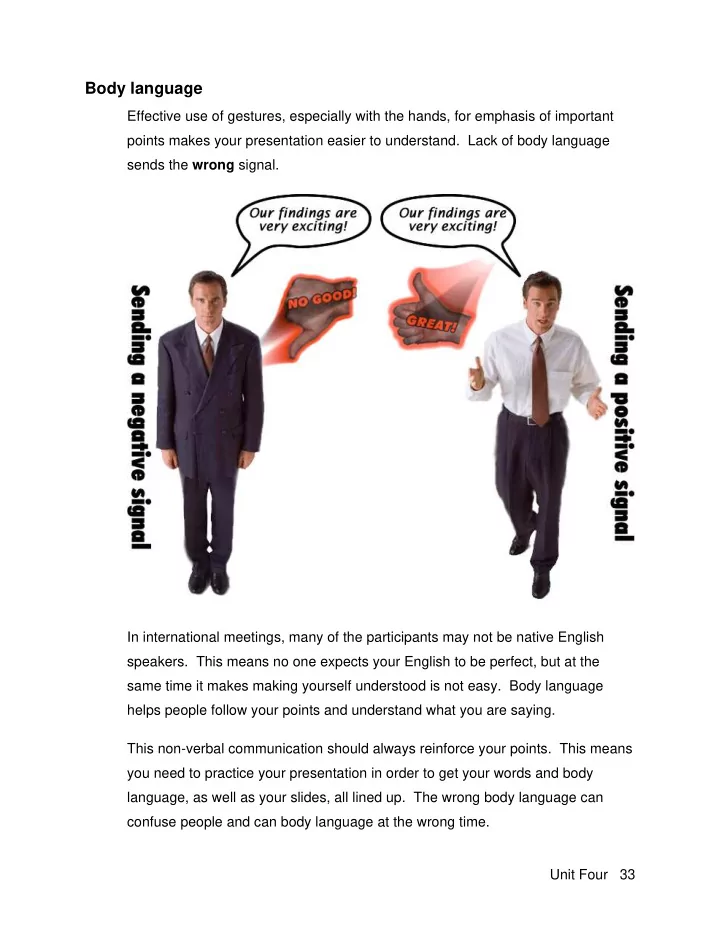
Body language Effective use of gestures, especially with the hands, for emphasis of important points makes your presentation easier to understand. Lack of body language sends the wrong signal. In international meetings, many of the participants


slide-1
SLIDE 1

Unit Four 33

Body language

Effective use of gestures, especially with the hands, for emphasis of important points makes your presentation easier to understand. Lack of body language sends the wrong signal. In international meetings, many of the participants may not be native English

  • speakers. This means no one expects your English to be perfect, but at the

same time it makes making yourself understood is not easy. Body language helps people follow your points and understand what you are saying. This non-verbal communication should always reinforce your points. This means you need to practice your presentation in order to get your words and body language, as well as your slides, all lined up. The wrong body language can confuse people and can body language at the wrong time.

slide-2
SLIDE 2

34 Content Don’t overuse body language. Use more at important points and less at less important points. Your body language should show you are confident and relaxed, but remember to always stay professional and never slip into informality

  • r extreme gestures.

Make eye contact with members of the audience and spread that contact around. Do not center your attention on someone you feel is supportive or listening closely, rather try to make eye contact with everyone. This will help everyone feel involved with your presentation.

slide-3
SLIDE 3

Unit Four 35

Important parts of body language

Facial expression: smiles and frowns are universally understood by all of us from

  • infancy. Make sure your facial expressions match the information being
  • presented. In your presentation, be sure to include some moments where you

can express a relaxed expression, which makes the audience also feel comfortable.

slide-4
SLIDE 4

36 Content Facial expressions can confuse the audience if they are not positive and related to the presentation. Especially distracting are expressions that suggest the presenter is not happy making the presentation. Although being nervous is normal, expressing unhappy feelings can make the audience very uncomfortable. The most common error of presenters is to avoid contact with the audience. This can include hiding behind a computer or a podium, looking somewhere else, or simply not facing the audience at all. Everyone knows this mistake when they see someone else do it, but it is hard to know when you do it yourself.

slide-5
SLIDE 5

Unit Four 37 Hand movement can show when profits are rising or when revenue is declining. Hand gestures can emphasize when a point is vital and when one point links to

  • another. Effective use of the hands are key to body language in a presentation.

Overuse or extreme hand gestures confuse people and look silly. Try to use more hand gestures but stay conservative.

slide-6
SLIDE 6

38 Content Reading a presentation directly from notes makes your talk very boring. Even if the speaker is not reading directly from notes, the audience can easily become

  • bored. Moving away from the podium and toward the audience gets everyone’s

attention and makes a presentation much more personal and exciting. Walking around the room, while speaking, shows a strong command of the topic as well as openness toward the audience. Standing, as well as sitting, positions signal your interest in the topic as well as self confidence. Try to have good posture without looking too nervous.

slide-7
SLIDE 7

Unit Four 39 Practice your presentation in a mirror to perfect your facial expressions and body

  • language. This kind of practice helps you see just how many expressions you

are capable. Without practice, the expressions to show to an audience may not have the meaning you intended. By far, the best way to practice for a presentation is to record yourself with a video camera (camcorder). Looking at yourself on video is not easy because it feels embarrassing. Try to think of the person on the video as someone else, not yourself, and be critical of where the body language doesn’t work and how improvements can made. After making some improvements, record yourself again and then ask some friends to give you feedback. Ask them to be honest and help you improve.

slide-8
SLIDE 8

40 Content

Facial Expressions

Friendly smile: often used at start of a presentation and when making contact with the audience. Serious statement: used when presenting important points, facts, lists, or other factual information. Emphasizing statement: used when placing a strong emphasis on some information that can be strongly positive, strongly negative, or simply important. Negative emphasis: used to reinforce that the information spoken is not good, has a negative meaning, or simply is not liked by the speaker. Thinking: used to introduce a pause that precedes an important point, show the speaker takes the next point very seriously, or convey a generally contemplative feeling.

slide-9
SLIDE 9

Unit Four 41

Body Language

Friendly start: used while waiting to begin, including a relaxed stand and even some friendly contact with the audience. Look relaxed in posture with hands and legs generally bent. Making a point: used when main points are being covered, when lists are recited,

  • r when conclusions are stated.

Use hands to show a strong forward motion or point to your points on a slide. Thinking: used between points or as a pause before an important point. Keep facing the audience and relax your head, using the arms to reflect you are listening or thinking.