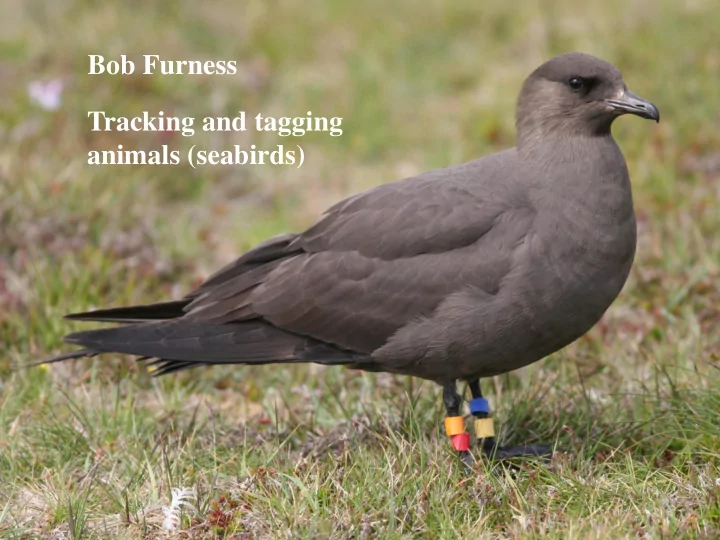
SLIDE 1
Tracking and tagging animals (seabirds) Bob Furness
SLIDE 2 Reasons to tag animals
- Individual identification (e.g. colour rings)
- Movement studies (e.g. ringing, transmitters)
- Survival analysis (e.g. from ring data or tags)
- Behavioural analysis (e.g. activity budgets)
- Impact assessment (e.g. offshore wind farms)
- To understand pollutant accumulation
- To assess foraging habitat use
- As one layer in a GIS (overlay with habitat etc)
SLIDE 3 Tag types
- [Radio transmitters]
- Geolocators (light, temperature, activity)
- Argos satellite PTTs
- GPS storage tags + base station (Amsterdam)
- GPS-GSM tags
- Altimeter tags
- Time-depth recorders (TDRs)
- Accelerometer tags (activity)
- ‘Critter-cams’; Heart-rate monitors; stomach
temperature loggers
- Review of tags and tagging literature available
SLIDE 4 Animal welfare and data quality issues
- Tagging is regulated (highly regulated in UK);
- Tagging and tags DO affect animals
(e.g. corticosterone higher in tagged birds);
- Phillips’ 3% rule does not justify lack of assessment of
tag effects;
- Harnesses and surgical implanting may or may not be
acceptable depending on study species and researcher;
- Studies should design in an assessment of tag impacts
– but most don’t
SLIDE 5
www.divertracking.com
SLIDE 6
Basking shark tracking to identify key habitat to include In MPA Witt et al. 2016 SNH CR No 908
SLIDE 7
Basking shark tracking: Long-distance movements tracked using Argos
SLIDE 8 Gannet foraging ranges
Wakefield et al. 2013. Space partitioning without territoriality in gannets. Science, 341, 68-70.
Satellite-tracked breeding adult gannets from twelve colonies foraged in largely mutually non-overlapping exclusive areas, apparently determined by density-dependent competition (somehow).
SLIDE 9 Leat et al. 2013. Influence of wintering area on persistent organic pollutants in a breeding migratory seabird. Marine Ecology Progress Series, 491, 277-293. Kernel density distribution for winter ranges of breeding adult great skuas from Bear Island, Iceland and Shetland colonies identified from geolocator deployments. The logger data allowed C & N isotopes in feathers to be used to identify wintering areas. Organochlorine pollutant burdens In birds caught at nests differed according to wintering areas.
SLIDE 10
Gannet geolocator location estimates using light data only
Two locations per day; Months in different colours Individual estimates are +/- about 100 km
SLIDE 11 Gannet geolocator location estimates using light data plus sea surface temperature satellite data and logger temperature at night
Two locations per day; Months in different colours Use of SST seems to greatly improve location estimates
Garthe et al. 2016 Marine Biology
SLIDE 12 Raptor tagging
- Satellite tags show Scottish golden eagles tend
to ‘disappear’ in a small number of discrete areas
- Whitfield & Fielding 2017. Analyses of the
fates of satellite tracked golden eagles in
- Scotland. SNH CR No. 982.
SLIDE 13
Discussion theme
Opportunities to combine other technological approaches (e.g. earth observation data sets, stable isotopes, genetic markers, pollutant loads, hormone levels, thermal imaging), with tracking of individuals to gain better understanding of animal ecology based on studies of individuals bob.furness@snh.gov.uk bob.furness@glasgow.ac.uk bob.furness@macarthurgreen.com