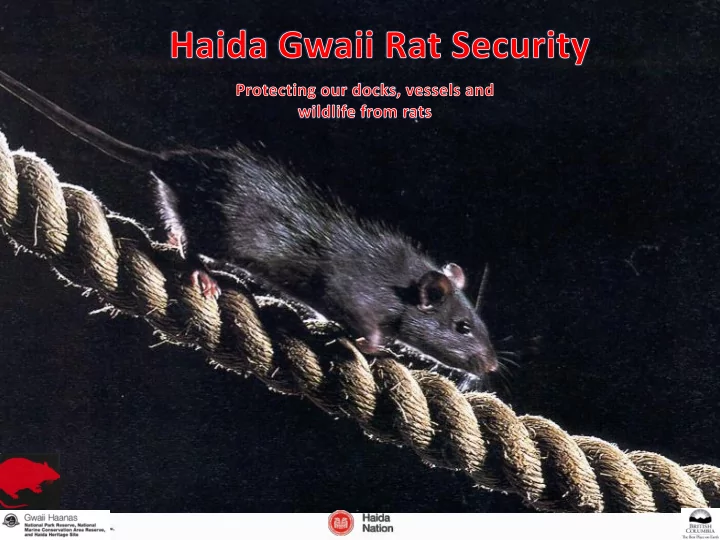
SLIDE 1
Why the concern about rats on Haida Gwaii? Haida Gwaii supports 1.5 - - PowerPoint PPT Presentation
Why the concern about rats on Haida Gwaii? Haida Gwaii supports 1.5 million nesting seabirds from 12 species Seabirds in Haida Gwaii are a local, regional, and global trea\sure Half of the worlds ancient murrelets. 18% of the
SLIDE 2
SLIDE 3
Seabirds in Haida Gwaii are a local, regional, and global trea\sure
- Half of the world’s ancient
murrelets.
- 18% of the world’s Cassin’s auklets
(BC has 80% of global population)
- Fork tailed and Leach’s storm
petrels – 21% of BC population
- Rhinocerus auklet – 4% of global
population (7% of BC population)
- Half of the British Columbia
population of Pigeon guillemots
SLIDE 4
Rats are Predators
- Rats are very efficient
at preying on seabirds
- They consume eggs, as
well as chicks and adults during breeding seasons
- This has an extremely
detrimental effect on populations.
- Rats ability to
reproduce rapidly can increase this effect.
Alaska Alaska
SLIDE 5
Rats also
- Threaten human health
- Damage property and infrastructure
including boats
- Eat most anything including, wires, wood
and electronics
- Are prolific breeders; one pair can have
2000 young/year
- 100 million per year in USD on rat control
- Half of bird and reptile extinctions have
been caused by rats worldwide
SLIDE 6
Islands are particularly vulnerable to rats and introduced species
- Isolated from the mainland,
islands on Haida Gwaii are hotspots for biodiversity
- Seabirds evolved in the absence
- f rats; they have no natural
defences
- Seabirds are ground nesters. This
makes them easy prey for rats.
Langara Island ANMU - Gaston 1992; Regehr et al. 2007
SLIDE 7
Marinas can be an introduction point. Rats can “hitch” rides from marinas to remote locations in a number of ways:
- Fishing vessels
(including fish processers)
- Passenger vessels
- Aircraft
This provides an easy source of transportation for rats to invade remote areas. Why the focus on docks and marinas?
SLIDE 8
We want your help by:
- Distributing rat proofing
kits to vessel owners
- Talk to boat owners about
the importance of keeping vessels rat free
- Prevention
- Rat control around
marinas to reduce risk of invasions to islands
SLIDE 9
What can you do?
- Store food and wastes securely.
- Shake out nets and lines.
- Keep decks tidy so rats have fewer
places to hide.
- Inspect your vessel and
equipment for signs of rats (i.e. chewed wires, rub marks, feces and hair).
- Use rat traps and bait stations to
trap rats.
- Seal entry points on your vessel.
rats can get through holes as small as ½ inch.
- Use rat guards on tie up lines.
- Toxic baits are an effective control
measure
SLIDE 10
Use the Best Control Methods Available
- Learn rat behaviours
- Place traps, baits in rat
territories and routes
- Establish an on-going
prevention/ control program
- It is better to maintain a
continuous prevention program than to respond to a rat crisis
SLIDE 11
- Do not throw a live rat
- verboard! They are good
swimmers and may reach land.
- Dispose of the rat in a
secure garbage receptacle.
- Do not assume it is the
- nly one, most likely there
are more
If you find a rat aboard your boat
SLIDE 12
Prevention is easier and costs less
- Ongoing control for rats to
prevent future invasions is needed
- Regular monitoring is essential
Rat eradications are difficult, time consuming and very expensive! Many cost over a million dollars.
SLIDE 13
Shake out nets Rat guards Store food properly
SLIDE 14
Contact the Harbour Master, Parks Canada or BC Parks in Masset for a FREE rat-proofing kit for your vessel.
SLIDE 15