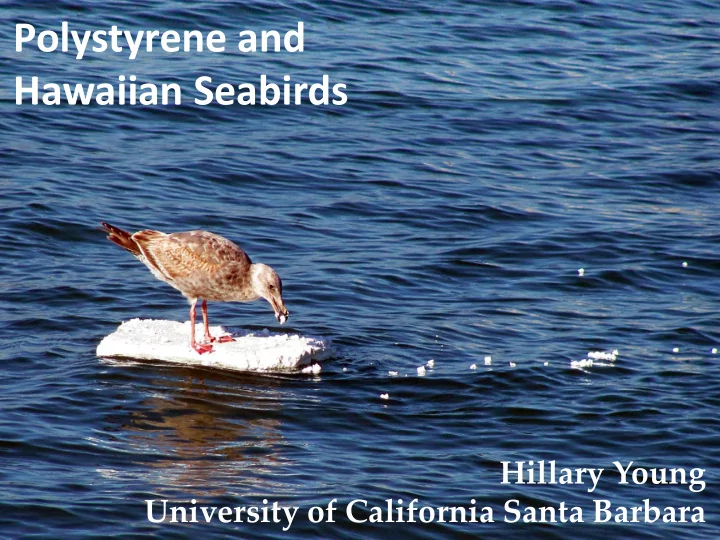
SLIDE 1
Hillary Young University of California Santa Barbara
Polystyrene and Hawaiian Seabirds
SLIDE 2
Largest Tropical Seabird Rookery on the Planet
Hawaiian islands are a seabird hotspot
SLIDE 3
Globally, seabirds have declined by 70% since 1950
SLIDE 4
Globally, seabirds have declined by 70% since 1950
SLIDE 5
Largest declines in long-ranging species including many Hawaiian species such as albatross
SLIDE 6
Tropical seabirds face particular foraging challenges
SLIDE 7
Polystyrene compounds these challenges.
SLIDE 8
SLIDE 9 Frans Lanting, National Geographic Vericool Packaging
SLIDE 10 Polystyrene resistant to biodegredation
- Easily persists 500 years in environment
SLIDE 11 Thus we expect that by 2050 polytsyrene and other plastics will be found in 99% of seabirds
Wilcox et al., 2015
SLIDE 12
Polystyrene quickly breaks down to small pieces
SLIDE 13 Lee et al., 2013
Polystyrene quickly breaks down to small pieces
SLIDE 14 These pieces accumulate in the smallest prey species
Lee et al., 2013
Flourescently labeled polystyrene microfragments Marine Copepods
SLIDE 15 Polystyrene fragments then accumulate toxins (e.g. Hg & PCBs)
Graca et al., 2014
SLIDE 16
Toxins bioccumulate
SLIDE 17 Jaymi Heimboch J.L. Lavers et al., 2014
This can cause secondary poisoning in marine animals, including seabirds
SLIDE 18
- Mortality
- Reduced Body Size
- Infertility
- Disrupted Neurological
Function
This can cause secondary poisoning in marine animals, including seabirds
Jaymi Heimboch J.L. Lavers et al., 2014
SLIDE 19
Polystyrene also causes mechanical blockages, false feelings of ‘fullness’, and interrupted breathing
SLIDE 20
98% of dead albatross chicks are found to have plastics in their stomachs
SLIDE 21 Polystyrene seabird declines
J.L. Lavers et al., 2014
Ingested plastic
SLIDE 22
Wide range of wildlife exposed
More than 180 marine species documented eating plastics, including many of Hawaii’s most iconic species
SLIDE 23
Cultural as well as conservation significance
Seabirds have important roles in Hawaiian culture including traditional wayfinding roles for voyagers
SLIDE 24
SLIDE 25