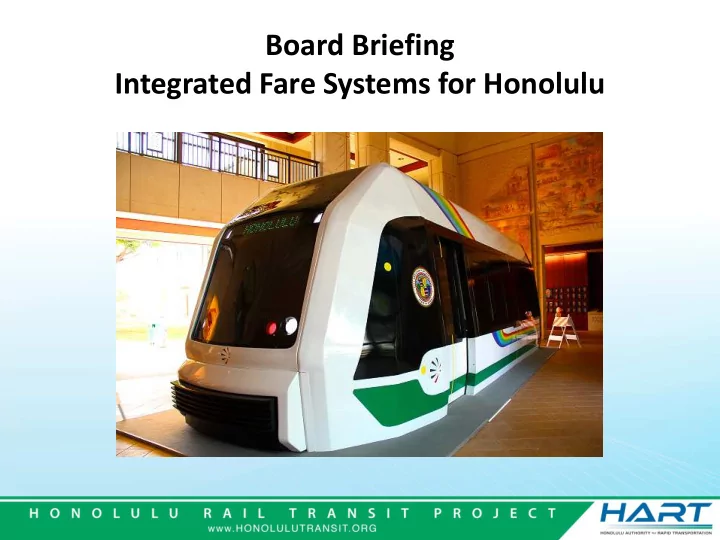
Board Briefing Integrated Fare Systems for Honolulu Purpose - - PowerPoint PPT Presentation

board briefing integrated fare systems for honolulu
SMART_READER_LITE
LIVE PREVIEW

Board Briefing Integrated Fare Systems for Honolulu Purpose - - PowerPoint PPT Presentation

Board Briefing Integrated Fare Systems for Honolulu Purpose Update Board on progress with Fare System for HART Overview of Fare System decision Overview of Integrated Transit Fare System for Oahu Fare Systems Project


slide-1
SLIDE 1

Board Briefing Integrated Fare Systems for Honolulu

slide-2
SLIDE 2

Purpose

  • Update Board on progress with Fare System for HART
  • Overview of Fare System decision
  • Overview of Integrated Transit Fare System for Oahu
slide-3
SLIDE 3

Fare Systems Project

  • Originally planned to purchase basic ticket vending

machines to issue print tickets

  • Concerns about fraud, integration and station safety

with this approach arose

  • Updated system allowed for:

 More convenient methods for purchasing tickets or passes;  Better data about customers travel needs;  Faregates to provide additional security in stations;  Updated system that reduces fraud and provides for

  • perational efficiencies
slide-4
SLIDE 4

Participants for Fare System Design

  • Multi-agency Steering Committee met beginning in Fall

2013 to March 2015 comprised of  HART  DTS/OTS  BFS  DIT

  • Consultant: CH2M Hill
  • HART Permitted Interaction Group I

 (“Group” = Bunda, Formby, Horner, Hui, Okinaga)

slide-5
SLIDE 5

Project Goals by Steering Committee

  • Design a simple and convenient fare collection system that
  • perates seamlessly between modes
  • Adopt proven fare technology based upon industry

standards that reduces fraud and maximizes interoperability

  • Enables enhanced data collection for improved customer

service

  • Increase distribution channels and fare purchasing options
  • Increase participation in instructional programs and facilitate

new transit partnerships e.g. bike share

  • Minimize capital and operating costs
slide-6
SLIDE 6

Board Involvement

  • Meetings

 4 Board Briefings (including PIG recommendation in October 2014)  4 Group Meetings

  • Interagency Steering Committee determined optimal

fare media and system options

  • PIG I makes 2 main fare policy recommendations to

the Board

slide-7
SLIDE 7

Interagency Steering Committee made several key fare system determinations

  • Smart card media
  • Account based
  • Open architecture

These features provide:

  • Security of proven IT architecture
  • Transition path to new payment systems in the future
  • Greatest potential for integration with Handi-Van and other

non-transit services

  • Potential for differential and location-specific fares
  • Accommodates new payment systems in the future
slide-8
SLIDE 8

PIG I Policy Recommendations

  • Design of the fare collection system should plan for
  • perations that maximize use of existing expertise and

capacity at the City, OTS and HART

  • HART’s fare collection system should include use of

fare gates

  • Both recommendations are intended to provide

general direction, and are subject to further appropriation and budgeting decisions by the City and HART Today is an update to the Board on the status of these recommendations

slide-9
SLIDE 9

Operations Strategy takes advantage of Existing Skills and Cost Efficiencies

  • City/HART

 Program and Financial Management  Central System Hosting (DIT)

  • OTS

 Fare system call center  Special Program/Retail Management  Bus equipment maintenance

slide-10
SLIDE 10

Honolulu Fare System will integrate Bus and Rail

  • Closed loop, account based smart card system

 Cash will be accepted on board bus and at TVMs in rail stations

  • Faregates at rail station entrances will only accept smart cards to

enter

 Seamless transfer using smart card from bus to rail \rail to bus

  • TVMs at all rail entrances (2 per entrance)
  • TVMs also planned at major bus transfer locations
slide-11
SLIDE 11

Fare System Architecture

slide-12
SLIDE 12

How the System will Work- Getting a Card

slide-13
SLIDE 13

How the System Will Work– Loading a Card

slide-14
SLIDE 14

How the System Will Work- Using the Card

slide-15
SLIDE 15

Bus equipment will be piloted first

  • Exiting farebox for cash

collection will remain

  • Smart card target will

be mounted before farebox with minimal driver interaction

  • Routers on board will

allow for real time connection

slide-16
SLIDE 16

Stations will be launched after bus service

  • Ticket Vending Machines

(TVMs)

  • Faregates & Wheelchair

ADA Access

  • Neighborhood & Station

Locations Map

  • Customer Information

Phones

  • Emergency Phones
  • Public Address and Digital

Variable Messages

  • Directional Signage to

Platform

  • Automated External

Defibrillator (AED)

slide-17
SLIDE 17

Faregates will be at all station entrances

  • Quantities

determined based upon anticipated ridership and NFPA 130

  • Also considers

ADA requirements

slide-18
SLIDE 18

Equipment will be service proven

  • Two TVMs at every entrance
  • TVMs will be ADA compliant
  • Intent is to have CCTV monitoring

at the array

slide-19
SLIDE 19