BLE Security Authentication Privacy Discussion EECS 582 -- Spring - - PDF document

ble security
SMART_READER_LITE
LIVE PREVIEW

BLE Security Authentication Privacy Discussion EECS 582 -- Spring - - PDF document

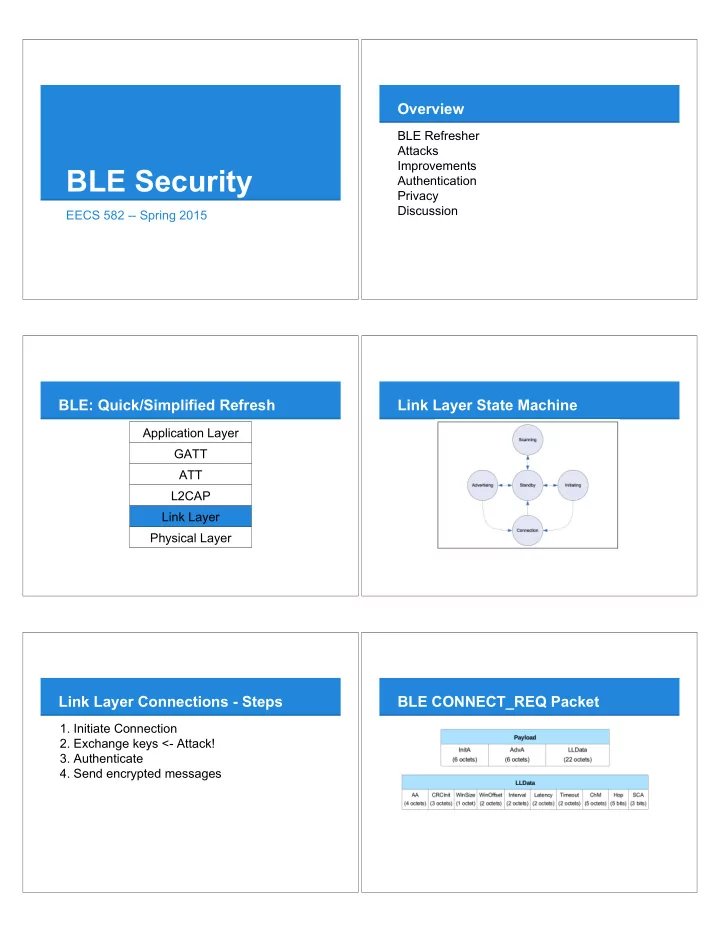
Overview BLE Refresher Attacks Improvements BLE Security Authentication Privacy Discussion EECS 582 -- Spring 2015 BLE: Quick/Simplified Refresh Link Layer State Machine Application Layer GATT ATT L2CAP Link Layer Physical Layer


slide-1
SLIDE 1

BLE Security

EECS 582 -- Spring 2015

Overview

BLE Refresher Attacks Improvements Authentication Privacy Discussion

BLE: Quick/Simplified Refresh

Application Layer GATT ATT L2CAP Link Layer Physical Layer

Link Layer State Machine Link Layer Connections - Steps

  • 1. Initiate Connection
  • 2. Exchange keys <- Attack!
  • 3. Authenticate
  • 4. Send encrypted messages

BLE CONNECT_REQ Packet

slide-2
SLIDE 2

Initiating a BLE Connection

  • Peripheral advertises
  • Initiator starts connection
  • hopInterval
  • hopIncrement
  • accessAddress
  • crcInit
  • Initiator and peripheral move

to next channel

Sniffing an on going connection

  • Wait for a packet on two separate data channels
  • Eliminate false positives (how do you know what is a packet)
  • Look for 16-bit header for empty packet, take prior 32-bits as AA
  • crcInit can be reversed, by running the packet through the LFSR in

reverse (magic, magic, math, math...)

  • Access Address is set in each packet.
  • Wait on a channel and observe subsequent packets, record time between

Encryption - BLE 4.0 & 4.1

  • Custom key exchange
  • Select TK (128 bit AES key)
  • Use TK to agree upon LTK
  • What’s TK?
  • Just WorksTM: key == 0
  • 6-digit passkey: key in 0-999,999
  • Out of Band: You’re on your own.

BLE 4.2 - Secure Simple Pairing

  • Elliptic Curve Diffie Hellman
  • 96 bits of entropy with P-192 or 128 bits with P-256
  • Protects against passive eavesdropping
  • Does not protect against MITM
  • Association models (anti-MITM)
  • Numeric comparison
  • Out of Band
  • Passkey
  • Secure Connections Only Mode

Link Layer Encryption

  • TCP/IP
  • No encryption
  • No authentication
  • Relies on application layer
  • Vulnerable to passive listener
  • BLE
  • Node-to-node encryption
  • Impractical authentication (for many IoT)
  • Simply Secure is safe from passive listener

Could I be tracked?

  • Device Address Randomization
  • Access Address generated by identity key (IRK)
  • IRK exchanged during bonding
  • Do people use it?
  • “We do not currently employ Bluetooth Smart in this capability.”
  • “...we do not use randomize device address.”
  • “As far as we are aware, our two products that use BLE do not utilize

this feature.”

slide-3
SLIDE 3

Summary

  • Proven link-layer encryption scheme node to node (in 4.2)
  • No protection against MITM without traditional I/O
  • Option for randomizing device address

Wishlist

  • Better way to do authentication
  • Many IoT class devices don’t have classical I/O
  • How to I control what devices are connected to my gateway?
  • How can I control what gateways I connect to?
  • Multihop communication
  • Do I trust the nodes in between the gateway and destination?
  • What happens if one of my devices is compromised?
  • Do I trust my gateway?

References

https://lacklustre.net/bluetooth/ Ryan_Bluetooth_Low_Energy_USENIX_WOOT.pdf https://eprint.iacr.org/2013/309.pdf https://www.bluetooth.org/DocMan/handlers/DownloadDoc.ashx? doc_id=286439

What does IoT need?

  • Confidentiality
  • I don’t want people monitoring my habits at home

! ...but people can already see if my lights are on…

  • Communication between nodes should be kept secret
  • Authentication
  • We want to know what nodes are on our network and that they’re legit.
  • Preventing pivots
  • If a node is compromised, it should be hard for that node to pop other devices.
  • Do I want people to know what devices I have in my house?
  • Prevent neighbors from turning off lights
  • General framework that different classes of devices can “inherit” from: medical IoT

can specify something that fitness IoT needn’t have.