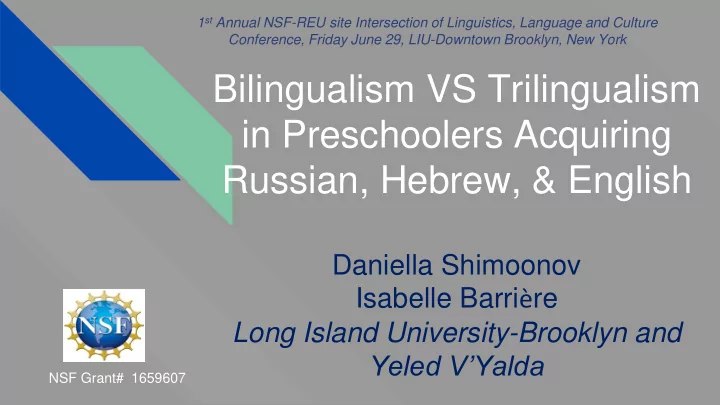
Bilingualism VS Trilingualism in Preschoolers Acquiring Russian, - - PowerPoint PPT Presentation

bilingualism vs trilingualism
SMART_READER_LITE
LIVE PREVIEW

Bilingualism VS Trilingualism in Preschoolers Acquiring Russian, - - PowerPoint PPT Presentation

1 st Annual NSF-REU site Intersection of Linguistics, Language and Culture Conference, Friday June 29, LIU-Downtown Brooklyn, New York Bilingualism VS Trilingualism in Preschoolers Acquiring Russian, Hebrew, & English Daniella Shimoonov


slide-1
SLIDE 1

Bilingualism VS Trilingualism in Preschoolers Acquiring Russian, Hebrew, & English

Daniella Shimoonov Isabelle Barrière Long Island University-Brooklyn and Yeled V’Yalda

NSF Grant# 1659607 1st Annual NSF-REU site Intersection of Linguistics, Language and Culture Conference, Friday June 29, LIU-Downtown Brooklyn, New York

slide-2
SLIDE 2

Languages Other Than English In NYC

3rd Most Spoken Language Other Than English in NYC with 202,225 speakers. 14th Most Spoken Language Other Than English in NYC with 52,424 speakers.

Languages Other Than English (LOTE) spoken by New Yorkers over 5 years of age, US Census Bureau (2009) American Community Survey Table B160001 in Garcia, Zakharia & Otcu, 2013, p13.

Русский Russian תיִרבִע Hebrew

slide-3
SLIDE 3

Key Concepts

  • Bilingualism –The ability to speak and understand two languages.
  • Trilingualism – The ability to speak and understand three

languages.

  • Subject-Verb Agreement (SVA)– Sentence structure in

which both subject and verb are in accordance in person and

  • number. Examples of Mainstream American English:
  • the boyØ sleeps
  • *the boyØ sleepØ
  • Bootstrapping- Children can acquire the morphosyntax of one

language by transferring their knowledge from another language.

slide-4
SLIDE 4

Similarities and Differences Across English, Hebrew and Russian

Similarity: All 3 languages have overt subject. Differences:

  • English has overt marking subject

verb agreement only for 3rd person singular present.

  • Russian and Hebrew are overtly

marked for person, 1st, 2nd, 3rd singular and plural number and gender for different tenses. English: The boys throwØ the toy. The boyØ throws the toy. Russian: Mal'chiki brosayut igrushku. Mal'chikØ brosayet igrushku. Hebrew: Hayeladim zorkim et hadavar. HayeledØ zorek et hadavar.

slide-5
SLIDE 5

Background

  • Cumulative Enhancement Model (Flynn, Foley and

Vinnitskaya, 2004): trilingual learners' use all of their languages- L1 and L2- when learning an L3; confirmed on production data focused on relative clauses on Kazakh- Russian- English trilinguals

  • Versus Other ‘Deficit’ Models: trilinguals at a disadvantage

compared to the usual Hebrew-English or Russian-English bilinguals due to them receiving lower amount of input in each individual language.

slide-6
SLIDE 6

Research Question

Does the Cumulative Enhancement Model apply to comprehension and production in trilingual preschoolers who are simultaneously exposed to Russian (L1A) and Hebrew (L1B) before being exposed to English (L2)?

slide-7
SLIDE 7

First step

  • What are the similarities and differences

between the comprehension patterns of bilinguals Russian-English and Hebrew – English?

  • Doe Russian and Hebrew bootstrap

comprehension in English?

slide-8
SLIDE 8

Methodology

  • Parents’ Background Information Questionnaires
  • % of input in each language

Participants (3.5 to 5 year old preschoolers):

  • 2 Groups of Bilinguals

17 Russian/L1- English/L2 6 Hebrew/L1- English/L2

  • Trilinguals: ongoing data collection
slide-9
SLIDE 9

Comprehension Task

Mal’chikØ chitaet knigu Mal’chiki chitayut knigu

slide-10
SLIDE 10

Conditions: English: Russian: Hebrew: Transitive Real NP The boys throwØ the toy. The boyØ throws the toy. Mal'chiki brosayut igrushku. Mal'chikØ brosayet igrushku. Hayeladim zorkim et hadavar. HayeledØ zorek et hadavar. Transitive Real NP Pronouns

  • Hem zorkim et hadavar.

Hu zorek et hadavar. Transitive Nonce NP The boys throwØ the muk. The boyØ throws the muk. Mal'chiki brosayut keryag. Mal'chikØ brosayet keryag. Hayeladim zorkim et hatechirah. HayeledØ zorek et hatechirah. Transitive Nonce NP Pronouns

  • Hem zorkim et hatechirah.

Hu zorek et hatechirah. Intransitive Medial PP The boys sleepØ on the bed. The boyØ sleeps on the bed.

  • Intransitive Medial

Adverb

The boys sleepØ deeply. The boyØ sleeps deeply.

  • Intransitive Final

The boys sleepØ. The boyØ sleeps.

slide-11
SLIDE 11

Results: Evidence of Comprehension (Mean Sensitivity) by Number and Condition

0.1 0.2 0.3 0.4 0.5 0.6 0.7 0.8 0.9 1

transnonce transreal Mean Sensitivity

SINGULAR PLURAL

* *

Hebrew Russian

*

0.1 0.2 0.3 0.4 0.5 0.6 0.7 0.8 0.9 1

nonceNP noncePN realNP realPN

Mean Sensitivity

SINGULAR PLURAL

* ** *

slide-12
SLIDE 12

Results: Mean Sensitivity by Number and Condition

0.1 0.2 0.3 0.4 0.5 0.6 0.7 0.8 0.9 1

Mean Sensitivity

SINGULAR PLURAL

*

0.1 0.2 0.3 0.4 0.5 0.6 0.7 0.8 0.9 1

Mean Sensitivity

SINGULAR PLURAL * * *

English for Hebrew English for Russian

slide-13
SLIDE 13

Results: English Comprehension by Exposure to English

0.1 0.2 0.3 0.4 0.5 0.6 0.7 0.8 0.9 1

high low medium Mean Sensitivity English Exposure Group

*

Group English Exposure Russian/ Hebrew Exposure Low 10 25 90 75 Medium 50 50 High 75 10 25 90

 Significant L1 exposure bootstraps bilinguals’ performance in their L2

slide-14
SLIDE 14

Conclusions and Significance

1.Examination of bootstrapping from L1 to L2 in preschoolers’ comprehension

  • 2. 50%/50% Exposure advantage: evidence of boostrapping from

L1 to L2

  • 3. Russian-English Bilinguals understand a broader range of

structures in L2/English than Hebrew-English Bilinguals

  • 4. Cumulative Enhancement Model predicts: Hebrew/L1-

Russian/L1-English/L2 trilinguals will comprehend broader range of structures compared to bilingual Hebrew-Englishongoing data collection

  • 5. Significance: assessment of bilinguals and trilinguals
slide-15
SLIDE 15

Acknowledgments

Katsiaryna Aharodnik Nargizakhon Yunusova Michelle Zinger Inna Fredericks Chana Karp Esther Nigri Children, their parents and education professionals at: Yeled V’Yalda Imaginarium Kings Way

NSF Collaborative Grant BCS#1548147 & NSF Grant REU Site Grant SMA# 1659607