Mythbusters: Bilingualism & CAS Childhood Christina - - PDF document

mythbusters bilingualism cas
SMART_READER_LITE
LIVE PREVIEW

Mythbusters: Bilingualism & CAS Childhood Christina - - PDF document

Mythbusters: Bilingualism & CAS Childhood Christina Gildersleeve-Neumann, Ph.D., CCC-SLP Apraxia of Speech Portland State University For Apraxia-Kids, July 22, 2020 Type of Speech Sound Disorder 2 template by SlidesCarnival;


slide-1
SLIDE 1

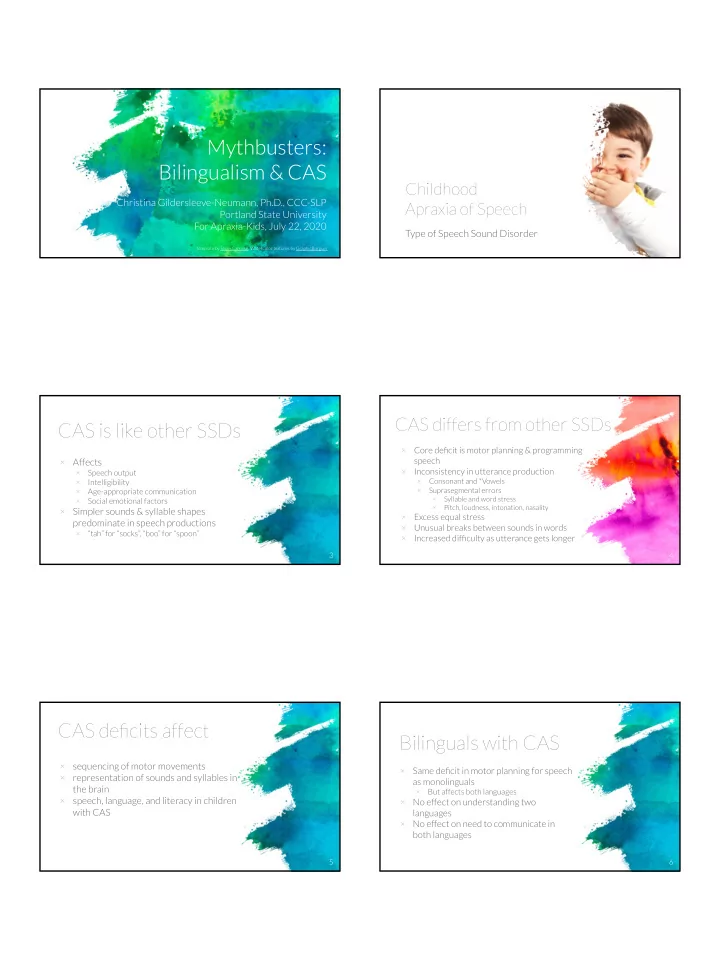
Mythbusters: Bilingualism & CAS

Christina Gildersleeve-Neumann, Ph.D., CCC-SLP Portland State University For Apraxia-Kids, July 22, 2020

× template by SlidesCarnival; Watercolor textures by GraphicBurguer

Childhood Apraxia of Speech

Type of Speech Sound Disorder

2

CAS is like other SSDs

× Affects

× Speech output × Intelligibility × Age-appropriate communication × Social emotional factors

× Simpler sounds & syllable shapes predominate in speech productions

× “tah” for “socks”, “boo” for “spoon” 3

CAS differs from other SSDs

× Core deficit is motor planning & programming speech × Inconsistency in utterance production

× Consonant and *Vowels × Suprasegmental errors × Syllable and word stress × Pitch, loudness, intonation, nasality

× Excess equal stress × Unusual breaks between sounds in words × Increased difficulty as utterance gets longer

4

CAS deficits affect

× sequencing of motor movements × representation of sounds and syllables in the brain × speech, language, and literacy in children with CAS

5

Bilinguals with CAS

× Same deficit in motor planning for speech as monolinguals

× But affects both languages

× No effect on understanding two languages × No effect on need to communicate in both languages

6

slide-2
SLIDE 2

Diagnosis, Assessment & Intervention for Bilinguals

× Growing # of studies of CAS × Limited work with bilinguals × Next to none on bilinguals with CAS

7

Myths about Bilingualism & CAS

× Need to pick one language because it’s CAS × Parents can choose to speak a language they don’t speak × English is more important

× Because the SLP can speak it × Because the child will need to speak it for school, to be successful × Because child is “choosing” English

× Picking the “shorter word” is a conscious language choice

× (eg., “ba” for “ball” instead of “pelota”) 8

Careful of cultural bias in CAS

9

Same CAS signs across languages

× Based on English properties × Strong-weak stress pattern × Importance/high frequency of one syllable words × Moderate # of consonants × Lots of vowels × Signs look different in languages with × Different stress patterns × Longer words × Few vowels × More/fewer consonants × Different word shapes × Differences affect assessment & treatment! 10

I want an

  • range ball

= yo necesito una pelota anaranjada

11

Learning two languages is harder than learning one

× Based on monolingual U.S. mainstream culture × Most people speak two languages all the time × Many speak 3+!

12

slide-3
SLIDE 3

Bilinguals only need one language

× Lack of value for home language × Assumption that only classroom language important × For success × Devaluing of home environment × Assumption that Americans should/can/want to speak × English fluently × Have access to English learning resources × Want to speak English in their homes 13

Focus on English because SLP speaks English

× Assumption that family - not SLP, school - must adapt × Dominant cultural bias × Assumes families can adapt

14

FACT: Most people in the world are multilingual

15 × Need speech skills to communicate with their community × Monolingualism will impoverish their communication × Beware the “Matthew Effect”

×

Those with access to therapy in their languages will improve their communication; those who are deprived of the opportunity to communicate in a language lose that language and effective communication with their community.

Bilinguals with CAS

16 × Assessment in both languages × Individualized treatment approach × Plan for language(s) of intervention × Which × When × How

Bilinguals with CAS need

17

A (weak) analogy: Should my child with global apraxia learn to swim?

18

slide-4
SLIDE 4

Which kid gets to swim?

19 × Live on a houseboat × Live on a lake × Has a house on a lake that they spent weekends at × Visit extended family on a houseboat for weeks every summer × Older siblings and friends at neighborhood pool all summer × Your child really wants to learn how to swim × You don’t swim but you really want your child to ×

× Severity of apraxia? Maybe × Redefine “swim” so reflects difficulty × Family considerations? × What impact will not swimming have on child? × Child considerations? × Present and future needs?

×

For CAS Bilingual: What decision factors?

20

Can a child with CAS learn to speak two languages?

YES

Should a child with CAS learn two languages?

FAMILY DECISION. SLP provides appropriate supports.

21 22

Bilinguals with CAS

× Same difficulties as monolinguals × Treatment for “meta” language skills needed × For generalization of learning across languages

× Children with Speech and/or Language Disorder

× Need as rich a communication environment as possible × Impoverished internal child factors × Need for enriched external factors

× Bilingual children with CAS need intense therapy in both languages.

× At greatest risk of losing L1

(c.f., Kohnert, 2012)

Treatment for Bilingual CAS

23

Important of Home Language in Treatment

× Can be used to strengthen English × Learn new information × in a stronger language × then transfer to weaker language × Better language choice if no English yet × Lots of opportunity for practice!

24

slide-5
SLIDE 5

Intervention for Bilingual CAS

× CAS motor planning disorder whether a bilingual or a monolingual × Framework for CAS therapy doesn’t change × Need to consider specific language and socio-cultural needs, × Need meta skills × Transferring skills in two languages is generalization practice

25 × Elective vs. Circumstantial Bilingual × Languages families speak × Current language environment of child × Who the family interacts with

×

Daily/Annually/Occasionally

× Value of language for

×

Family

×

Child

× Severity of apraxia

Considerations

26

× Only home language × Not in school yet × Child with severe CAS

× Who needs strong foundation in communication first × Less exposure to school language

× Only school language

× Speech skills well-developed in both × Focus on school with transfer to home × Not now doesn’t mean not ever

Exceptions to Bilingual Approach

27

Summary

28

× Bilingual children have SSDs × SSDs will not go away or get better if you are (or try to become) monolingual × Monolingualism means you can’t talk to a lot of people in your world × Isolating × Lack of generalization

×

And now your questions!

29