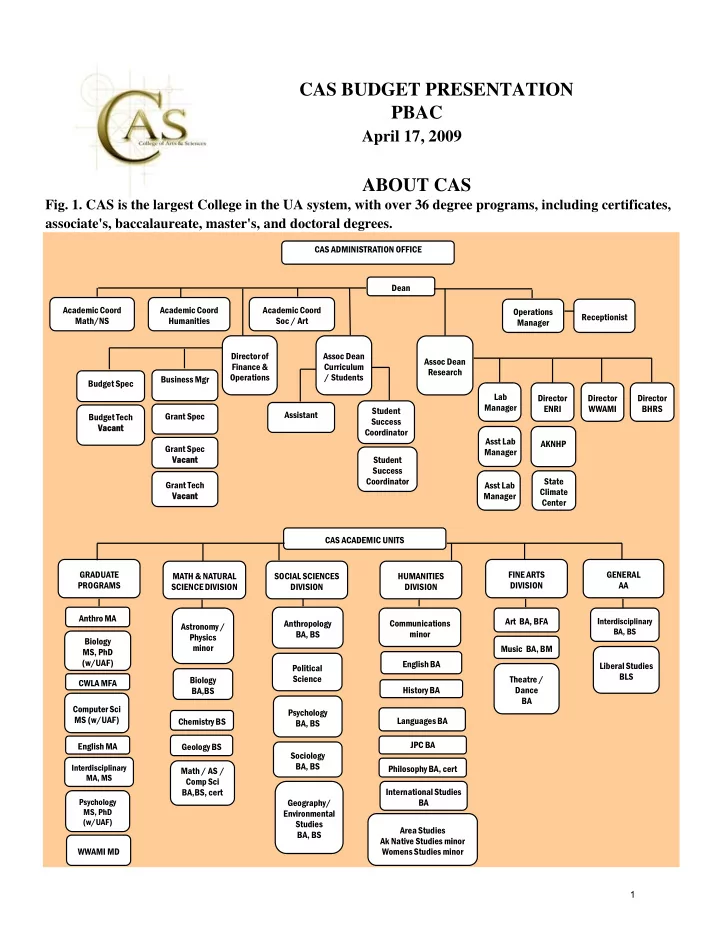
CAS BUDGET PRESENTATION PBAC April 17, 2009 ABOUT CAS Fig. 1. CAS - - PDF document

cas budget presentation pbac
SMART_READER_LITE
LIVE PREVIEW

CAS BUDGET PRESENTATION PBAC April 17, 2009 ABOUT CAS Fig. 1. CAS - - PDF document

CAS BUDGET PRESENTATION PBAC April 17, 2009 ABOUT CAS Fig. 1. CAS is the largest College in the UA system, with over 36 degree programs, including certificates, associate's, baccalaureate, master's, and doctoral degrees. CAS ADMINISTRATION


slide-1
SLIDE 1

CAS BUDGET PRESENTATION PBAC ABOUT CAS

  • Fig. 1. CAS is the largest College in the UA system, with over 36 degree programs, including certificates,

April 17, 2009

associate's, baccalaureate, master's, and doctoral degrees.

CAS ADMINISTRATION OFFICE Operations Manager CAS ACADEMIC UNITS Sociology BA, BS Art BA, BFA Music BA, BM Theatre / Dance BA Interdisciplinary BA, BS Liberal Studies BLS Psychology BA, BS Anthropology BA, BS Political Science Biology BA,BS Chemistry BS Geology BS Math / AS / Comp Sci BA,BS, cert Astronomy / Physics minor Communications minor English BA History BA Languages BA JPC BA Philosophy BA, cert Area Studies Ak Native Studies minor Womens Studies minor Academic Coord Math/NS Academic Coord Humanities Academic Coord Soc / Art Receptionist Assoc Dean Research Student Success Coordinator Student Success Coordinator Assistant Budget Spec Budget Tech Vacant ant Business Mgr Grant Spec Grant Spec Vacant ant Grant Tech Vacant ant AKNHP Director ENRI Director WWAMI Director BHRS Dean GRADUATE PROGRAMS MATH & NATURAL SCIENCE DIVISION SOCIAL SCIENCES DIVISION HUMANITIES DIVISION FINE ARTS DIVISION GENERAL AA Anthro MA Biology MS, PhD (w/UAF) CWLA MFA Computer Sci MS (w/UAF) English MA Interdisciplinary MA, MS Psychology MS, PhD (w/UAF) WWAMI MD Geography/ Environmental Studies BA, BS International Studies BA Director of Finance & Operations Assoc Dean Curriculum / Students State Climate Center Lab Manager Asst Lab Manager Asst Lab Manager 1

slide-2
SLIDE 2

FY05 FY06 FY07 FY08 FY 09 Temp Staff 36 21 34 19 20 Perm Staff 64 55 54 57 55 Student Ass 104 105 134 129 130 Grad Studen 53 59 65 64 64 Term Faculty 56 51 55 52 57 Tenure Trac 147 157 151 155 150 Adj Faculty 201 198 194 201 211 Total Employ 661 646 687 677 687

CAS 608 CAS 140,124 Other Colle 1048 Other Colle 143,392

EMPLOYEE NUMBERS

  • Fig. 3&4. CAS produces about 50% of the SCH for UAA with about 37% of the academic faculty and staff. Personnel expenditures account for

93% of our budget.

36 64 104 53 56 147 201 661 21 55 105 59 51 157 198 646 34 54 134 65 55 151 194 687 19 57 129 64 52 155 201 677 20 55 130 64 57 150 211 687 100 200 300 400 500 600 700 800 Employee Type

Figure 2. CAS Employees FY05-FY09

FY05 FY06 FY07 FY08 FY 09

CAS 49% Other Colleges 51%

SCH Anchorage Campus *

CAS 37% Other Colleges 63%

Academic Employee Count- Anchorage Colleges*

2

slide-3
SLIDE 3

WHO WE SERVE:

CAS 3,522 Other Colleges 3,446 Inter MAU 78 Non Degree Seeking 1,458 8,504

1.10% 2.18% 1.41%

  • 0.89%

0.40% 2.17%

  • 0.87%

0.47%

  • 0.23%

3.30%

  • Fig. 5. We serve a large number of students outside of our College. Every degree seeking

student takes courses from our programs. We also support courses for Engineering, Business, Education and the Health Sciences.

Figure 6: Number of Students Served Per Semester % Change Figure 8: Number of CAS Baccalaureate and Grad Majors % Change Fall 04 8,246 Fall 05 8,430 Fall 05 3,401 Fall 08 8,504 Fall 04 3,431 Fall 08 3,522 Fall 06 8,549 Fall 06 3,417 Fall 07 8,473 Fall 07 3,409 CAS, 3,522 Other Colleges, 3,446 Inter MAU, 78 Non Degree Seeking, 1,458 CAS Other Colleges Inter MAU Non Degree Seeking

3

slide-4
SLIDE 4

CAS PERFORMANCE METRICS

ACTUAL TARGET ACTUAL TARGET

FY 04 67.2% FY 04 $16,218.6 FY 05 65.6% FY 05 $17,966.4 FY 06 67.4% FY 06 $19,619.8 FY 07 70.6% FY 07 $21,157.5 FY 08 68.7% FY 08 $21,501.5 FY 09 71.9% FY 09 $23,000.0 FY 10 70.0% low target FY 10 $23,690.0 low target FY 10 72.0% nominal target FY 10 $24,150.0 nominal target FY 10 74.0% high target FY 10 $25,841.0 high target

ACTUAL TARGET ACTUAL TARGET

FY 04 $3,744.1 FY 04 199 FY 05 $3,885.0 FY 05 181 FY 06 $3,959.0 FY 06 168 FY 07 $3,679.2 FY 07 183 FY 08 $3,829.0 FY 08 195 FY 09 $4,000.0 FY 09 200 FY 10 $4,040.0 low target FY 10 206 low target FY 10 $4,120.0 nominal FY 10 210 nominal FY 10 $4,200.0 high FY 10 214 high

Figure 8: CAS Retention Rate for Freshmen Figure 9: CAS University Generated Funds Figure 12: Grant-Funded Research Expenditures Figure 13: CAS High-Demand Jobs

FY 02 FY 03 FY04 FY05 FY06 FY07 FY08 FY 09 FY 10 History with FY10 nominal target 119,113 126,794 134,465 138,098 138,552 137,911 138,679 140,124 141,175 with FY10 low 140,124 with FY10 high target 142,226

119,000 124,000 129,000 134,000 139,000

Figure 7: CAS SCH History with FY10 Targets

4

slide-5
SLIDE 5

Figure 10 Figure 11 Figure 12 Figure 13 Figure 14

5

slide-6
SLIDE 6

HOW EFFICIENT ARE WE?

  • Fig. 22. Compared to national benchmarks our cost per SCH is significantly below the average.

Note: Based on FY04 data; 10 programs, 13 peer institutions

  • Fig. 23. Our Tier I and Tier II GER classes have high capacity, and we have alleviated some of the bottleneck in the GERs

Notes:

  • 1. The Integrative Capstone is required for graduation beginning Fall 08.
  • 2. History is a Humanities GER only as of 06-07 catalog, 05-06 catalog listed it as a Humanities and Soc Sci GER.
  • Fig. 24. Our class caps are increasing, while our percent of capacity is quite high.

85.2%

% Cap

Fall 2005 Fall 2006 Fall 2007 Fall 2008

Sections

FY 04

% Cap 54

FY05 Figure 17: CAS Class Capacity and Percentage of Capacity

85.9% 136.46 93,784.00 11,422,633.00

FY07

94,247.00 Oral Comm Skills Total CAS Direct Instructional Cost for Comparison Programs Total SCH Count for Comparison Programs Comparable CAS Instructional Cost/SCH 146.44 84,341.00 10,891,656.00 Year

FY04

Figure 15: Comparison Instructional Cost for CAS with Delaware Study FY04

150.48 9,603,461.00 12,955,839.00 98,367.00 Delaware Comparison Avg Instructional Cost/SCH* 163.68 146.20 159.38 168.10 99,630.00 12,697,941.00 142.46 172.30

FY08 FY06

135.14 87.2% FY 08 24.7 Avg Percent of Capacity 24.6 FY05 FY 06 FY 07 87.7% 28.2 87.6% Avg Class Cap 24.2 24.6 Sections % Cap Sections % Cap Sections Quantitative Skills Fine Arts Humanities Social Sciences Natural Sciences 23 56 34 14 120 87.6% 87.7% 87.2%

Enrollment Management Plan: Our enrollment management plan has succeeded in moving us from 85.9% of class capacity in 04 to 87.6% in 08. For our GER courses this is higher, from 87% of capacity in FY 0100 to 91% of capacity in 09.

Integrative Capstone Totals 473 93% 465 160 Writ Comm Skills 2 463 101% 100% 92% 101% 94% 97% 92% 82% 3 88% 95% 29 101% 64 100% 35 94% 13 14 101% 98% 60 92% 155 89% 99% 114 146 90% 108 30 103% 70 98% 38 91% 94% 39 100% 74 99% 38 88% 95% 499 91% 16 97% 112 92% 55 91%

Figure 16: General Education Requirements

UAA College of Arts & Sciences 153 85% 12 85% 6 82% 53 94%

6

slide-7
SLIDE 7

What sort of fiscal discipline have we maintained?

Fiscal Year SCH TT Faculty SCH/FTE FY 05 138,098 157 879.61 FY 06 138,552 154 899.69 FY 07 137,911 158 872.85 FY 08 138,679 152 912.36 FY 09 140,124 150 934.16 Total vacant Tenure Tenure Faculty Positions Tenure Track Positions filled by Term Faculty Net Vacant Tenure Track Positions Total Savings 49 39 10 Savings 467,441 636,990 $1,104,431

  • Suspended Youth Theatre Program
  • 10 Unfilled TT Faculty Lines
  • Deferred Equipment and Technology Needs
  • Extending a minimum of two year wait on filling TT resignations or retirement
  • 3 unfilled positions in the Dean's Office
  • Number of TA and RA positions remain flat
  • Majority of department operating budgets have not been increased in three years
  • Faculty Development fund has not been increased since FY 04 effectively

reducing it from 40K to approximately 35K Figure 18: Because of serious deficits experienced from FY 05-07, we have been forced to keep a number of tenure-track positions vacant. Figure 19: Shows how much savings we have used to fund ordinary operations of the college from vacant tenure-track positions.

7

slide-8
SLIDE 8

FY02 * FY03 * FY04 * FY05 FY06 FY07 FY08 FY09

16,487,200 $ 17,311,400 $ 18,237,000 $ 20,131,209 $ 22,470,860 $ 26,818,883 $ 27,642,541 $ 27,667,550 $ 17,219,230 $ 19,115,030 $ 20,797,593 $ 21,912,165 $ 23,352,599 $ 28,241,446 $ 29,352,638 $ 32,114,802 $ 7,073,009 $ 7,045,740 $ 6,638,268 $ 7,005,661 $ 8,542,491 $ 10,038,882 $ 10,689,224 $ 10,481,475 $ 41.1% 36.9% 31.9% 32.0% 36.6% 35.5% 36.4% 32.6% 53,100 $ (130,400) $ (401,249) $ (851,400) $ (2,210,116) $ 484,664 $ 1,782,520 $ 850,171 $

*Based on estimates, GF pooled at time

Our Current Financial Situation

Beginning Base Budget Authority Carry forward General Fund % State GF

Figure 20: College of Arts and Sciences: Key Factors FY02-FY09

Final Budget

8

slide-9
SLIDE 9

Major Budget Unit:

College of Arts and Sciences

Year to Projected Total

Expenditures:

Adjusted Date Exp to YTD and Budget Budget Activity Year End Projections Variance

1000 Salaries/Ben 26,929,136 18,397,704 8,186,986 26,584,690 344,446 2000 Travel 516,543 372,763 184,247 557,010 (40,467) 3000 Contr Svcs 965,583 740,823 240,709 981,532 (15,949) 4000 Commdty 3,056,855 480,518 2,242,778 2,723,296 333,559 4500 Resale

  • 5000

Equipment 236,644 13,479 365,146 378,625 (141,981) 6000 Fin Aid 4,848 2,104 4,244 6,348 (1,500) 7000 Overhead (2,280) 390 (1,890) 1,890 8000 Misc 9,284 7,868 27,152 35,020 (25,736) Total Expenditures 31,718,893 20,012,979 11,251,652 31,264,631 454,262

Year to Projected Total

Revenues:

Adjusted Date Rev to YTD and Budget Budget Activity Year End Projections Variance

9100 Tuition 16,881,605 16,489,727 524,097 17,013,824 (132,219) 9150 Lab Fees 1,874,739 1,838,029 48,596 1,886,625 (11,886) 9210 Gen Fund 10,481,475 10,459,475 22,000 10,481,475

  • 9700

Aux Receipts

  • 9801

Interest Income

  • 9802

Overhead 364,210 280,546 113,670 394,216 (30,006) 9900 Intra Agency Rcpt 102,160 131,166 11,000 142,166 (40,006) 9960 CIP Receipts 3,697 3,697 31,439 35,136 (31,439) Other 93/94/95/98 2,011,007 2,002,760 158,600 2,161,360 (150,353) Total Revenues 31,718,893 31,205,400 909,402 32,114,802 (395,909) Net Surplus/(Deficit) 850,171 WWAMI 236,824 Misc CAS 184,028 Psych PhD 140,000 ISB Move 118,000 ENRI 116,014 BHRS 55,305 Net Surplus 850,171 Projected Net Surplus for FY 09 consists almost entirely of non-fungible amounts:

9

slide-10
SLIDE 10

FY 09 Budget FY 09 Instructional Budget FY 09 Non- instructional budget TOTAL FY 10 Operational Budget Request

$32,114,802 $28,735,745 $3,379,057 $33,402,802

Proposal Title GF NGF(authority NGF (one time) Veterinarian & Animal Care Facility Manager $130,000 ISB Staffing Support $708, 000 INBRE Match - Stress physiologist Faculty $100,000 INBRE Match - Clinical/Translatio n Science Faculty $150,000 CAS Graduate Assistant Support $200,000 TOTAL $1,288,000 $0 $0

Requests which made the Redbook but not legislative support

CAS Increment Requests FY 11 - Priority I

FY 10 Instructional Budget Request

$1,288,000 CAS FY 10 Operating Budget Request

10

slide-11
SLIDE 11

ATTACHMENT VI Project/Initiative Evaluation

PBAC SPRING 09 Project/Initiative Title: FY 08 GER Offerings - $ 1,280,000

  • 1. What were the original objectives of this initiative?

Correct the structural imbalance within UAA, relieve prior CAS deficit and continue current level of support to all academic programs within UAA. At its current level CAS continued to create a deficit that was projected to exceed 3.2M by FY 07.

  • 2. What was accomplished?

The deficit within CAS was eliminated. CAS has maintained a balance budget for the past three consecutive fiscal years.

  • 3. What has been the impact?

The additional funding allowed CAS to operate without creating a continued deficit. The deficit projection for FY 07 was in excess of 3M prior to receipt of this increment.

  • 4. What are the expected future outcomes of this initiative?

Continued CAS support levels within a balanced budget.

  • 5. To what extent, if any, was this initiative allocation to your unit offset by

reductions? N/A

11

slide-12
SLIDE 12

ATTACHMENT VI Project/Initiative Evaluation

PBAC SPRING 09 Project/Initiative Title: FY 07 Correct Structural Imbalance - $ 850,000

  • 1. What were the original objectives of this initiative?

Correct the structural imbalance within UAA, relieve prior CAS deficit and continue current level of support to all academic programs within UAA. At its current level CAS continued to create a deficit that was projected to exceed 3.2M by FY 07.

  • 2. What was accomplished?

The deficit within CAS was eliminated. CAS has maintained a balance budget for the past three consecutive fiscal years.

  • 3. What has been the impact?

The additional funding allowed CAS to operate without creating a continued deficit. The deficit projection for FY 07 was in excess of 3M prior to receipt of this increment.

  • 4. What are the expected future outcomes of this initiative?

Continued CAS support levels within a balanced budget.

  • 5. To what extent, if any, was this initiative allocation to your unit offset by

reductions? N/A

12

slide-13
SLIDE 13

ATTACHMENT VI Project/Initiative Evaluation

PBAC SPRING 09 Project/Initiative Title: FY 09 GER Offerings - $ 320,000

  • 1. What were the original objectives of this initiative?

This request was to provide funding for six faculty positions for Tier I and Tier II programs to support the bottleneck of student demand within these programs. Tier I courses were at near 100% capacity; Tier II courses at or near 95% capacity. The faculty positions within the request included Math, English and Communications within Tier I and Humanities and Fine Arts in Tier

  • II. This increment was requested to decrease the time to degree for many students and ensure

that students receive basic GER skill courses within the freshman and sophomore years.

  • 2. What was accomplished?

This increment allowed CAS to hire three additional Term English Faculty within FY 09. This allowed an increase in the number of sections offered. In addition, two Term Communication Faculty were recruited during FY 09 and will begin working in FY 10. Math hires in previous years addressed the need in that area.

  • 3. What has been the impact?

The impact has been to reduce the bottleneck in Tier I and Tier II GER’s The additional funding allowed English GER sections to increase 16% from FY 06 to FY 08. Communication GER sections increased 34% during the same time frame. From FY 07 to FY 08 most categories of GER increased from Social Sciences, up 1%, to Written Communication up 9%. With new hires we were also able to reduce the high capacity level in Social Sciences from 97% to 91% and Fine Arts from 101% to 97%. These are indicators of a reduction in the bottleneck in both Tier I and Tier II areas.

  • 4. What are the expected future outcomes of this initiative?

Further reduction of the GER bottlenecks which reduces time to degree for many students.

  • 5. To what extent, if any, was this initiative allocation to your unit offset by

reductions? N/A

13

slide-14
SLIDE 14

ATTACHMENT VI Project/Initiative Evaluation

PBAC SPRING 09 Project/Initiative Title: FY 07 Joint PhD in Psychology - $ 268,000

  • 1. What were the original objectives of this initiative?

The primary objectives of the proposed program are as follows:

  • 1. To train doctoral-level psychologists with integrated expertise in clinical, community, and

cross-cultural psychology with an emphasis in indigenous, Alaska Native, and American Indian psychology.

  • 2. To increase significantly the number of doctoral-level psychologists with expertise and

sensitivity to cross-cultural issues who will practice clinical-community psychology throughout Alaska, in particular, but also in isolated rural communities in the Circumpolar North and the Lower 48 U.S. states.

  • 3. To increase significantly the number of doctoral-level psychologists who will conduct

research on clinical, community, and cross-cultural issues relevant to Alaska, underserved ethnic minorities, and rural communities in Alaska and the Circumpolar North.

  • 4. To increase significantly the number of doctoral-level psychologists who are of Alaska

Native and American Indian descent.

  • 2. What was accomplished?

Teaching Contributions

  • UAA doctoral students taught eight courses in Fall 2007 and Spring 08:

Service Contributions to the Community and Profession

  • UAA doctoral student served as the ANPsych UAA Campus Coordinator providing

recruitment and outreach efforts serving approximately 1000 students, tutoring and mentoring services for nine ANPsych students, as well as hosting and sponsoring eight workshops

  • UAA doctoral students supported clinical services provision through practicum

placement in the Psychological Services Center, Alaska Children’s Services, Providence Family Medical Center, and Veterans Administration Medical Center providing approximately 1250 hours of therapy services to students and community members

  • UAA doctoral students supported community services provision through practicum

placement in the Salvation Army Clitheroe Center, American Cancer Society, and Cook Inlet Tribal Council (where the first joint program Ph.D. student was placed in an Alaska Native Behavioral Health agency) providing over 1250 hours of services to community members.

14

slide-15
SLIDE 15
  • UAA doctoral students conducted program evaluation and consultation projects at

McLaughlin Youth Center, Denali Family Children’s Services, Salvation Army Booth Memorial Home, Cares for Kids Crisis Center, Safe Harbor Inn.

  • UAA doctoral students provided training to staff members at several community

agencies.

  • UAA doctoral students in research assistantships supported the research functioning of

two major research units on campus, namely, the Center for Human Development and Behavioral Health Research and Services (which in turn funded the doctoral students. Research Contributions

  • UAA Core Faculty have been awarded 5 grants, totaling $3,503,936.
  • UAA Core Faculty have submitted 8 grant proposals in the total amount of $7.378,200
  • UAA Core Faculty have 23 professional publications.
  • UAA Core Faculty have given 17 presentations at professional conferences
  • UAA Core Faculty have 8 manuscripts currently under review
  • UAA doctoral students began contributing to the research literature through submission
  • f research presentations and manuscripts.
  • UAA doctoral students begun soliciting funding for their own research; to date 4 doctoral

students have successfully secured research support

  • 3. What has been the impact?

Current there 15 doctoral students enrolled who would not otherwise have been served. Additionally, all doctoral students (UAF and UAA) who so choose will graduate from the MS Program in Clinical Psychology. To date, two have graduated with master’s degree.

  • 4. What are the expected future outcomes of this initiative?

Doctoral trained psychologists who will serve the Alaska community in an area where health disparities are great. Filling of a void in terms of healthcare provision statewide.

  • 5. To what extent, if any, was this initiative allocation to your unit offset by

reductions? N/A

15

slide-16
SLIDE 16

ATTACHMENT VI Project/Initiative Evaluation

PBAC SPRING 09 Project/Initiative Title: FY 09 WWAMI Support - $ 217,200

  • 1. What were the original objectives of this initiative?

To double its entry class size from 10 to 20 students per year, with the purpose of addressing physician shortage in the state. Funding was approved in the FY09 budget for the two new faculty positions, staff support, and operational costs needed to support this expansion. The expectation by the Legislature was that class size would be increased for the fall of 2007. Other development steps required to support this rapid class size increase are being progressively implemented, as detailed below, to ensure high quality in the expanded medical education program for the state.

  • 2. What was accomplished?

Despite the difficulty of having already accepted applicants by the time that legislative approval and the governor’s signature were obtained, class size increase was accomplished to 20 incoming students in fall 2007, and is being sustained. There have been no significant problems, delays or concerns. But it is worth noting that the class size increase was accomplished on a very compressed time scale, one that is no longer permitted by the Liaison Committee on Medical Education which accredits US and Canadian medical schools. Rather than attempting a very rapid expansion of all the required program development, especially faculty hiring, we are implementing the class expansion plans in a progressive manner that optimizes both current and future program development. Two faculty positions were funded to assist in the additional teaching load for new students. Medical school faculty must be experts in a specialized area of basic medical science to provide high-quality instruction. Thus, in hiring tenure track faculty, it is much more important to recruit the most qualified candidates rather than hurrying to fill a vacancy. Therefore, while class size was increased in rapid fashion, we elected to import visiting faculty from medical schools in the lower 48 to assist in teaching in the short term. This expediency is not viable in the long term, since arranging visits and finding faculty with the proper expertise who are willing to make the trip is both time consuming and difficult. In the short term, however, it bought sufficient time to conduct a thorough faculty search which has so far yielded an extremely well-qualified group of applicants. The funding for faculty was designed to support two entry-level faculty. However, current program development can best be supported and augmented with the hiring of an established mid-career biomedical scientist. Thus, we are in the process of conducting that hire – the WWAMI Professor of Biomedical Sciences. This will require us to use some of the funding for the second faculty position to support this hire. The second faculty position will be filled either by sharing a position with Alaska Public Health Laboratories as previously discussed with

16

slide-17
SLIDE 17

Director Bernd Jilly and Alaska State Chief Medical Officer Jay Butler, and/or by developing additional salary support in concert with University Advancement, a process already underway. Other interim accomplishments made possible as faculty hiring was progressing include:

  • New non-clinical elective designed with UAA’s GEC and approved for trial offering in

spring 2009 by UW Curriculum Committee.

  • Search initiated and applicants screened for first Alaska WWAMI Professorship of

Biomedical Sciences

  • New Internal Medicine Interest Group formed
  • First Alaska WWAMI Pathways Coordinator selected and hired.

Fiscal report: $217,200 available $164,388.68 spent as of 3/25/09 $52,811.32 balance unspent as of 3/25/09

  • 3. What has been the impact?

The salient outcome of this project is an increase in the number of physicians for the State of

  • Alaska. Tracking of Alaska WWAMI graduates demonstrates that nearly half of those who enter

the program in Alaska will return to practice here (national average for public medical schools is less that 40% - Assn. Amer. Med. Coll. database). Alaska’s return on investment, however, is even greater because Alaska WWAMI brings medical students from other WWAMI states to Alaska during their 3rd and 4th years of medical school. Some of them return to practice in

  • Alaska. Thus, for every 10 medical students that Alaska has subsidized, about 8.8 WWAMI

graduates, from all WWAMI states, have returned to practice in Alaska. UAA has benefitted in several ways from this initiative. There has been widespread recognition in the Alaska Legislature, the healthcare community and other constituencies that UAA is responding to the recommendations of the Alaska Physician Supply Task Force (2006) that was appointed by President Hamilton and the Alaska Commissioner of Health and Human Services. This is congruent with workforce development plans of UAA, especially in healthcare careers. Since it takes a minimum of 7 years from the start of medical school until a physician is able to practice independently, the full impact of the class size increase on physician supply in the state will not be realized for at least 5 more years. However, we have now accepted the 3rd class of 20 students, an increase of 30 medical students as a result of this initiative.

  • 4. What are the expected future outcomes of this initiative?
  • Classes of 20 new WWAMI students will continue to be accepted annually.
  • Candidates for the Alaska WWAMI Professor of Biomedical Sciences are being

interviewed and hiring is expected in the next few months.

  • The second faculty hire will be completed during the coming academic year.
  • The Alaska Physician Supply Task Force Report recommended that Alaska WWAMI

class size be increased to 30 incoming students per year as soon as possible. Current

17

slide-18
SLIDE 18

classroom and lab facilities have a capacity for 24 students. The new Health Sciences Building will increase that capacity to 40.

  • Alaska Senator Weilichowski and Representative Dahlstrom have introduced legislation

in the current session to further increase Alaska WWAMI class size to 24 students starting in 2010. Additional class size increases will increase the number of health care professionals educated by UAA by a small number. However, the impact of additional physicians for Alaska, especially in view of the critical documented shortage, is great. UAA’s ownership of Alaska’s Medical School can have great impact in terms of public support for the University.

  • 5. To what extent, if any, was this initiative allocation to your unit offset by

reductions? N/A

18

slide-19
SLIDE 19

ATTACHMENT VI Project/Initiative Evaluation

PBAC SPRING 09 Project/Initiative Title: FY 07 Support for BSE Engineering – 150K

  • 1. What were the original objectives of this initiative?

The goals of this initiative was to support BSE pre-professional coursework within the Physics and Chemistry departments due to the increased level of funding and admissions into the BSE program.

  • 2. What was accomplished?

One half-time Tenure Track faculty was funded within the Chemistry Department, one-half time TT faculty was funded with the Physics Department and an additional term faculty member was funded within the Math Department. This allowed for additional course offerings within these three departments.

  • 3. What has been the impact?

UAA has benefited from this initiative with an increased retention rate as well as an increase in the number of degrees awarded within the School of Engineering. SOE awards increased 23%, including the first 9 graduates of the new BS Engineering program and the first 2 graduates of the Port and Coastal Engineering graduate certificate program. Enrollment has increased 22% from Fall 2007.

  • 4. What are the expected future outcomes of this initiative?

The initiative has allowed an increase in the number of BES graduates and an increased retention rate.

  • 5. To what extent, if any, was this initiative allocation to your unit offset by

reductions? N/A

19

slide-20
SLIDE 20

ATTACHMENT VI Project/Initiative Evaluation

PBAC SPRING 09 Project/Initiative Title: FY 09 ISB Support - $118,200

  • 1. What were the original objectives of this initiative?

This initiative recognized our need to increase personnel and other operational budgets associated with the expansion of programs and additional capacities with the construction and

  • ccupancy of the CPISB. Our objective was to fully fund the academic support component of

the operations of this new facility.

  • 2. What was accomplished?

Our request described a need for $792K in new FY09 funds and an additional $528K in FY10, for a total of $1.29M in new support personnel and operations budgets. Of this request we were awarded a total of $118K in FY09 funds, and a total FY10 request was generated of $635K ($505K plus vivarium staff @$130K) within the Regent’s budget. The legislative process has not yet concluded, and the ISB operating funding requested includes the needs of Facilities and Maintenance for building operations in addition to CAS’s academic needs. It is not yet certain how much if any additional funds may become available to CAS through this process. As we were faced with CPISB-associated needs within CAS of $1.29M with a budget this year

  • f $118K, the decision was made to delay new hires until we knew the extent of our FY10

CPISB operational budget. The rationale being that any strategy for meeting personnel needs would change given different funding levels, and committing to personnel in the FY09 year would limit our ability to optimize the use of these funds to mitigate the inevitable shortfall. We know funds will be inadequate to meet all of our identified needs, but until we know the magnitude of the deficit, we are unable to determine which operations we would choose to

  • postpone. Although some positions were truly needed this year to establish operations at year-

end, without knowing if we will be able to open these operations has led to a delay in proceeding with hires. The funding we acquired through the budget process last year is being used to pay for professional oversight of the installation of the projection equipment in the Planetarium and to pay for temporary help with packing and unpacking our teaching and research laboratories in June (or as soon thereafter as our building occupancy is allowed). This GF will be used in future years to partially offset the $1.29M needed for operations in subsequent years. We are hopeful that some additional funding will result from the FY10 Legislative process and will continue with additional requests until we can fund all operations.

  • 3. What has been the impact?

The impact is that we have the capacity to move into the building, but we are still far short of being able to fund its operations. The benefits of this initiative to UAA will be realized in future

20

slide-21
SLIDE 21

years as we begin to reap the rewards of utilizing the new building, as students experience more modern, efficient, and safer teaching laboratories, and as our graduate programs and research productivity are enhanced through operations of a vivarium and modern research infrastructure.

  • 4. What are the expected future outcomes of this initiative?

The challenge for this initiative continues to be to develop the full resources necessary to utilize the CPISB in the manner for which it was designed. As the resources become available to fund the necessary personnel and operations budgets, the outcomes of this initiative will include increased offerings of laboratory sections, reduced limitation of available laboratory instruction for health-related and other curricula, enhanced research productivity (contributing to the development of our capacities within INBRE and EPSCoR), enhanced quality of graduate and undergraduate instruction in the Sciences, reduced risks associated with better programmed and safer laboratories, and enhanced faculty recruitment and retention opportunities.

  • 5. To what extent, if any, was this initiative allocation to your unit offset by reductions?

This increment was offset with the 1% FY 09 holdback of $ 102,602.

21

slide-22
SLIDE 22

ATTACHMENT VI Project/Initiative Evaluation

PBAC SPRING 09 Project/Initiative Title: FY 09 CAS Budget Reduction – $102,602

  • 1. What were the original objectives of this initiative?
  • 2. What was accomplished?

CAS made the decision to absorb the reduction internally through cost savings from positions left vacant by unanticipated resignations before the beginning of the Fall semester.

  • 3. What has been the impact?

The FY 09 “holdback” of $ 102,602 impacted CAS in primarily one area of the budget. The reduction caused a slowdown in our ability to replace tenure-track faculty positions. Currently positions remain vacant for a minimum of one year after a retirement or

  • resignation. The “holdback” is not linked to a specific TT position due to saving from
  • ther vacant positions.
  • 4. What are the expected future outcomes of this initiative?

With only a large reduction in the number of retirements and full-year sabbaticals the salary savings experienced over the past three years are not anticipated. The current projected FY 10 budget and approved TT recruitments for FY 11 will be negatively affected.

  • 5. To what extent, if any, was this initiative allocation to your unit offset by

reductions? N/A

22

slide-23
SLIDE 23

ATTACHMENT VI Project/Initiative Evaluation

PBAC SPRING 09 Project/Initiative Title: Seawolf Debate Program - $20,000 Contact: Steven Johnson, Director E-mail: steve.johnson@uaa.alaska.edu Org #: 11070

  • 1. What were the original objectives of this initiative?

Our request for increased funding was organized around two objectives: maintaining the competitive excellence of UAA’s Seawolf Debate team and expanding opportunities that involve UAA’s community in the practice of reasoned discourse. Specifically, we sought funding to ensure our continued participation in the US Universities Debating Championships and to promote on-campus events like the Cabin Fever Debates, the Northern Lights Open debating tournament and our various public debates.

  • 2. What was accomplished?

We have been very successful in meeting our intended goals. With regard to our competitive excellence, the Seawolf Debate program fielded competitive teams at seven intercollegiate debating tournaments this year; UAA teams placed in over ½ of those tournaments, including reaching the Semifinal round of the US Universities Debating Championships. This tournament, featuring competition from over 125 teams from around the United States, is the largest and most competitive tournament in the international format of debate held in the United States. Our on-campus efforts were equally successful. This year’s Cabin Fever Debates—UAA’s intramural debating tournament—was the largest ever, with over 60 students registering for the

  • competition. We regularly drew audiences of 50 or more people for our preliminary rounds; our

final round was attended by over 150 people. Our high school tournament, the Northern Lights Open, offers high school students from around Alaska the opportunity to compete in the format

  • f debate used in collegiate competitions around the world. Finally, we had a variety of on-

campus events that promoted debate and discussion in our community. These events—ranging from Presidential and Vice Presidential Debate watch events to an exhibition debate with the Irish Champion team—were very well attended and received.

  • 3. What has been the impact?

We are proud to represent the academic excellence of UAA at competitions around the nation and the world. I’m confident that academic debating provides UAA students one of the only

  • pportunities to regularly engage in direct competition with students from some of the most

23

slide-24
SLIDE 24

prestigious universities in the world—including Harvard, Yale, Oxford and Cambridge. UAA’s debating program is recognized for excellence around the world. We also provide an important connection between our community and our university. Promotion

  • f our public events typically draws many community members to our campus to watch and

participate in debates, further reinforcing UAA’s place as a vital center of culture and discussion in our community.

  • 4. What are the expected future outcomes of this initiative?

With this support, we are able to recruit students to UAA more aggressively. Already, we have students from the Pacific Northwest and from around Alaska attending UAA specifically to participate in the debating program. We also plan to continue to grow our already successful projects; we would like to see the Cabin Fever Debates add 15-20 more student competitors in coming years. Finally, we will continue to host public events that serve as an important venue for debate and discussion within our community.

  • 5. To what extent, if any, was this initiative allocation to your unit offset by

reductions? N/A

24

slide-25
SLIDE 25

ATTACHMENT VI - A Project/Initiative Evaluation

PBAC SPRING 09 Project/Initiative Title: Dancing Histories: Elder Oral History in Perico, Agramonte and Jovellanos, Cuba Contact: Jill Flanders-Crosby E-mail: afjaf@uaa.alaska.edu Org #: 12294

  • 1. What were the original objectives of this initiative?

This proposal was for a one-month research trip to Perico, Agramonte and Jovellanos,

  • Cuba. One major goal was to conduct and record elder oral history interviews and stories

surrounding the historical foundations of the Arará religion, one of the important traditional religions of Cuba involving dance and music. It is the Perico elders in particular, grandchildren of both former slaves and the originators of Arará, who are the primary knowledge keepers of Arará history. These elders are the living links between the past and the present and were and still are about to pass away without their stories being told (one important elder has since passed away).A second goal was to investigate the movement of Arará into Agramonte and Jovellanos, nearby communities that “received” Arará from Perico.

  • 2. What was accomplished?

A total of 17 formal interviews were conducted, recorded, transcribed and translated. Elder photos in the homes of their descendents were photographed and identified. Religious artifacts were identified and clarified. I, along with my research team attended and photographed and/or videotaped 7 ceremonies. We also visited and videotaped two significant sites; the sugar refinery Union de Fernandez where the former slaves who eventually settled in Agramonte worked, and the lagoon where these same slaves ran away to hide and hold religious ceremony. I also visited the historical museums in nearby Colon and in Perico. All goals were met and all funds were spent in Cuba.

  • 3. What has been the impact?

From this project I have a chapter forthcoming (Crosby, J. F. (forthcoming). “Secrets Under the Skin: They Brought the Essence of Africa.” In Caribbean Dance: How Movement Shapes Identity Editor, Susana Sloat. University of Florida Press). I also presented this material one scholarly conference (Society for Ethnomusicology) with a second abstract in consideration (African Studies Association). I presented this work at the American College Dance Festival in March 2009, at the CAS Relevant Research Series, and for OLE. Information from this project has informed my lectures inside of my Dance Appreciation GER course. At present, this project is the primary inspiration for a

25

slide-26
SLIDE 26

new work of choreography set to premiere April 9 as part of the Department of Theatre and Dance’s New Dances concert. Fieldwork videos are incorporated into the work of choreography in order to create a multi-media performance work. This dance was also presented a work in progress as part of the CAS Relevant Research Series March 26. Considering Strategic priority A, this further number 7, under priority B this furthers number 3, under priority D it furthers number 1, and under priority E, it furthers number

  • 4. What are the expected future outcomes of this initiative?

This project continues to grow. In May, June and July 2010, I anticipate returning to Ghana, Togo and Benin to carry the Cuba elder oral histories and all Cuban videotape to African religious elders for response (Arará is a result of the slave trade of Ewe and Fon peoples carried over to Cuba). This work will become part of a larger presentation that will open at the Ludwig Foundation in Havana Cuba 2010. At that opening, another researcher (visual artist Susan Mathews) and I will present the elder oral histories through the format of illuminated manuscripts (Matthew’s contribution), elder stories on storyboards, the work of choreography premiering April 9 as a filmed event (my contributions), an art-video using my fieldwork clips and new material to be filmed in Africa 2010 (a third contributor’s project) and a live performance of a solo set on me by a UAA departmental colleague (Brian Jeffery) in response to my research. At the same time Jeffery and I will also give separate lecture contemporary dance choreography. We plan to move the project next to San Francisco, and finally back to Alaska.

  • 5. To what extent, if any, was this initiative allocation to your unit offset by

reductions? N/A

26

slide-27
SLIDE 27

ATTACHMENT VI - B Project/Initiative Evaluation

PBAC SPRING 09 Project/Initiative Title: Filipino American, Asian American, and Pacific Islander Mental Health Contact: E.J.R. David E-mail: ejrdavid@uaa.alaska.edu Org #: 12293

  • 1. What were the original objectives of this initiative?

The proposed research program attempted to further understand two relatively understudied and underserved populations: (1) Filipino Americans in the United States; and (2) Asian American/Pacific Islanders in Anchorage and Alaska. The first line of research attempted to better understand the reasons for one major finding in Asian American/Pacific Islander (AAPI) mental health research: As low as the rate of help-seeking is among Asian Americans, Filipino Americans seek mental health services at a much lower rate even compared to other Asian Americans. The second line of research is composed of conducting a pilot study intended to obtain more information concerning the mental health status and needs of the rapidly growing AAPI population in Anchorage and Alaska. Despite their large representation in the state, there is currently no psychological research on this racial group. The limited information concerning this racial group suggests that they are underrepresented in the state’s mental health service settings. Given that this group is composed largely of immigrants and immigrants typically face more psychosocial stressors, it is unlikely that such underrepresentation is due to lower levels and occurrences of distress. Instead, such underutilization of mental health services is likely due to cultural variables such as loss of face or stigma, cultural mistrust, and the perception of AAPIs that Western health care settings are non-responsive and insensitive to their needs. This second line of research attempts to test such hypotheses using survey methodologies on a community sample

  • f AAPI individuals.
  • 2. What was accomplished?

The proposed projects were conducted as proposed. Also as proposed, the majority of the funds received were used as compensation for the principal investigator. The rest of the funds are being spent on participant recruitment and compensation. Data collection was more difficult than expected, especially from non-Filipino participants (i.e., other Asians, Pacific Islanders). However, it is believed that a large enough sample will be obtained from non-Filipinos by the end of the spring semester for reliable results to be obtained. Preliminary results from the Filipino American portion of the project seem to provide support for the hypotheses, which are provided below:

  • I. Specific Aim 1.

H1.1: Higher levels of the covert aspects of CM will be related to lower tendencies to seek help. We will determine whether colonial mentality (CM) plays a role in Filipino American help-seeking attitudes and behaviors. H1.2: Higher levels of the covert aspects of CM will be related to higher tendencies to somatize and higher levels of loss of face concerns.

27

slide-28
SLIDE 28

H1.3: Higher levels of the overt aspects of CM will be related to lower tendencies to somatize and lower levels of loss of face concerns. H1.4: Higher levels of the overt aspects of CM will be related to more positive attitudes about mental health services and higher tendencies to seek help.

  • II. Specific Aim 2.

H2.1: A large proportion of Filipino Americans will report having daily and lifetime experiences of racism. We will determine whether experiences of racism contribute to cultural mistrust and, in turn, whether cultural mistrust contributes to lower likelihood of help-seeking among Filipino Americans. H2.2: More experiences of racism will be related to higher levels of cultural mistrust against mental health services and providers. H2.3: Higher levels of cultural mistrust will be related to less than positive attitudes toward mental health services and providers. H2.4: Higher levels of cultural mistrust will be related to lower tendencies to seek help.

  • 3. What has been the impact?

At UAA, the number of AAPI students has grown significantly. In the Fall Semester of 1998,

  • nly 724 AAPI undergraduate students enrolled, making up 4% of the total student population.

By Fall Semester of 2007, AAPI undergraduate enrollment increased to almost 1,300, making up 7% of the total student population (UAA, 2008). Despite of the growing AAPI population, research, education, service, and other creative projects for and with this specific population are

  • lacking. Moreover, there seems to be a disconnect between the AAPI community and the
  • university. Thus, the project acknowledges the increasing diversity in UAA’s student population,

as well as contributes to UAA’s efforts to be responsive to the larger community. Furthermore, the project also contributes toward better understanding the psychological experiences of AAPIs and their mental health needs.

  • 4. What are the expected future outcomes of this initiative?

This study may contribute toward further illuminating the need for interventions that may reduce or eliminate disparities in mental health service utilization. Furthermore, this project also has the potential to encourage the development of more culturally sensitive treatment options for Filipino

  • Americans. Such culturally improved services, in turn, may also lead toward addressing the

underutilization of mental services by Filipino Americans. Due to the lack of research attention on AAPIs in Anchorage and Alaska, it is not surprising that there is also no mental health service specifically targeting members of this group. Thus, it is likely that many AAPIs in Anchorage and Alaska have unmet mental health needs. This line of research is the first systematic attempt at assessing the mental health experiences and needs of the AAPI community in Alaska. It is hoped that such an effort will result into policy changes in the city and the state that will improve the allocation of attention and resources for Alaskan AAPIs.

  • 5. To what extent, if any, was this initiative allocation to your unit offset by

reductions? I am not aware of how this initiative allocation may have been offset by reductions.

28

slide-29
SLIDE 29

ATTACHMENT VI - C Project/Initiative Evaluation

PBAC SPRING 09 Project/Initiative Title: Antibiotic Resistant Bacteria in Chester Creek, Anchorage, Alaska: Toward Elucidating the Factors Affecting Abundance and Distribution. Contact: Khrys Duddleston E-mail: afkd1@uaa.alaska.edu Org #: 12292

  • 1. What were the original objectives of this initiative?

The objectives of the proposed study are as follows: 1) To determine the abundance and distribution of antibiotic resistant bacteria in Chester creek. 2) To determine if the population of antibiotic resistant bacteria in Chester creek is a subset of antibiotic resistant E. coli and/or Enterococcus sp. 3) To assess whether the presence of heavy metals in Chester creek sediments may be serving as a selective pressure maintaining the antibiotic resistant phenotype

  • 2. What was accomplished?

To date 2 undergraduate students have worked on the project (one graduated in the fall, the other is currently working). Water and sediment samples were collected periodically last summer (late) and fall for bacterial enumerations. Sampling had to be suspended when the creek froze. Currently sampling for enumeration has begun again at some sites (some are still frozen) and the metals analysis has begun. Sampling will continue through June. Approximately 2/3 of the funds have been spent to support a) consumable supply purchases, b) purchase of a bench-top incubator and c) student summer support.

  • 3. What has been the impact?

Data analysis are still underway, however to date the data suggest that antibiotic resistant bacteria are not merely a subset of the fecal indicator bacteria, but rather the phenotype is more widespread among the heterotrophic population. These data also suggest that other environmental factors are affecting the distribution of the antibiotic phenotype and the presence

  • f metals may be one of those factors. The analysis of sediment metals is ongoing. Two students

have had the opportunity to participate in scientific research, which is an extremely important component of their overall education in biological sciences.

  • 4. What are the expected future outcomes of this initiative?

An abstract summarizing the results to date was accepted for presentation of a poster at the 109th General Meeting of the American Society for Microbiology in May of this year (in Philadelphia

29

slide-30
SLIDE 30

PA). This meeting is attended by approximately 10,000 microbiologists each year. Funds from this award will cover the cost of an undergraduate to attend the meeting and present the poster and help offset the cost of my attendance as well. The student (Tiffany Hamilton) will represent UAA and the Department of Biological Sciences as 1st author of the presentation. Following completion of the project data analysis will be completed and a report written. This may lead to a) a continuation of the project to further understand what is affecting the abundance and distribution of antibiotic resistance in the creek or b) publication of the current results in a peer reviewed publication.

  • 5. To what extent, if any, was this initiative allocation to your unit offset by

reductions? To no extent.

30

slide-31
SLIDE 31

ATTACHMENT VI - D Project/Initiative Evaluation

PBAC SPRING 09 Project/Initiative Title: Gene response to muscle denervation in Xenopus Contact: Tim Hinterberger E-mail: aftjh Org #: 11153

  • 1. What were the original objectives of this initiative?

To define carefully the time course of changes in levels of MRF4 mRNA in several muscles of the normal frog hind limb following sciatic nerve transection; to then use frog transgenic lines to define the time course of changes in levels of reporter gene mRNA expression, controlled by each of the MRF4 test promoters, following denervation.

  • 2. What was accomplished?

Currently we have completed the normal muscle denervations and prepared RNA and cDNA from all specimens. Analysis of mRNA levels is in progress.

  • 3. What has been the impact?

At lease 4 undergraduates, including 2 NSF-supported REU students, gained laboratory

  • experience. Progress has been made toward a peer-reviewed publication.
  • 4. What are the expected future outcomes of this initiative?

A manuscript should be submitted by spring 2010. This work will directly increase the likelihood

  • f future NIH funding to the investigator’s lab.
  • 5. To what extent, if any, was this initiative allocation to your unit offset by

reductions? None

31

slide-32
SLIDE 32

ATTACHMENT VI - E Project/Initiative Evaluation PBAC Spring 09 Project Title: The Politics of Climate Change: A Comparative Study of Local Community Responses Contact: Mara Kimmel or Kimberly Pace, Dept. of Political Science, UAA Email: afmek1@uaa.alaska.edu or afkjp@uaa.alaska.edu Org #: 12290

  • 1. What were the original objectives of this initiative?

The original objectives were two-fold, reflecting the two disciplinary approaches adopted by the initiative. The first objective was to compare local policy responses to climate

  • change. This objective required original research into three communities: Tatabanya,

Hungary, Tromso, Norway, and Anchorage, Alaska. The research methodology involved six students and one faculty member traveling to Tatabanya and Tromso in the Summer

  • f 2008 to conduct interviews with local officials and community groups to identify how

these communities have created public policy to respond to climate change. Before and after that research trip, we also met with city and community officials in Anchorage for the same purpose. The second objective of the initiative involved engaging UAA students very directly into the community of Anchorage. After conducting the research, the six students drafted a Climate Action Plan for our Municipality. They formally presented the CAP to the Municipal Assembly and the Mayor once the project was finalized.

  • 2. What was accomplished.

See above. In addition, two of the students have been hired by the Municipality of Anchorage to evaluate the “carbon footprint” for our community. This has not yet been done in Anchorage, and the information is critical to our ability to initiate meaningful and responsible climate change policies. Further, there are continued discussions between the Municipalities of Anchorage and Tromso and the Universities in both communities to formalize an exchange agreement so that we can continue to work together on issues of sustainability, climate change, community development and civic engagement.

  • 3. What has been the impact?

See above. This project has been tremendous in the way that it has helped open the doors for our students. One of the students involved in the project has been awarded the prestigious Marshall Scholarship so will be studying at the London School of Economics next Fall. Another one of the students plans to likewise continue his graduate studies in

32

slide-33
SLIDE 33

England on issues of environment and sustainability. A third student is currently applying for an internship with the Denali Commission on Energy issues, and a fourth is writing a paper for publication on eco-feminism and climate change. A fourth student is researching returning to Hungary to live and work on climate change issues, and the fifth was just notified that she was accepted in a study abroad program.

  • 4. What are the expected future outcomes of this initiative?

In addition to remaining very hopeful that the students’ work will be thoroughly integrated into the municipal efforts to create a city-wide climate action plan, one of the most exciting outcomes could be continued relations between the universities and municipalities of Tromso and Anchorage. As noted above, dialogue between the four parties involved continues to this day as we adopt a strategy to create a focused student

  • exchange. . The exchange would be structured so that each University would select one

student who would spend their first semester in their home country studying climate change and sustainability, and interning in their Municipal government’s office (for example, in Anchorage, that intern would be placed in the Sustainability office). The students would then switch places during the second semester and go to work and school in the sister city. It is hoped that this internship/student exchange may be able to begin as early as the Spring of 2010.

  • 5. To what extent, if any, was this initiative allocation to your unit offset by

reductions? None.

33

slide-34
SLIDE 34

ATTACHMENT VI - F Project/Initiative Evaluation

PBAC SPRING 09 Project/Initiative Title: (R)evolutionary Image Compression Contact: Frank W. Moore E-mail: affwm@uaa.alaska.edu Org #: 12289

  • 1. What were the original objectives of this initiative?

The two primary goals of this research were (a) to utilize supercomputing resources of the Arctic Region Supercomputer Center (ARSC) in Fairbanks, AK, to evolve compression and reconstruction transforms that outperform the 9/7 Cohen-Daubechies-Feauveau wavelet under conditions subject to quantization error, for two distinct classes of digital images: satellite images, such as those used by the military; and photographs, such as those you might take of family members and friends. (b) The second goal was to establish a methodology for simultaneously evolving the number

  • f transform coefficients, as well as the values of those coefficients.

Based upon our previous success in evolving fingerprint compression transforms that were better than those currently used by the FBI, I expected to be able to evolve optimized transforms for both satellite images and digital photographs.

  • 2. What was accomplished?

All of the funds awarded for this research were used to hire Brendan Babb to conduct these

  • experiments. Brendan utilized ARSC supercomputers to conduct hundreds of hours of tests.

He was successful in each of the following areas: (a) He wrote, tested, and debugged all software changes necessary to run a genetic algorithm

  • n ARSC’s supercomputer “midnight”, the most powerful system available to us at the

time this project began. He then maintained this software in response to hardware and software upgrades at ARSC. He transformed the original genetic algorithm to an Evolution Strategy with Covariance Matrix Adaptation (CMA-ES). He experimented with using different images as inputs to the system in order to identify images that produce the best transforms. (b) Under conditions subject to 64:1 quantization, the best one-level CMA-ES-evolved transform evolved during this research reduced the mean squared error (MSE) present in reconstructed satellite images by an average of 33.78% (1.79 dB), while maintaining the average information entropy (IE) of compressed images at 99.57% in comparison to the 9/7. In addition, this transform achieved 49.88% (3.00 dB) average MSE reduction when tested on 80 images from the FBI fingerprint test set, and 42.35% (2.39 dB) average MSE

34

slide-35
SLIDE 35

reduction when tested on a set of 18 digital photographs, while achieving average IE of 104.36% and 100.08%, respectively. These results [4] indicate that Brendan’s best evolved transform greatly improved the quality of reconstructed images without substantial loss of compression capability over a broad range of image classes. (c) The best 3-level multiresolution analysis (MRA) transform evolved during this study reduced MSE by an average of 11.71% (0.54 dB) while maintaining an average IE of 99.47% in comparison to the 9/7 wavelet. Thus, Brendan’s best evolved MRA transform reduces MSE in reconstructed images while continuing to match the compression capabilities of the 9/7. This result is especially impressive when you consider that the evolution of a 3-level MRA transform requires simultaneous optimization of 96 floating- point coefficients. Although we identified a methodology for using our software to simultaneously evolve both the number of coefficients in each transform and the values of those coefficients, Brendan was unable to make substantial progress towards the second goal stated above during the funded period.

  • 3. What has been the impact?

This research resulted in the publication of three technical papers at international conferences: (a) Babb, B., F. Moore, and M. Peterson 2009. Optimized Satellite Image Compression and Reconstruction via Evolution Strategies, to appear in Evolutionary and Bio-Inspired Computation: Theory and Applications III, SPIE International Defense and Security Symposium (DSS’2009), Proceedings of SPIE, Orlando, FL, 4/13-17, 2009, SPIE. (b) Babb, B., F. Moore, M. Peterson, and G. Lamont (Air Force Institute of Technology)

  • 2008. Improved Satellite Image Compression and Reconstruction via Genetic

Algorithms, Electro-Optical Remote Sensing, Photonic Technologies, and Applications II, SPIE Symposium on Optics/Photonics in Security & Defence, Cardiff, Wales, UK, 9/15-18, 2008, SPIE. (c) Babb, B., F. Moore, M. Peterson, and G. Lamont 2008. Evolving Better Satellite Image Compression and Reconstruction Transforms, Proceedings of the Tenth Annual Genetic and Evolutionary Computation Conference (GECCO’2008), Atlanta, GA, 7/12-16, 2008, ACM Press. Note that all of these papers are jointly authored by a UAA student (Brendan). In addition, an invited article was distributed to two technical interest groups of SPIE, the world’s leading

  • rganization for “advancing the science and application of light”:

Moore, F., B. Babb, M. Peterson, and G. Lamont 2009. Evolved Transforms Improve Image Compression, SPIE Newsroom, SPIE Newsroom E-Alert: (a) Electronic Imaging & Signal Processing, Feb. 10, 2009 (b) Defense & Security, Feb. 13, 2009. These publications improve UAA’s visibility in the computer science and engineering research community. This research was also incorporated into a Small Business Innovation Research proposal for joint research between UAA and Natural Selection Inc. (NSI), of San Diego, CA. NSI is an

35

slide-36
SLIDE 36

international leader in the research and development of evolutionary computation and its

  • applications. This $100,000 Phase I proposal, titled “Evolved Bandwidth Efficient SATCOM

Waveform Techniques”, was submitted to the Air Force Research Laboratory. This proposal is currently pending.

  • 4. What are the expected future outcomes of this initiative?

Development of additional proposals for externally funded research is underway. Several funding sources, including the National Institutes of Health, are seeking proposals for projects that would enhance the quality of ultrasound images. NIH proposals will involve WWAMI personnel. If awarded, the results produced could have a dramatic impact upon state-of-the-art medical imaging systems. I also intend to develop a new upper-division course in which students learn fundamentals of evolution strategies and then apply an evolution strategy to an image compression problem similar to those addressed during this research. This course could be taken by any student who has completed CS A330 (Data Structures) or any course involving MATLAB, such as those offered by the Engineering School.

  • 5. To what extent, if any, was this initiative allocation to your unit offset by reductions?

None.

36

slide-37
SLIDE 37

ATTACHMENT VI - G Project/Initiative Evaluation

PBAC SPRING 09 Project/Initiative Title: Physiology of non-hibernating sub-arctic & arctic mammals Contact: Dr. Ian van Tets, Dept. of Biological Sciences E-mail: afivt@uaa.alaska.edu Org #: 12288

  • 1. What were the original objectives of this initiative?

To maintain and improve upon a long-term (20+ year) lemming population data set in Barrow that gives environmental and climate change significance to my current NSF-funded research on non-hibernating Alaskan rodents and provides the preliminary data necessary for my (currently in preparation) submission for further NSF funding.

  • 2. What was accomplished?

All proposed field work was completed. A capture / re-capture population study was completed at a new and key site in the Barrow Environmental Observatory and snap trapping was carried

  • ut in the same manner and at the same sites as it had been in previous years. The data set was

thus maintained for an additional year and enriched by a more accurate concurrent measurement at the site at which I intend to conduct my future research. Agreement was reached with the owl research project and the Barrow Arctic Science Consortium to continue both measurements this summer.

  • 3. What has been the impact?

The data will be included in UAA MS student Jake Templin’s MS thesis and related peer- reviewed publications. As he did much of the field work and also carried out concurrent measurements on a related species here in Anchorage (the northern red-backed vole). The carcasses of the lemmings that were collected as part of this project will be further analysed this summer by a UAA/UAF PhD student (Veronica Padula studying viral distributions in North Slope animal populations) and will also be used in at least one UAA-based NIH NIDDK STEP UP research project (projects that help students from minority backgrounds into biomedical research careers).

  • 4. What are the expected future outcomes of this initiative?

The most important benefit of this project is the value of the collected data to a proposed 5 year NSF grant. I am currently working on a 5-year funding request for community-based monitoring

  • f lemming populations in the 7 North Slope villages. Lemming population cycles have become

increasingly irregular in the last 20 years, possibly as a result of climate change. I am applying, in collaboration with colleagues at the Barrow Arctic Science Center and high school science

37

slide-38
SLIDE 38

teachers at each of the major North Slope Villages for funding to support monitoring of lemming populations by senior high school students in each location under the mentorship of their local science teacher (in turn mentored by myself) and for the use of the collected lemming and population data to test hypotheses regarding the effect of climate and season on this environmentally important species (many endangered species in the North can only breed successfully when lemming populations are high) that flow naturally from my work here in Anchorage on related vole species. This grant, if successful, will fund collaborative UAA-village projects across the North Slope, graduate student research here in UAA and test the effect of climate change on a key arctic

  • species. The grants chances of success have, naturally, been significantly enhanced by the

successful and collaborative execution of a single year of data collection using the proposed techniques at one of the proposed sites.

  • 5. To what extent, if any, was this initiative allocation to your unit offset by

reductions? It was not.

38

slide-39
SLIDE 39

ATTACHMENT VI - H Project/Initiative Evaluation

PBAC SPRING 09 Project/Initiative Title: Hmong Residential Patterns in the United States, 1990-2000: Segregation or Assimilation? Contact: Chad R. Farrell, Ph.D. E-mail: afcrf@uaa.alaska.edu Org #: 12039

  • 1. What were the original objectives of this initiative?

This research assesses the residential circumstances of Hmong populations in a large sample of U.S. counties and boroughs (including Anchorage). It uses housing and population data from the U.S. Census summary files for 1990 and 2000 to answer three guiding questions: 1) How segregated are the Hmong compared to other groups in the United States? 2) Have they become more or less segregated over time? 3) What are the characteristics of the neighborhoods in which the Hmong reside? This research is the first empirical, generalizable assessment of Hmong residential segregation in the United States.

  • 2. What was accomplished?

My Chancellor’s Fund Award ($8,000) was applied toward 1) one month’s summer salary, 2)

  • ne undergraduate research assistant, 3) one software purchase (GeoLytics Neighborhood

Change Database). During Summer and Fall 2007, I carried out these activities related to the project:

  • 1. Purchased GeoLytics Neighborhood Change Database (NCB). This software

(http://www.geolytics.com) facilitates the extraction of population and housing data across multiple decennial censuses.

  • 2. Extracted demographic data and created datasets

3. . In all, my sample included 66 counties/boroughs (including Anchorage) which were comprised of a total

  • f 9,797 census-defined tracts. All the extracted data were imported into

SPSS statistical software. Recruited and trained an undergraduate research assistant 4. . Kelly Lanzarone, a sociology major, conducted a library search for relevant literature and participated in the process of data extraction. Her primary responsibilities involved extracting, merging and importing data into SPSS. Conducted data analysis 5. . I calculated segregation indices and conducted bivariate and multivariate analyses of the correlates of Hmong residential segregation using Lanzarone’s data extracts. Drafted a manuscript detailing the research . This unpublished manuscript is approximately 40 pages including tables/figures.

39

slide-40
SLIDE 40
  • 3. What has been the impact?

This research generated four primary findings:

  • 1. In general, Hmong residents evince relatively high levels of residential

segregation from white populations, but this is highly dependent on county population size. Hmong residents tend to be most segregated in larger urban environments.

  • 2. On average, Hmong residents became more segregated from white residents

during the 1990s but became less segregated from other minority populations, particularly Latinos.

  • 3. Hmong labor force participation and English language proficiency decrease

levels of residential segregation, consistent with spatial assimilation theory.

  • 4. Despite some changes in Hmong residential circumstances over the period,

many Hmong residents still face highly disadvantaged neighborhood environments characterized by low income and high poverty. In additional to these important findings, my Chancellor’s Fund Award aided in the training and professional socialization of an undergraduate student, Kelly Lanzarone. Furthermore, I have used the NCB software on other research projects, resulting in three peer-reviewed journal publications and four conference presentations. Thus, the Chancellor’s Fund Award has truly worked as a multiplier for my research productivity.

  • 4. What are the expected future outcomes of this initiative?

Given that the 2010 census is nearly upon us I will soon be able to include an additional decade

  • f data to my dataset. This will update the study by capturing the most recent trends in Hmong

population growth and migration. Once this update is accomplished, I will revise my manuscript and submit it for publication in a peer-reviewed journal and seek public and professional outlets to present the research. This study will increase scholarly understanding of Hmong resettlement specifically and, in more general terms, it will add to our knowledge about refugee incorporation and adaptation in the United States.

  • 5. To what extent, if any, was this initiative allocation to your unit offset by

reductions? N/A

40

slide-41
SLIDE 41

ATTACHMENT VI - I Project/Initiative Evaluation

PBAC SPRING 09 Project/Initiative Title: That which doesn’t kill you makes you stronger: A whole genome approach to studying acquired thermotolerance in yeast Contact: Jocelyn E. Krebs E-mail: afjek@uaa.alaska.edu Org #: 12040

  • 1. What were the original objectives of this initiative?

This work addressed the role of histone H2A, a key structural and regulatory component of all eukaryotic chromosomes, in the survival of heat stress. Using the yeast S. cerevisiae as a model, we tested the effects of three mutations of H2A on the transcription of the complete genome. We had previously shown that all three of these mutants are sensitive to heat shock, and show varying abilities to acquire thermotolerance (the ability to survive a severe heat shock after a mild heat pre-treatment). This proposal had two aims: the first was to use DNA microarray technology to assess expression of the entire genome in wild-type and H2A mutant cells, under both normal growth conditions and heat shock conditions. The second aim was to explore chromatin structural defects that might result from these H2A mutations.

  • 2. What was accomplished?

Data generated/specific research goals met: The first aim of this award we accomplished essentially as proposed. Wild-type and mutant strains were grown, and either left untreated or subjected to heat shock treatments, and total RNA was isolated from each sample, purified and quantitated. Purified RNA was sent to Nimblegen, Inc., for hybridization to microarrays containing all known and hypothetical genes of

  • S. cerevisiae, including 5868 individual targets.

Analyses of these large datasets revealed three interesting and unexpected results.

  • 1. There is no significant alteration in the global transcriptional response to heat shock in

any of the three H2A mutants. While a few genes show altered regulation under heat shock in the mutants, none of these are previously identified stress-related genes (in fact most are previously uncharacterized and may be interesting to follow up on), and a survey of known heat-shock genes reveals no large differences in induction in the mutants.

  • 2. Under normal growth conditions (no heat shock), gene expression changes in two of the

mutants (C∆ and N∆) are nearly indistinguishable, and both differ from the third mutant (S122A). This is unexpected in that the C- and N-terminal deletions are significant deletions at opposites ends of the protein, yet this results in a very similar profile of transcriptional changes compared to wildtype. Comparing S122A to C∆, in contrast, reveals a very different spectrum of gene expression changes, even though residue S122 is actually contained in the region that is deleted in C∆.

41

slide-42
SLIDE 42
  • 3. Under normal growth conditions, S122A mutants exhibit severely impaired levels of

mitochondrial gene transcripts. This result was utterly unexpected and very exciting. No mutation in a chromatin component has ever been shown to impact mitochondrial gene expression or function. The second aim of this award was to assess chromatin structural defects in H2A mutants. Although we initiated some of this work during the project period, the unexpected results from the whole-genome analysis also redirected our focus for the second portion of this work. Funds: All funds were expended. Personnel: This award supported an M.S. student, who performed the research described above. She subsequently completed her M.S. thesis shortly after this award.

  • 3. What has been the impact?

Benefits to students: As stated above, this award supported the research of an M.S. student. Since completing her M.S., she has remained in my lab to pursue a Ph.D. (Biochemistry and Molecular Biology, joint w/UAF), working on a project developed from this research. In addition, an undergraduate student has worked on the project that emerged from this work; he obtained further competitive funding for his research and has since been admitted to medical school. Research completed: Described for question #2, above. The indicators that point to the impacts include a manuscript in preparation for publication, and submission of a grant proposal to the NIH for future funding. Strategic objectives/Performance Measures: This work has supported the development of UAA research, and is hoped to soon result in additional extramural funding for the research.

  • 4. What are the expected future outcomes of this initiative? (Where is this initiative

going next? How will this initiative continue to benefit UAA and its constituents? What is the anticipated future impact on UA Performance Measures?) Future outcomes: As stated above, this award has led to the development of a Ph.D. project for a student in my laboratory, and has established a new direction of research in our group. Not only does this create potential for extramural funding, but it also creates a number of research opportunities for graduate, undergraduate, and high school students in my lab.

  • 5. To what extent, if any, was this initiative allocation to your unit offset by

reductions? N/A

42

slide-43
SLIDE 43

ATTACHMENT VI - J Project/Initiative Evaluation

PBAC SPRING 09 Project/Initiative Title: Archaeological Survey of upland southwest Adak Island Contact: Diane K. Hanson E-mail: afdkh@uaa.alaska.edu Org #: 12041-104110

  • 1. What were the original objectives of this initiative?

The object of the research proposed was to conduct an upland survey on the southwest corner of Adak Island in the central portion of the Aleutian chain of southwest Alaska. We anticipated finding perhaps 3 sites within the survey area which would verify that this resource merited more consideration when creating land use models, and predictive models for site locations in the Aleutian Islands.

  • 2. What was accomplished?

By June 2007, a crew of four was conducting an archaeological pedestrian survey between the Bay of Waterfalls and Three Arm Bay on the southwest side of Adak Island. That summer the crew discovered eight new upland sites, some with 17 to 22 cultural depressions. The survey doubled the number of reported upland sites with cultural depressions for the entire Aleutian archipelago and demonstrated that upland sites are far from the anomalous features they were assumed to be. Owing in part to the generous logistical support by the U.S. Fish and Wildlife Survey, the remaining funds were extended to FY08 to partly fund the summer 2008 field season, and a second archaeological survey was conducted on Adak Island. Logistical problems prevented the crew from returning to southwest Adak Island so a survey was conducted on the northern part of the island. Another three upland sites were found although the survey was hampered by the amount of military disturbance from World War II and Cold War construction surrounding the Adak military base.

  • 3. What has been the impact?

The UAA Chancellor’s Fund Award produced two field seasons of research on Adak Island. This in turn provided the data to produce a research proposal that was submitted to the National Science Foundation on November 18, 2008, and provided the information for a U.S. Fish and Wildlife Service Challenge Grant proposal (unsuccessful), a National Park Foundation proposal, and a proposal to National Geographic this year. Two conference papers were produced from the 2007 survey (Hanson et al. 2008a, 2008b), and a paper was submitted to the peer reviewed journal Arctic Anthropology in October 2008 that discusses the results of the 2007 and 2008 surveys (Hanson and Corbett, submitted). The data will also be included in a book that Debra Corbett and Diane Hanson are writing on Aleutian Island prehistory. This project will also provide thesis projects for two graduate students in the Department of Anthropology. Erika Malo will be producing an educational film for distribution to Alaska public schools on

43

slide-44
SLIDE 44

archaeology in the Aleutian Islands, and she will be presenting her film at the 2010 Alaska Anthropological Association meetings. Another graduate student will be developing a predictive model for upland sites on Adak Island that may have applications for land managers in the Aleutian archipelago. At least three public presentations were made in 2007 about the project (Department of Anthropology at UAA, Anchorage Museum of Art and History docents, and at the U.S. Fish and Wildlife Alaska Islands and Ocean Visitor Center, Homer, Alaska). The Chancellor’s Fund has provided the foundation to develop a much larger research project in the Aleutian Islands.

  • 4. What are the expected future outcomes of this initiative?

This summer we will be conducting a survey on the south side of Adak Island to determine the relationship between coastal and upland sites in this unsurveyed area. This will be done while I am off contract through a non-profit organization. The survey is designed to mentor an Alaska Native High School student and provide information about coastal environments. I haven’t heard about the results of the NSF submission but if that is funded, there will be a 3 year program that will include funding for graduate and undergraduate students and an excavation to determine the purpose of the sites.

  • 5. To what extent, if any, was this initiative allocation to your unit offset by

reductions? None

44

slide-45
SLIDE 45

ATTACHMENT VI - K Project/Initiative Evaluation

PBAC SPRING 09 Project/Initiative Title: Arsenic Load in Groundwater Resources of Anchorage, Alaska: Sources, Seasonal Variations and Bioavailability Contact: LeeAnn Munk E-mail: aflm@uaa.alaska.edu Org #: 12042

  • 1. What were the original objectives of this initiative?

To investigate the occurrence and geochemical speciation of arsenic in groundwater in

  • Anchorage. Speciation is important as it is directly related to bioavailability and therefore

toxicity of arsenic. Over 12,000 private drinking water wells tap into the Anchorage groundwater therefore many citizens are consuming arsenic on a daily basis. The expected

  • utcomes were that we would find a seasonal variation in arsenic concentration and speciation.

We hoped to develop a geochemical model of arsenic occurrence and mobility.

  • 2. What was accomplished?

All proposed field work was completed except for sampling during winter months which was prohibited by frozen taps at residential properties that participated in this study. Three researchers were involved in the project, equipment was purchased, and analyses paid for in the ASET lab. All funds were expended. All goals and objectives were met. A manuscript of this work has been accepted for publication in the Journal of Environment, Society, and Health to be published this year.

  • 3. What has been the impact?

UAA has benefited from this project because it has built research infrastructure and collaboration at the UAA campus. Students were involved in the field work and the data is now being used in two undergraduate courses in geology. Additionally, UAA will have its name on a peer- reviewed scientific publication.

  • 4. What are the expected future outcomes of this initiative?

Proposal to NSF and other funding agencies to extend the research.

  • 5. To what extent, if any, was this initiative allocation to your unit offset by

reductions? N/A

45

slide-46
SLIDE 46

ATTACHMENT - L Project/Initiative Evaluation

PBAC SPRING 09 Project/Initiative Title: Isotopic Analysis of Groundwater and Surface Water Nitrate: Tracing Sources of Pollution in the Anchorage Bowl Contact: Derek Sjostrom, Dept. of Geological Sciences E-mail: ands3@uaa.alaska.edu Org #: 12043

  • 1. What were the original objectives of this initiative?

This study was designed to explore the potential for environmental impact/degradation by the introduction of human-derived nitrate to surface water systems in the Anchorage

  • Bowl. It was inspired by reports of elevated nitrate concentrations in groundwater in

sections of Anchorage with abundant septic systems and private drinking water wells. The source of this nitrate was thought to be human-derived, but no hard evidence supported this hypothesis. The amount and source of nitrate in Chester, Campbell, and Rabbit Creeks was to be identified via colorimeter and stable isotope ratio analysis techniques using the UAA/ENRI Stable Isotope Laboratory. Samples were to be collected both upstream and downstream of developed areas. This analysis was to be conducted over the course of an entire year; most studies of this type are limited to one sampling event or a particular sampling season. The study was designed in this way to explore if sampling bias has potentially affected precious similar studies in other geographic locations.

  • 2. What was accomplished?

The study has been quite successful so far. An entire year of samples was collected on a monthly (or more frequent) timescale. Preliminary data has suggested some surprising

  • results. Nitrate concentrations are elevated in areas with a high density of septic systems,

but stable isotope analysis suggests this nitrate is natural and not human-derived. Seasonal trends suggest a large pulse of nitrate during spring snowmelt that is most likely an indicator of a “flushing” of the groundwater system into the surface water system. An exception to these general trends was nitrate concentrations from Chester Creek. Here the nitrate isotope ratio data could be interpreted as either natural or human-derived, and a large pulse of nitrate was not observed associated with snowmelt events. Due to a large sample backlog in the ENRI Isotope Lab, many of the samples for this project have not yet been analyzed. This sample analysis will most likely take place this spring or early this summer. I do not expect my overall conclusions to change, but I would like to have the entire time series of data before proceeding to publication and application for external funding

46

slide-47
SLIDE 47
  • 3. What has been the impact?

The impact of this study has been a broadening of our knowledge of the human impact on the surface water system in the Anchorage Bowl. It had previously been assumed that human-derived nitrate was likely causing degradation of surface water systems; this study suggests nitrate in streamwater systems is natural. The study also clarified somewhat the dynamics of surface- and groundwater connections in the Anchorage aquifer. It appears that significant recharge takes place in the spring during snowmelt events, and to a much lesser degree during the summer “wet season”. I am waiting for the data from all of the samples I collected, but I will eventually share my findings with the Municipality of Anchorage Water and Wastewater Utility staff.

  • 4. What are the expected future outcomes of this initiative?

This project has led to many more questions about how nitrate (a very important nutrient) acts in this area. I foresee the expansion of this project to a larger geographic area and the incorporation of more systems (soils, biota, groundwater, etc.). I am also planning on conducting some geochemical modeling to ascertain if certain scenarios are feasible

  • chemically. For example, geochemical modeling will allow for predictions of the extent

to which human-derived nitrate may modify the isotopic composition of total nitrate in a

  • stream. I am planning on submitting grant proposals to continue this project to the

National Science Foundation, the Department of Energy, and/or the Environmental Protection Agency. Additionally, there may be some funding available from MOA and the State of Alaska. I have been approached by several students in the Dept. of Geological Sciences whom are interested in this project as an undergraduate thesis topic. I will also recruit undergraduate thesis and perhaps graduate thesis students in the Biology Department (in cooperation with ENRI) to assist with the next stages of this initiative.

  • 5. To what extent, if any, was this initiative allocation to your unit offset by

reductions? This allocation was not offset by reductions.

47

slide-48
SLIDE 48

ATTACHMENT VI - M Project/Initiative Evaluation

PBAC SPRING 09 Project/Initiative Title: Exploring Health Practices of UAA Undergraduate Students Contact: Christiane Brems, Ph.D., ABPP E-mail: afcb@uaa.alaska.edu Org #: 12045

  • 1. What were the original objectives of this initiative?

The purpose of this study was to begin the accumulation of information about young Alaskan college students’ overweight and obesity rates, nutritional habits, and other related behaviors in an effort to prepare for intervention planning. As such, this study collected anthropometric (e.g., weight, height, BMI) and related psychosocial data from UAA college students aged 18 and 19.99. The collected data helps develop a clearer understanding of these individuals’ nutritional and related health behaviors and habits to make it possible to target interventions accurately and relevantly to the primary problem areas that lead to weight gain during this high-risk developmental period. This preliminary study was utilized to begin to develop a set of policy recommendations for UAA to address obesity and overweight issues at the university and to provide a basis for an intervention study to reduce weight and weight gain that will seek federal funding through an R01 proposal to the National Institutes of Health. However, the following information is based on baseline data collection only; at the time of this writing, an 18-month follow-up effort is underway. Final recommendations will not be

  • ffered until the follow-up phase of this project is completed.
  • 2. What was accomplished?

Approximately 200 student volunteers completed several psychosocial measures, including physical activity assessments, nutritional assessments, motivation-to-change measures, and self-efficacy scales. Upon completion of the surveys, participants’ height and weight measurements were obtained. In examining the data, a number of risk factors were revealed in the sample:

  • Overall, almost a third (31%) of the sample was overweight or obese, with no notable

gender differences.

  • With regard to physical activity, 74% of the overall sample met federally recommended

amounts of physical activity; however, 25% did not meet the guidelines, with half of those students not engaging in any type of exercise.

  • Participants overall did not meet the recommended daily amount (RDA) for intake of

whole grains (82%), fruit (83%), dairy (67%), vegetables (63%), or meat, fish and beans (57%).

  • Despite their reported actual health behaviors, approximately 80% of the respondents

identified their physical health as good, very good, or, excellent, demonstrating a disconnect between what participants believe is healthy, versus evidence-based health- related behaviors.

48

slide-49
SLIDE 49
  • 3. What has been the impact?

Further research is required to assist in developing effective policy for UAA to address the health issues of students embarking on university life. This report offers information based on baseline data collection; at the time of this writing, an 18-month follow-up effort is underway. Final recommendations will not be offered until the follow-up phase of this project is completed. In the meantime, the following preliminary recommendations are being considered: Conducting a needs assessment to identify health promotion needs and to determine cost- effective health interventions would be helpful in advancing better health among young college students. Implementation of health coaching for lifestyle-related issues in the areas of primary (health promotion) and secondary (disease management) prevention should be explored, especially for the high-risk entry level college student. Provision of medical screenings, including blood lipid profile, glucose (blood sugar), blood pressure, basic fitness testing, and brief health coaching would be useful services that might be added to existing routine health services on campus. Provision of educational services, including health coaching for at-risk students, health education handouts and materials, and health promotion course requirements may be supportive of better college student health and improved health behaviors.

  • 4. What are the expected future outcomes of this initiative?

As this baseline research has provided interesting and concerning information, future efforts will be directed to develop health promotion and prevention strategies that will provide opportunities for first-year college students to create healthful lifestyles. Future research objectives include an examination of the factors that help students maintain their health, as well as identifying barriers to healthy living for those engaged in health-risk behaviors. Additionally, future efforts will attempt to facilitate policy change at a systemic level within the university to provide an environment in which living a healthy lifestyle would be easier to develop and sustain for young college students.

  • 5. To what extent, if any, was this initiative allocation to your unit offset by

reductions? N/A

49

slide-50
SLIDE 50

ATTACHMENT VI - N Project/Initiative Evaluation

PBAC SPRING 09 Project/Initiative Title: Two Exhibitions: “A Sense of Self” and “Reel to Real: A Sense of Family” Contact: Professor Garry Kaulitz E-mail: afgck@uaa.alaska.edu Org #: 12046

  • 1. What were the original objectives of this initiative?

To create, execute and mount two separate exhibitions. The first dealing with the individual (self) portrayed by illustrating a collection of personal artifacts that will relate to a visual narrative and metaphor about life choices and consequences. The second will explore the family dynamics I witnessed and relate them visually to imagery caught in home movies and film as well as time based popular culture. To investigate and experiment with new technology that allows for a substantial bridge between traditional printmaking and hand papermaking practices with that of contemporary digital imaging technology and software (Photoshop, Poser and Corel Painter).

  • 2. What was accomplished?

I was able to design and produce a rather large body of work which enabled me to mount two highly acclaimed exhibitions “Sankofa 64 in 64” at the INTERNATIONAL GALLERY OF CONTEMPORARY ART, Anchorage AK July 2007 and “The Caretakers” at the Alaska State Museum Personal Services (1000) N/A Travel (2000) N/A , Juneau, AK Feb. 2008. All funds were spent as outlined in original proposal with some slight adjustments between some amounts shifts between 3000 and 4000. Contractual (3000) State Museum project Writer for catalogue $300 Printing of Catalogue $3235.00 Commodities (4000) IGCA and State Museum projects Artist papers (drawing, printmaking, digital, proofing) $800.00 Papermaking supplies (screens, linters, additives) $1000.00 Printmaking supplies (copper and lithographic plates, blocks, inks, solarplates etc.) $2000.00 Construction supplies (shipping containers, installations) $600.00 Art supplies (paint, canvas and other art consumables $875.00 Framing $1200.00 Total $10,000.00

50

slide-51
SLIDE 51

I was, through the research and experimentation for the exhibitions, also afforded the chance to explore new avenues of papermaking, printmaking and digital applications, which in turn allowed me to expand contemporary and experimental processes to the printmaking program at UAA.

  • 3. What has been the impact?

The exhibitions resulted in high acclaim in both press and word of mouth. As a result of the exhibitions I was awarded a residency in Argentina in November and December 2008, as well as a inclusion in the May 2009 China Sanbao International Printmaking Exhibition and Symposium in Beijing China, representing the United States in a gathering of artists from 21 different countries in an exchange of new concepts. Through these exhibitions I have represented the University of Alaska Anchorage regionally, nationally and internationally as well as being a role model for my students. It has enriched my teaching by allowing me to bring added international perspectives to the students with whom I have contact. Furthermore new process of printmaking, papermaking and digital imaging that I investigated working on the two exhibits are now a part of the UAA printmaking program, with its emphasis in new processes and direction, which is helping prepare students to think and work in a rapidly changing art world.

  • 4. What are the expected future outcomes of this initiative?

Student Retention is improved by infusing new processes to printmaking helping it remain as a nationally recognized competitive program. As indicated I have or will be representing UAA as well as myself in international forums. In relationship to the offer to go to China I will also be spending time touring the handmade paper industry in China. This will certainly increase my ability to add knowledge in Chinese handmade paper to our students growing interest in

  • papermaking. I expect that other opportunities will afford themselves in the future based upon

the exposure the Chancellors award has given me. In late 2009 or early 2010 a book on the exhibit “SANKOFA 64 in64” should be ready for printing.

  • 5. To what extent, if any, was this initiative allocation to your unit offset by

reductions? I don’t believe any.

51

slide-52
SLIDE 52

ATTACHMENT VI - O Project/Initiative Evaluation

PBAC SPRING 09 Project/Initiative Title: Investigation of Site Response around UAA Campus Area from Dense Array of Strong Motion Stations Contact: Utpal Dutta E-mail:afud@uaa.alaska.edu Org #: 12047

  • 1. What were the original objectives of this initiative?
  • analyze the earthquake data from these stations in order to compute the site amplification

at these additional sites,

  • improve the existing site amplification map of the UAA campus area and
  • prepare 1-D layered earth model at each of the site by inversion of site amplification data

in order to identify the subsurface source of high site amplification around the campus area.

  • 2. What was accomplished?
  • The fund has been fully utilized.
  • The work have been performed as planned.
  • There was some initial delay in the starting of the analysis due to non-availability of the

data from the U. S. Geological Survey. However, later the data was made available. More analysis will be done in future. However, the objective of the proposed task has mostly been achieved

  • We have successfully carried out the inversion of site response data from several sites of

the Anchorage basin including three sites from UAA campus area to obtain 1-D layered earth model for the studied area. We have delineated the near surface (0- 300 m) sedimentary structure of the area in order to understand the cause of the high frequency (~ 5Hz) site response in the UAA campus area.

  • 3. What has been the impact?
  • Help in the future building design and construction practices in UAA
  • Future planning for earthquake risk assessment of the University and surrounding areas.
  • We have now initiated a Graduate certificate in earthquake engineering course in the

University to train the students adequately into the earthquake engineering related problem in the Anchorage Bowl area

  • 4. What are the expected future outcomes of this initiative?

We are planning to prepare soil characteristic mapping of the Anchorage bowl. This will help the engineers to develop better site assessment for future earthquake resistant structural design. This

52

slide-53
SLIDE 53

would be a potential research project that can leverage external funding for future. The project will also provide a basic idea about the soil response of the UAA campus area during any strong event, which will be a potential source of information for the future expansion project of the campus area.

  • 5. To what extent, if any, was this initiative allocation to your unit offset by

reductions? No substantial impact.

53

slide-54
SLIDE 54

ATTACHMENT VI - P Project/Initiative Evaluation

PBAC SPRING 09 Project/Initiative Title: “How to Detect Supernova Neutrinos” Contact: Katherine Rawlins E-mail: afkr@uaa.alaska.edu Org #: 12048

  • 1. What were the original objectives of this initiative?

A “supernova” is the sudden explosion of a large star, and it produces (in addition to a great deal

  • f bright light), a burst of subatomic particles called “neutrinos”. I am a collaborator on a

neutrino telescope experiment, which is capable of detecting these particles. The detector continuously measures the “ambient light level” inside its volume; if a supernova were to explode, the light level is expected to rise. The goal of this project was to search for algorithms that could be used to “trigger” on a supernova explosion from this continuous stream of data. The detector currently employs an extremely primitive algorithm for this task. This project aimed to search for a more sophisticated one, which would be sensitive to weaker signals, yet would not produce false alarms.

  • 2. What was accomplished?

Money was spent in two ways: 1) to purchase “Matlab”, a proprietary software package capable

  • f a wide range of techniques for calculations and analysis of data, and 2) to hire an

undergraduate for a summer to help with the research itself. Together, we did come up with an algorithm which works well on “fake” data, and my student produced a short report on the results.

  • 3. What has been the impact?

My student, Joshua Bell, received his first taste of real computer programming experience with this project. He has since transferred to UAF, where he's pursuing a major in physics or something very related to physics. Almost no physics research happens without significant use

  • f the computer as a tool, so if he stays in this field (or any related field), he is going to benefit

from experience using computers to analyze data. We did come up with an algorithm for detecting supernova bursts in noisy data. It was based on “fake” noise data with “fake” supernova signals (of varying strengths) added to it. The algorithm was tested on these different signals, as well, as pure noise, to evaluate its effectiveness. Several different algorithms (some based on time-series, others in frequency-space) were tested, and the best algorithm we found was a time-series algorithm which picks out events where the rate of change of the data is particularly rapid in both a rise, and then a fall (a “spike”).

  • 4. What are the expected future outcomes of this initiative?

Although the algorithm is effective, it is (at this time) still too prone to false alarms to be of practical use to the collaboration. I hope to continue with the project on my own, in order to improve it further.

54

slide-55
SLIDE 55
  • 5. To what extent, if any, was this initiative allocation to your unit offset by

reductions? Funds for the purchase of Matlab was supplemented by some money from the Technology Fund. (This did not decrease the allocation itself, but it did decrease the amount actually spent on software.)

55

slide-56
SLIDE 56

ATTACHMENT VI – Q Project/Initiative Evaluation

PBAC SPRING 09 Project/Initiative Title: Aristotelian Hylomorphism and Non-Reductive Materialism Contact: John Mouracade, Ph.D. Assistant Professor of Philosophy E-mail: afjmm2@uaa.alaska.edu Org #: 12053

  • 1. What were the original objectives of this initiative?

The objectives of this initiative were (a) to travel to Oxford University to work with a renowned scholar on Aristotle, (b) convene a conference focused on the topic of my research, and (c) publish the papers presented at the conference.

  • 2. What was accomplished?

Objectives (a)-(c) were accomplished. I traveled to Oxford in May 2007, convened the conference in August 2007, and was guest editor for a special issue of Apeiron that contained the conference papers, published September 2008.

  • 3. What has been the impact?

UAA benefited by gaining recognition as a center of scholarship. The success of the conference enabled me to convene another conference last year. Knowledge of these successful conferences has spread and UAA’s reputation as an academic institution has

  • benefited. As mentioned above, I completed my research project, a paper on Aristotle,

which was published in the journal. Additionally, the other 6 scholars involved in the project brought unpublished work to the conference and were able to complete their work and have it published as a result of the conference. UAA 2017 says too little about scholarship in general and scholarship in the Humanities in particular to really know how this project furthered the strategic objectives of UAA 2017.

  • 4. What are the expected future outcomes of this initiative?

As mentioned above, the conference was successful enough to generate interest in future

  • conferences. The second was convened last summer and the third is schedule for this
  • summer. As a result of the colleagues met through the conferences, my work has become

better known and respected with the result that I was invited to give two papers this year at philosophy departments with graduate programs.

  • 5. To what extent, if any, was this initiative allocation to your unit offset by

reductions? N/A

56

slide-57
SLIDE 57

ATTACHMENT VI - R Project/Initiative Evaluation

PBAC SPRING 09 Project/Initiative Title: Modeling Smoke Exposures in Humans Contact: Dr. Cindy Knall E-mail: afcmk@uaa.alaska.edu Org #: 12054

  • 1. What were the original objectives of this initiative?

Chronic Obstructive Pulmonary Disease (COPD) is the 4th leading cause of death in the United States and the 5th leading cause of death in Alaska. Although 90% of all cases of COPD are linked to cigarette smoking, the underlying mechanisms for disease development remain

  • unknown. Samples from COPD patients show a loss in lung lining integrity. Without a clear

understanding of the biological mechanisms initiated by cigarette smoke resulting in the loss of lung epithelial integrity, new therapies for COPD are unattainable. Our long-range goal is to define the mechanisms used by cigarette smoke to alter lung epithelial cell function in order to develop effective therapeutic strategies to inhibit this altered function. The objective of this proposal, which was the next step in pursuit of this goal, was to establish an in vitro air-liquid interface exposure system that models the conditions under which lung epithelial cells are exposed in vivo. The central hypothesis of this proposal was that exposure of lung epithelial cells to cigarette smoke in this system will result in the reversible loss of epithelial tight junction

  • function. This project was significant because it established a model system in which to define

the signal transduction pathways that regulate cigarette smoke induced loss of tight junction function in lung epithelium. We tested our central hypothesis and accomplish our objective by carrying-out the following specific aims:

  • 2. What was accomplished?

SPECIFIC AIMS

  • Build an in vitro air-liquid interface exposure system at the University of Alaska

Anchorage that models in vivo lung exposure. The system was constructed and validation of aerosol generation was achieved through in-line particle collection using 0.2μm hollow fiber filters and IR particle detection.

  • Validate the air-liquid interface exposure system by determining the extent to which

reversible loss of tight junction function in lung epithelial cells is achieved upon exposure to cigarette smoke in this system. Respiratory epithelial derived Calu-3 cells were used for these experiments. Cultures with TER values greater than 800 Ωcm2 were used for exposures. Alterations in ion flow were tracked by measuring TER. Results were obtained with Marlboro Full Flavor, Lights and Ultralights, as well as full flavored non-metholated and metholated cigarettes.

57

slide-58
SLIDE 58
  • 3. What has been the impact?

The $10,000 awarded to Dr. Knall through the Chancellor’s Fund provided for partial summer salary from approximately May 15 to June 30, 2007. During the summer of 2007, Dr. Knall was able to carrier out the proposed work in the Chancellor’s Fund proposal which allowed her to integrate two Alaska Native summer research students, Joshua Proper and Jorjana Alakayak, who were participants in the National Institutes of Health (NIH) NIDDK STEP-UP Program. In total the Chancellor’s Fund monies resulted in two presentations at national student research meetings at the NIH, a paper published (Ethnicity and Disease. 18(2) suppl. 1: 45- 46), and a grant submitted to and funded by the NIH (1 R15HL092536 – AREA Program: In Vitro Modeling of Smoke Induced Loss of Lung Barrier Function) to Dr. Knall. The work developed through this Chancellor’s Fund Award contributed to Dr. Knall’s project within the new Alaska INBRE grant from the NIH which was awarded on March 25, 2009.

  • 4. What are the expected future outcomes of this initiative?

The two NIH (1 R15HL092536 – AREA Program: In Vitro Modeling of Smoke Induced Loss of Lung Barrier Function, and her project within the new Alaska INBRE) grants awarded to Dr. Knall will continue for several years providing research experiences for undergraduate and graduate students, F&A to UAA and research publications for Dr. Knall.

  • 5. To what extent, if any, was this initiative allocation to your unit offset by

reductions? I don’t know what this means.

58

slide-59
SLIDE 59

ATTACHMENT VI - S Project/Initiative Evaluation

PBAC SPRING 09 Project/Initiative Title: Nicotine dependence and smoking motives in alcohol and drug dependent smokers Contact: Gloria Eldridge, Ph.D. E-mail: afgde@uaa.alaska.edu Org #: 12061-104110

  • 1. What were the original objectives of this initiative?

Tobacco use is the leading preventable cause of death in Alaska. Despite significant advances in tobacco prevention and treatment with other populations, individuals who abuse alcohol and

  • ther drugs are more likely to smoke, more likely to be heavily dependent on nicotine, less likely

to quit smoking, more likely to experience serious health consequences than individuals without those conditions, and more likely to die from tobacco-related illnesses than from alcohol or drug- related causes. The objective of this study was to examine relationships among nicotine dependence, smoking motives, and alcohol dependence among individuals in outpatient and residential chemical dependence treatment in Alaska.

  • 2. What was accomplished?

Throughout the period of data collection, there were no changes to the research activities

  • utlined in the original proposal and all funds were expended as proposed. Research assistants

from Behavioral Health Research and Services, along with graduate students from the Ph.D. program in community/clinical psychology at UAA, were trained to recruit potential participants from two alcohol treatment programs in Anchorage, AK (Salvation Army Clitheroe Center and Akeela House). Both treatment programs were concerned about the problem of high rates of smoking among their clients and were interested in the opportunity to participate in a study assessing nicotine dependence and smoking motives. One hundred current smokers in chemical dependence treatment were recruited and completed a battery of measures including the Wisconsin Inventory of Smoking Dependence Motives (WISDM-68), the Fagerstrohm Test for Nicotine Dependence (FTND), Kawakami Tobacco Dependence Screener (KTDS) , Alcohol Dependence Scale (ADS), short form of the Center for Epidemiologic Studies Depression Scale (CES-D), and a brief instrument assessing basic demographic information, use of substances other than alcohol, and smoking history. Participants also provided a breath sample to measure alveolar carbon monoxide (CO) to confirm smoking status and estimate smoking heaviness. Individuals in the sample were both alcohol and nicotine dependent and had long histories of substance misuse, repeated alcohol and drug treatment episodes, and repeated and unsuccessful attempts to quit smoking. Participants were, on the whole, interested in smoking cessation interventions during alcohol and drug treatment but tended to have low confidence in their ability

59

slide-60
SLIDE 60

to quit successfully. The most common motives for smoking were social and environmental goads, negative reinforcement, craving, cue exposure, and development of nicotine tolerance. This study provides information useful for chemical dependence treatment programs to (1) address readiness and confidence in quitting smoking and (2) tailor smoking cessation strategies to address the most commonly reported motives for smoking among clients in chemical dependence treatment.

  • 3. What has been the impact?

The data were presented at the eighth annual conference of the American Academy of Health Behavior in March 2008. We are working on a manuscript, tentatively titled “Assessment of Tobacco Dependence and Smoking Motives in Alcohol-Dependent Smokers.” We are using the data as a preliminary study in a grant proposal being prepared for submission to the National Institute on Drug Abuse (NIDA) under its Challenge Grant Initiative from the American Recovery and Reinvestment Act of 2009. The grant proposal focuses on the high rates of tobacco use and nicotine dependence among incarcerated women (approximately 2 – 3 times the rate in the adult female population) and the potential for prison-based tobacco cessation programs to prevent tobacco relapse and associated relapse to other substances of abuse after release from prison. The Chancellor’s Award provided us with experience in collecting tobacco dependence data (including biological data) and provided evidence of the high comorbidity between nicotine and alcohol dependence in Alaska. This information will greatly strengthen

  • ur grant proposal.
  • 4. What are the expected future outcomes of this initiative?

As indicated in the Chancellor’s Award research proposal, we anticipated that the research award would open the door to developing an area of research focusing on the intersection of alcohol and nicotine dependence. This is becoming an increasingly active area of research nationally and one that will provide UAA with the opportunity to address a pressing state problem while contributing to a national research agenda.

  • 5. To what extent, if any, was this initiative allocation to your unit offset by

reductions? There was no reduction in the funds allocated to this initiative. All funds were received and allocated as proposed.

60

slide-61
SLIDE 61

ATTACHMENT VI - T Project/Initiative Evaluation

PBAC SPRING 09 Project/Initiative Title: "Identity and the Moral Status of Animals: Developing an Animal Ethics through the Philosophy of Technology." Contact: Dr. Raymond Anthony, 907.786.4459 E-mail: afrxa@uaa.alaska.edu Org #: 12075

  • 1. What were the original objectives of this initiative?

Travel to Oslo, Norway (to the Norwegian University) and Copenhagen, Denmark (to the Danish Centre of Bioethics and Risk Assessment) for research on recent changes to the Norwegian Animal Welfare Act (2007) and Council of Europe’s Convention for the Protection of Animals (2005). Continue to work on the various articles and manuscripts for the book project through the summer so I may ready them for publishers’ eyes – Summer 2007

  • 2. What was accomplished?

I am very grateful to the Chancellor and the Selection Committee and PBAC for their support of my research. Although the schedule of activity has morphed somewhat, I am pleased to report that the opportunities afforded to me by the grant have exceeded my expectations. The monies provided from the grant, in conjunction with other more recent travel grants from UAA (e.g., CAS and the Provost's Office) enabled me to be successful in both aspects of my research, namely presentations and publications, and also in my teaching. The following international and national conferences and speaking engagements served as a forum for me to exchange ideas and share my research with others and to solicit invaluable feedback for my manuscript and other publications. Presentations: Co-facilitator, PhD Course in Ethics and Animals: Connecting the Perspectives of Science and Philosophy (funded by a grant from Nordforsk and under the auspices of the Nordic Network of Agriculture and Food Ethics), Vilnius, Lithuania, August 24-30th, 2008. Panelist, "Moral Testimonies a Re-examined: Integrating Moral Knowledge: Inupiaq Subsistence Constructs in Dialogue with Western Approaches on the Moral Status of Animals," 22nd World Congress of Philosophy, Seoul, Korea, July 30-August 5, 2008. "Building a Sustainable Future for Animal Agriculture: An Environmental Virtue Ethic of Care Approach within the Philosophy of Technology," 7th Congress of the European Society for Agricultural and Food Ethics, Vienna, Austria, 13-15 September, 2007.

61

slide-62
SLIDE 62

“Identity and the Moral Status of Animals: Developing an Animal Ethics through the Philosophy of Technology,” Searching for the Animal of Animal Ethics IX Annual Swedish Symposium on Biomedicine, Ethics, and Society, Seglarhotellet, Sandhamn, Sweden, 11-12 June, 2007. "Animal Ethics as Virtue: Why We will not Achieve Animal Welfare by Present Means and Exploring the Next Foundation for Animal Welfare. Agriculture and Human Values,” Joint 2007 Meeting of the Agriculture, Food and Human values Society and the Association for the Study of Food and Society, May 30-June 3, 2007, The University of Victoria, British Columbia. Invited Speaker, “Animal Welfare and Veterinary Ethics” Norwegian Veterinary School, Oslo, Norway, March 23, 2007. Invited Speaker, “Ethics and Animals: A Primer” UMB, As, Norway, March 21, 2007. Invited Speaker, “Thinking Ethically about Animals in a Human-centered World: A New Direction,” Norwegian Veterinary School, Oslo, Norway, March 19, 2007. Monies from the grant have also led to the following publications, which in turn have informed my book project: Publications: Under Revision. "Integrating moral knowledge: Inupiaq animal constructs in dialogue with Western approaches on the moral status of animals." Environmental Values.

  • Forthcoming. “Farming Animals and the Capabilities Approach: Understanding Roles and

Responsibilities Through Narrative Ethics” Society and Animals.

  • 2007. Lien, M and Anthony, R. Special Issue “Food and Politics,” Journal of Agricultural and

Environmental Ethics (co-editor), 20: 5.

  • 2007. Lund et al. “Expanding the Moral Circle: Farmed Fish as Objects of Moral Concern”. In

Diseases of Aquatic Organism: Disentangling Sociopolitical, moral, ethical and Scientific Aspects

  • f Animal Welfare in Aquatic Organisms, 75:109-118.
  • 3. What has been the impact?

Please see above for particular research impact. I have also added various new themes to my environmental ethics class that touch on animal ethics issues.

  • 4. What are the expected future outcomes of this initiative?

Fortunately, I continue to be a resource for animal ethics and environmental ethics issues both nationally and internationally and am humbled to represent UAA to the world. My collaborations continue and invitations to present and teach about these issues continue to stream in. I am happy to offer specifics here or include a vitae with my current undertakings and how they impact UAA, Alaska and myself professionally.

62

slide-63
SLIDE 63

Also, I am current in talks with Springer Publications regarding my manuscript for my book tentatively titled, "Identity and the Moral Status of Animals: Developing an Animal Ethics through the Philosophy of Technology." As a result of my research and collaborations, I am hoping to offer a clearer statement of Alaska's contributions in my scholarship. I am getting the proposal and partial manuscript ready for review for the beginning of May 2009.

  • 5. To what extent, if any, was this initiative allocation to your unit offset by

reductions? N/A

63

slide-64
SLIDE 64

ATTACHMENT VI - U Project/Initiative Evaluation

PBAC SPRING 09 Project/Initiative Title: The Cabin Fever Debates, UAA’s intramural debating tournament Contact: Steven Johnson E-mail: steve.johnson@uaa.alaska.edu Org #: 11070

  • 1. What were the original objectives of this initiative?

The initiative was used to expand the Cabin Fever Debates tournament. The tournament’s goals were to offer UAA students not on the competitive debating team access to the training and skill development offered by competitive debating.

  • 2. What was accomplished?

With the support of the initiative, we were able to expand considerably the size and scope of the competition.

  • 3. What has been the impact?

The tournament has become a respected academic competition. We now involve over 80 students in the competition and audiences in the hundreds come to the debates. The topics addressed include the most compelling policy issues facing the State of Alaska and the nation.

  • 4. What are the expected future outcomes of this initiative?

The tournament will continue to operate much as it has since its inception. We have reached a manageable scope, with over 30 teams entered in last year’s competition.

  • 5. To what extent, if any, was this initiative allocation to your unit offset by

reductions? N/A

64

slide-65
SLIDE 65

ATTACHMENT VI - V Project/Initiative Evaluation

PBAC SPRING 09 Project/Initiative Title: Private Music Instruction Project Contact: Christopher Sweeney E-mail: afcrs@uaa.alaska.edu Org #: 11972

  • 1. What were the original objectives of this initiative?

The original objective behind the Private Music Instruction Project was to allow music majors from UAA to offer private music lessons to band students in the Anchorage School District. This would enable the UAA students to hone the craft of teaching, and see if they truly wanted to pursue music education as a career. It also gave students at Clark Middle School and Bartlett High School the opportunity to receive private instruction. As Clark and Bartlett are Title 1 schools, many students had not been given this opportunity before. Goals included continuing the project in subsequent years, and expanding the program to additional Title 1 schools, as well as to orchestra and vocal students. In other words, the goal was to expand or enlarge the pathways/collaboration between UAA and the ASD music programs. Expected outcomes were that students involved in the project from both UAA and the ASD would have an enhanced music education. In addition, my hope was that participating band directors would notice an improvement in this students playing.

  • 2. What was accomplished?

Nine UAA Music Education majors in total participated in the project. In the Fall semester, 37 private or small group lessons were conducted at Clark Middle School and Bartlett High

  • Schools. In the Spring Semester the numbers were slightly less, with only approximately 20

private or small group lessons taught by approximately 5 -6 UAA students. As the project was attached to MUS A466 (Winds Masterclass), I expected more students to take

  • part. This is because students in MUS A466 are required by their instructor to go out into the

public schools and teach at least three times each semester. As I do not teach MUS A466, I do not know why more students did not participate. As the project coordinator, I collected UAA student schedules, and scheduled times when they would go teach at Clark and Bartlett. I also notified the participating schools as to who would be coming when. The majority of lessons were conducted as Clark, and the director’s schedule fit the UAA students’ schedules better. Students reported to me when and how often they taught, and I would then check with the band directors to make sure that this was correct. I also would chat with the UAA students to see how it was going, any problems they were having, etc. I

65

slide-66
SLIDE 66
  • riginally wanted the UAA students to submit lesson plans to me, but this idea was discarded. It
  • nly would have worked if the UAA students taught the same ASD students each time, but due

to scheduling, ASD students, being absent, etc, it just did not work. $1337 of the initial $4000 was spent on the project. Approximately $925 was used in the first semester of the project, with the remaining $412 being spent in the second semester. The goal of having better pathways between UAA and ASD were met, and both UAA and ASD participants responded that they found the experience valuable. Of the 9 participating UAA students, 2 are currently completing the MAT program to receive certification to teach, 2 more have applied to enter the program for the 2009 – 2010 school year, and 2 more plan to continue to the MAT program whenever they finish their undergraduate degree. 1 student could not enter the MAT program immediately due to finances, but is currently serving as a long-term substitute teacher for the district. Finally, 2 students realized from this experience that teaching really was not the path they should be following, and I have to agree with them. Directors at Clark and Bartlett both reported that they felt that their students who took the lessons were playing better. Furthermore, the band director from Clark reported that he had the highest number of students participate in Solo and Ensemble that year. The goal of continuing and expanding the project was not met, as I applied for funding the next year, and did not receive it.

  • 3. What has been the impact?

Again, as the main idea behind the program was to enrich the quality of the music education students’ program by allowing them to apply their acquired knowledge in a real life situation, they greatly benefited. Furthermore, it helped increase the collaboration between the department and school district, which I feel is important. Finally, it allowed music teachers in the district to see that we do have a quality music education program here at UAA, which I believe many did not know. No additional courses were offered, nor were additional students served. No research was completed, other than just asking students how they felt it went, what they learned etc. Again, overall student and director attitudes towards the project were favorable. I believe that the fact that Clark had the most participants ever at Solo and Ensemble point towards a favorable impact of the project. I cannot say if participation in Solo and Ensemble decreased again when the project was over, as Clark was razed the next year. Moreover, since this project was completed, I have noted increased collaboration between the music department and ASD, and I feel this project may have been one of the catalysts to get this started. As I am not familiar with the strategic objectives of UAA 2017 or the UA Performance Measures, I cannot comment. However, I can say that since the project was not funded for additional years, I would guess that the impact, if any, is minimal.

  • 4. What are the expected future outcomes of this initiative?

As the project was not funded again, there are no expected outcomes for this initiative. I do feel that, if we would choose to try to do this again, the actual instructor of record for classes involved should apply for and run the project. Since I was not the instructor of record, it did not run as smoothly as it could have, since I was always once removed from the students, and would have to find times to meet with them, or interrupt class to speak with them about the project.

66

slide-67
SLIDE 67
  • 5. To what extent, if any, was this initiative allocation to your unit offset by

reductions? Not applicable.

67

slide-68
SLIDE 68

ATTACHMENT VI - W Project/Initiative Evaluation

PBAC SPRING 09 Project/Initiative Title: Undergraduate Research Curriculum: A Quantum Approach Contact: Kenrick Mock E-mail: kenrick@uaa.alaska.edu Org #: 11973

  • 1. What were the original objectives of this initiative?

The objective of this initiative was to support faculty to establish a curriculum of undergraduate research and scholarship modules that in turn would stimulate undergraduate research from both the student and faculty perspectives. The modules or “quanta” were designed to attach to any appropriate existing course at the 200-400 level in the form of an Independent Study or Individual Research course. Our curriculum was modeled on a similar program that was successfully deployed at Arizona State University. We also envisioned a website that would be used to track research modules and provide a mechanism to measure the research activities Implementation of our proposal required approval by the Undergraduate Research Task Force, the University Honors Council, and the Undergraduate Academic Board. All of these efforts were conducted under the aegis of the University Honors College.

  • 2. What was accomplished?

Our proposal was successfully developed and the website was created. While the curriculum was approved by the Undergraduate Research Task Force and the University Honors Council, it was not approved by the Undergraduate Academic Board. Nevertheless, our activities directly resulted in many outcomes that did meet our goal of supporting undergraduate research. First, the website was adapted to provide information about all grants submitted to the Office of Undergraduate Research and Scholarship and is available at http://ugresearch.uaa.alaska.edu/ . Any faculty member can create a research project on the site and allow his or her students to upload information about the project, including an abstract, keywords, papers, or electronic documents associated with the project. For the public, the site illustrates the breadth of research undertaken at UAA. For students, the site demonstrates what

  • ther students have accomplished with regard to undergraduate research and has resulted in

several queries from interested undergrads as to how they can also conduct research at UAA. Second, the curriculum led to the approval of a course involving Participatory Action Research. This course involves a faculty-student collaborative process of inquiry and action for change in response to organizational or community problems. Third, through the course of developing our proposed curriculum we realized there was a great need to educate faculty how to mentor undergraduates in research. Consequently, we developed a handbook on mentoring

68

slide-69
SLIDE 69

undergraduate students along with a seminar series on mentoring undergraduates in collaboration with CAFÉ. Both were delivered in Fall 08.

  • 3. What has been the impact?

The benefit to UAA is that we have enhanced our ability to provide quality research experiences to undergraduate students. The Participatory Action Research course was approved and there are 12 undergraduate students enrolled in the spring 2009 course. The CAFÉ mentoring series produced three faculty “graduates” that attended all sessions and are currently developing proposals to include undergraduates in their research. We plan to continue the mentoring series next fall with a special effort toward recruiting incoming faculty members. The faculty mentoring handbook that we developed was distributed in fall 2008 to all faculty members and will continue to be distributed to new faculty members. As a result we hope to see an increase in undergraduate research in 2009. The Undergraduate Research Project Management System website currently lists 138 projects involving 145 students and 87 faculty members. We intend to update the system yearly and encourage faculty members to submit information directly to the site.

  • 4. What are the expected future outcomes of this initiative?

Pending funding, we have developed a collaboration initiative that will increase faculty participation in undergraduate research. We believe all of the outcomes listed under question three are guiding UAA toward increased awareness, participation, and productivity regarding undergraduate research. These efforts will continue in the future and we expect a corresponding increase in undergraduate research.

  • 5. To what extent, if any, was this initiative allocation to your unit offset by

reductions? No extent.

69

slide-70
SLIDE 70

ATTACHMENT VI -X Project/Initiative Evaluation

PBAC SPRING 09 Project/Initiative Title: UAA program for professional development in the anatomical sciences Contact: David Pfeiffer, Biological Sciences E-mail: afdcp@uaa.alaska.edu Org #: 11974

  • 1. What were the original objectives of this initiative?

Background: Practicing physical therapists are required to complete a set number of continuing education units (CEUs) biennially in order to maintain licensure. To date, Alaska has not offered any continuing education courses in the anatomical sciences and this necessitates Alaskan clinicians travel out-of-state to obtain CEUs in the field of anatomy. Goal: This project was designed to establish an annual program of continuing education courses at UAA for physical therapists. Expected Outcome: UAA will become recognized as a center for continuing educational courses relevant to licensed physical therapists. Expected Accomplishments: By the end of this project, a set of continuing education courses will be in place at UAA (course design, advertisement, and first offerings will have been completed). UAA will be positioned to continue to offer these courses on an annual basis.

  • 2. What was accomplished?

What actually Happened: Two new continuing education courses were designed and received approval to be offered at UAA: BIOL 501, “Anatomy and Kinesiology of the Extremities: A Clinician’s Review” and BIOL 590, “Neuroanatomy: A Clinician’s Review”. One of these courses, BIOL 590, was offered during S08. Due to low enrollment, BIOL 501 was cancelled during S08. The decision was made to delay the next offering of these courses until S10. Due to the cancellation of BIOL 501 during S08 and the delay in the next offering of these courses, funds were not completely expended from this award. Changes to Original Plan: These courses are designed to be self-supportive, i.e. instructor salaries are completely covered by student tuition. Each course requires a minimum enrollment

  • f 12. As noted above, BIOL 501 failed to meet its minimum enrollment during S08 and was

thus cancelled. We found that our two courses were actually competing against each other for a similar group of participants. Feedback from the Physical Therapy community in AK indicated that offering our courses biennially instead of annually is more desirable. Therefore, the next course offerings will be during S10.

70

slide-71
SLIDE 71

Goals Met: This project did meet its goal of designing and implementing a set of new continuing education courses at UAA. Specific Outcomes: In addition to providing UAA with a set of new continuing education courses, this project has been successful in raising awareness among the Physical Therapist community across AK that UAA is a center professional development. As an example, we have received several inquiries from across the state as to when our next course offerings will be.

  • 3. What has been the impact?

Benefit to UAA: Through this project, UAA reputation at the local and state levels has been

  • strengthened. Alaska clinicians are beginning to turn to UAA for professional development.

UAA is beginning to serve as a focal point that brings together professionals from across the state and provides them with a venue in which to exchange ideas, expand their knowledge base, and enrich their understanding of clinically relevant anatomy. Indicators that point to Impact: Overwhelmingly positive feedback from course participants + inquiries from across the state as well as from the Pacific Northwest about when our next course

  • fferings will occur.
  • 4. What are the expected future outcomes of this initiative?

Future Direction and Continuing Benefits: The set of continuing education courses put into place by this project will continue to be offered on a biennial basis. Their presence at UAA will continue to serve our state clinicians and, as such, will continue to strengthen the reputation of

  • ur institution. Therefore, this is program helps further “programmatic excellence” at UAA as

well as enhance UAA’s role as a “public square”.

  • 5. To what extent, if any, was this initiative allocation to your unit offset by reductions?

N/A

71

slide-72
SLIDE 72

ATTACHMENT VI - Y Project/Initiative Evaluation

PBAC SPRING 09 Project/Initiative Title: UAA Theatre for Young People Contact: Tom Skore/Department of Theatre and Dance E-mail: tskore@ptialaska.net Org #: 11975

  • 1. What were the original objectives of this initiative?

The original objective of this initiative was to provide for a development plan for UAA’s Theatre for Young People as it transitioned back to the College of Arts and Sciences and the Department

  • f Theatre and Dance.
  • 2. What was accomplished?

Of the $25,000.00 to assist in the personnel expenses for the Program Director, $20,496.59 was expended in wages and benefits. TFYP was able to hire several guest artists to assist creatively in the production of “The Elephant’s Child,” directed by UAA adjunct faculty member Elizabeth Ware in April 2007. $2,985.00 of the $3,000.00 Contractual Services obligation was used in this

  • effort. With a purchase of an all-in-one office machine for TFYP, the commodities expenditures

have been completed, with a total of $1,674.95 of the $2,000.00 allocated spent. Of the $30,000.00 allocated, a balance of $4,843.46 remained unspent, primarily in personnel

  • services. It was requested in our final report that this balance be carried into FY08, but no

response was received.

  • 3. What has been the impact?

A short-term impact on TFYP was gained by this funding, as the program director and the Department of Theatre and Dance made an effort to serve the youth in our community. However, the lack of general funds to support TFYP ultimately led to the suspension of the program, so no long-term impact has resulted.

  • 4. What are the expected future outcomes of this initiative?

Due to lack of general funds, there are no expected future outcomes. At this time, the Department of Theatre and Dance has established a working relationship with the Anchorage Theatre of Youth (ATY) for the purpose of co-sponsoring a summer youth theatre program within the Fine Arts Building. It was the department’s intention to initiate the program this summer (2009) but due to building maintenance (replacing the building’s Strand Lighting System in the three theatres) the co-sponsored program will not take place until summer 2010. This program will not be reliant on general funds, and should supply a modest revenue stream for the department, as well as forming a partnership with a well established community youth theatre program.

72

slide-73
SLIDE 73
  • 5. To what extent, if any, was this initiative allocation to your unit offset by

reductions? The department is not aware of any offset by reductions, as when the program was transferred back to the Department of Theatre and Dance (from CTC/Wendy Williamson), no funding was provided other than adjusted budget based revenue receipts.

73

slide-74
SLIDE 74

ATTACHMENT VI – Z Project /Initiative Evaluation

PBAC SPRING 09 Project: Faculty Writing Fellows Program 2006-2007 ($ 20,000 awarded) Contact: Jackie Cason (afjec1) and Trish Jenkins (aftmj) Org #: 11978

  • 1. What were the original objectives of this initiative?

Our original goals were to promote student success and programmatic excellence by enabling teachers to integrate writing and best practices associated with writing assignments into their disciplinary coursework across the curriculum. Furthermore, we argued that it is feasible that the program’s impact will extend beyond the initial courses and will provide the basis for an ongoing interdisciplinary dialogue about writing on our campus. We proposed to accomplish our goals by hosting during the fall semester a three-day training retreat with a well-known WAC consultant and requiring that participants implement a writing activity, meet periodically during the spring semester to discuss successes and failures, devise a revision plan for future writing assignments, and share their experiences at a CAFÉ-hosted session. In addition to the training from the outside consultant, we proposed that participants would receive meals and snacks at the retreat, two books (Engaging Ideas: The Professor’s Guide to Integrating Writing, Critical Thinking, and Active Learning in the Classroom by John Bean and The WAC Casebook by Chris Anson), access to the outside WAC consultant, and a stipend of $800, plus benefits. We required Faculty Writing Fellows to 1) implement a writing activity, 2) meet periodically during the fall and spring semesters to discuss plans, successes and failures, 3) devise a revision plan for future writing assignments, and 4) share their experiences at a CAFÉ-hosted session. The revision plan and the presentations were to serve as a means for assessing the effectiveness

  • f this program.
  • 2. What was accomplished?

Here is an overview of what the initiative’s accomplishments.

  • Applicants. We received 15 applications for the program but our budget allowed us to accept
  • eight. We attempted to allow for representation from as many disciplines as possible. The

disciplines represented at the retreat were as follows: aviation, sociology, math, biology, chemistry, and justice.

  • Retreat. We hosted a two-and-a-half day retreat that took place in GHH 107 and 109 on Friday,

September 28 to Sunday October 1, 2006. The retreat featured Dr. Chris Anson, Professor of

74

slide-75
SLIDE 75

English and Director of the Campus Writing and Speaking Program at North Carolina State University, where he teaches graduate and undergraduate courses in language, composition, and literacy and works with faculty in nine colleges to reform undergraduate education in the areas of writing and speaking. Chris is the editor of The WAC Casebook: Scenes for Faculty Reflection and Program Development, a collection of scenarios for faculty development in writing across the curriculum. Chris has spoken or led workshops at over 225 conferences and universities in 38 states and ten foreign countries. He has left himself open for all participants who wish to consult with him further, and he has granted permission for participants to use all workshop materials for future on campus faculty development in writing across the curriculum. At the retreat, participants received two books, Engaging Ideas: The Professor’s Guide to Integrating Writing, Critical Thinking, and Active Learning in the Classroom by John Bean and The WAC Casebook by Chris Anson. We can supply a detailed agenda for the retreat if requested. Social Events. We hosted two social events to foster a sense of community. Friday night, several

  • f the Writing Fellows met with Chris Anson and us at the Glacier Brew House. On Saturday,

we hosted a gathering at Trish Jenkins’ house. Follow-up Spring Meeting. We hosted a follow-up spring meeting during which we discussed ways that participants implemented things they learned from the retreat. Participants shared writing assignments as well as experiences in the classroom.

  • 3. What has been the impact?

The retreat was a great success. Dr. Anson’s workshop covered a wide variety of considerations for implementing writing into courses. The workshop included time for faculty to analyze their

  • wn current practices or ideas about practices and to design or redesign assignments or

documents used with assignments (e.g., supporting activities, grading criteria). All participants left eager to take the next steps. The social events were a success as well in that participants expressed appreciation for the

  • pportunity to talk more with other Writing Fellows outside the three-day retreat. We were

surprised and pleased that most of the participants attended both events. The eight Faculty Writing Fellows were an impressive group, and what they brought to this program and how they related to it speaks well for UAA. They are hard working, and they are committed to student success. Many of them had already implemented writing into their courses prior to participating in this initiative. Finally, they were open to what this program had to offer. Chris Anson remarked to us several times that he enjoyed working with this group of faculty. We feel that we met our original goal of promoting student success and programmatic excellence by enabling teachers to integrate writing and best practices associated with writing assignments

75

slide-76
SLIDE 76

into their disciplinary coursework across the curriculum based primarily on the feedback we received at the spring meeting where participants shared assignments and experiences. However, we did not meet our other goal as well—a goal suggesting that the program’s impact will extend beyond the initial courses and will provide the basis for an ongoing interdisciplinary dialogue about writing on our campus. We did not continue to meet as planned after the project concluded.

  • 4. What are the expected future outcomes of this initiative?

At the conclusion of the program, we had expected that that dialogue would continue among the Writing Fellows and extend to include others as well. Unfortunately, our workloads did not allow for pursuing this as part of our service obligation, which is the only way to make this initiative

  • continue. However, both of us speak with participants from time to time, and they relay to us

with much enthusiasm how much of an impact this program had on their teaching. Trish Jenkins uses most of Chris Anson’s handouts and ideas from the retreat in her Best Practices session, “Student Writing: Getting What You Want.” In this regard, then, the initiative is continuing at UAA.

76

slide-77
SLIDE 77

ATTACHMENT VI - AA Project/Initiative Evaluation

PBAC SPRING 09 Project/Initiative Title: Alaska Native Oratory Society FY 07 Contact: Nancy J Furlow, Interim Director, UAA Alaska Native Studies E-mail: afnjf1@uaa.alaska.edu Org #: 11980

  • 1. What were the original objectives of this initiative?

Background: Two important goals for UAA in 2006 were (1) increasing retention rates of Alaska Native/American Indian (AN/AI) students and strengthening relationships with Native communities statewide. Although UAA has several successful discipline specific programs, such as ANSEP, RRANN, AnPsych, etc, to meet these goals, the Alaska Native Oratory Society (AkNOS) is the only program to cross disciplinary boundaries in order to meet the needs of students across the entire campus. The Chancellor’s Performance ’06: Measures, Targets, Strategies, stated that AkNOS was one of the “most important, unique, and successful student success strategies” on the UAA campus and the report recommended institutionalizing AkNOS. Although the obvious intent of AkNOS is to hold a series of speech competitions on the UAA campus, in villages, and communities throughout Alaska, it is much more than this. AkNOS competitions are open to Native and Non-Native university and high school students who speak in one of four categories: Oratory, Native Language, Dramatic Declamation, and Storytelling. These competitions promote public speaking, as well as culturally specific oratory skills. The program also foster leadership skills and encourages cross-cultural communication among students involved with Native issues. It cultivates strong partnerships between various UA campuses, Alaska’s high schools, Native corporations and organizations, non-profits, and advocacy groups such as First Alaskans, the Alaska Native Heritage Center, CIRI Foundation, and Alaska Federation of Natives, to name a few. This helps build mentoring networks for university and high school students, supporting their movement into careers, higher education, and leadership positions. Goals: The SOF ’07 grant goals were to: (1) stabilize the competitions, (2) re-establish an UAA AkNOS Regional Competition, (3) move AkNOS to the UAA Alaska Native Studies (AKNS) program while still maintaining close ties with the Department of Communication and Discourse Studies, (4) provide prize money and administrative support, and (5) increase outreach and training for competitors. Outcomes: (1) increased student visibility and participation by moving AkNOS into AKNS, (2) stabilized AkNOS administrative support, (3) held a Southcentral regional competition providing students with speaking opportunities available to AkNOS competitors from other campuses and schools, and (4) initiated a Heritage Month Preliminary competition.

77

slide-78
SLIDE 78
  • 2. What was accomplished?

Personnel: Professor Nancy Furlow, assumed Directorship, moving AkNOS to Alaska Native Studies; Professor Shawnalee Whitney volunteered time, support, organization skills and coaching; Chanille Lewis acted as Program Coordinator, but left UAA at the end of fall semester; a student assistant and work study student were trained and hired to assist the Director and take over duties previously carried out by Chanille Lewis. Expenditures: $28, 819.52 were expended on AkNOS prize money, wages, travel and lodging, catering, advertising including a permanent poster, and all other costs associated with holding three campus events. Carryover funds were used to support AkNOS for FY08 because stable institutional funding was not available. Events: Three AkNOS events were held (instead of 2 events): the Heritage Month Prelim, AkNOS Southcentral Regional, AkNOS Statewide. The AkNOS (1) Prelim gave students new to public speaking the opportunity to speak in a small, non-competitive setting and receive feedback and concrete suggestions for improving speaking skills. Honorariums were given to students who entered. Native Student Services hosted a Prelim/Heritage Month Potluck, making the Prelim part of the month-long Anchorage Heritage Month events. It was publicized citywide. Since the event was held on Veterans Day, the Native Veterans posted colors, and the King Island Dancers, and Naa Luu Disk Gwaii Yatx’I Dance group honored our students. Approximately 100 people were in attendance. (2) Southcentral Regional was the first time in years that UAA students had a regional competition, although these competitions are held elsewhere in the state. Regional competitions give students a local forum to speak to audiences and judges. Students can improve speeches and hone skills before the statewide competition. Two striking features were that there were more judges than competitors and all students entered

  • Oratory. The fear of public speaking was so great that over half the registered students did not

compete and 6 students competed (3 from the Prelim). In order to address this fear, Tlingit storyteller Bob Sam was brought to UAA to give a series of workshops for UAA students. While here he also participated in a UAA Bookstore event and spoke at an ASD grade school. (3) Statewide had 24 Native and Non-Native (N/NN) high school and university competitors from across the state ranging in age from 13 years to 50 years. 42 different speeches were given multiple times; 2 Alaska Native languages and Samoan were entered in the Native Language

  • category. $7000.00 in awards was awarded to university and high school students from UAA,

UAS, Lower Kuskokwim School District, and Lake and Peninsula School District. Community Square & High School Outreach: Twenty-three N/NN judges came from the UAA campus, the Anchorage community, and all walks of life. Judges volunteer their time to support and develop student’s speaking abilities. A day long rural high school campus tour was

  • implemented. Rural high school students toured the UAA/APU Consortium Library, met with

advisors and students in ANSEP, RRANN, NSS, and the Cama-i Room and participated in a UAA Bookstore panel event on subsistence. The goal is to highlight Native student success for high school students and begin a mentoring network for these students before they enter as college freshman. Jon Ross donated the Alaska Native Heritage Center for the AkNOS Awards Banquet to honor the student competitors.

78

slide-79
SLIDE 79
  • 3. What has been the impact?

UAA Impacts: AkNOS advances the UAA Mission and 2017 Strategic Plan. UAA Mission: AkNOS serves the education needs of the state, its communities, and diverse peoples by providing a platform in which to discuss and disseminate knowledge about issues important to Alaska’s Native peoples to a broad audience of Natives and Non-Natives. Competitors speak on a wide range of topics that increases awareness, leads to further reflection and discussion in classroom settings, organizations and businesses and personally. Strategic Plan 2017: The Vision, Core Values, and Strategic Priorities are met through AkNOS. Vision and Core Values are met by providing an avenue for excellence and expanded educational opportunities in learning, creative expression that promotes student success when students conduct research and work with community members and leaders to give their speeches. This engagement promotes the university as a public square with students actively participating in issues relevant statewide. Judges for the event come from all walks of life throughout Alaska and outside, and from many cultural backgrounds. Strategic Priorities in (1) Instruction are supported through student success, collaborative partnerships for workforce development, and inter-cultural programs. The mentoring necessary to research and develop speeches helps students develop networks which

  • ften lead to employment opportunities after graduation. Success in these arenas is often credited

to the ability to speak effectively in a variety of public and private arenas. Many AkNOS students are considered the leaders of the future; others have furthered their education in graduate programs. (2) Educational Opportunity and Student Success is supported through the inclusion of high school students which makes AkNOS a particularly effective recruitment tool for rural students. They become familiar with the UAA campus, the academic programs and

  • pportunities during the competitions, and have an established mentoring network of AkNOS

students to assist them in the transition into higher education when they are ready. They also have role models in AkNOS students who have attained academic distinction and honors. Quentin Simeon, 2006 Student Commencement Speaker, attributed AkNOS and AKNs with his success at UAA and continues to work with students. These role models are crucial in order to encourage Alaska Native student success. (3) Community priorities are supported by promoting cultural and intellectual diversity that emphasizes Alaska Natives and other under-represented

  • populations. This diversity is seen in the wide range of speeches, but also in the cultural

backgrounds of the student competitors. In AkNOS Statewide Alaska Native, Non-Native, and indigenous (Samoan) students came together to engage audiences and judges in issues relevant to

  • Alaska. Competitor’ confidence and pride in their heritages, languages, and communities grows

and they learn to speak well in public settings. AkNOS also creates strong collaborations across programs on the UAA campus, within the UA system of extended and community campuses, in local and rural high school districts, and with Native organizations, communities, leaders, and Elders throughout the state. (4) Public Square is enhanced as UAA becomes a venue to actively, creatively, and critically discuss issues important to Alaska Natives through AkNOS

  • competitions. Strong speeches require continual collaboration within our communities and this

leads to fertile partnerships that demonstrate that UAA is a responsible neighbor and takes seriously the commitment to supporting diversity and Alaska Native students.

79

slide-80
SLIDE 80
  • 4. What are the expected future outcomes of this initiative?

AkNOS Future: Stable funding is necessary for AkNOS’ future even though its success is proven and it’s the only program to support student success that crosses disciplinary and college boundaries to meet the needs of students across the UAA campus and the UA system. At this time there is no stable source of funding and considerable time is spent each year seeking funding to continue the program. Stable funding would be used to provide staff support for event planning, fund raising, outreach, grant management, and promotion of AkNOS. It would also be used for prize monies, honorariums for keynote speakers, dance groups for the competitions, Elders, promotional materials and administrative costs. If funding is made available, AkNOS will include students from additional university campuses and high schools statewide. This increased growth will continue the success of leadership training, civic engagement, mentorship, and student success. In the words of many AkNOS students: “I wouldn’t be here [at UAA] if it weren’t for AkNOS. I would have dropped out.” AkNOS success can only continue with stable funding.

  • 5. To what extent, if any, was this initiative allocation to your unit offset by

reductions? Does not apply.

80

slide-81
SLIDE 81

ATTACHMENT VI - AA Project/Initiative Evaluation

PBAC SPRING 09 Project/Initiative Title: Alaska Native Oratory Society FY 09 Contact: Nancy J Furlow, Interim Director, UAA Alaska Native Studies E-mail: afnjf1@uaa.alaska.edu Org #: 11980

  • 1. What were the original objectives of this initiative?

Background: Alaska Native Oratory Society (AkNOS) was started at the urging of Alaska Native Elders concerned that Native youth did not know how to speak effectively in public

  • settings. AkNOS is a series of speech competitions providing forums for Native and non-Native

high school and college students to develop public speaking skills in four categories: Oratory, Storytelling, Native Language, and Commemorative Narration. As students research speeches, they work closely with Elders, community and family members, and Native leaders. This model helps students establish a network of learners, teachers, and mentors that can assist them in their speeches and in their academic and professional careers. The Native focus of the speeches engages students involved with Native issues both within and outside Alaska. It also encourages cross-cultural awareness and communication among Alaska Natives and between Native and Non-Native communities locally and statewide. Funding Goals will (1) maintain the program since no stable source of institutional funding is available, (2) provide administrative staff support (non-student support), and (3) provide funds for awards for excellence, promotion, outreach, and expansion efforts.

  • 2. What was accomplished?

Personnel: (1) AkNOS Director: AkNOS is administered by the Alaska Native Studies Interim Director; (2) Administrative Planner: a part-time staff position was added in October to assist with event coordination and planning, publicity, grant administration, outreach and coordination with local and statewide university campuses and high schools. In the past, students assisted the director, but class schedules and academic commitments make it difficult to meet the needs of the competitions and work with student schedules. The staff position is a move toward further stabilizing AkNOS and providing stronger overall support to the Director. (3) Two student interns assist with event coordination, publicity, and outreach. Student and community volunteers assist with judging, organizing, and assisting on competition days. AkNOS Events: One informational meeting and two competitions will be held in FY09. (1) AkNOS Prelim Informational Meeting was part of Anchorage Native Heritage Month and started students getting reading for the larger competitions. (2) AkNOS Southcentral Regional was held the third Saturday in February. Students who identified as Cup’ik/Yup’ik, Yup’ik, Lingit, Tsimpshean, and Pueblo entered and spoke on a wide range of topics. This date is now standardized to allow greater UAA and Anchorage School District participation, increased coordination with statewide AkNOS Regional competitions, and additional community and Elder

  • support. An online registration process also makes it easier to track student participation, cultural

81

slide-82
SLIDE 82

identity, speech topics, and school identity. Native Student Services and the Cama-i Room hosted AkNOS workshops. Kenai Peninsula campus held their first Regional competition and the AkNOS Director gave the opening keynote. (3) AkNOS Statewide will be held on April 3-4,

  • 2009. High school and university students are currently registering. We are excited to offer the

first AkNOS Special Topics Category as a result of a partnership with the UAA/APU Books of the Year called, Growing Up Native: Looking Towards the Future. At last year’s event students who identified as Alaska Native, Native Hawaiian, Den’ina, Eskimo-Aleut, Tlingit, Cup’ik, Yup’ik, Siberian Yup’ik, Tsimshian, Inupiaq, Athabaskan, Choctaw, Menominee, African American, and German gave over 40 different speeches in multiple rounds. The first place Oratory speech was so powerful it moved the audience to tears at the Alaska Native Heritage Center Awards Celebration, generously donated by Jon Ross. Community Square: We are working at increasing student involvement with AkNOS and as part of this effort the AKNS Native Dance class will dance at the Statewide competition for the second year. We now rely on student volunteers to assist with the competitions and at last year’s statewide event we had 15 student volunteers and already have students signing up. A UAA English professor required her graduate students to assist with either the regional or statewide competition as a way to expand their cross-cultural awareness of oratory and Alaska Native

  • issues. Native and Non-Native judges and volunteers come from across the UAA campus,

Anchorage and statewide and have professional affiliations as faculty, lawyers, state workers, regional and village profit and non-profit employees, and Elders. Expenses: $26, 797.07 has been expended to date from SOF FY09. These funds were used for salaries, awards, local and statewide outreach, publicity, honorariums for speakers and performers, catering, and miscellaneous expenses for three competitions. Travel expenses were used to assist Kenai Peninsula Campus hold its first regional AkNOS competition. Funds were used to supplement a $500 donation to AkNOS from the UAA/APU Books of the Year committee to host the first Special Topics Category, Growing Up Native: Looking Towards the Future.

  • 3. What has been the impact?

UAA Impacts & Benefits: AkNOS continues to uphold the UAA Mission and Strategic Plan 2017 by increasing diversity, promoting student success, attracting Alaska’s top high school students, involving UAA in the public square, and building a mentoring network that furthers career success upon graduation. For example, former AkNOS competitor and UAA alum, Barbara Franks, gave a series of powerful speeches on suicide prevention and the death of her

  • son. Through AkNOS Barb began speaking first in UAA classes, then in the Anchorage

community and then statewide; she now serves as Alaska’s representative for suicide prevention under Governor Palin and recently represented Alaska at the national level. AkNOS helps attract and bring to campus some of Alaska’s top Native students from urban and rural Alaska. A day long high school tour organized so AkNOS high school competitors can see the “Native villages” spread across the UAA campus in programs such as ANSEP, RRANN, AnPsych, Native Student Services, the Cama-i Room, the UAA/APU Consortium Library, the UAA Bookstore help rural students, in particular, envision themselves as university students. Native students across campus meet and mentor high school students while they’re here for

  • AkNOS. As these students graduate from high school they are enrolling in UAA.

82

slide-83
SLIDE 83

Diversity and the public square are strengthened by AkNOS. The powerful speeches given by AkNOS competitors open dialogue and discussion on current Native issues across the diverse Alaska Native cultural regions, age groups, genders, and Non-Native volunteers and participants. These conversations occur within the competitions and long past them. Students are invited into various settings to speak effectively and persuasively on a variety of Native issues on the campus, the local and regional communities, statewide and on national levels.

  • 4. What are the expected future outcomes of this initiative?

AkNOS Future: If stable funding is acquired, AkNOS will (1) stabilize staff support. Training new staff every year delays the process of outreach and expansion; (2) expand involvement of students on the three UA main campuses, the community campuses, and urban and rural high school students. Conversations have started to integrate AkNOS high school outreach with the NSS Native Early Transition Program (NET); (3) establish a network of Elders to guide the competitions and competitors; (4) develop distance delivered coaching through E-Live; (5) build the partnership started this year with the UAA/APU Books of the Year; (6) foster inclusion of grade 6-8 students so they can overcome intense fears of public speaking before reaching high school. Challenges: Although the new staff position has made all aspects of administering and coordinating AkNOS events less demanding on the Director, lack of future funding will eliminate this position at a critical time for AkNOS. The stability and success of AkNOS led to greater interest and support for student speakers locally and statewide. First Alaskans Elders and Youth Conference expressed an interest in having AkNOS competitors involved with the conference this coming year; the Anchorage School District’s Title VII Indian Education Program has asked AkNOS students to mentor high school students; community campuses want assistance in bringing AkNOS to their campus so community campus students can enter the statewide competition; and diminishing institutional funding makes it crucial to seek outside funding sources to supplement university funding and this will have to be done with no staff support for the Director.

  • 5. To what extent, if any, was this initiative allocation to your unit offset by

reductions? Does not apply.

83

slide-84
SLIDE 84

ATTACHMENT VI - BB Project/Initiative Evaluation

PBAC SPRING 09 Project/Initiative Title: “Anchorage as Place, Portal, and Process: Growing the Diverse Voices of Anchorage” (2006-08) Contact: Kerry Feldman, Anthropology E-mail: afkdf@uaa.alaska.edu Org #: 11981

  • 1. What were the original objectives of this initiative?

We proposed to create a two-year participatory action project to celebrate and understand the 93 ethnic groups in Anchorage, Alaska as represented by the diverse population of students on the University of Alaska Anchorage campus. This proposal sought funding support for an interdisciplinary cadre of fifteen upper division students to create written and visual narratives in video format. Students engaging in the study were offered 3 credit tuition waivers for upper division Independent Study courses (paid for by grant funds) and a $200 stipend. Students worked with appropriate faculty mentorship (receiving training in appropriate research and documentation methods, and IRB approval for projects). $10,000 was received. Goals and Expected Outcomes:

  • 1. Forefront UAA as visible Public Square in Anchorage for understanding and

celebrating the presence of the emerging global village in our metropolitan center by growing those voices via dialogue, research and work with and among the diverse communities of Anchorage.

  • 2. Support, inform, and enhance related efforts by other agencies including the

Municipality of Anchorage’s Bridge Builders which seeks to create a friendlier and safer community, the grass-roots organization, Healing Racism in Anchorage, and others. These and local ethnic group organizations would be participate for two years in provide feedback

  • n and guidance for this project.
  • 3. Seek information from these diverse groups regarding how UAA might better serve

them and provide it to UAA units.

  • 4. Provide research and learning opportunity for students; to learn from communities not

just “study” them as “problems.”

  • 5. Draw attention of faculty and students to the research/applied scholarship opportunity

surrounding them (Anchorage as potential laboratory/research locus/engaged learning locus).

  • 2. What was accomplished?
  • A. 11 student project proposals were accepted, 9 completed their projects. Students included

a transgendered Samoan Liberal Studies major, Hispanic female Languages major, a female Caucasian and an Alaska Native Psychology major, a male Alaska Native Journalism and Public Communication major, two Caucasian female Anthropology

84

slide-85
SLIDE 85

majors, a Caucasian female Art major/Creative Writing minor, a Caucasian male Music major, and two African American females, majoring in Psychology (graduate level) and Social Services (AA degree level).

  • B. The Municipality of Anchorage Mayor’s Office Director of Office of Equal Opportunity,

Executive Director of Bridge Builders of Anchorage and Board members of Healing Racism in Anchorage participated fully, with 6 member project advisory board comprised

  • f diverse faculty and 1 staff member of UAA.
  • C. Our project, students and project posters were featured at the Mayor’s Diversity Week

dinner, Sheraton Hotel.

  • D. 9 students received awards from the UAA Office of Undergraduate Research.
  • E. 1 student (Samoan student) was feature on the front page of the Anchorage Daily News

(no credit given to our project, however).

  • F. Three students have applied to graduate programs this spring, using this project as part of

their application Resume; one of these (Art major) is already in graduate school in Oregon.

  • G. All students viewed the opportunity for this kind of community based project, with public

presentations required, as among the most, or THE most, meaningful experience of their academic careers.

  • H. Anchorage Mayor’s Office of Equal Opportunity funded additional work by the Arts

student for additional work in Mnt View Clark Middle School; the principal there was going to hand two or three major art works from this project in the new Clark Middle School (I have not visited the school to see if they are publicly hung; will do so, though).

  • I. Students presented their projects at a session to which communities were invited, at
  • UAA. Community Partners attended.
  • 3. What has been the impact?

Benefits to UAA:

  • A. UAA made 200 DVD copies of the 40 minute documentary video by an Alaska Native

journalism major, Isaiah Woods, from Unalakleet, to send to rural Alaska Native villages, AFN, post on the UAA website (coming, as a podcast). The documentary was entitled, “Villagers in the City” It documented, in an engaging personal style, the experiences of 4 Unalakleet students coming to Anchorage and UAA, with positive messages about UAA and earning a degree.

  • B. UAA Advancement office received the top CASE District VIII honors, Grand Gold, in

the 2009 video & multimedia category, based on the above documentary by Mr. Woods. CASE is a national advertising/marketing organization. The video and the advertising package for rural Alaska students were the basis for this extraordinary award.

  • C. UAA Native Student Services, with UAA Advancement and Recruiting, has taken the

DVD of Mr. Woods’ film to many rural villages, and plans on visiting more. Many rural Alaska Native students reported interest in attending UAA who did not consider it prior to the personal meeting with UAA representatives and seeing Mr. Woods’ film.

  • D. This film had its premier showing at Native Student Services to a full house/standing

room only crowd of Native students, and interested others.

85

slide-86
SLIDE 86
  • E. Mr. Woods’ film was shown in his hometown of Unalakleet to a packed house at his

school, with local parents and others attending, in addition to village students.

  • 4. What are the expected future outcomes of this initiative?

Our project proposal to the Chancellor’s Fund the following year was not funded and we could not secure additional funding, so it ended.

  • 5. To what extent, if any, was this initiative allocation to your unit offset by

reductions? None. STUDENT PROJECTS COMPLETED/PUBLIC REPORTS DELIVERED: Robin Morales – Alaska Native Elders: Traditional Educators in the Urban Environment Lauren Shutt -- Roll Along: the Impact of the Army community in Anchorage Shelley Giraldo – The Twinings of my Being: from Paisa to Pupil Austin Roach – The India Muse in the Far North: an Original Music Composition Inspired by the Traditional and Folk Music of India Isaiah Woods – Villagers in the City Tafilisaunoa Toleafoa – Exploring Generational Difference among Samoan Fa’afafine Elizabeth Granville - Anchorage’s Political Refugee’s: A Survey of Factors that Lead to Successful Resettlement: Kimberly Fleming - Birthing from Multicultural Perspectives Cassandra Rockwood-Rice - Diverse Artistic Voices of Mountain View

86

slide-87
SLIDE 87

ATTACHMENT VI - CC Project/Initiative Evaluation

PBAC SPRING 09 Project/Initiative Title: Enhancing Student Success in Human Anatomy & Physiology Contact: Tim Hinterberger E-mail: aftjh@uaa.alaska.edu Org #: Biology

  • 1. What were the original objectives of this initiative?

To purchase computers and educational software for teaching human anatomy in Biol A111L and Biol A112L; to support faculty during the summer for course development, incorporating the new software into the curriculum.

  • 2. What was accomplished?

Computers and software were purchased. The laboratory curriculum was modified to include student use of the software. We use the computers on a regular basis in lab; it is not required but students are encouraged to use them to study during lab, office hours and open labs. It benefits the students in a few ways. First, it lets them use technology in their studies, which broadens their horizons in general and prepares them for life after school, where understanding and using technology is often important. Second, it is an alternative learning tool that gives them more

  • ptions and opens their eyes to additional ways of studying. For example, some students are shy

and don't like to ask many questions during lab, and they gravitate more toward the computers because it requires less interaction with the instructor (not ideal in my opinion, but everyone learns differently, and some students do quite well with very little contact with instructors). Third, the CD-Rom has features like 1) audio pronunciation of many structures, which is difficult for many students, 2)animations that make abstract concepts more realistic and allow students to look more at the big picture, 3) interactive histology sections that allow students to highlight specific structures and read details about them, 4) detailed pictures of a human cadaver dissection, which many students find interesting because it makes their study of A&P come to life (or death), and 5) quizzes that allow students to self-evaluate their progress. In summary, the computers and CD-Roms give students more options from which to devise their studying strategy, and they present students with multiple ways to understand challenging concepts.

  • 3. What has been the impact?

The impact on student learning has not been specifically assessed.

  • 4. What are the expected future outcomes of this initiative?

Biol 111 and 112 labs will continue to use the educational software. Having up-to-date computers will enable us to take advantage of additional software that becomes available.

87

slide-88
SLIDE 88
  • 5. To what extent, if any, was this initiative allocation to your unit offset by

reductions? None

88

slide-89
SLIDE 89

ATTACHMENT VI - DD Project/Initiative Evaluation

PBAC SPRING 09 Project/Initiative Title: Critical Mass Among High Achieving Initially Underprepared Chemistry Students Contact: Beverly Barker E-mail: afbdb@uaa.alaska.edu Org #: 11429-104110

  • 1. What were the original objectives of this initiative?

The goal of this project was to sustain a unified endeavor among Chemistry Faculty to implement successful teaching innovations in the first and second year chemistry courses in

  • rder to enable our diverse students to progress to the higher levels of chemistry (or other

science) program. The aspiration of this project was to repeat the success of the Fall 2006 implementation of POGIL among the chemistry faculty in the Fall 2008 in both the first and second year level

  • courses. The coordinated efforts across these courses might have propelled more students to the

Chemistry major and to the higher level courses. Chemistry and other interested science faculty were to be encouraged to participate in a workshop to experience how learning takes place in the classroom and how to apply the approach. Follow-up coaching and co-facilitation would have been conducted to mentor faculty as they practiced the approach. Archival data showing student outcomes across several semesters would have been explored for demographic similarities and differences among students, and then compared to this new cohort, to create a baseline of anticipated performance and to create criteria for evaluating achievement among students in these POGIL classes. A within sample increase in achievement across course levels and an increase of students remaining within their discipline, working toward a science degree was anticipated.

  • 2. What was accomplished & what actually happened:

A two-day workshop was held August 13-14, 2008 and several UAA faculty members attended the workshop representing a crosscut of colleges and programs. One chemistry faculty member attended and participated in the workshop both days. While three non-chemistry faculty members expressed interest to implement this approach in their classes (computer science, justice, and social services) no chemistry faculty (other than the initiator) implemented this teaching approach in either semester Fall 2008 or Spring 2009. The initiator was on family medical leave Fall 2008. Changes: A follow-up workshop is planned for this semester (Spring 2009) to reconvene interested faculty and to provide guidelines and support to construct and implement process-

  • riented guided inquiry learning activities in their various fields.

89

slide-90
SLIDE 90

Data will be compiled April-May and analyzed May-June to track the progress of the general chemistry student cohort of 2006-2007 in their academic progress in the years from Spring 2007 to Spring 2009. The final report will describe how these students fared relative to earlier and later cohorts and relative to their measured preparedness based on the diagnostic test conducted in their first year course. A comparison of student progress across the levels of experienced vs. inexperienced practitioners will help reveal how much continuous support both practitioners and students need to have to ensure long-term success among chemistry students. Expenditures August 2008- March 2009: August 2 day Workshop: $816.00 Catering $400.00 stipend to the chemistry faculty member (not the initiator) who participated in the two- day workshop. Data compilation, analysis and reporting performed by the initiator are budgeted together for approximately $1500. Data management and analysis will also involve a temporary employment position requiring approximately $4500 for work performed on this comparative study with archival data. The data will show a comparison of student retention to earlier years and will demonstrate preparedness and achievement across semesters and levels.

  • 3. What has been the impact?

One of several impacts of this project was that the workshop included and disseminated many features of the Kansas University Scholarship of Teaching and Learning workshop, including their recommended readings. Key features also included how to incorporate ‘inquiry’ into the teaching practice. This entailed faculty framing a question to their student learning outcomes and designing an approach to explore their questions and present their findings to colleagues as a form of faculty development and appreciation.

  • 4. What are the expected future outcomes of this initiative?

The expected future outcomes is to attract faculty from the STEM disciplines and interested faculty across UAA to build a supportive, collegial environment to explore and implement the

  • verlapping, integrated programs of the SoTL and the POGIL projects. The central focus will be

to engage and sustain success among more diverse learners in Chemistry and the other sciences at UAA to the higher-level courses. Secondly, the initiative will encourage and provide support to faculty who corroborate this success by applying methods of inquiry to their student outcomes such as sustainability and achievement using pre and post testing protocols. This initiative will inculcate a culture in the sciences that appreciates diversity within its community, building upon the experience and use of teaching approaches that have long-term effects across the curriculum. This study can explore and corroborate these effects at UAA to encourage faculty to adopt these successful approaches. The greater prestige afforded to practicing faculty might attract more senior faculty if this project demonstrates success and appreciation to those who practice.

  • 5. To what extent, if any, was this initiative allocation to your unit offset by

reductions? N/A

90