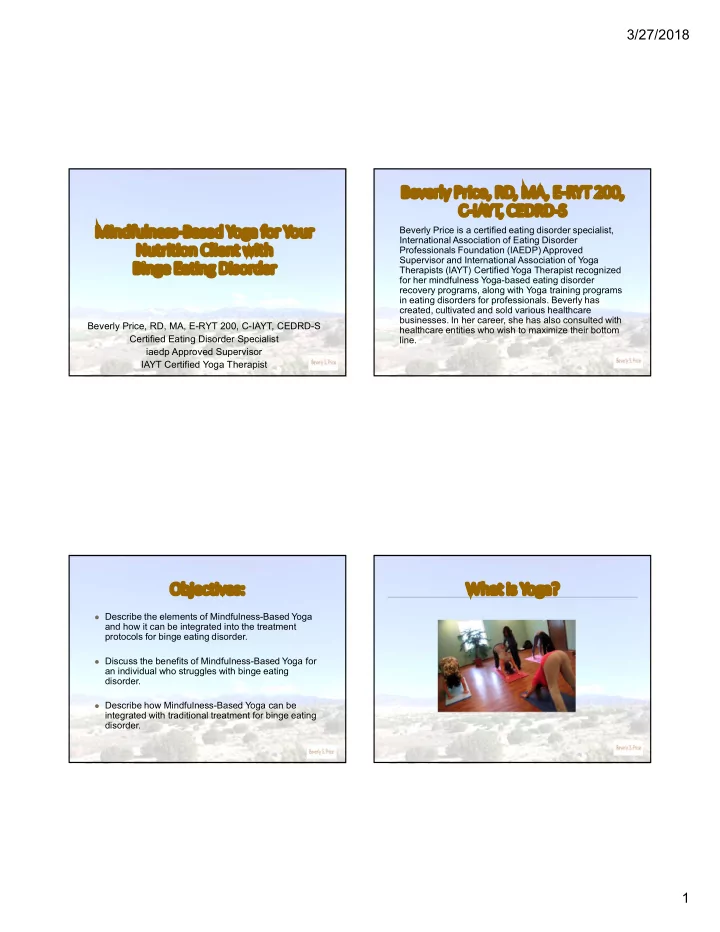
Beverly Price, RD, MA, E-RYT 200, C-IAYT, CEDRD-S Mindfulness-Based - - PDF document

beverly price rd ma e ryt 200 c iayt cedrd s mindfulness
SMART_READER_LITE
LIVE PREVIEW

Beverly Price, RD, MA, E-RYT 200, C-IAYT, CEDRD-S Mindfulness-Based - - PDF document

3/27/2018 Beverly Price, RD, MA, E-RYT 200, C-IAYT, CEDRD-S Mindfulness-Based Yoga for Your Beverly Price is a certified eating disorder specialist, International Association of Eating Disorder Nutrition Client with Professionals Foundation


slide-1
SLIDE 1

3/27/2018 1

Mindfulness-Based Yoga for Your Nutrition Client with Binge Eating Disorder

Beverly Price, RD, MA, E-RYT 200, C-IAYT, CEDRD-S Certified Eating Disorder Specialist iaedp Approved Supervisor IAYT Certified Yoga Therapist

Beverly Price, RD, MA, E-RYT 200, C-IAYT, CEDRD-S

Beverly Price is a certified eating disorder specialist, International Association of Eating Disorder Professionals Foundation (IAEDP) Approved Supervisor and International Association of Yoga Therapists (IAYT) Certified Yoga Therapist recognized for her mindfulness Yoga-based eating disorder recovery programs, along with Yoga training programs in eating disorders for professionals. Beverly has created, cultivated and sold various healthcare

  • businesses. In her career, she has also consulted with

healthcare entities who wish to maximize their bottom line.

Objectives:

 Describe the elements of Mindfulness-Based Yoga

and how it can be integrated into the treatment protocols for binge eating disorder.

 Discuss the benefits of Mindfulness-Based Yoga for

an individual who struggles with binge eating disorder.

 Describe how Mindfulness-Based Yoga can be

integrated with traditional treatment for binge eating disorder.

What is Yoga?

slide-2
SLIDE 2

3/27/2018 2

Yoga Premise of Yoga

Conversation is a barrier to intimacy…You can talk your way out of feeling…

Binge Eating Disorder and Presentation on the Yoga mat Binge Eating Disorder Presentation On the Mat

 Higher functioning  Often failed AN and/or BN  Caution when integrating with BN and AN

slide-3
SLIDE 3

3/27/2018 3

Yoga Therapy

What is Yoga Therapy?

Yoga therapy is the application of teachings and practices in a therapeutic context in order to support a consistent yoga practice that will increase self- awareness and engage the client’s energy in the direction of desired goals

Yoga Therapy Requirement

 Foundational understanding of yoga theory and

practice

 Biomedical and psychological foundations  Teaching and therapeutic skills  Yoga therapy tools and their application  Professional practice that includes

– Legal – Regulatory – Ethical issues pertaining specifically to Yoga therapy

slide-4
SLIDE 4

3/27/2018 4

Goals of Yoga Therapy

 Eliminate, reduce, or manage symptoms  Improve function  Prevent the occurrence or reoccurrence of

underlying causes of illness

 Improved health and wellbeing  Help clients change their relationship to and

identification with their condition

Who Can Provide Yoga Therapy?

 Yoga therapists are now certified through a

governing and accrediting body

 The International Association of Yoga Therapists

(IAYT), is recognized as the as the governing body for yoga therapists based on – Evidenced-based practice and peer reviewed literature – Standards of practice that differentiate between a Yoga therapist and Yoga teacher are now emerging

Yoga Therapy Assessment

Yoga Therapy Assessment

 Application of knowledge on how to synthesize

intake, evaluation, observations, and working assessment

 Development of an appropriate practice or session

strategy for individual clients with eating disorders and substance use disorder

 Formulation of group classes, taking into

consideration the individual make up and needs of the client

slide-5
SLIDE 5

3/27/2018 5

Yoga Therapy Assessment

 Assessment is similar to that of any other treatment

team member’s preliminary assessment

 Collection of information to develop a client-

centered, integrated treatment plan.

Yoga Therapy Assessment

Current healthcare information relevant to the work of a Yoga therapist treating the eating disorder and substance use disorder population

Pathologies, co-occurring disorders, drugs, surgical procedures

Evaluation of the physical, energetic, mental, emotional, and spiritual dimensions of well-being

Breath patterns

Posture and movement patterns

Yoga Therapy Treatment Plan

 Client-centered recovery plan based on the

assessment

 Implementation of the Yoga therapy treatment plan  Importance for the client to know and understand

why they are engaging in the recommended postures

Yoga Therapist Practice Setting

 Private practice  Part of a treatment team in a comprehensive setting.  In the former setting, the Yoga therapist is

encouraged to have a relationship and open communication with a multidisciplinary outpatient treatment team.

slide-6
SLIDE 6

3/27/2018 6

Yoga Therapist in Private Practice

 Behavioral assessment is crucial before starting the

day’s Yoga therapy session – Is the client following their meal plan? – Are they restricting? – Bingeing? Purging? – Are they hungover? – Did they come into the Yoga therapy session drunk or high?

Yoga Therapist in Private Practice

 Physical Assessment

– Yoga therapist as licensed medical or nursing professional trained to perform physical assessments – Yoga therapist not trained medically with concerns - having the client sit on their Yoga mat and breathe may be the extent of that day’s Yoga session, as meditation is in fact Yoga

Comprehensive Practice Setting

 Medical professional available to perform a medical

exam, with lab work, prior to the client embarking on Yoga therapy

 Medical and/or nursing professional to perform

concurrent vitals, along with a physical and behavioral assessment prior to each subsequent Yoga therapy session, in order to determine medical stability

 Processing of emotions by psychotherapist post

Yoga therapy session/MNT by registered dietitian

Registered Dietitian as Yoga Therapist

 Private practice  Yoga studio  Gyms  Groups  Workshops

All disciplines grounded in their recovery!

slide-7
SLIDE 7

3/27/2018 7

Yoga Physiology and Benefits

Yoga Physiology

 Decreased activity of sympathetic nervous system

– Decreased heart rate – Decreased blood pressure

 Decreased cortisol

– Increased bone formation and calcium absorption – Increased production of insulin/homeostasis of insulin/glucagon

 Parasympathetic -homeostasis of digestive tract

Yoga Physiology

 In recent studies, Yoga has been shown to increase

the levels of GABA in the brain by more than 20 percent.

 This is important because people dealing with

substance abuse usually exhibit low levels of GABA.

 If an activity such as Yoga can increase these

levels, even for short periods of time, then people struggling with substance abuse can more conscientiously focus on their recovery.

Yoga Physiology

 Mindful Yoga and meditation can affect the cerebral

cortex, improving focus and awareness.

 The cerebral cortex is the center of the brain that is

responsible for impulses, irrational thoughts and behaviors.

 Activating the cerebral cortex can diminish the

impulsivity along with irrational thoughts and behaviors involved in eating disorders, substance abuse and related addictions.

slide-8
SLIDE 8

3/27/2018 8

Yoga Benefits

 Yoga can help delay impulses 

Through Yoga, clients may find themselves in postures that are difficult or awkward

 Learning to stay within the poses and work through

these postures can help the client, who feels an urge binge or practice unhealthy food behaviors, delay acting on this urge

Yoga Benefits

 In our society, there is a natural tendency to want to

escape anything that causes psychological or physical discomfort

 Clients tend to escape by bingeing, working too

much, getting caught up in unhealthy relationships

  • r by drug/alcohol use

 In Yoga, individuals are encouraged to observe

rather than react to their discomfort (anxiety, depression) by breathing and listening carefully for what his/her body/mind is conveying

Yoga Benefits

 Often, clients with eating disorders and other

addictions tend to want to “run away” from uncomfortable situations and/or ambivalent about treatment

 Practicing Yoga can help maintain discipline, help

clients to feel and accept uncomfortable emotions and avoid eating and other impulsive behaviors

Yoga Benefits

 Clients begin to enjoy their body for the first time  They start to define their body in terms of “what it

can do” versus “what it is”

They learn that they are not mere extensions of their body, but possess beautiful internal qualities.

 In this way, Yoga can improve body image concerns

and self-esteem.

slide-9
SLIDE 9

3/27/2018 9

Yoga Benefits

 For many clients, part of weight homeostasis is

learning to tune in to the body's signals of hunger and satiety

 For clients with eating disorders, particularly those

who struggle with binge eating disorder, eating only when hungry and stopping when the body is satisfied will result in the body slowly return to its natural weight

Yoga Benefits

 Individuals who have attempted to control their

weight through dieting are fearful of allowing themselves to decide when and how much to eat

 Yoga can help those with weight and food issues

trust their body and understand the messages given to them by their own body

Yoga Benefits

 The physical discomfort of overeating and under

eating becomes more obvious as greater awareness learned in the regular practice of Yoga makes all sensations more apparent

 This can make it easier for clients with eating

disorders to choose to stop eating before the point

  • f physical discomfort as well as honor hunger and

nourish the body

Yoga Benefits

 Yoga also emphasizes mindfulness  Clients learn to experience the taste, texture, and

  • ther sensual qualities of food

 They also learn to begin to make thoughtful vs

impulsive choices related to eating behaviors, substance use and daily life decisions

 Mindful awareness, which emphasizes “observing”

  • vs. “reacting” to daily stresses in life also comes into

play for clients who are repulsed by food

slide-10
SLIDE 10

3/27/2018 10

Yoga Benefits

 Staying present is another important concept

learned in Yoga, whereas the mind starts to wander, clients are taught to draw their attention back to the breath

 Although many poses are uncomfortable, others are

also meant to be enjoyable, thus teaching clients how to engage into life and “let go” of whatever they are holding on to that is hindering them from untangling the hold of their addiction.

Yoga Benefits

 Clients are taught to find their physical edge

meaning working at a pace of intensity that is not too extreme where breathing is compromise

 This may be simply sitting on one’s mat and

breathing if they are nutritionally and weight compromised - but also challenging themselves and taking balanced risks

Yoga Benefits

 Clients begin to “take their Yoga off the mat” and

find their edge in everyday life

 Finding their physical edge can help peel away

layers to tapping into an emotional and spiritual edge

slide-11
SLIDE 11

3/27/2018 11

Yoga Postures and Flows for Binge Eating Disorder Limited Movement

 Gentle hatha intervention is recommended  Yin Yoga flow - seated, long holding postures using

the lower half of the body – no muscle used

 Yin Yoga may bring up extreme agitation for the

client as their work is to be still

 Emotions tend to be elicited in these postures,

where the client is unable to avoid feeling these emotions

Very Restricted and Risk Factors

 Vigorous or slower paced preferences/Chair Yoga  Identifying risk factors, based on a thorough

assessment, hypertension and type II diabetes

 If not monitored and managed, this can be a

concern in an intense Yoga plan

 For the Yoga therapist who practices in a private

setting, client self-monitoring of blood pressure and/or blood glucose is crucial with available results guiding the respective day’s Yoga postures

Clients who Overdo

 Exercise as compensatory method  Overdoing  Perfection  Resistance  Goal:

– Food intake, timing and calories – Work at appropriate pace – Focus on feeling vs. doing – Yin Yoga, Ashtanga or Slow moving Hatha Vinyasa

slide-12
SLIDE 12

3/27/2018 12

Other Concerns Affecting Movement

 Gastric implications – including gastric balloons

– Slow Hatha with modifications – Yin Yoga – Chair Yoga

Clients Physically Fit

Clients needing a faster pace Yoga can be guided through a series of poses, followed by the freedom to “flow on their own”

Clients can then add or delete poses of their choosing

Clients move at their own pace, tap into their breath and feel the movement of their bodies on a much deeper level This type

  • f free flow can also be very empowering

This style of Yoga can help clients with binge eating disorders begin to break free from the rigidity that often mirrors the history of the “diet” mentality

Binge Eating Disorder Larger Bodied

 Intuitive Eating  Instinctive Eating  Physiological/Medical Benefits

Yoga in the Community

Gym or studio can be a progression for the client who is higher functioning, weight and risk factor normalized/ managed and who is empowered to understand that not all of the postures and word choices directed by the Yoga teacher are appropriate

These clients are confident enough to take what they need from their Yoga, and not react to inappropriate word choices.

It is important for a private practitioner and/or comprehensive eating disorder treatment center that offers Yoga to understand the Yoga culture of the community.

Practicing your own Yoga at various studios in order to understand the lay of the land is necessary in order to safely advise clients where to practice Yoga in the community.

slide-13
SLIDE 13

3/27/2018 13

Yoga in the Community

 Yoga therapist accompanying client to Yoga studio

to guide them and debrief

 Comprehensive treatment field trips for clients who

had medical clearance

 Unsupervised while active in disorder is a No No

Yoga in the Community

 Feeling comfortable in the presence of a community

Yoga teacher

 Word choices congruent with someone in recovery

Yoga Adjustments

 Physical  Non-physical  Non-verbal cues/body language

Trauma Informed Yoga

Trauma informed Yoga is a specialty on its own where adjustments, placement of legs in postures along with

  • pen vs closed eyes, along with the integration with

the multidisciplinary treatment team are highly significant concerns.

slide-14
SLIDE 14

3/27/2018 14

The Therapeutic Yoga Asana Practice

Lighting

  • Dim
  • Close all curtains
  • Temperature
  • Moderate (75-80 degrees)
  • No Mirrors!

The Asana Practice

  • Theme
  • The Edge
  • Adjustments
  • Moments of Silence
  • The Breath

Client comments

“Yoga therapy was so important for my recovery. I learned so many things about myself through practice

  • everyday. The most important thing I learned from

yoga was probably that everything in life is temporary. Whether it is happiness or sadness, anger or joy, all emotions will pass and that is okay. I used to dislike happiness because I knew it wouldn't last, but now I know that it will return. I am okay to experience each and every emotion. I can use this in my recovery because I know that these emotions and stresses will pass”

In Summary

The Yoga practitioner can observe whether or not the client sinks into the postures, as a metaphor for sinking into their life,

  • r whether they hold back with tension and apprehension.

Often, attachment is the root of the tension that your client may be experiencing physically and emotionally. Yoga therapy can help move your client forward with awareness. However, it is difficult for the client to let go of something, when they don’t know what they are holding onto.

By observing and recording body language, including the resistance the client may be experiencing, the Yoga practitioner can become in tune to what is going on in the

  • moment. The Yoga therapist can then consult with the

treatment team in order to hone the team’s support in helping the client uncover what may be holding them back from participating in their own life.

slide-15
SLIDE 15

3/27/2018 15

Your client’s relationship with food parallels all relationships in their lives as well as their relationship with their Yoga mat

Research

Brewerton, TD and Brady, K. The Role of Stress, Trauma, and PTSD in the Etiology and Treatment of Eating Disorders, Addictions, and Substance Use Disorders. 2014 Jan. Eating Disorders, Addictions and Substance Use Disorders, pp.379-404.

Kanbur N1, Harrison A2, Co-occurrence of Substance Use and Eating Disorders: An Approach to the Adolescent Patient in the Context of Family Centered Care. A Literature

  • Review. 2016 Jun 6. EPub;51(7):853-60.

Lavender, JM, Green, DD, Anestis, MD, Tull, MT. Negative Affect, Negative Urgency, Thought Suppression, and Bulimic Symptoms: A Moderated Mediation Analysis in a Sample at-Risk for Bulimic Symptoms 2016 Mar. European Eating Disorders Review; 23(3).

Lavender, JM, Green, DD, Anestis, MD, Tull, MT. The interactive role of distress tolerance and eating expectancies in bulimic symptoms among substance abusers. 2014 Nov. Eating Behaviors; 16.

Munn-Chernoff, MA and Baker, JH. A Primer on the Genetics of Comorbid Eating Disorders and Substance Use Disorders 2015 Dec. European Eating Disorders Review; 24(2).

Questions?

slide-16
SLIDE 16

3/27/2018 16

Beverly S Price

 Phone – (248) 390-4150  Email – Beverly@beverlysprice.com  Website – beverlysprice.com  Facebook –BeverlySPriceRD  Twitter – BeverlySPriceRD  LinkedIn – pricebeverly  Instagram – BeverlySPriceRD  Blog – BeverlySPriceRD.blog