Best General Reviews Marik PE, Rivera R. Hypertensive emergencies: an - - PDF document

best general reviews marik pe rivera r hypertensive
SMART_READER_LITE
LIVE PREVIEW

Best General Reviews Marik PE, Rivera R. Hypertensive emergencies: an - - PDF document

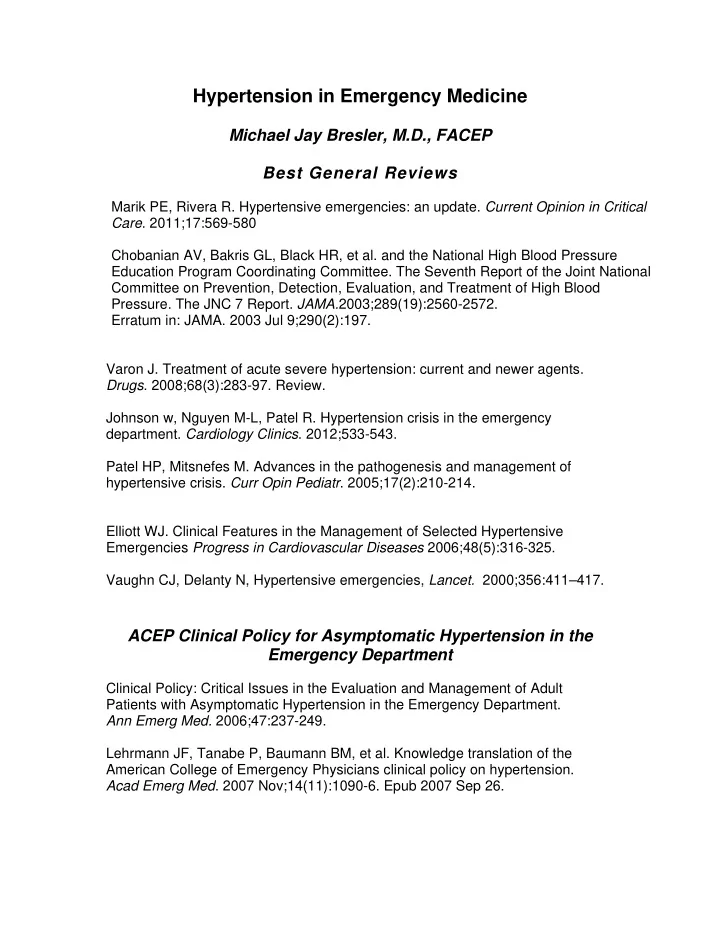
Hypertension in Emergency Medicine Michael Jay Bresler, M.D., FACEP Best General Reviews Marik PE, Rivera R. Hypertensive emergencies: an update. Current Opinion in Critical Care . 2011;17:569-580 Chobanian AV, Bakris GL, Black HR, et al. and the


slide-1
SLIDE 1

Hypertension in Emergency Medicine

Michael Jay Bresler, M.D., FACEP Best General Reviews

Marik PE, Rivera R. Hypertensive emergencies: an update. Current Opinion in Critical

  • Care. 2011;17:569-580

Chobanian AV, Bakris GL, Black HR, et al. and the National High Blood Pressure Education Program Coordinating Committee. The Seventh Report of the Joint National Committee on Prevention, Detection, Evaluation, and Treatment of High Blood

  • Pressure. The JNC 7 Report. JAMA.2003;289(19):2560-2572.

Erratum in: JAMA. 2003 Jul 9;290(2):197. Varon J. Treatment of acute severe hypertension: current and newer agents.

  • Drugs. 2008;68(3):283-97. Review.

Johnson w, Nguyen M-L, Patel R. Hypertension crisis in the emergency

  • department. Cardiology Clinics. 2012;533-543.

Patel HP, Mitsnefes M. Advances in the pathogenesis and management of hypertensive crisis. Curr Opin Pediatr. 2005;17(2):210-214. Elliott WJ. Clinical Features in the Management of Selected Hypertensive Emergencies Progress in Cardiovascular Diseases 2006;48(5):316-325. Vaughn CJ, Delanty N, Hypertensive emergencies, Lancet. 2000;356:411–417.

ACEP Clinical Policy for Asymptomatic Hypertension in the Emergency Department

Clinical Policy: Critical Issues in the Evaluation and Management of Adult Patients with Asymptomatic Hypertension in the Emergency Department. Ann Emerg Med. 2006;47:237-249. Lehrmann JF, Tanabe P, Baumann BM, et al. Knowledge translation of the American College of Emergency Physicians clinical policy on hypertension. Acad Emerg Med. 2007 Nov;14(11):1090-6. Epub 2007 Sep 26.

slide-2
SLIDE 2

Hypertension in Emergency Medicine Michael Jay Bresler, M.D. SUGGESTED LITERATURE Page 2

Epidemiology

Lee M, Saver JL, Chang B, et al. Presence of baseline prehypertension and risk

  • f incident stroke: a meta-analysis. Neurology. 2011;77(14):1330-1337.

Baumann BM, Abate NL, Cowan RM, Boudreaux ED. Differing prevalence estimates of elevated blood pressure in ED patients using 4 methods of categorization. Am J Emerg Med. 2008 Jun;26(5):561-5. Tanabe P, Persell SD, Adams JG, et al. Increased blood pressure in the emergency department: pain, anxiety, or undiagnosed hypertension? Ann Emerg Med. 2008;51:221-229. Cline DM, Selvin V, Ferrario CM, et al. Emergency department versus clinic follow-up blood pressures. Acad Emerg Med 2006; 13:S188. Vasan RS, Beiser A, Seshadri S, et al. Residual lifetime risk for developing hypertension in middle-aged women and men: The Framingham Heart Study.

  • JAMA. 2002;287:1003-1010.

Lewington S, Clarke R, Qizilbash N, et al. Age-specific relevance of usual blood pressure to vascular mortality. Lancet. 2002;360:1903-1913.

Cushman WE, Ford CE Cutler JA, et al. Success and predictors of blood pressure control in diverse North American settings: The Antihypertensive and Lipid-Lowering Treatment to Prevent Heart Attack Trial (ALLHAT). J Clin Hypertens. 2002;4:393-404. Staessen JA, Gasowski J, Wang JG, et al. Risks of untreated and treated isolated systolic hypertension in the elderly: Meta-analysis of outcome trials.

  • Lancet. 2000;355:865-872.

Wang Y, Wang QJ, The prevalence of prehypertension and hypertension among US adults according to the new Joint National Committee guidelines, Arch Intern

  • Med. 2004;164:2126–2134.

Vasan RS, Larson MG, Leip EP, , et al. Impact of high-normal blood pressure on the risk of cardiovascular disease. N Engl J Med. 2001; 345: 1291–1297.

slide-3
SLIDE 3

Hypertension in Emergency Medicine Michael Jay Bresler, M.D. SUGGESTED LITERATURE Page 3

Pathophysiology (Also discussed in reviews above)

Beevers G, Lip GY, O'Brien E. The pathophysiology of hypertension,

  • BMJ. 2001;322:912–916.

Bautista LE. Inflammation, endothelial dysfunction, and the risk of high blood pressure: epidemiologic and biological evidence. J Hum Hypertens. 2003 Apr;17(4):223-230. Ault MJ, Ellrodt AG. Pathophysiologic events leading to the end organ effects of acute hypertension, Am J Emerg Med. 1985;3:10–15. Strandgaard S, Paulson OP. Cerebral autoregulation, Stroke. 1984;709:413–416. Okada M, Matsumori A, Ono K, et al., Cyclic stretch upregulates production of interleukin-8 and monocyte chemotactic and activating factor/monocyte chemoattractant protein-1 in human endothelial cells, Arterioscler Thromb Vasc

  • Biol. 1998;18:894–901.

Verhaar MC, Beutler JJ, Gaillard CA, et al., Progressive vascular damage in hypertension is associated with increased levels of circulating P-selectin, J Hypertens. 1998;16:45–50.

Specific Treatment Modalities

Abstracts of the American Society of Hypertension 23rd Annual Scientific

  • Meeting. May 14-17, 2008. New Orleans, Louisiana, USA.

J Clin Hypertens. 2008 May;10(5 Suppl A):A1-169. Moser M, Oparil S, Cushman W, Papademetriou V. The ALLHAT study revisited: do newer data from this trial and others indicate changes in treatment guidelines? J Clin Hypertens. 2007 May;9(5):372-80. Kowaluk EA, Seth P, Fung HL. Metabolic activation of sodium nitroprusside to nitric oxide in vascular smooth muscle. J Pharmacol Exp Ther. 1992 Sep;262(3):916-22. Kowaluk EA, Fung HL. Vascular nitric oxide-generating activities for organic nitrites and organic nitrates are distinct. J Pharmacol Exp Ther. 1991 Nov;259(2):519-25.

slide-4
SLIDE 4

Hypertension in Emergency Medicine Michael Jay Bresler, M.D. SUGGESTED LITERATURE Page 4 Agvald P, Adding LC, Artlich A, et al. Mechanisms of nitric oxide generation from nitroglycerin and endogenous sources during hypoxia in vivo. Br J Pharmacol. 2002 Jan;135(2):373-82. Morgenstern LB, Hemphill JC, 3rd, Anderson C, et al. Guidelines for the management of spontaneous intracerebral hemorrhage: a guideline for healthcare professionals from the American Heart Association/American Stroke

  • Association. Stroke 2010;41:2108-29.

Adams HP, Jr., del Zoppo G, Alberts MJ, et al. Guidelines for the early management of adults with ischemic stroke: a guideline from the American Heart Association/American Stroke Association Stroke Council, Clinical Cardiology Council, Cardiovascular Radiology and Intervention Council, and the Atherosclerotic Peripheral Vascular Disease and Quality of Care Outcomes in Research Interdisciplinary Working Groups: The American Academy of Neurology affirms the value of this guideline as an educational tool for

  • neurologists. Circulation 2007;115:e478-534.

Arima H, Anderson CS, Wang JG, et al. Lower treatment blood pressure is associated with greatest reduction in hematoma growth after acute intracerebral

  • hemorrhage. Hypertension 2010;56:852-8.

Anderson CS, Huang Y, Arima H, et al. Effects of early intensive blood pressure lowering treatment on the growth of hematoma and perihematomal edema in acute intracerebral hemorrhage: the Intensive Blood Pressure Reduction in Acute Cerebral Haemorrhage Trial (INTERACT). Stroke 2010;41:307-12. Flanigan JS, Vitberg D. Hypertensive emergency and severe hypertension: what to treat, who to treat, and how to treat. Med Clin North Am. 2006 May;90(3):439-

  • 51. Review.

Davis BR, Piller LB, Cutler JA. Role of diuretics in the prevention of heart failure: the antihypertensive and lipid-lowering treatment to prevent heart attack trial.

  • Circulation. 2006;113:2201-2210.

Bender SR, Fong MW, Heitz S, Bisognano JD. Characteristics and management of patients presenting to the emergency department with hypertensive urgency. J Clin Hypertens (Greenwich). 2006 Jan;8(1):12-8. Fenves AZ, Ram CV. Drug treatment of hypertensive urgencies and

  • emergencies. Semin Nephrol. 2005 Jul;25(4):272-80.
slide-5
SLIDE 5

Hypertension in Emergency Medicine Michael Jay Bresler, M.D. SUGGESTED LITERATURE Page 5 Varon J. Diagnosis and management of labile blood pressure during acute cerebrovascular accidents and other hypertensive crises. Am J Emerg Med. 2007 Oct;25(8):949-59. Review. Pollack CV, Varon J, Garrison NA, Ebrahimi R, Dunbar L, Peacock WF 4th. Clevidipine, an intravenous dihydropyridine calcium channel blocker, is safe and effective for the treatment of patients with acute severe hypertension. Ann Emerg

  • Med. 2009 Mar;53(3):329-38.

Deeks ED, Keating GM, Keam SJ. Clevidipine: a review of its use in the management of acute hypertension. Am J Cardiovasc Drugs. 2009;9(2):117-34. Aronson S, Dyke CM, Stierer KA, Levy JH, Cheung AT, Lumb PD, Kereiakes DJ, Newman MF. The ECLIPSE trials: comparative studies of clevidipine to nitroglycerin, sodium nitroprusside, and nicardipine for acute hypertension treatment in cardiac surgery patients. Anesth Analg. 2008 Oct;107(4):1110-21 Musini VM, Fortin PM, Bassett K, Wright JM. Blood pressure lowering efficacy of renin inhibitors for primary hypertension. Cochrane Database Syst Rev. 2008 Oct 8;(4):CD007066 Düsing R, Sellers F. ACE inhibitors, angiotensin receptor blockers and direct renin inhibitors in combination: a review of their role after the ONTARGET trial. Curr Med Res Opin. 2009 Jul 28. [Epub ahead of print] Tumlin JA, Dunbar LM, Oparil S, et al., Fenoldopam, a dopamine agonist, for hypertensive emergency: A multicenter randomized trial. Fenoldopam Study Group, Acad. Emerg. Med. 2000;7:653–662. Shusterman NH, Elliott WH, White WB. Fenoldopam, but not nitroprusside, improves renal function in severely hypertensive patients with normal or impaired baseline renal function, Am. J. Med. 1993;95:161–168. Panacek EA, Bednarczyk EM, Dunbar LM, et al. Fenoldopam Study Group. Randomized, prospective trial of fenoldopam vs. sodium nitroprusside in the treatment of acute severe hypertension. Acad Emerg Med. 1995;2:959-965. White WB, Halley SE. Comparative renal effects of intravenous administration of fenoldopam myselate and sodium nitroprusside in patients with severe hypertension. Arch Intern Med. 1989;149:870-874. Elliott WJ, Weber RR, Nelson KS, et al. Renal and hemodynamic effects of intravenous fenoldopam versus nitroprusside in severe hypertension. Circulation. 1990;81:970-977.

slide-6
SLIDE 6

Hypertension in Emergency Medicine Michael Jay Bresler, M.D. SUGGESTED LITERATURE Page 6 Elliott WJ. Management of hypertension emergencies. Curr Hypertens Rep. 2003 Dec;5(6):486-92. Review. Elliott WJ. Hypertensive emergencies. Crit Care Clin 2001:17:435-451. Reisin E, Huth MM, Nguyen BP, et al. Intravenous fenoldopam versus sodium nitroprusside in patients with severe hypertension. Hypertension. 1990;15 (2 suppl):159-162. Post JB, Frishman WH: Fenoldopam: A new dopamine agonist for the treatment

  • f hypertensive urgencies and emergencies. J Clin Pharmacol. 1998;38:2.

Oparil S, et al. Fenoldopam: A new parenteral antihypertensive: Consensus roundtable on the management of perioperative hypertension and hypertensive crisis. Am J Hypertens. 1999. 12:653. Devlin JW, Seta ML, Kanji, et al. Fenoldopam versus nitroprusside for the treatment of hypertensive emergency. Ann Pharmacother. 2004;38:755-759. Murphy MB, Murray C, Shorten GD. Fenoldopam: a selective peripheral domapine-receptor agonist for the treatment of severe hypertension. N Engl J Med 2001;345:1548-1557. Olsen KS, Svendsen LB, Larsen FS, et al. Effect of labetalol on cerebral blood flow, oxygen metabolism and autoregulation in health humans. Br J Anaesth. 1995;75:51-54. Vincent JL, Berlot G, Preiser JC, et al., Intravenous nicardipine in the treatment

  • f postoperative arterial hypertension, J. Cardiothorac. Vasc. Anesth.

1997;11:160–164. Wallin JD, Fletcher E, Ram CVS, et al., Intravenous nicardipine for the treatment

  • f severe hypertension, Arch. Intern. Med.1989;149: 2662–2669.

Wallin JD. Intravenous nicardipine hydrochloride: Treatment of patients with severe hypertension. Am Heart J. 1990;119 (2 pt 2):434-437. Neutel JM, Smith DH, Wallin D, et al. A comparison of intravenous nicardipine and sodium nitroprusside in the immediate treatment of severe hypertension. Am J Hypertens 1994;7:623-628. Yang HJ, Kim JG, Ryoo E. et al. Nicardipine versus nitroprusside infusion as antihypertensive therapy in hypertensive emergencies. J Int Med Res. 2004;32(2):118-123.

slide-7
SLIDE 7

Hypertension in Emergency Medicine Michael Jay Bresler, M.D. SUGGESTED LITERATURE Page 7 Savvidou MD, Hingorani AD, Tsikas D, et al. Endothelial dysfunction and raised plasma concentrations of asymmetric dimethylarginine in pregnant women who subsequently develop pre-eclampsia. Lancet. 2003;361:1511-1517. Adams RE, Powers WJ. Management of hypertension in acute intracerebral

  • hemorrhage. Crit Care Clin. 1997. 13:131.

Vidaeff AC, Carroll MA, Ramin SM.. Acute hypertensive emergencies in

  • pregnancy. Crit Care Med. 2005;33(10 Suppl):S307-12. Review.

Cailleux A, Subra JF, Riberi P, et al. Cyanide and thiocyanate blood levels in patients with renal failure or respiratory disease. J Med. 1988;19(5-6):345-51. Bakris GL, Kaplan NM, Forman JP. Management of severe asymptomatic hyptertension (hyptertensive urgencies). UpToDate. October 2012;Topic 3830. Version 8.0 Bahadur, MM, Aggarwal VD, Mali M, et al. Novel therapeutic option in hypertensive crisis: sildenafil augments nitroprusside-induced hypotension. Nephrol Dial Transplant. 2005;20:1254-1256.

Outpatient Therapy

Toh S, Reichman ME, Houstoun M, et al. Comparative risk for angioedema associated with the use of drugs that target the Renin-Angiotensin-aldosterone

  • system. Arch Intern Med. 2012 Nov 12;172(20):1582-9.

Cross-Reactivity of ACE Inhibitor–Induced Angioedema with ARBs www.uspharmacist.com/content/c/10394/?t=women's_health... Feb 20, 2007 Law MR, Morris JK, Wald NJ. Use of blood pressure lowering drugs in the prevention of cardiovascular disease: meta-analysis of 147 randomised trials in the context of expectations from prospective epidemiological studies. BMJ. 2009 May19;338:b1665 Wald DS, Law M, Morris JK, Bestwick JP, Wald NJ. Combination therapy versus monotherapy in reducing blood pressure: meta-analysis on 11,000 participants from 42 trials. Am J Med. 2009 Mar;122(3):290-300. Frank J. Managing hypertension using combination therapy. Am Fam Physician. 2008 May 1;77(9):1279-86.

slide-8
SLIDE 8

Hypertension in Emergency Medicine Michael Jay Bresler, M.D. SUGGESTED LITERATURE Page 8 Aliskiren/Valsartan (Valturna) for Hypertension. The Medical Letter. Nov 30, 2009;51(1326):94-95. Moser M, Cushman WC, Kaplan NM. Control of blood pressure: does it matter which agent you use? J Clin Hypertens . 2007 Dec;9(12):964-73. Neutel JM, Sica DA, Franklin SS. Hypertension control: still not there-how to select the right add-on therapy to reach goal blood pressures. J Clin Hypertens. 2007 Nov;9(11):889-96. The ALLHAT Officers and Coordinators for the ALLHAT Collaborative Research Group: The major outcomes in high risk hypertensive patients randomized to angiotensin-converting enzyme inhibitor or calcium channel blocker vs. diuretic. The Antihypertensive and Lipid-Lowering Treatment to Prevent Heart Attack Trial (ALLHAT). JAMA. 2002;288:2981-2997. Blood Pressure Lowering Treatment Trialists’ Collaboration: Effects of ACE inhibitors, calcium antagonists, and other blood-pressure-lowering drugs: results

  • f prospectively designed overviews of randomized trials.
  • Lancet. 2000;356:1955-1964.

Julius S, et al. The Valsartan Antihypertensive Long-Tem Use Evaluation Trial.

  • Lancet. 2004;363:2022.

Cook NR, Cutler JA, Obarzanek E, et al. Long term effects of dietary sodium reduction on cardiovascular disease outcome: observational follow-up of the Trials of Hypertension Prevention (TOHP) BMJ. 2007;334(7599):885-888. Cutler JA, Roccela A. Salt reduction for preventing hypertension and cardiovascular disease. Hypertension. 2006;48(5):818-819. Wing LM, Reid CM, Ryan P, et al. for the Second Australian National Blood Pressure Study. A comparison of outcomes with angiotensin-converting-enzyme inhibitors and diuretics for hypertension in the elderly. N Engl J Med. 2003;348:583-592.