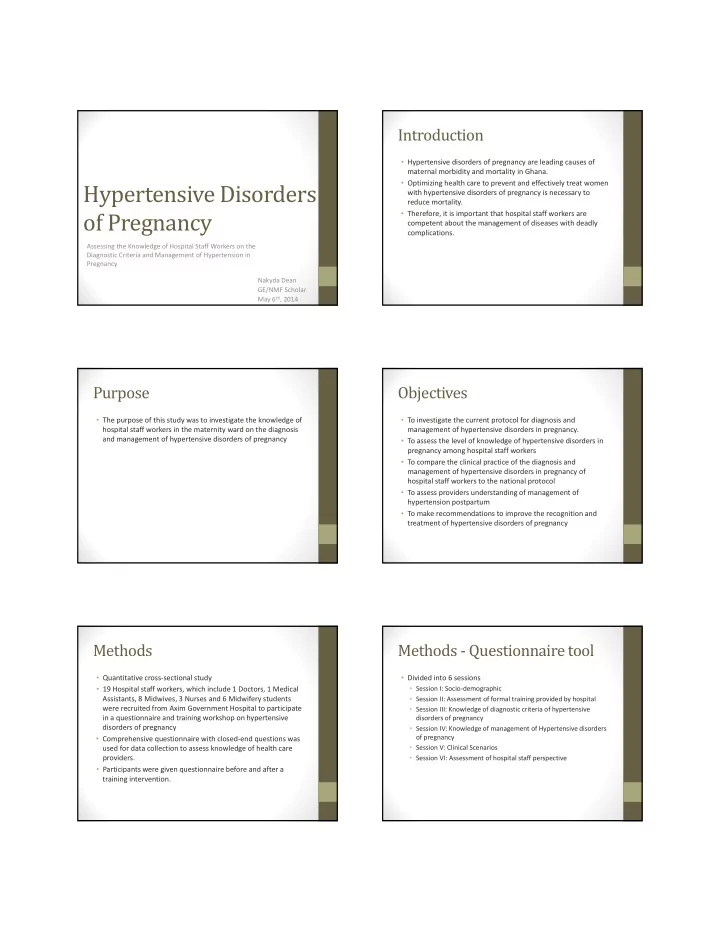
Hypertensive Disorders Optimizing health care to prevent and - - PDF document

hypertensive disorders
SMART_READER_LITE
LIVE PREVIEW

Hypertensive Disorders Optimizing health care to prevent and - - PDF document

Introduction Hypertensive disorders of pregnancy are leading causes of maternal morbidity and mortality in Ghana. Hypertensive Disorders Optimizing health care to prevent and effectively treat women with hypertensive disorders of pregnancy


slide-1
SLIDE 1

Hypertensive Disorders

  • f Pregnancy

Assessing the Knowledge of Hospital Staff Workers on the Diagnostic Criteria and Management of Hypertension in Pregnancy Nakyda Dean GE/NMF Scholar May 6th, 2014

Introduction

  • Hypertensive disorders of pregnancy are leading causes of

maternal morbidity and mortality in Ghana.

  • Optimizing health care to prevent and effectively treat women

with hypertensive disorders of pregnancy is necessary to reduce mortality.

  • Therefore, it is important that hospital staff workers are

competent about the management of diseases with deadly complications.

Purpose

  • The purpose of this study was to investigate the knowledge of

hospital staff workers in the maternity ward on the diagnosis and management of hypertensive disorders of pregnancy

Objectives

  • To investigate the current protocol for diagnosis and

management of hypertensive disorders in pregnancy.

  • To assess the level of knowledge of hypertensive disorders in

pregnancy among hospital staff workers

  • To compare the clinical practice of the diagnosis and

management of hypertensive disorders in pregnancy of hospital staff workers to the national protocol

  • To assess providers understanding of management of

hypertension postpartum

  • To make recommendations to improve the recognition and

treatment of hypertensive disorders of pregnancy

Methods

  • Quantitative cross‐sectional study
  • 19 Hospital staff workers, which include 1 Doctors, 1 Medical

Assistants, 8 Midwives, 3 Nurses and 6 Midwifery students were recruited from Axim Government Hospital to participate in a questionnaire and training workshop on hypertensive disorders of pregnancy

  • Comprehensive questionnaire with closed‐end questions was

used for data collection to assess knowledge of health care providers.

  • Participants were given questionnaire before and after a

training intervention.

Methods ‐ Questionnaire tool

  • Divided into 6 sessions
  • Session I: Socio‐demographic
  • Session II: Assessment of formal training provided by hospital
  • Session III: Knowledge of diagnostic criteria of hypertensive

disorders of pregnancy

  • Session IV: Knowledge of management of Hypertensive disorders
  • f pregnancy
  • Session V: Clinical Scenarios
  • Session VI: Assessment of hospital staff perspective
slide-2
SLIDE 2

Methods

  • The Intervention
  • 30 minute training lecture addressing the updated national

protocol on the diagnosis and management of hypertensive spectrum of disease in pregnancy

  • Content covered
  • Spectrum of hypertensive disorder of pregnancy
  • Diagnosis criteria
  • Assessment of disease
  • Appropriate management supported by Standard Treatment Guide.

Results ‐ Demographics Results ‐

  • Averages from Pre and Post intervention

Results

  • Assessing knowledge of diagnostic criteria of hypertensive

disorders of pregnancy

TOTAL STRATIFIED topic Pre Post Pre Post Gestation Age 71.43% 85.71% 71.43% 85.71% Postpartum 14.29% 14.29% 14.29% 28.57% Systolic BP 42.86% 71.43% 57.14% 71.43% Diastolic BP 57.14% 71.43% 42.86% 71.43% Proteinuria 28.57% 57.14% 57.14% 57.14% Symptoms 42.86% 42.86% 42.86% 57.14%

Results ‐

  • Diagnosing Hypertensive Disorders of Pregnancy from

Clinical Scenarios

0.00% 10.00% 20.00% 30.00% 40.00% 50.00% 60.00% 70.00% 80.00% 90.00% 100.00% PIH GH MPE SPE E PPE CH TOTAL Pre TOTAL Post STRATIFIED Pre STRATIFIED Post

slide-3
SLIDE 3

Analysis/Discussion

  • The intervention showed improvement in knowledge
  • In comparison to the general group, the stratified group,

participant who participated in both the pretest and post‐test, showed the highest acquisition of knowledge, assessed by the questionnaires

  • In general the Average score was highest among those who

participated in the intervention lecture.

  • Of the six variables used to define hypertensive disorders of

pregnancy, Systolic and Diastolic BP showed the biggest improve pre and post intervention.

Results

  • Impaired knowledge
  • Participant seem to have limited understanding of Postpartum
  • diagnosis. After intervention only 15‐30% responded to question

correctly

  • Participants selected answer choices leading to over medicating

patients for hypertension

  • Based on results, understanding of less emergent disorders like

Transient HTN, Gestational HTN, and Mild Pre‐Eclampsia is still limited

Chart Review

  • Quantitative Chart review of Diagnosis and Management of

Hypertensive Disorders from Jan 2014 – April 2014.

  • Rough Analysis
  • Inconsistency in diagnosis of patient among record books
  • Inappropriate management of patient
  • Over medicating hypertensive patient
  • Postpartum Eclampsia
  • Not following current guidelines for management of patient with

hypertensive disorder in pregnancy

Limitations

  • Many participant in the pre‐test group were lost to follow‐up.

Therefore, the sample size that participated in both the pre‐ test and post‐test was small

  • The delivery of the intervention
  • Timing
  • Equipment

Conclusion

  • What Axim is doing well
  • Emergency packs for hypertensive emergency available
  • Continuous communication between midwives and Doctors/PAs

with difficult cases

  • Support education of midwives
  • Training sessions can increase the knowledge of hospital staff

workers on the diagnosis and management of hypertensive disorders of pregnancy.

  • The knowledge gained can improve the outcome of

hypertensive obstetrics emergencies and decrease maternal morbidity and mortality

  • It’s important to stay up to date with national guideline

Recommendations

  • The Maternity Ward are currently use Ghana National SM

guideline of 2007 for management of hypertensive disorder of pregnancy

  • Therefore recommend incorporating up to date information from

the Standard Treatment Guide of Ghana from 2010

  • Provide Continue Workshops/Lectures to educate staff

workers

  • Encourage midwives to invest in the knowledge and teaching
  • f midwifery students and nurses
  • Assigned senior midwife in charged of education
  • Improvement of data capture