Outline Vertebroplasty and Kyphoplasty: Vertebral fracture - - PowerPoint PPT Presentation

outline vertebroplasty and kyphoplasty
SMART_READER_LITE
LIVE PREVIEW

Outline Vertebroplasty and Kyphoplasty: Vertebral fracture - - PowerPoint PPT Presentation

Outline Vertebroplasty and Kyphoplasty: Vertebral fracture epidemiology, consequences and diagnosis Who, What, and When Kyphoplasty and vertebroplasty: what are they and how are they done? Douglas C. Bauer, MD Outcomes University


slide-1
SLIDE 1

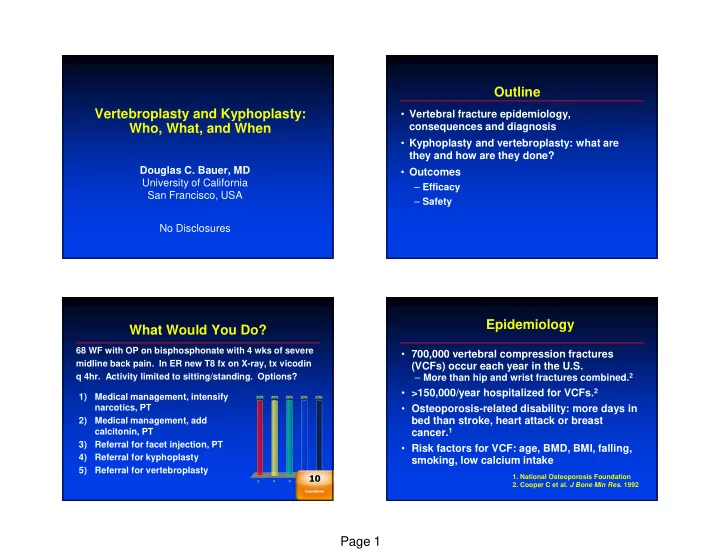
Page 1 Vertebroplasty and Kyphoplasty: Who, What, and When

Douglas C. Bauer, MD University of California San Francisco, USA No Disclosures

Outline

  • Vertebral fracture epidemiology,

consequences and diagnosis

  • Kyphoplasty and vertebroplasty: what are

they and how are they done?

  • Outcomes

– Efficacy – Safety

What Would You Do?

68 WF with OP on bisphosphonate with 4 wks of severe midline back pain. In ER new T8 fx on X-ray, tx vicodin q 4hr. Activity limited to sitting/standing. Options?

1) 2) 3) 4) 5)

20% 20% 20% 20% 20%

1) Medical management, intensify narcotics, PT 2) Medical management, add calcitonin, PT 3) Referral for facet injection, PT 4) Referral for kyphoplasty 5) Referral for vertebroplasty

Countdown

10

Epidemiology

  • 700,000 vertebral compression fractures

(VCFs) occur each year in the U.S.

– More than hip and wrist fractures combined.2

  • >150,000/year hospitalized for VCFs.2
  • Osteoporosis-related disability: more days in

bed than stroke, heart attack or breast cancer.1

  • Risk factors for VCF: age, BMD, BMI, falling,

smoking, low calcium intake

  • 1. National Osteoporosis Foundation
  • 2. Cooper C et al. J Bone Min Res. 1992
slide-2
SLIDE 2

Page 2 Consequences: Future Fracture Risk

  • VCF increases risk of

subsequent vertebral fracture: – 5-fold after first VCF – 12-fold after 2 or more VCFs

  • Vertebral fracture is a strong

indication for preventive therapy (i.e. anti-resorptive or anabolic)

Ross et al. Annals of Internal Med 1991

Pain and Decreased Quality of Life

  • Pain typically lasts 2-12 weeks
  • Physical and functional performance lower

in patients with vertebral fracture 1,2 – Restricted ADL – Sleep disturbances

  • Psychosocial consequences3

– anxiety, depression, low self-esteem, and alteration in social role

  • Long-term outcomes poorly studied
  • 1. Lyles et al. (1993) Am J Med 94: 595-601
  • 2. Silverman SL (1992) Bone 13, S27-S31
  • 3. Gold DT (1996) Bone 3: S185-S189

Mortality

  • Study of Osteoporotic Fractures: Women ≥ 65

years (n=9,407) with or without vertebral fracture

  • Prospective follow-up, cause-specific mortality
  • Conclusions

– Women with prevalent vertebral fracture had a 23% higher age-adjusted mortality rate – VCF patients are two to three times more likely to die of pulmonary causes – Most common cause of death was pulmonary disease, i.e., COPD and pneumonia

Kado DM et al. Arch Intern Med. 1999

Identifying Vertebral Fractures

  • Approximately two thirds of all vertebral

fractures go undiagnosed, in part due to difficulty determining cause of symptoms.

  • Vertebral fractures may be asymptomatic.
  • Pain ranges from mild to severe and may

be chronic, but typically resolves over 2-12 weeks

slide-3
SLIDE 3

Page 3 Radiologic Assessment

  • Lateral spine X-ray examination is the

standard test

  • Differentiation between back pain from

vertebral compression fracture and disk disease or osteoarthritis often difficult

–Correlate radiographic findings with exam

  • STIR sequence MR can be useful to determine

cause and/or acuity of plain radiograph abnormality

8 weeks post fracture First week post fracture

Courtesy of B. Boszczyk & R. Bierschnieder, BG Unfallklinik

MRI: T2 Image

Radiologic Assessment Vertebral Fractures: Three Types

Wedge Biconcave Crush

  • Wedge fractures are most common

Genant HK et al. J Bone Miner Res. 1993;8:1137–1148.

Outline

  • Vertebral fracture epidemiology,

consequences and diagnosis

  • Kyphoplasty and vertebroplasty: what are

they and how are they done?

  • Outcomes

– Efficacy – Safety

slide-4
SLIDE 4

Page 4 What Your Patients See and Hear: Kyphoplasty vs. Vertebroplasty

  • Vertebroplasty uses cement only (no balloon), no

attempt to increase vertebral height

  • Both minimally invasive

– Bilateral, 1cm incisions

  • Typically one hour per treated fracture
  • General or local anesthesia

– Most are performed under general anesthesia – Can be performed under local anesthesia, often supplemented with conscious sedation

  • Seldom require an overnight hospital stay

Outline

  • Vertebral fracture epidemiology and

diagnosis

  • Kyphoplasty and vertebroplasty: what are

they and how are they done?

  • Outcomes

– Efficacy – Safety

Kyphoplasty and Vertebroplasty Literature

  • Uncontrolled studies or historical controls
  • Case-series
  • Registries (Kyphon)
  • Randomized controlled trials
slide-5
SLIDE 5

Page 5 Summary of Non-randomized Studies

  • Beneficial effects observed on

– Vertebral body height and angular deformity – Pain – Quality of life – Ambulatory status – Physical function

  • Asymptomatic cement extravasation common
  • Safe and well tolerated, but…

Risk of Subsequent Fracture

  • Concern that rigid cement alters biomechanics: case

reports of new adjacent fractures after procedure

  • Mudano et al (2009)

– Retrospective cohort from large health plan – 45 patients underwent vertebroplasty or kyphoplasty and 164 underwent conservative treatment – Adjustment for age, gender, history of osteoporosis and comorbidities – Risk of recurrent vertebral fracture higher among surgically treated after 90 d (OR=6.8) and 1 yr (OR=2.9) – Too small to analyze adjacent fractures

Mudano, et al. (2009) Osteoporosis Int 20;819-826

Mortality Benefit?

  • Medicare claims data 2005-08

– Compared to non-surgical treatment, risk of mortality reduced 24% with vertebroplasty and 44% with kyphoplasty – Adjusted for age, health status, comorbity

  • Medical claims data 2008-11

– Traditional adjusted analysis: vertebral augmentation reduced mortality 17% – With propensity scores: no difference

Edidin et al, JBMR 2011 McCullough et al, Jama Internal Med 2013

What About Randomized Trials?

  • Early NIH trial with sham-therapy abandoned
  • First successful multi-centered randomized

trial funded by Kyphon (FREE) – Up to 3 acute VF (< 3 months old) – Confirmed by x-ray and MR – Randomized to balloon kyphoplasty (n=149) vs. usual non-surgical care (n=151) – Outcomes: pain, QOL, function and new VF after 3 and 12 months (24 mo just reported)

Wardlaw et al, Lancet 2009 Boonen et al, JBMR 2011

slide-6
SLIDE 6

Page 6 FREE Demographics

  • Subjects

– 72 years old, 77% female – 96% primary osteoporosis

  • Previous exposures

– 17% steroids – 33% bisphosphonates

  • Duration of symptoms

– 6 weeks on average

  • Fracture location

– 22% T5-T9 – 62% T10-L2 – 16% L3-L5

FREE Results: Back Pain (0 to 10 Visual Analogue Scale)

1 2 3 4 5 6 7 8 9 10 2 4 6 8 10 12 Follow-up (months) Score

BKP NSM

FREE Results: Days of Limited Activity in the Previous 2 Weeks

2 4 6 8 10 12 14 3 6 9 12 Follow-up (months) Days

BKP NSM

Kyphoplasty group had, on average, 60 fewer days

  • f limited activity during the 12 months

At 12 months, 60 fewer days of limited activity in kyphoplasty group

FREE Resutls: Physical Component Summary (SF36)

10 20 30 40

3 6 9 12

Follow-up (months) Score

BKP NSM

At 12 months, no difference in physical function

slide-7
SLIDE 7

Page 7 FREE Results: Narcotic Use

68 64 34 74 46 28 20 40 60 80 Baseline 1 month 12 month

Percent

Nonsurgical Kyphoplasty p=0.46 p=0.008

FREE Complications

  • Similar number of CV events, infections and

deaths

  • Cement extravasation in 27% (asymptomatic)
  • Subsequent VF: 33% with kyphoplasty and

25% with non-surgical therapy (p=0.22)

FREE 24 Month Results

  • Persistent benefit at 24 mo

– VAS back pain score: 2.6 vs. 3.8 (p=0.01)

  • No benefit at 24 mo

– Activity limitation, physical function, narcotic use

  • Two serious kyphoplasty events: spondylitis

and anterior cement migration

  • New vertebral fractures: 48% vs. 41% (p=0.68)

Boonen et al, JBMR, 2011

Vertebroplasty

  • Vs. Sham Procedure Trials
  • Two similar trials (N=131 and N=71)

– Up to 2 or 3 acute VF (< 12 months old) – Confirmed by x-ray and/or MR – Randomized to vertebroplasty vs. sham procedure – Outcomes: pain, QOL, physical function, medication use after 3 or 6 months

Buchbinder et al, NEJM 2009 Kallmes et al, NEJM 2009

slide-8
SLIDE 8

Page 8 Vertebroplasty vs. Sham: Back Pain

Buchbinder et al, NEJM 2009

Vertebroplasty vs. Sham: QOL

Buchbinder et al, NEJM 2009

Vertebroplasty Vs. Sham: Pain

Kallmes et al, NEJM 2009

Vertebroplasty Vs. Sham: SF-36

Kallmes et al, NEJM 2009

slide-9
SLIDE 9

Page 9 Vertebroplasty vs. Usual Care Trial: VERTOS II

  • Randomized open label European trial
  • Eligible if new VF (<6 wks, confirmed by MR)

and VAS score>5

  • 934 screened to randomize 202

– 229 improved before randomization

  • VAS lower in vertebroplasty arm at 1 mo (-5.2
  • vs. -2.7) and 1 yr. (-5.7 vs. -3.7)
  • Less narcotic use in surgical arm

Klazen et al, Lancet, 9746:1085, 2010

Discordant Trials?

  • Duration of symptoms?

– Sham RCTs: results similar if duration <6wks

  • Sham vs. usual non-surgical care?

– Prolonged placebo effect plausible. Likely?

  • Benefit from anesthetic/steroid injection?

– Case series found pain reduction in 34%

  • Kyphoplasty vs. vertebroplasty?

– Trials ongoing

Staples et al, BMJ, 2011 Wilson et al, Eur Radiol, 2011

Summary

  • Vertebral fractures associated with significant

disability and high risk of subsequent fractures

– Should be aggressively treated with effective anti- resorptive (or anabolic) therapy

  • Kyphoplasty and vertebroplasty associated with

reduced pain and disability in non-randomized studies

– Serious complications rare, but do occur

  • Single unblinded kyphoplasty trial found reductions in

pain and disability, less apparent after 12 and 24 mo.

  • Two smaller but blinded sham-controlled

vertebroplasty trials found no benefit

Conclusions

  • Effect on subsequent fracture rates unknown,

preliminary data reassuring

  • Kyphoplasty, but not vertebroplasty, may be

useful to reduce pain and disability

– Consider after failure of 6-12 weeks non- surgical therapy – Need additional trials before widespread use

  • Unanswered issues: optimal patient selection,

prevention of kyphosis, long-term outcomes

slide-10
SLIDE 10

Page 10 Questions and Comments Welcome!