SLIDE 1 Best Battery Practices For FRC Teams
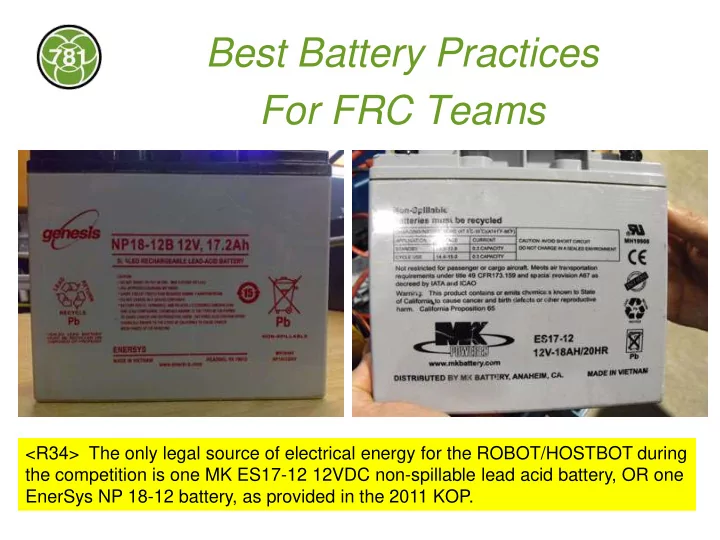
<R34> The only legal source of electrical energy for the ROBOT/HOSTBOT during the competition is one MK ES17-12 12VDC non-spillable lead acid battery, OR one EnerSys NP 18-12 battery, as provided in the 2011 KOP.
SLIDE 2
Current
SLIDE 3
Voltage
SLIDE 4
Resistance
SLIDE 5 VRLA Batteries
(sealed)
motive battery
discharge
SLIDE 6 Chemistry
Volts 2.1 O 2H 2PbSO 2HSO 2H PbO Pb
O 2H PbSO 2e 3H HSO PBO cathode 2e H PbSO HSO Pb anode SO 2H SO H e electrolyt
2 4 4 2 2 4 4 2 4 4 4 4 2
SLIDE 7 Inside the Battery
Discharge in any position, charge UPRIGHT
SLIDE 8
PbO2 Cathode, Pb Anode
SLIDE 9
Matted Glass Fiber Separators
SLIDE 10
Valves
SLIDE 11
Each Battery is Unique
SLIDE 12
Know your batteries!
SLIDE 13
Specifications
SLIDE 14 Nominal Capacity
Genesis NP18-12B
- Q = 17.2 A-hr
- 20 hour rate
- i = 0.86 A to 10.5V
MK ES17-12
- Q = 18 A-hr
- 20 hour rate
- i = 0.9 A to 10.5V
Q = i (Amps) x Time (hours)
SLIDE 15
Capacity is not linear
SLIDE 16
How many Amps does the robot use?
SLIDE 17 Estimate current > Calculate time
Load Minimum (A) Maximum (A) Estimate (A) 2 each CIM motors 2 x 2.7 2 x 40 2 x10 = 20 compressor 10 2 arm motor 0.82 108.7 20 signal light 1.1 2.2 2 radio 1.0 2.5A 2.5 TOTAL 8.2 203.9 46
Nominal Capacity @ 46A ~ 6.3 Ahr (MK Battery)
SLIDE 18
SLIDE 19 Test
Battery Starting Voltage Ending Voltage On-load Voltage Time (min) comments Brady ? ? ? 18 Time not accurate Tron 12.96 11.78 11.45 36 Mostly standby Gwen 13.25 12.98 12.65 27 Mostly standby David 12.95 12.67 12.32 23 Half driving, half playing, swapped out early Silly-D 12.92 11.90 11.54 31 Half driving, half playing 29 average
Average current must be less!
i = Q/t = 8.1 Ahr x 60 min/hr / 29 min = 17 A
SLIDE 20
Time per match?
SLIDE 21
How much Q is used in a match?
Battery capacity required for a match? Qmatch = Qplaying + Qwaiting = (2.25 min * 17 A) + (4.55 * 8 A) = 74.65 A-min How many matches is a battery good for? matches = Q / Qmatch = 8.1 Ahr x 60min/hr x 486 A-min / 74.65 A-min = 6 matches
SLIDE 22 How many batteries do we need?
IF no batteries are recharged, how many batteries are required?
- 18 matches / 6 matches/battery = 3 batteries
Not confident – Add a Safety Factor! 3 batteries x 2 = 6 batteries
SLIDE 23
How long will a battery stay charged?
SLIDE 24
Cold Battery Capacity?
Store > -15C
SLIDE 25
How long to warm up a cold battery? Store > -15C
SLIDE 26 Open Circuit Voltage Does NOT Indicate State of Charge
10 11 12 13 14 20 40 60 80 100 OPEN CIRCUIT VOLTAGE (V) REMAINING CAPACITY (%)
OPEN CIRCUIT VOLTAGE VS REMAINING CAPACITY
SLIDE 27 Driver Station On-Load Voltage
<R61> A National Instruments 9201 module must be installed in slot 1 of the cRIO-FRC. An analog breakout must be connected to this module. A jumper must be installed in the “Power” position (two outer pins) on the analog breakout. The analog breakout must be powered from the PD Panel. These connections enable monitoring of the battery charge by the team and the Field Management System. This is a required element of the ROBOT configuration.
SLIDE 28 Chargers
<R41> An automatic battery charger rated for a maximum of 6 amperes must be used to charge the supplied batteries. When recharging the KOP batteries, either the charger provided by FIRST or an automatic charger with an equivalent charging current rating may be used.
SLIDE 29 Charging
Genesis NP18-12B
- 14.4 to 15.0 V
- 4.3 A maximum
MK ES17-12
- 14.4 to 15.0 V
- 5.4 A maximum
SLIDE 30 Chargers charge differently!
- Constant voltage (older)
- Constant current (newer)
- Combination (“smart”)
Read the manual!
SLIDE 31 Constant Current
i = 4 Amps Q = 17.1 Ahrs Q = i * t t = Q / i = 17.1 / 4 = 4.275 hours
SLIDE 32 Constant Voltage
Q = 17.1 Ahrs Q = i * t t = Q / i = 17.1 / 6 = 2.85 hours NOT!
SLIDE 33
SLIDE 34 “Smart” Chargers
- Desulphation < 0.5 hours
- Constant current 3.3 A
Q = 17.1 Ahrs Q = i * t t = Q / i = 17.1 / 3.3 = 5.2 hours
= ? Hours = observed < 2 hours
SLIDE 35
Can we shorten the time by charging 2 batteries in parallel?
No! Need to charge twice the capacity: 2 x Q = 2 x 17.2 A-hr = 34.2 A-hr Charge at a constant current t = Q / A t = 34.2 A-hr / 4.0 A = 8.5 hours WARNING If the batteries are not identical, the battery currents will not be the same
SLIDE 36
Internal Resistance Changes with Age
Genesis NP18-12B 10 mΩ MK ES17-12 11 mΩ
Team 781 observes 3mΩ (new) to 7mΩ (old)
SLIDE 37
Good Battery Charged too long
t = Q / i Battery G i1 = 2.8 A t = 17.1 / 2.8 = 6.1 hr Battery A i2 = 1.2 A t = 17.1 / 1.2 = 14.3 hr Unequal current when charging new and aged batteries in parallel
SLIDE 38
DON’T DO IT!
SLIDE 39 Make a Plan – Work the Plan
- Sequence of using your batteries
- Number of matches per battery
- Sufficient time to charge
- Method of tracking battery state of charge
SLIDE 40 Mechanical Safety
- Lift with knees
- Hold close to your body
- Minimize grip lifts
- Don’t drop it!
SLIDE 41 <R16> When positioned on the ROBOT, the primary battery must be secured so that it will not dislodge should the ROBOT be turned over or placed in any arbitrary
<R37>
- G. The 120-amp circuit breaker must be quickly accessible from the exterior of the
ROBOT.
SLIDE 42 Electrical Safety
- Never short the terminals
- Insulate the terminals
- Install the Anderson
connectors and use the battery plugs
breaker
– Before charging – Before discharging
SLIDE 43
SLIDE 44
SLIDE 45 <R37>
- C. The battery terminals and the connecting lugs must be insulated with shrink
tubing and/or electrical tape.
SLIDE 46
SLIDE 47
SLIDE 48
SLIDE 49
SLIDE 50 <R37>
- A. The battery must be connected to the ROBOT power system through the use of the Anderson Power Products (APP)
connector.
- B. The APP connector must be attached to the battery with either the copper lugs provided in the KOP or appropriately-rated
and sized lug connectors.
- D. The main 120-amp circuit breaker must be directly connected to the hot (+) leg of the ROBOT-side APP connector. Only
- ne 120-amp main circuit breaker is allowed. This breaker must not be bypassed.
- E. The PD Board must be directly connected to the APP connector and main 120-amp circuit breaker. No other loads may be
connected to the main 120-amp circuit breaker.
- F. Each primary power connection between the battery and PD Board must be made with #6 AWG (4.11mm) red and black
wire or larger.
SLIDE 51 <R37>
- A. The battery must be connected to the ROBOT power system through the use of the Anderson Power Products (APP) connector.
- B. The APP connector must be attached to the battery with either the copper lugs provided in the KOP or appropriately-rated and
sized lug connectors.
- D. The main 120-amp circuit breaker must be directly connected to the hot (+) leg of the ROBOT-side APP connector. Only one
120-amp main circuit breaker is allowed. This breaker must not be bypassed.
- E. The PD Board must be directly connected to the APP connector and main 120-amp circuit breaker. No other loads may be
connected to the main 120-amp circuit breaker.
- F. Each primary power connection between the battery and PD Board must be made with #6 AWG (4.11mm) red and black wire or
larger.
SLIDE 52
Chemical Safety
SLIDE 53
Be Prepared
SLIDE 54 How do you know your battery is sick?
- Charger indicates it’s sulphated.
- Charger indicates it’s charged too soon.
- Charger takes a long time to charge.
- The case is distorted.
- The battery is unusually hot.
- The open-circuit voltage is unusually low or
high.
- The on-load voltage is unusually low.
SLIDE 55
- High self-discharge
- Wouldn’t charge 2A
- Too fast charge 4A
SLIDE 56
Distortion, Heat Damage
SLIDE 57
Distortion, Corrosion
SLIDE 58
Sulphated Plates
SLIDE 59 More Sulphate
MICHELLE’S RULE Recharge your batteries as soon as possible after use.
SLIDE 60
When will your battery die?
Genesis NP18-12B
100% discharge 250 cycles 50% 550 cycles 30% 1200 cycles 3 to 5 years
MK ES17-12
100% discharge 200 cycles 80% 225 cycles 50% 500 cycles 3 to 5 years
SLIDE 61 Disposal
– Only twice a year; plan for it – Volunteer
SLIDE 62 Best Battery Practices
- Follow the rules
- Assign someone to know the batteries
- Keep a battery log
- Don’t leave batteries in a discharged state
- Don’t charge batteries in parallel
- Develop a plan to use/charge batteries at
competition
- Don’t keep sick batteries; dispose of them properly