
SLIDE 1
Benefits, Myths & Misconceptions of Resistance Training for the Female Population
Presented By:
- Dr. Rori Alter-Petrizzo, PT
, DPT
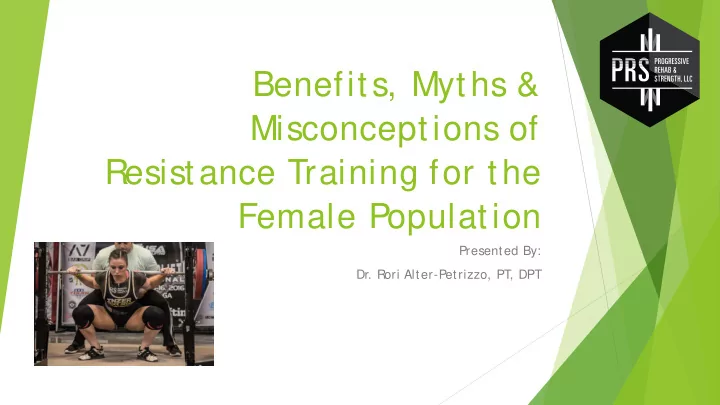
Benefits, Myths & Misconceptions of Resistance Training for the - - PowerPoint PPT Presentation
Benefits, Myths & Misconceptions of Resistance Training for the Female Population Presented By: Dr. Rori Alter-Petrizzo, PT , DPT Resistance Training defined: A type of exercise that involves moving the body segments (individually
Presented By:
, DPT
A type of exercise that involves moving the body segments (individually
For the general population the intended goals of resistance training are usually to:
Improve muscular st rengt h and size
Improves resting metabolic rate
Improved abilit y t o lose fat
Reduces susceptibility to osteopenia/osteoporosis
Reduces risk of sarcopenia with age
Reduces risk of falls
Improves hormone production
Reduces fatigue
The number of calories your body would burn if
Fat free mass (muscles, bones, organs, etc.) is
A 9 month study conducted on 61 healthy adults examining the effects of resistance training and various protein supplementation on RMR concluded that irrespective of protein supplementation, RMR was significantly improved 5% (on average) in all test groups
What does this mean for fat loss?
You are burning more calories even at rest!
Sarcopenia can lead to:
Loss of funct ional independence Increased risk for falls, fract ures, and hospit alizat ions
Increased risk of deat h
What’s the best cure? Prevention!
Resistance training has been shown to significantly slow or even halt the progression of sarcopenia as we age
“ In cont rast t o aerobic exercise t raining, resist ance exercise t raining appears t o have a larger effect on augment ing muscle mass and st rengt h and at t enuat es t he development
“ The maj orit y of st udies have shown t hat resist ance exercise t raining must be carried
Burt on &S umukadas, Opt imal Management of S
2010; 5:217-228.
Resistance training has a direct effect on the prevention and reduction of
In August 2016 the Sports Medicine Journal published an overview of systematic reviews and meta-analyses covering the effects of exercise on bone mineral density in young females through post-menopausal women and concluded that:
“ Combined-impact exercise protocols (impact exercise with resistance training) are
the best choice to preserve/improve bone mineral density in pre- and postmenopausal women. Peak bone mass in young girls can be improved with short bouts of school-based high-impact plyometric exercise programs.”
Resist ance exercise is more import ant t he older you get !
More on Resistance Training:
“in contrast to traditional pharmacological and
Killing two birds with one stone!
To build muscle and bone the system needs to be stressed to a level at which it is not accustomed to
Stress Adaptation
For muscles, bones, and connect ive t issues!
Over time you must do more to drive continued adaptation:
More reps More load More set s
“ Walking, running, body weight exercises and activities of daily living count as resistance training, right? ” “ Pilates, Y
training, right? ”
None of these have the ability to be progressively overloaded over time.
When walking and running, our j oints, bones and muscles are not worked through their full range of motion
Goal oriented resistance training has 3 important traits that these forms of exercise generally do not
Goal Oriented Resistance Training for Health & Longevity is:
1.
Quant ifiable
2.
Planned
3.
Progressive
It takes a lot of work and a long time to put on enough muscle to look like Arnold!
A 2016 study published in the Journal of Sports Medicine & Physical Fitness studied the effects of a 12 week resistance training program versus a control group on strength and body composition. All subjects maintained their normal diet during the 12 week study
The st udy’s result s suggest t hat resist ance t raining improves muscle st rengt h
wit hout alt ering body composit ion in older women under diet ary int ake maint enance
Women do not have as much testosterone as men!
Journal of Physical Activity and Health: Resistance Training during Pregnancy and Perinatal Outcomes
Reduces risk for hypertensive disorders and gestational diabetes compared to
pregnant women who do not perform resistance training
NO DIFFERENCE in risk of preterm labor, mode of delivery or gestational age at
delivery based on exercise status!!!!
Two other studies that support resistance training is safe for the baby:
British Journal Of Sports Medicine (2008): Does exercise training during
pregnancy affect gestational age? Randomized control trial
International Journal of Obesity (2009) Resistance exercise training during
pregnancy and newborn's birth size: a randomized controlled trial
Journal of Early Human Development (2016): Benefits of aerobic or resistance training during pregnancy on maternal health and perinatal outcomes: A systematic review.
Helps reduce fatigue and feelings of low energy:
“ … act ue, low-t o-moderat e int ensit y muscle st rengt hening exercise during pregnancy is effect ive for t ransient ly improving feelings of energy and fat igue.”
Helps maintain meternal health:
“ The exercise modalit y t hat seems t o induce a more favorable effect on mat ernal healt h is t he combinat ion of aerobic and resist ance exercises during pregnancy.”
What the ladies say:
Ret ains muscle mass t hroughout pregancy improving abilit y t o regain “ pre-pregancy body.”
Resist ance t raining t hrough pregancy helps wit h vaginal delivery
Use available resources!
American College of S ports Medicine Guidelines
Minimum of 2 x per week Non-consecut ive days Train all t he maj or muscle groups Don’t be afraid t o work hard!
On Campus
Adelphi Adult Fitness Program Campus Recreation