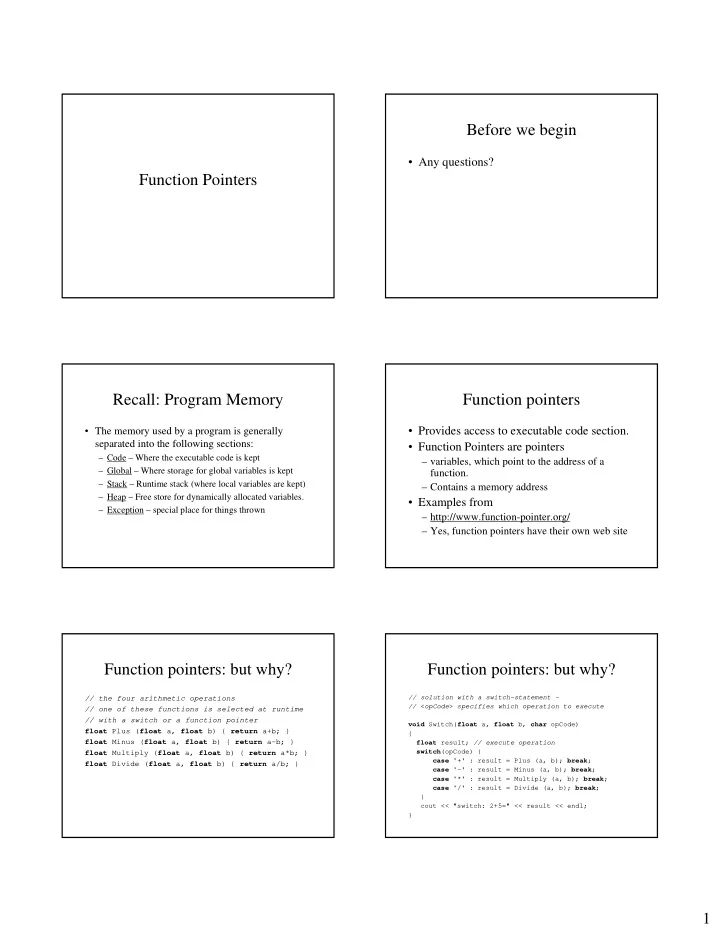
Before we begin Any questions? Function Pointers Recall: Program - - PDF document

before we begin
SMART_READER_LITE
LIVE PREVIEW

Before we begin Any questions? Function Pointers Recall: Program - - PDF document

Before we begin Any questions? Function Pointers Recall: Program Memory Function pointers The memory used by a program is generally Provides access to executable code section. separated into the following sections: Function


slide-1
SLIDE 1

1

Function Pointers Before we begin

  • Any questions?

Recall: Program Memory

  • The memory used by a program is generally

separated into the following sections:

– Code – Where the executable code is kept – Global – Where storage for global variables is kept – Stack – Runtime stack (where local variables are kept) – Heap – Free store for dynamically allocated variables. – Exception – special place for things thrown

Function pointers

  • Provides access to executable code section.
  • Function Pointers are pointers

– variables, which point to the address of a function. – Contains a memory address

  • Examples from

– http://www.function-pointer.org/ – Yes, function pointers have their own web site

Function pointers: but why?

// the four arithmetic operations // one of these functions is selected at runtime // with a switch or a function pointer float Plus (float a, float b) { return a+b; } float Minus (float a, float b) { return a-b; } float Multiply (float a, float b) { return a*b; } float Divide (float a, float b) { return a/b; }

Function pointers: but why?

// solution with a switch-statement – // <opCode> specifies which operation to execute void Switch(float a, float b, char opCode) { float result; // execute operation switch(opCode) { case '+' : result = Plus (a, b); break; case '-' : result = Minus (a, b); break; case '*' : result = Multiply (a, b); break; case '/' : result = Divide (a, b); break; } cout << "switch: 2+5=" << result << endl; }

slide-2
SLIDE 2

2

Using function pointers

// solution with a function pointer // <pt2Func> is a function pointer and points to // a function which takes two floats and returns a // float. Thefunction pointer // "specifies" which operation shall be executed. void Switch_With_Function_Pointer(float a, float b, float (*pt2Func)(float, float)) { // call using function pointer float result = pt2Func(a, b); cout << result << endl; }

Using function pointers

// execute example code void Replace_A_Switch() { // '+' specifies function 'Plus' to be executed Switch(2, 5, '+'); //pointer to function 'Minus Switch_With_Function_Pointer(2, 5, &Minus); }

Using function pointers

  • Important note:

– A function pointer always points to a function with a specific signature! – all functions, you want to use with the same function pointer, must have the same parameters and return-type!

  • Questions so far?

Function pointer syntax

  • int (*pt2Function) (float, char, char) ;

Name of variable holding the memory address of a function Return type Argument types

Function pointer syntax

  • int (*pt2Function) (float, char, char) ;

– Defines a pointer variable pt2Function – The function that this pointer is pointing to takes a float and 2 chars as arguments – The function that this pointer is pointing to will return an int.

Function pointer syntax

  • Note:

– int (*pt2Function) (float, char, char) ;

  • Is not the same as

– int *pt2Function (float, char, char) ;

slide-3
SLIDE 3

3

Function pointer syntax

  • Note:

– int (*pt2Function) (float, char, char) ;

  • Defines a function pointer variable

– int *pt2Function (float, char, char) ;

  • Defines a function that returns a pointer to an int.

Function pointer syntax

  • Assigning to a function pointer:

int DoIt (float a, char b, char c) { printf("DoIt\n"); return a+b+c; } int DoMore(float a, char b, char c) { printf("DoMore\n"); return a-b+c; } int (*pt2Function) (float, char, char) ; pt2Function = DoMore; // assignment pt2Function = &DoIt; // alternative

Must have same arguments and return type!

Function pointer syntax

  • Calling a Function using a Function

Pointer

– Can call directly or dereference

int result1 = pt2Function (12, 'a', 'b'); int result2 = (*pt2Function) (12, 'a', 'b');

Function pointer syntax

  • Can also assign to member functions.

class TMyClass { public: int DoIt (float a, char b, char c){ return a+b+c; }; int DoMore(float a, char b, char c){return a-b+c; }; /* more of TMyClass */ };

int (TMyClass:: *pt2Function) (float, char, char) ; pt2Function = TMyClass::DoMore; // assignment pt2Function = &TMyClass::DoIt; // alternative

Function pointer syntax

  • Can also assign to member functions

int (TMyClass:: *pt2Function) (float, char, char) ; pt2Function = TMyClass::DoMore; // assignment TMyClass A = new TMyClass(); A->pt2Function (7.7, ‘a’,’b’); // direct call A->(* pt2Function)(7.7, ‘a’,’b’); // dereference

Function pointer syntax

  • Once again, return type and args must match:

void (*pf)(string); void f1 (string); int f2 (string); void f3 (int *); void f() { pf = &f1; // okay pf = &f2; // bad return type pf = &f3; // bad arg type pf (“Foo”); // okay pf (1); // bad arg type int i = pf (“Zero”); // bad return type; }

slide-4
SLIDE 4

4

Function pointer syntax

  • Passing function pointer to a function

// <pt2Func> is a pointer to a function which returns an int and takes a float and two char void PassPtr(int (*pt2Func)(float, char, char)) { // call using function pointer float result = pt2Func(12, 'a', 'b'); } // execute example code - 'DoIt' is a suitable function void Pass_A_Function_Pointer() { PassPtr(&DoIt); }

Function pointer syntax

  • Returning a function pointer

// function takes a char and returns a pointer to a // function which is taking two // floats and returns a float. // <opCode> specifies which function to return float (*GetPtr1(const char opCode))(float, float) { if(opCode == '+') return &Plus; if(opCode == '-') return &Minus; }

Function pointer syntax

  • float (*GetPtr1(const char opCode))(float,

float)

Actual function name Indicates pointer to a function is returned Type returned by function pointed to Args of function pointed to

Function pointer syntax

  • Returning a function pointer
  • Use typedef to avoid that crazy syntax

typedef float(*pt2Func)(float, float); pt2Func GetPtr2(const char opCode) { if(opCode == '+') return &Plus; if(opCode == '-') return &Minus; }

Arrays of function pointers

  • Since function pointers are just pointers, you can

easily have arrays of them

typedef int (*pt2Function)(float, char, char); / void Array_Of_Function_Pointers() { pt2Function funcArr[10]; funcArr[0] = &DoIt; funcArr[1] = &DoMore; printf("%d\n", funcArr[1](12, 'a', 'b')); printf("%d\n", funcArr[0](12, 'a', 'b')); }

Arrays of function pointers

  • But why?

– Let’s assume we have a menu system for a GUI. – Each menu item will correspond to an action. – Can use array of function pointers rather than a large switch or if/then statements.

slide-5
SLIDE 5

5

Arrays of function pointers

typedef void (*MenuF)(); MenuF edit_ops[] = { &cut, &copy, &paste, &find }; MenuF file_ops[] = { &open, &new, &close, &save }; MenuF *button2 = edit_ops; MenuF *button3 = file_ops; // When selection is made Button2[2]();

Questions?

Callbacks

  • Function Pointers provide the concept of

callback functions.

  • Example

typedef void (*terminate_handler)(); terminate_handler set_terminate(terminate_handler);

Callbacks

  • Consider qsort:

void qsort( void* field, size_t nElements, size_t sizeOfAnElement, int(_USERENTRY *cmpFunc)(const void*, const void*) );

Callback that defines compare function

Callbacks

void qsort( ... , int(_USERENTRY *cmpFunc)(const void*, const void*)) { /* sort algorithm - note: item1 and item2 are void- pointers */ int bigger=cmpFunc(item1, item2); // make callback /* use the result */ }

Callbacks

  • Of course, if we want to do generic

programming, why not use STL?

The function object

  • Or functor

– Object that mimics a pointer to a function. – Overrides the call operator (operator()).

class cmpFunct { public: cmpFunct() {} int operator() (int a, int b) { return a < b; } } cmpFunct f; int result = f (7, 10);

slide-6
SLIDE 6

6

The function object

  • The signature of the function object is

dependent on the args/return type of the

  • perator() that is overridden

class cmpFunct { public: cmpFunct() {} int operator() (int a, int b) { return a < b; } }

The function object

  • Interesting means to have multiple definitions.

class cmpFunct { public: cmpFunct() {} int operator() (int a, int b) { return a < b; } int operator() (double a, double b) { return a < b; } } cmpFunct f; int result = f (7, 10); // okay int result2 = f (5.6, 8.9); // also okay

The function object

  • Must still follow the rule that signatures

cannot differ by return type alone.

class cmpFunct { public: cmpFunct() {} int operator() (int a, int b) { return a < b; } double operator() (int a, int b) { // } // not ok int operator() (double a, double b) { return a < b; } }

Generic programming

  • We all know that the “correct” way of doing

generic programming in C++ is to use STL algorithms:

template <class RandomAccessIterator, class Compare> void sort (RandomAccessIterator first, RandomAccessIterator last, Compare comp); vector<int> v1; cmpFunct f; sort (v1.begin(), v1.end(), f)

Templated functors

  • Of course, function objects can be templated

template <class T> class cmpFunct { public: cmpFunct() {} int operator() (T a, T b) { return a < b; } } cmpFunct<int> f; int result = f (7, 10); // okay

Templated functors

  • Can use on classes as well!

– As long as operator< is defined for Foo

template <class T> class cmpFunct { public: cmpFunct() {} int operator() (T a, T b) { return a < b; } } cmpFunct<Foo> f; int result = f (Foo(7), Foo(10)); // okay

slide-7
SLIDE 7

7

Functors and state

  • Because functors are objects, they can

contain state and additional methods

template <class T> class Sum { private: T res; public: Sum (T i=0) : res (i) {} void operator() (T x) { res += x; } T result const { return res; } };

Fine as long as T can be initialized by 0

Fine as long as += Is defined for T

Functors and state

  • What you can do with this:

void f (list<double> ld) { Sum<double> s; for_each (ld.begin(), ld.end(), s); cout << “The sum is “ << s.result() << endl; }

Functors and algorithms

  • Generally, algorithms do not care if a

“function argument” is a

– Function – Pointer to a function – Functor

Functors and algorithms

int compareFunction (int a, int b) { return a < b; } vector<int> v1; cmpFunct f; sort (v1.begin(), v1.end(), f); // is okay sort (v1.begin(), v1.end(), &compareFunction); // is

  • kay

sort (v1.begin(), v1.end(), compareFunction); // is

  • kay

Questions?

Functors

  • Questions?