
SLIDE 1
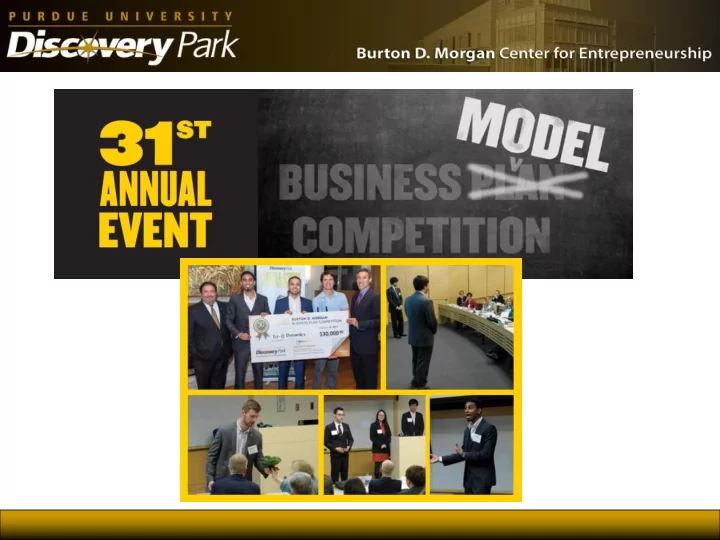
Be sure you have signed-in Team registration is open - - PowerPoint PPT Presentation
Be sure you have signed-in Team registration is open http://www.purdue.edu/dp/bdmce/ Questions can be emailed to bmc@purdue.edu Competition Statistics 31 st year One of the oldest competitions in the US Purdue: 1987
2016 2015 2015 2014 2013
Black: Undergrad Gold: Grad
Open/Big Idea Small Business Social Entrepreneurship
Concepts that have a very large potential market (both monetarily & geographically). Likely would involve need for external funding and longer timelines. 1st Prize: $ 25,000 2nd Prize: $ 15,000 3rd Prize: $ 5,000 Finalist: $ 2,500
Ideas primarily focusing on addressing socioeconomic needs & challenges. May be within developing countries or underserved populations. 1st Prize: $ 15,000 2nd Prize: $ 10,000 3rd Prize: $ 5,000 Finalist: $ 2,500
Business that will target a smaller geographic region. May have a slower, methodical growth rate and be an incremental innovation to existing practice. 1st Prize: $ 15,000 2nd Prize: $ 10,000 3rd Prize: $ 5,000 Finalist: $ 2,500
Exec Summary Business Plan Finals Pitch
Business Model Development Preliminary Competition Entrepreneurial Expo (Finals) monthly workshops mentors Oral Presentation Keynote Speakers Finalist Pitches Short Video Trade Show Booth Networking Events
Financial Projections Product Development Plans Marketing & Sales Activities
“The difference between a static business plan and a dynamic business
model could well be the difference between a flameout and success
The Startup Owner’s Manual
“How a company creates value for itself while delivering products or services for customers.”
‘The Startup Owner’s Manual’ (Steve Blank)
“A business model describes the rationale of how an organization creates, delivers, and captures value.”
‘Business Model Generation’ (Alexander Osterwalder & Yves Pigneur)
Business Model + Customer Discovery Business Plan Focused on identifying Product-Market fit initially (“Is the idea needed?”) Focused on market sizing, financial projections & organizational strategy Emphasis on testing via customer insights and input Less focused on validation from potential customers Embraces the concept of ‘guessing’ (hypothesis) and adjusting as needed Technical, detailed and focused on how to capture & realize opportunity
“New ventures of all kinds are attempting to improve their chances
failing fast and continually learning.” “A business plan is essentially a research exercise written in isolation at a desk before an entrepreneur has even begun to build a product.”
Lean Startup & Business Model Development perspective (May 2013) Findings about business plan importance (July 2017)
BOTH are important, but the order of the activities matters
“Writing a plan is unlikely to be best for all entrepreneurs. But if an entrepreneur wants to raise money and grow quickly, eventually they’ll want to write a plan.” “Plans support the process of turning an entrepreneur’s vision into tangible actions by promoting the organization and direction of startup activities.”
Previous Approach New Format
“New Ideas”
Proceed to “Business Plan” creation
Business Plan Documents “New Ideas”
Business Model Development & Validation
Un-validated Business Model Test, Validate, Adjust
September 25th: Team Registration Deadline October 4th: Business Model Canvas Seminar, Market Analysis & Customer Discovery Workshop November 8th: Entrepreneurial Finance Presentation January 17th: Communicating the Concept & Presentation workshop & Video January 31st : Preliminary Competition Finalists selected
Start
Timeline & Schedule
February 7th: Pitch and Trade show Booth Workshop Week of Feb 12th: Practice presentations and critique sessions Feb 22nd and 23rd: Entreprenueiral Expo Keynote speakers Trade show Finals pitch Networking Events
Timeline & Schedule
Business Hypothesis (20%):
interviews to validate (or invalidate) this hypothesis? Testing Approach & Customer Discovery (40%):
needs, preferences and buying approaches. Results & Findings (30%):
from potential customers and individuals interviewed throughout the customer discovery interviews?
product / service? Overall Market & Opportunity (10%):
market growth & overall opportunity?
students, during the Fall Semester of the Competition.
venture (if company has been formed)
Business Plan Competitions cannot re-enter with the same product or service
Ask us if you are not sure