Welcome to the Festival of Learning Step 1 Make sure that your PC - - PowerPoint PPT Presentation

welcome to the festival of learning
SMART_READER_LITE
LIVE PREVIEW

Welcome to the Festival of Learning Step 1 Make sure that your PC - - PowerPoint PPT Presentation

Welcome to the Festival of Learning Step 1 Make sure that your PC Make sure that your headphones are plugged in. volume control isnt on Step 2 mute. Make sure that your If you want to chat online or have a microphone isnt on mute


slide-1
SLIDE 1

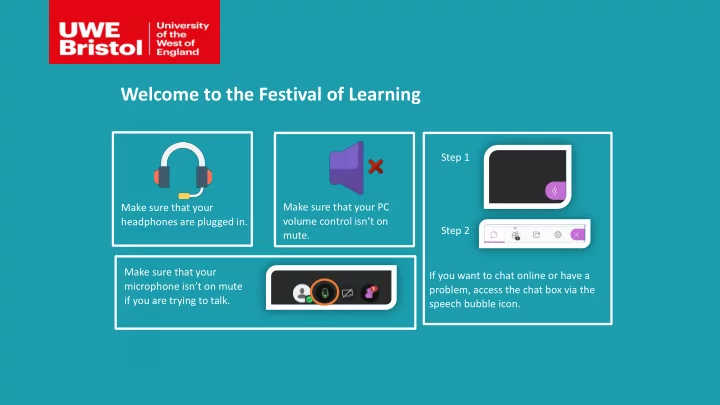
Welcome to the Festival of Learning

Make sure that your headphones are plugged in. Make sure that your PC volume control isn’t on mute. If you want to chat online or have a problem, access the chat box via the speech bubble icon. Step 1 Step 2 Make sure that your microphone isn’t on mute if you are trying to talk.

slide-2
SLIDE 2

Please close your emails If you have a headset with a microphone please also make sure that the microphone is

  • n mute or we will hear all the noise in your
  • ffice.

If you can’t see what is happening on screen you can zoom in using the magnifying glass icon

slide-3
SLIDE 3

This session will be recorded!

This includes the comments panel.

slide-4
SLIDE 4

What does decolonising the curriculum mean?

Myra Evans

Faculty Academic Director for Inclusive and Practice Oriented Curriculum

Dr Shawn Sobers

Associate Professor of Cultural Interdisciplinary Practice Date, June 19, 2020

Original illustration by Angus Maguire

slide-5
SLIDE 5

Th The c context

The attainment gap between white and black students qualifying with a 1st or 2:1 degree between 2016/17 was 24% (Advance HE, 2018)

At UWE Bristol the attainment gap between white and black students is 31.6% (OFS data, 16/17)

Black graduates’ unemployment rate is over two times higher than white

  • graduates. (Equity, 2019)

52% of Black graduates go on to undertake low skilled employment after

  • University. (Equity, 2019)

Race pay gap after GCSEs is 11% , after university it is 23% . (Equity, 2019)

slide-6
SLIDE 6

And a at UW UWE B Bristol?

  • l?

UWE Bristol 17% of students are UK BAME. (Equity, 2019)

22% of the population of Bristol is BAME (Bristol City Council, 2020)

In Bristol, there are now at least 45 religions, at least 187 countries of birth represented and at least 91 main languages spoken by people living in Bristol. (Bristol City Council, 2020)

slide-7
SLIDE 7

Original illustration by Angus Maguire

slide-8
SLIDE 8

Dr Dr Shawn S Sobers

Associate Professor, Dept of Film & Journalism

slide-9
SLIDE 9

Dec ecolo lonis isin ing in P Practice

slide-10
SLIDE 10

What at i is decolon lonisation ion in a university ty c context? t?

“You may have recently read false news reports that SOAS students have called for the removal of white philosophers such as Plato and Kant from their reading lists. It bears repeating that these reports are untrue – they are calling for a greater representation of non-European thinkers, as well as better historical awareness of the contexts in which scholarly knowledge has been produced. This is part of a wider student campaign to ‘decolonise the university’, which includes discussions around the curriculum and teaching, support and outcomes for BME students, terms and conditions for campus workers and

  • ther aspects of university life.”

Meera, ‘Decolonising the Curriculum: What’s all the fuss about?’ SOAS Blog, 2017

slide-11
SLIDE 11

What at i is decolon lonisation ion in a university ty c context? t?

“You may have recently read false news reports that SOAS students have called for the removal of white philosophers such as Plato and Kant from their reading lists. It bears repeating that these reports are untrue – they are calling for a greater representation of non-European thinkers, as well as better historical awareness of the contexts in which scholarly knowledge has been produced. This is part of a wider student campaign to ‘decolonise the university’, which includes discussions around the curriculum and teaching, support and outcomes for BME students, terms and conditions for campus workers and

  • ther aspects of university life.”

Meera, ‘Decolonising the Curriculum: What’s all the fuss about?’ SOAS Blog, 2017 Fears and myths Broader representation Critical thinking about subjects A bigger project which addresses inequality, bias and power.

slide-12
SLIDE 12

“Decolonisation is a word that gets bandied around a lot, and it gets bandied around in a kind of simplistic way, like for universities for example, that just put more black people on the curriculum... but that’s not really decolonisation...[that’s diversification, which is also necessary]. Decolonising really is about structures and policies and practices, it goes a lot deeper than things that are just on the surface...it comes down to who has the power. The colonial era was about power and control and who has rights and who doesn’t, and it’s more than what is on the walls and representation which is more

  • f a different kind of agenda, more of a diversity agenda.”

Sobers, S. (2020), ‘Black Heritage & Culture in the South West: What’s Next for the Future of Decolonial Practice?’, Sharratt, J. and Branch, M. BSWN (report pending)

slide-13
SLIDE 13

“One of the basic fundamental facets to achieve true decolonisation, that is, we must learn to decolonise our minds. This essentially means that we must stop thinking like our oppressor, and thereby stop trying to fit a round peg in a square hole.”

Ghillar Michael Anderson ‘What is 'Decolonisation'? - How do we Decolonise?’ (2017), Article

slide-14
SLIDE 14

“One of the basic fundamental facets to achieve true decolonisation, that is, we must learn to decolonise our minds. This essentially means that we must stop thinking like our oppressor, and thereby stop trying to fit a round peg in a square hole.”

Ghillar Michael Anderson ‘What is 'Decolonisation'? - How do we Decolonise?’ (2017), Article Recognition of unconscious bias (Praxis) The problem in a UK context is that it is square peg in a square hole. It fits fine. Bias is easy to do. But such complacency still needs challenging.

slide-15
SLIDE 15
slide-16
SLIDE 16
  • Engage in curriculum review to ensure inclusion of histories of

disciplines, with particular foci on race, empire, slavery and how each discipline navigated these. Such inclusions should start from first year units;

  • Encouraging development of new units that discuss race, empire,

colonization (on every degree program);

  • Introduce citation policies for reading lists which recommends a

percentage of marginal scholars are included in reading;

  • Actively recruit scholars from the Global South and under-

represented demographics (Black British women belong to one of the most underrepresented groups in academia);

  • Ensure that our buildings project an accurate picture of who we

want to be and what we value;

  • Take direct action to engage with our history of using slave-

profited money;

  • Engage in community-based research with marginal communities

in Bristol [ Linda Tuhiwai Smith says not to write research questions for communities, but to ask them what they need] ;

  • Collaborate equally with universities from a wider range places

[ not just universities] in the Global South.

Recommenda endations ns for what U t University ty Execut cutive c can d n do for the w he who hole e insti titu tuti tion:

Dr Foluke Ifejola Adebisi University of Bristol 2019, Article
slide-17
SLIDE 17

Recommenda endations ns for wha hat t tea eaching staff ca can d do for their classr srooms: s:

Shannon Morreira and Kathy Luckett University of Cape Town 2018, Article

  • 1. What principles, norms, values and worldviews inform your selection of knowledge for

your curriculum? (think about absences as well as presences, centres as well as margins)

  • 2. Do you articulate your own social and intellectual position, from which you speak when

lecturing?

  • 3. For whom do you design your curriculum? Who is your ideal, imagined student and

what assumptions do you make about their backgrounds, culture, languages and schooling?

  • 4. Does your curriculum reflect its location in the global South? To what extent does it

draw on subjugated histories, voices, cultures and languages?

  • 5. How does your teaching recognise and affirm the agency of ethnically diverse students?

How does your teaching legitimate and respect their experiences and cultures?

  • 6. How do you build a learning community in your classroom where students learn actively

from each other and draw on their own knowledge sources?

  • 7. How do your assumptions about curriculum knowledge play out in the criteria that you

use to assess students?

  • 8. How far do your teaching and assessment methods allow students to feel included

without assuming assimilation?

slide-18
SLIDE 18

We have a responsibility to make the learning environment safe for them to do so. We still have students today, who feel too embarrassed

  • r awkward to

explore their

  • wn culture

in the UWE assignments.

slide-19
SLIDE 19

Brea eak-out D Discu cussio ions

  • Group 1 (2) - Reading lists and resources
  • Group 3 (4) - Teaching and assessment: What do we class as knowledge and how do we

measure it?

  • Group 5 (6) - Finding solutions to perceived challenges to decolonisation
  • Group 7 (8) - Student recruitment and outreach
  • Group 9 (10) - Tackling gaps in inclusivity in staff
slide-20
SLIDE 20

Feedback ck a and A Action

  • ns

How are you going to make a difference?

slide-21
SLIDE 21

Thank you

  • We hope you have enjoyed this event. We would be really

grateful if you could please fill in the feedback sheet that will be sent to you in the next couple of days.