Bathing and Diapering an Infant Unit Two, Lesson Five - Bathing and - - PowerPoint PPT Presentation

bathing and
SMART_READER_LITE
LIVE PREVIEW

Bathing and Diapering an Infant Unit Two, Lesson Five - Bathing and - - PowerPoint PPT Presentation

Bathing and Diapering an Infant Unit Two, Lesson Five - Bathing and Diapering an Infant Slide 1 Disposable vs. Cloth Diapers Disposable Diapers Cloth Diapers Advantages Convenient Less diaper rash** Less leaking More


slide-1
SLIDE 1

Slide 1 Unit Two, Lesson Five - Bathing and Diapering an Infant
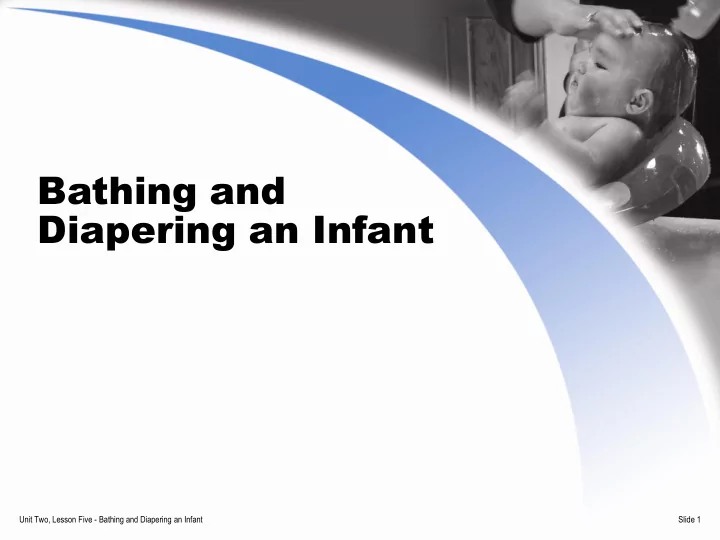
Bathing and Diapering an Infant

slide-2
SLIDE 2

Slide 2 Unit Two, Lesson Five - Bathing and Diapering an Infant

Disposable

  • vs. Cloth

Diapers

Disposable Diapers Cloth Diapers Advantages

  • Convenient
  • Less leaking
  • Easier to put on
  • Less diaper rash**
  • More comfortable
  • Less expensive
  • Do not run out
  • Environmentally friendlier*

Disadvantages

  • More diaper rash**
  • Not as comfortable
  • Expensive
  • Can run out
  • Less convenient
  • Messier
  • Harder to put on

*Commonly debated because cloth diapers need washing and drying, using energy, water, and detergents. **Whatever diaper type you use, you can reduce the frequency and severity of diaper rash by changing diapers more often.

slide-3
SLIDE 3

Slide 3 Unit Two, Lesson Five - Bathing and Diapering an Infant

Bathing an Infant

  • 1. Gather supplies
  • 2. Line tub
  • 3. Fill tub with 2-3 inches of water; test with elbow
  • 4. Wipe infant’s eyes with damp cotton balls or pads
  • 5. Gently place infant in tub
  • 6. Wash infant’s face, ears, and neck
  • 7. Wash infant’s hair
  • 8. Wash infant’s body
  • 9. Pat infant dry with clean towel

10.Lay infant down to diaper, then dress

slide-4
SLIDE 4

Slide 4 Unit Two, Lesson Five - Bathing and Diapering an Infant

Bath Safety

  • Choose a place where there are

no drafts

  • Never leave the infant alone, even

for a moment

  • Do not use bubble bath or harsh soap
  • Regularly pour water over the infant so

he or she does not get cold

slide-5
SLIDE 5

Slide 5 Unit Two, Lesson Five - Bathing and Diapering an Infant

Diapering an Infant — Disposable Diapers

  • 1. Gather supplies
  • 2. Wash hands; put on gloves
  • 3. Place pad under infant’s bottom
  • 4. Remove dirty diaper
  • 5. Clean infant’s bottom
  • 6. Open clean diaper; slide under infant
  • 7. Position diaper; secure fasteners
  • 8. Wipe pad, remove gloves, and discard with dirty diaper
  • 9. Wash hands; wash infant’s hands
slide-6
SLIDE 6

Slide 6 Unit Two, Lesson Five - Bathing and Diapering an Infant

Proper Glove Removal Steps

Grab the one glove at the palm and strip it off. Touch dirty surface

  • nly to dirty surface.

Ball up the dirty glove in the palm

  • f the other gloved hand.

1 2

With the clean hand, strip the glove off from underneath at the wrist, turning the glove inside

  • ut. Touch clean surfaces only to clean surfaces.

3

Discard the dirty gloves immediately in the trash.

4

slide-7
SLIDE 7

Slide 7 Unit Two, Lesson Five - Bathing and Diapering an Infant

Diapering an Infant — Cloth Diapers

  • 1. Gather supplies
  • 2. Wash hands; put on gloves
  • 3. Place pad under infant’s bottom
  • 4. Remove rubber pants
  • 5. Remove dirty diaper
  • 6. Clean infant’s bottom
  • 7. Fold clean diaper; slide under infant
  • 8. Position diaper; secure with pins
  • 9. Place rubber pants over clean diaper
  • 10. Clean and discard dirty diaper, wipe pad, remove gloves, discard
  • 11. Wash hands; wash infant’s hands
slide-8
SLIDE 8

Slide 8 Unit Two, Lesson Five - Bathing and Diapering an Infant

Diaper Safety

  • Never leave the infant unattended
  • Use the safety straps on the

changing table to secure the infant

  • If the infant tends to squirm, distract

with a toy or sing to him or her