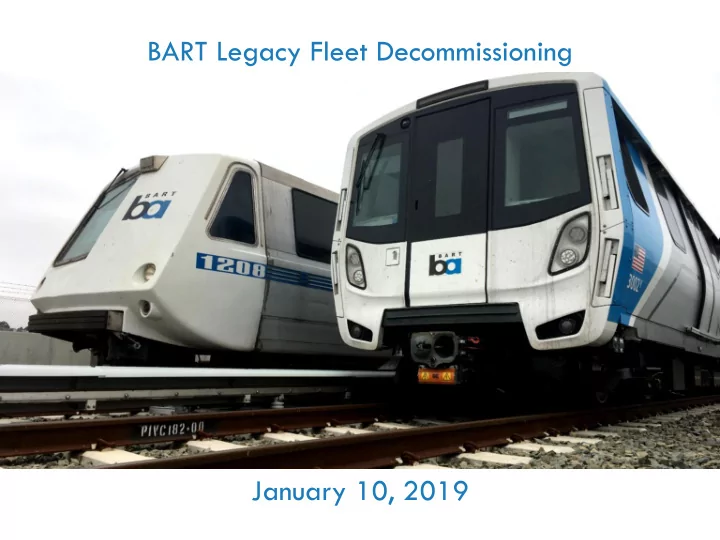
BART Legacy Fleet Decommissioning January 10, 2019 (#) 0 - - PowerPoint PPT Presentation

bart legacy fleet decommissioning january 10 2019
SMART_READER_LITE
LIVE PREVIEW

BART Legacy Fleet Decommissioning January 10, 2019 (#) 0 - - PowerPoint PPT Presentation

BART Legacy Fleet Decommissioning January 10, 2019 (#) 0 ANTICIPATED TIMELINE 80 new cars enable: Nearing Storage Capacity 1 FOTF on each of 5 lines 190 new cars enable: Two new weekday trains 15 FOTF trains in service 40%


slide-1
SLIDE 1

BART Legacy Fleet Decommissioning January 10, 2019

(#)
slide-2
SLIDE 2

2018

50 new FOTF Cars Delivered Lengthen trains by 7 cars 50% FOTF Spare Ratio

Apr. 2019

80 new cars enable:

  • 1 FOTF on each of 5 lines
  • Two new weekday trains
  • 40% FOTF Spare Ratio

Fall 2019

120 new cars enable:

  • 8 FOTF trains in service
  • Lengthen all peak-period

Transbay trains to 10 cars

  • Assume 40% FOTF spare

ratio

Early 2020

Nearing Storage Capacity 190 new cars enable:

  • 15 FOTF trains in service
  • SVBX service (46 cars)
  • Assume 30% FOTF spare ratio

2021

191+ new cars enable:

  • Grow fleet to ~925 cars
  • Complete train

lengthening of all trains

  • Begin steady state

legacy car retirement

  • Target 20% FOTF spare

ratio (Dec.)

ANTICIPATED TIMELINE

1 (#)

slide-3
SLIDE 3

Late 2022

  • Procurement of 775 FOTF

Complete

  • Hayward Yard East opens (to

accept 200-250 additional cars)

Aug. 2023

Legacy Fleet retirement completed

Dec. 2023

Nearing storage capacity constraints until Newhall is

  • available. 1,095 vehicles required

to operate under initial CBTC installation.

2026/2027

  • SVSX Opening.
  • Newhall Yard, forecasted to
  • pen in 2026 as part of VTA

Santa Clara extension, will accept about 200 – 250 cars

  • CBTC Installed
  • 12-min headways begin

Early 2028

30 peak hour Transbay train service attained

ANTICIPATED TIMELINE

2 (#) 2

slide-4
SLIDE 4

DECOMMISSIONING PROCESS OVERVIEW

Fleet Disposition Team (FDT)

Will provide input on Fleet Retirement Plan, comprised of RS&S, Planning, Operations, Transportation , etc.

Parts/Components to be Retained

Select parts to be harvested from retired vehicles

Retirement Car Selection

Bad actors first: failure rate, body condition, hours/miles, etc.

Expand Fleet

Hold legacy fleet (good actors) to maximize

  • perations, as

capacity allows

Begin Retirement

Retirement Options Include:

  • 1. Auction/sale
  • 2. Donate
  • 3. Keep
  • 4. Scrap

3 (#) 3

slide-5
SLIDE 5

BART STAKEHOLDERS

Department Role Fleet Disposition Team Overall project responsibility Coordination within departments and vendors Contract Administration Establish processes and desired outcomes Rolling Stock & Shops Car selection Preparation, parts removal Final equipment securement for over-the-road transport and handoff to the contractor Financial Planning Ensure FTA financial commitments have been met Receive sale or scrap value into General Fund Procurement Assists with the disposition of cars (auction, donation, scrap) Advertises cars for sale Negotiate with external vendors (transportation, recycler) Legal Ensure legal compliance, etc. Marketing Outreach to provide information and find public desires for vehicle retirement Fleet retirement announcement and ceremony

Rolling Stock & Shops

4

Fleet Disposition Team Financial Planning Procurement Legal Marketing

(#)

slide-6
SLIDE 6

FEDERAL REQUIREMENTS

Per FTA Circular 5010.1E, Grant Management Requirements: “After the useful life of federally assisted property is reached, or the property is no longer needed for the original Award, rolling stock and equipment with a current market value exceeding $5,000 per unit, or unused supplies with a total aggregate fair market value of more than $5,000, may be retained

  • r

sold. FTA is entitled to an amount calculated by multiplying the current market value, or net proceeds from sales, by FTA’s percentage of participation in the cost of the original purchase.”

5 (#)

slide-7
SLIDE 7

FEDERAL REQUIREMENTS

In addition to the decommissioning process, cross-departmental coordination will need to occur to inform the FTA of this process through the following reports:

  • Spare Ratio Justification
  • A Rolling Stock Status Report (describing fleet selected to be disposed
  • f, and remaining Federal interest in cars)
  • The Contingency Fleet Plan. A contingency justification and a specific

maintenance plan to keep CF in a state of ready-reserve (in case fleet needs to re-enter service)

  • The Transit Asset Management (TAM) Plan
  • National Transit Database (NTD) reporting
  • Transit Award Management System (TrAMS) reporting

6 (#)

slide-8
SLIDE 8

LEGACY FLEET COMPOSITION

Series Cars Manufacturer In-Service Date FTA Fund Participation Years Rehabilitated Years Eligible for Retirement*

A2 (1XXX) 59 Rohr Industries 1970's FTA funded rehab only 70.47% 1998 2018 2002 2022 B2 (1XXX) 380 FTA funded rehab only 70.47% 1998 2018 2002 2022 C1 (0XXX) 150 Alstom 1985 FTA funded 54.89% N/A 2015 1988 2018 C2 (25XX) 80 Morrison- Knudsen 1993 No FTA participation 2018 (No FTA Participation) 1995 2021 (No FTA Participation)

*Per FTA minimum Federal useful life and/or agreed upon useful life.

7

A2 B2 C1 C2

Series In-Service

Date

FTA Funding Years Rehabilitated Years Eligible for Retirement* Cars Manufacturer

(#)

slide-9
SLIDE 9

RETIREMENT OPTIONS

  • a. Auction - Sell vehicles to another

transit operator who will use the vehicles in operation

  • b. Disposal for recycling/scrap to the

highest bidder

  • c. Create a BART car museum,

sell/donate cars to existing rail museums, etc.

  • d. Donate car(s) to emergency

response forces, U.S. Army for exercises, drills, etc.

  • e. Donate car(s) to local technical

school to encourage trade students to learn rail car technology

8 (#)

slide-10
SLIDE 10

RETIREMENT OPTIONS

f. Sell car(s) for re-use as housing, Air BNB, as a restaurant, etc.

  • g. Donate or sell the car(s) for use as

homeless shelters or temporary shelters (i.e. Redwood Valley Fire Recovery has requested them)

  • h. Donate or sell the car(s) for use as art

projects or another similar repurposing i. Sell parts of the car(s) (pieces as memorabilia) j. Retain/Mothball some of the fleet for special service

  • k. Bury a carbon steel subway fleet in

the ocean for use as part of an artificial reef (the aluminum composition of the BART fleet prevents this from being feasible)

9 (#)

slide-11
SLIDE 11

CAR SELECTION CRITERIA

The car selection criteria for decommissioning will take into consideration the following, at a minimum:

  • Reliability – Mean Time Between Incident (MTBI) and MBTI

rate/1,000 hours over a 12 and 24-month period. Decommission “Repeaters” or bad actors that impact service reliability.

  • Availability – Long term holds due to accident damage.
  • Exterior and interior condition
  • Hours
  • Time remaining on key components
  • Status of component overhauls
  • APSE type

10 (#)

slide-12
SLIDE 12

YEARLY REPEATER RATES BY CAR TYPE

0.0 0.2 0.4 0.6 0.8 1.0 1.2 1.4 1.6

Jan 2016 Feb 2016 Mar 2016 Apr 2016 May 2016 Jun 2016 Jul 2016 Aug 2016 Sep 2016 Oct 2016 Nov 2016 Dec 2016 Jan 2017 Feb 2017 Mar 2017 Apr 2017 May 2017 Jun 2017 Jul 2017 Aug 2017 Sep 2017 Oct 2017 Nov 2017 Dec 2017 Jan 2018 Feb 2018 Mar 2018 Apr 2018 May 2018 Jun 2018 Jul 2018 Aug 2018 Sep 2018

A Car

0.0 0.2 0.4 0.6 0.8 1.0 1.2 1.4 1.6

Jan 2016 Feb 2016 Mar 2016 Apr 2016 May 2016 Jun 2016 Jul 2016 Aug 2016 Sep 2016 Oct 2016 Nov 2016 Dec 2016 Jan 2017 Feb 2017 Mar 2017 Apr 2017 May 2017 Jun 2017 Jul 2017 Aug 2017 Sep 2017 Oct 2017 Nov 2017 Dec 2017 Jan 2018 Feb 2018 Mar 2018 Apr 2018 May 2018 Jun 2018 Jul 2018 Aug 2018 Sep 2018

B Car

0.0 0.2 0.4 0.6 0.8 1.0 1.2 1.4 1.6

Jan 2016 Feb 2016 Mar 2016 Apr 2016 May 2016 Jun 2016 Jul 2016 Aug 2016 Sep 2016 Oct 2016 Nov 2016 Dec 2016 Jan 2017 Feb 2017 Mar 2017 Apr 2017 May 2017 Jun 2017 Jul 2017 Aug 2017 Sep 2017 Oct 2017 Nov 2017 Dec 2017 Jan 2018 Feb 2018 Mar 2018 Apr 2018 May 2018 Jun 2018 Jul 2018 Aug 2018 Sep 2018

C1 Car

0.0 0.2 0.4 0.6 0.8 1.0 1.2 1.4 1.6

Jan 2016 Feb 2016 Mar 2016 Apr 2016 May 2016 Jun 2016 Jul 2016 Aug 2016 Sep 2016 Oct 2016 Nov 2016 Dec 2016 Jan 2017 Feb 2017 Mar 2017 Apr 2017 May 2017 Jun 2017 Jul 2017 Aug 2017 Sep 2017 Oct 2017 Nov 2017 Dec 2017 Jan 2018 Feb 2018 Mar 2018 Apr 2018 May 2018 Jun 2018 Jul 2018 Aug 2018 Sep 2018

C2 Car

11 (#)

slide-13
SLIDE 13

AVERAGE MTBI BY FLEET TYPE

12

50 100 150 200 250 300 350 400

A Car B Car C1 Car C2 Car

(#)

Mean Time Between Incident (MTBI)

slide-14
SLIDE 14

MTBI OF C2 CARS

13 (#)

Mean Time Between Incident (MTBI)

50 100 150 200 250 300 350

Certain cars have very poor reliability

Car #

slide-15
SLIDE 15

PRELIMINARY FLEET RETIREMENT SCHEDULE

14

  • 5

10 15 20 25 Jan-19 Feb-19 Mar-19 Apr-19 May-19 Jun-19 Jul-19 Aug-19 Sep-19 Oct-19 Nov-19 Dec-19 Jan-20 Feb-20 Mar-20 Apr-20 May-20 Jun-20 Jul-20 Aug-20 Sep-20 Oct-20 Nov-20 Dec-20 Jan-21 Feb-21 Mar-21 Apr-21 May-21 Jun-21 Jul-21 Aug-21 Sep-21 Oct-21 Nov-21 Dec-21 Jan-22 Feb-22 Mar-22 Apr-22 May-22 Jun-22 Jul-22 Aug-22 Sep-22 Oct-22 Nov-22 Dec-22

A2 B2 C1 C2

(#)

# of Cars Retired

slide-16
SLIDE 16

DECOMMISSIONING SCHEDULE OVERVIEW

15

  • 200

400 600 800 1,000 1,200 1,400 Jul-17 Oct-17 Jan-18 Apr-18 Jul-18 Oct-18 Jan-19 Apr-19 Jul-19 Oct-19 Jan-20 Apr-20 Jul-20 Oct-20 Jan-21 Apr-21 Jul-21 Oct-21 Jan-22 Apr-22 Jul-22 Oct-22 Jan-23 Apr-23 Jul-23 Oct-23 Jan-24 Apr-24 Jul-24 Oct-24 Jan-25 Apr-25 Jul-25 Oct-25 Jan-26 Apr-26 Jul-26 Oct-26 Jan-27 Apr-27 Total # of Spaces Required Legacy Fleet Available (with CF) Fleet of the Future + New Procurement

Hayward Yard East Newhall Yard Legacy Fleet (Retiring) Fleet of the Future + New Procurement

(#)

# of Cars

Nearing Storage Capacity

slide-17
SLIDE 17

GLOSSARY OF TERMS, ACRONYMS, AND ABBREVIATIONS

16

  • Automatic Train Control (ATC) A train protection system that uses electrical signals to manage the

location and control train speeds on specific fixed segments of track.

  • Auxiliary Power Supply Equipment (APSE) Equipment that channels the 1,000-volt current that powers

BART trains and takes it to safe levels to power the lighting, air conditioning, etc.

  • Communication-Based Train Control (CBTC) is a railway signaling system that makes use of the

telecommunications between the train and track equipment for the traffic management and infrastructure control. A CBTC system allows trains to operate safely at much closer headways.

  • Consist A set of coupled revenue vehicles making up a revenue train.
  • Fleet of the Future (FOTF) The revenue vehicles currently being delivered to replace and expand

BART’s pre-existing fleet (legacy fleet) of ‘A’, ‘B’ and ‘C’ cars.

  • Federal Transit Administration (FTA) The agency of the U.S. Department of Transportation which

administers the federal program of financial assistance to public transit.

  • Headway Time interval between vehicles moving in the same direction on a particular route.
  • Mean Time Between Incidents (MTBI) The average time from when a system fails, until it next fails.
  • Peak Period Service The level of service delivered during the three-hour periods encompassing

greatest passenger demand.

  • Ready Reserve Train ready and crewed for placement in service in the event a scheduled train

becomes inoperable, or to cover some other unplanned disruption of service.

  • Repeater Rate The same or similar incident occurring within 100 hours of operation.
  • Spare Ratio The numerical proportion of the number of cars held from service at any time to the

number of cars deployed for peak- period service plus those in ready reserve status.

  • Silicon Valley Berryessa Extension (SVBX) Extension of the BART system commencing at the Santa

Clara County line and terminating at Berryessa Station, designed, financed and constructed by VTA.

  • Silicon Valley Santa Clara Extension (SVSX) Extension of the BART system through Santa Clara County

from the Berryessa Station via downtown San Jose to Santa Clara. The approximately six-mile extension includes four new stations and a rail yard. The extension is being designed, financed and constructed by VTA.

slide-18
SLIDE 18

QUESTIONS?

(#)