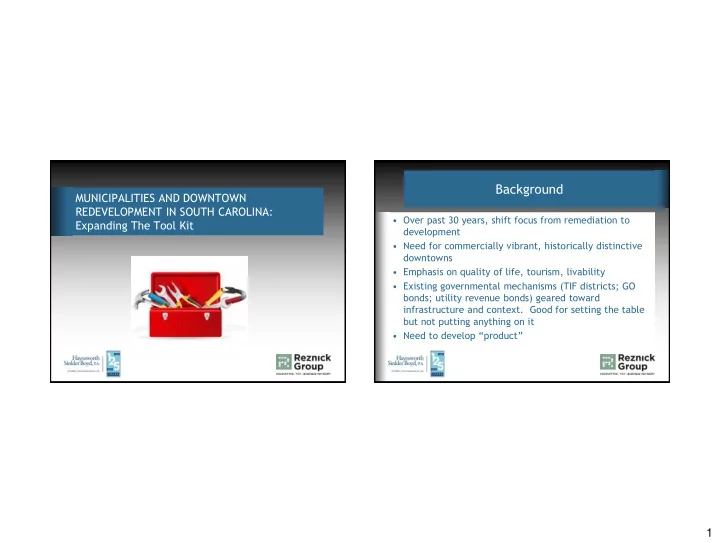
Background MUNICIPALITIES AND DOWNTOWN REDEVELOPMENT IN SOUTH - - PowerPoint PPT Presentation

background
SMART_READER_LITE
LIVE PREVIEW

Background MUNICIPALITIES AND DOWNTOWN REDEVELOPMENT IN SOUTH - - PowerPoint PPT Presentation

Background MUNICIPALITIES AND DOWNTOWN REDEVELOPMENT IN SOUTH CAROLINA: Over past 30 years, shift focus from remediation to Expanding The Tool Kit development Need for commercially vibrant, historically distinctive downtowns


slide-1
SLIDE 1

1 MUNICIPALITIES AND DOWNTOWN REDEVELOPMENT IN SOUTH CAROLINA: Expanding The Tool Kit

Background

  • Over past 30 years, shift focus from remediation to

development

  • Need for commercially vibrant, historically distinctive

downtowns

  • Emphasis on quality of life, tourism, livability
  • Existing governmental mechanisms (TIF districts; GO

bonds; utility revenue bonds) geared toward infrastructure and context. Good for setting the table but not putting anything on it

  • Need to develop “product”
slide-2
SLIDE 2

2

Direct Government “Product”

  • Libraries, museums, performing arts centers, parks,

recreation facilities, as well as government facilities

  • Some new mechanisms to drive these in addition to

traditional tools (like GO bonds) include installment purchase revenue bonds, hospitality and accommodations bonds, new market tax credit financing.

  • Development of collaborative and mixed use facilities
  • Examples: Greenwood Arts Center; Francis Marion

Performing Arts Center in Florence; Florence County Museum

Greenwood Cultural Facility

  • 1911 Federal Building
  • Jointly redeveloped by City, County, Self Foundation

with federal, state, local governmental and private

  • funds. Total Cost of $1,750,000
  • 20,118 square feet housing museum galleries,

conference and recreational facilities, visitor and tourism center, foundation and arts council offices

slide-3
SLIDE 3

3

Greenwood Federal Building/Cultural Facility Francis Marion University Performing Arts Center

  • 64,000 square foot facility built on site of abandoned

motel in downtown Florence

  • Contains 850 seat main theater, 150 seat “black box”

theater, University classroom and office space, nonprofit offices

  • $30M project, jointly developed by FMU, City, County,

and Drs. Bruce and Lee Foundation

  • First FMU presence in City of Florence in the

University‟s 40 year history

slide-4
SLIDE 4

4

Francis Marion University Performing Arts Center Florence County Museum

  • $12M, 28,000 square foot facility
  • Jointly financed by County, State, and Drs. Bruce and

Lee Foundation

  • Partnership with existing 501(c)(3) Florence Museum
  • County portion funded with hospitality fee revenue

bond

slide-5
SLIDE 5

5

Florence County Museum Incentivizing Private Investment

  • Expanding tax base, creating jobs
  • Not much in standard municipal tool kit in this regard
  • Most direct investment incentives at County level and

geared toward manufacturers

  • A couple of tools that are available and that are driving

projects in South Carolina

  • Special source revenue credits (direct subsidy resulting

in tax abatement with possibility of leverage)

  • Federal and state rehabilitation tax credits (largely

coordination and facilitation role with some possibility

  • f subsidy through participation)
slide-6
SLIDE 6

6

Special Source Revenue Credits

  • South Carolina Code Sections 4-1-175 and 4-29-68
  • Properties given multi-county business park (MCBP)

designation are eligible to receive credits against property taxes (which are “fees” generated by MCBP) to offset “cost of infrastructure serving the… project”

  • Level of credits and duration flexible
  • Credit granted by County Council
  • Unlike FILOT, available to any commercial activity
  • Can‟t overlay on TIF District
  • Potential for leveraging through special source bonds

SSRC Project: Hotel Florence

  • 53 room boutique hotel and 180 seat restaurant in 1905

building in downtown Florence

  • $4.2M project
  • Developer approached City and County for incentives
  • Centerpiece was 7 year, 85% SSRC
  • Would generate $533,000 in credits to developer/owner
  • Existing TIF created problem
  • Will generate approximately $1M in state and federal

historic rehab tax credits

slide-7
SLIDE 7

7

Hotel Florence Hotel Florence

slide-8
SLIDE 8

8

Rehabilitation Tax Credits

  • Several Types
  • Range from 10% to 25% of eligible project expenditures
  • Federal historic rehab credit (10 or 20%, depending on

National Register status)

  • State rehab credit (10%), follows federal
  • State retail rehab credit (10%), minimum 40,000 sf
  • Textile facility rehab credit (25%)
  • Abandoned building rehab tax credit (25%); authorizing

bill died in General Assembly earlier this month

Old Florence County Library (Before)

slide-9
SLIDE 9

9

Old Florence County Library (After) Old Florence County Library

  • 1925 County Library with 1970s addition
  • Removed addition and returned building to original

appearance

  • 24,000 sf leased by Turner Padget law firm
  • $5M project
  • Over $1M in tax credits
  • Largest commercial investment in Downtown Florence

in 50 years

slide-10
SLIDE 10

10

Key Federal Tax Incentives

  • Rehabilitation Tax Credit (IRC Section 47).
  • New Markets Tax Credit (IRC Section 45D).

What is a Tax Credit?

Credits vs. Deductions A Credit Offsets Tax Liability Dollar for Dollar Deduction Credit Income $100 $100 Less: Deductions (20)

  • Taxable Income

80 100 Gross tax Due @ 35% 28 35 Less: Credits

  • (20)

Net Tax Due @ 35% 28 15

slide-11
SLIDE 11

11

How Tax Credits Deliver Capital

Sample Structure

  • Federal tax credits not sold,

but passed to investors through partnerships

  • Require structuring with

partnerships and equity contributions

  • Generally, partnership

agreements contemplate exit

  • f tax credit investor after

compliance period

Tax Credit Investor 99% Owner Project General Partner 1% Owner 99% Credits

Example 1: Historic Tax Credits (HTCs)

  • Downtown office and retail
  • Multiple phased project with

additional HTC equity expected for future phases

  • HTC represented key piece of

financing to meet business requirements of developer

Developer Equity, $19.5 Hard Debt, $53.3 Soft Debt, $10 Project Total, $97.

slide-12
SLIDE 12

12

Example 2: Combining New Markets Tax Credit (NMTC) & HTC Halves Sponsor Equity

  • Renovation of historic hotel
  • Federal HTCs, State HTCs, Federal

NMTCs each with its own investor

  • Multiple parties involved
  • Low put price to exit tax credit

equity at compliance period

  • Market lender cooperated with

structuring to increase money in first loss position and decrease exposure

Project Total, $19.7 NMTC Equity, $3.0

  • Fed. HTC Equity, $3.0

State HTC Equity, $2.2 Developer Equity, $4.0 Hard Debt, $7.5 Tax Credit Equity, $8.2

Agenda

  • Types of Federal Historic Tax Credit
  • Calculating the Credit
  • Qualifying for the Credit
  • Claiming the Credit
  • Current Deal Structures
  • Questions
slide-13
SLIDE 13

13

The Rehabilitation Tax Credits

Internal Revenue Code Section 47

There are Two Types of Federal HTC:

10% & 20% Credit

slide-14
SLIDE 14

14

Important Dates in the History of the Rehabilitation Tax Credits

  • 1976: First federal tax incentives for historic

preservation (accelerated depreciation/ amortization).

  • 1978: First federal tax credit for rehab of historic

buildings (10%).

  • 1981: Three tiered tax credit (25%, 20% and 15%),

including first credit for rehab of older, non-historic buildings.

  • 1986: Current two tiered structure; passive loss

limitations imposed.

The 20% Rehabilitation Tax Credit Fundamentals

  • Tax Aspects Administered by the IRS.
  • Preservation aspects jointly administered by NPS and

State Historic Pres. Offices (SHPOs).

  • Tax Credits = dollar for dollar reduction in tax liability

(contrast with deduction).

  • RTC is the most important (in dollar volume) federal

preservation program.

slide-15
SLIDE 15

15

The 20% Rehabilitation Tax Credit Statistics

  • 937 projects approved by NPS in 2011*
  • In 2011, roughly 69% of HTC projects were for multi-family

housing, 16% for office space, 3% for commercial space*

  • Of the 94.5% of Projects receiving Part 3 approvals that used other

incentives or publicly supported financing, 48% used state historic tax credits* *Source: Annual Report for Fiscal Year 2011: Federal Tax Incentives for Rehabilitating Historic Buildings National Park Service

Federal Approval Process

  • 3 Part Application Process

– Part 1 – Historic Status – Part 2 – Design Approval – Part 3 – Project Completion

  • State and National Park Service Review

– 60-Day Minimum Review

  • Secretary of Interior‟s Standards for Rehabilitation
slide-16
SLIDE 16

16

What Types of Buildings Qualify?

  • The IRS Rules: Depreciable Building Requirement

– Must be a “building”. Building is defined as a structure or edifice enclosing a space within its wall and usually covered by a roof. – Building must be depreciable. Depreciable buildings are generally those used for nonresidential (i.e. commercial) or residential rental purposes. (See Section 168(e))

What Kinds of Buildings Qualify?

  • Almost Anything But a Personal Residence

– Apartments – Hotels – Office Buildings – Warehouses – Distribution Facilities – Back-Office Support/Computer/Call Centers – Sports Facilities – Mixed Use of Any of the Above

slide-17
SLIDE 17

17

What Types of Buildings Qualify? (cont‟d)

Option #1 Building is listed in the National Register of Historic Places.

The NPS Rules: Certified Historic Structure Requirement

What Types of Buildings Qualify? (cont‟d)

Option #2 Building is located in a registered historic district and certified by the Sec. of the Interior as being of historic significance to the district.

The NPS Rules: Certified Historic Structure Requirement

slide-18
SLIDE 18

18

Be Sure You Pass “The Test”

Standard Rehabilitation Test Phased Rehabilitation Test

Substantial Rehabilitation Test

  • Look back from placed in

service date to basis in building 24 months prior or beginning of project, whichever is later

  • QREs must exceed prior basis
  • r $5,000, whichever is

greater

  • Rolling 24-month window
  • Must be evidence that project

will take longer than 24 months to complete prior to commencing rehab

  • 60-month window
  • Otherwise similar rules

What Types of Rehabilitations Qualify?

Definition of QREs

  • “Qualified Rehabilitation Expenditures” (QREs) is the

tax term given to those development costs on which rehabilitation tax credits can be claimed.

  • QREs are any amounts chargeable to a capital account

made in connection with the renovation, restoration or reconstruction of a qualified rehabilitated building (including its structural components), except as provided by law.

slide-19
SLIDE 19

19

  • QREs include costs related to:

– walls, partitions, floors, ceilings; – permanent coverings such as paneling or tiling; – windows and doors; – air conditioning or heating systems, plumbing and plumbing fixtures; – chimneys, stairs, elevators, sprinkling systems, fire escapes;

What Types of Rehabilitations Qualify?

Definition of QREs (cont‟d.)

  • QREs include costs related to:

– construction period interest and taxes; – architect fees, engineering fees, construction management costs; – reasonable developer fees

What Types of Rehabilitations Qualify?

Definition of QREs (cont‟d.)

slide-20
SLIDE 20

20

What is Not a QRE?

  • Land & Interest Carry on Land
  • Building Acquisition & Interest Carry on Acquisition
  • Acquisition-Related Costs
  • Site Improvements & Landscaping
  • Enlargements & Demolition
  • Personal Property
  • Tax Exempt Use Property

Sample Development Budget

Qualified Depreciable Rehabilitation Non-Eligible Funded Total Expenditures Basis Expense Other Acquisition Costs-Land 40,000

  • 40,000

Acquisition Cost- Building 120,000

  • 120,000
  • Construction Period Interest for Rehab

20,167 20,167

  • Permanent/Construction Loan Fee

6,000 1,000

  • 5,000
  • Achitectural, Engineering

28,000 28,000

  • Construction Contract

300,000 300,000

  • Site Improvements

5,000

  • 5,000
  • Contingency

35,000 35,000

  • Appliances

17,800

  • 17,800
  • Historic Tax Credit Application Fee

2,500 2,500

  • Professional Fees

15,000 15,000

  • Marketing & Leasing Reserves

20,000

  • 20,000

Insurance and RE Taxes During Construction 15,000 15,000

  • Development Fee

124,893 83,333 41,560

  • TOTAL APPLICATIONS:

749,360 500,000 184,360 5,000 60,000

slide-21
SLIDE 21

21

Calculating the Credit

QREs $ 500,000 Credit Rate 20%* Credits $ 100,000

  • Calculate the equity amount: $1.15 per credit multiplied

by $100,000 credits = $115,000 * Credit Rate is sometimes 10%.

What Triggers the Credit?

  • Placement in Service

– CO or TCO is Evidence of Placement in Service

Is the building ready for occupancy?

slide-22
SLIDE 22

22

When Can the Credit Be Claimed?

  • Generally, the Year Placed In Service - 100% of the

Credit Claimed

  • Carry back One Year
  • Carry forward 20 Years

Who Can Claim the Credit?

  • Historic credits are shared among owners based on the

profits allocation

  • „Profits‟ is considered to include the owner‟s share of:

– Taxable income – Operating cash flow

  • These allocations must remain the same during the

recapture period

slide-23
SLIDE 23

23

Limitations of the Use of the Credit

  • Passive Loss Rules
  • Alternative Minimum Tax
  • At-Risk Rules

– Companies whose stock is publicly-traded generally aren‟t subject to these limitations

How to Claim the Rehab Tax Credit

slide-24
SLIDE 24

24

How to Claim the Rehab Tax Credit (cont‟d)

  • Credits are claimed by filing IRS form 3468 along with

the tax return for the year in which the taxpayer claims the credit.

  • Part 3 Approval need not have already been obtained

(but generally must be obtained within 30 months of tax return filing date)

What is the Risk of Recapture?

  • Triggering recapture

– Disposition of the property – Disposition of at least 1/3 partnership interest – Noncompliance with Secretary‟s Standards – Property becomes „tax exempt use property‟ – Total casualty loss

  • Amount of recapture

– 100% of the credit in the first 12 months from placed in service – Declines 20% every 12 months thereafter – Possible recapture becomes zero after 60 months

slide-25
SLIDE 25

25

Other Tax Credit Issues

  • Development Fee

– Amount – Payment

  • Tax Exempt Use Property - Check The Tenants!
  • Basis Adjustment-and impact on LIHTC

Single Entity Structure

Tenants Rental Payments Tax Credit Investor LLC Construction/ Perm Lender Managing Member (Developer Affiliate) Historic Tax Credit Equity 99.99% Credits, Profits & Losses and Cash Flow Loan Proceeds Debt Service Payments

Tax Credit, LLC (Property Owner)

Tax Credit Investor .01% Credits, Profits & Losses, Fees and Cash Flow Developer Equity Developer Dev. Fee

slide-26
SLIDE 26

26

Historic Tax Credit Syndication

The Credit Pass-Through Structure

  • Landlord LLC owns fee simple, undertakes rehab,

enters into Dev. Agreement, and earns the Historic Tax Credit.

  • Master Tenant, LLC leases the entire project from the

Landlord LLC for a fixed annual rental payment.

Historic Tax Credit Syndication

The Credit Pass-Through Structure (cont‟d.)

  • Master Tenant, LLC operates the property, subleases to

end users and enters into the Property Management Contract.

  • Landlord makes special tax election to pass the Historic

Tax Credit through to the Master Tenant LLC.

slide-27
SLIDE 27

27

Master Lease/Credit Pass-Through Structure

Sub-Tenants/ End Users Rental Payments Tax Credit Investor LLC Construction/ Perm Lender Managing Member (Developer Affiliate) Historic Tax Credit Equity 99.99% Credits, Profits & Losses, and Cash Flow Loan Proceeds Debt Service Payments .01% Credits, Profits & Losses, Fees and Cash Flow Developer Equity Master Tenant, LLC (Master Tenant) Landlord, LLC (Property Owner/Lessor) 99.99% Credits, Profits & Losses, Fees and Cash Flow Pass-through of Historic Tax Credits & Share of Lease Payment & Equity Investment

Investors Capitalize Project for Credit and Other Tax Benefits

Leveraged Lender (Bank) Tax Credit Investor Investment Fund LLC QALICB/Landlord LLC (Property Owner) Development Budget: $8M Sub-CDE LLC $4,312,030 $1,152,000 HTC Equity $2,007,720 NMTC Equity Load (4.5% of QEI) 321,750 Master Tenant, LLC 7,150,000 QEI Loan A 4,312,030 Loan B 2,837,970 100% Ownership Lease CDE: Community Development Entity QEI: Qualified Equity Investment QALICB: Qualified Active Low Income Business

slide-28
SLIDE 28

28

Thank you! More Information?

Joseph Wallace Reznick Group 704.837.7381 Joe.wallace@reznickgroup.com

  • J. Christopher Riddle, Esq.

Haynsworth Sinkler Boyd, P .A. 843.673.5309 criddle@hsblawfirm.com Benjamin T . Zeigler, Esq. Haynsworth Sinkler Boyd, P .A. 843.673.5304 bzeigler@hsblawfirm.com