Background Response rates (RR) have been declining over time. - - PDF document

background
SMART_READER_LITE
LIVE PREVIEW

Background Response rates (RR) have been declining over time. - - PDF document

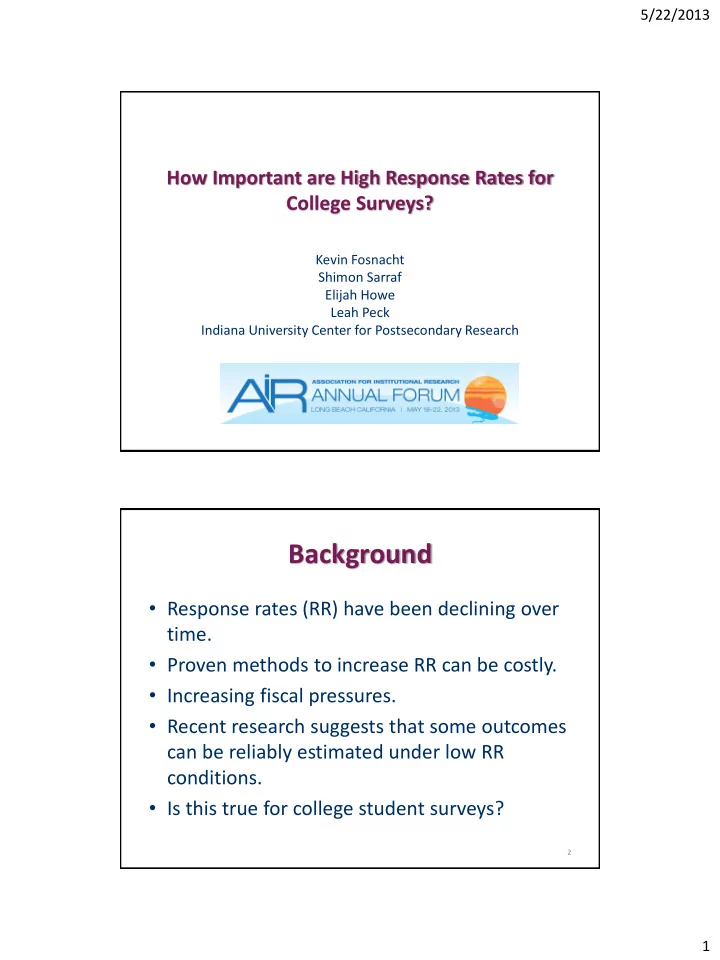
5/22/2013 How Important are High Response Rates for College Surveys? Kevin Fosnacht Shimon Sarraf Elijah Howe Leah Peck Indiana University Center for Postsecondary Research Background Response rates (RR) have been declining over time.


slide-1
SLIDE 1

5/22/2013 1

How Important are High Response Rates for College Surveys?

Kevin Fosnacht Shimon Sarraf Elijah Howe Leah Peck Indiana University Center for Postsecondary Research

Background

  • Response rates (RR) have been declining over

time.

  • Proven methods to increase RR can be costly.
  • Increasing fiscal pressures.
  • Recent research suggests that some outcomes

can be reliably estimated under low RR conditions.

  • Is this true for college student surveys?

2

slide-2
SLIDE 2

5/22/2013 2

Theory

3

  • Nonresponse bias is generally viewed as a

function of nonresponse rate and nonresponse effect (Keeter, et. al., 2000).

Nonresponse Bias Difference between sample and population statistics Nonresponse Rate Nonresponse Effect (difference between responders and nonresponders)

Theory (cont.)

  • Leverage-saliency theory
  • Survey features
  • Prominence in request to participate

4

slide-3
SLIDE 3

5/22/2013 3

Level of Effort

  • Response rate and nonresponse bias are

somewhat artificial and arbitrary because they are dependent on researcher decisions, or level of effort (Olson, 2006).

– Example: supermarket survey versus U.S. Census

5

Level of Effort (cont.)

Curtin, Presser, & Singer, 2000

  • Level of effort study on Index of Consumer

Sentiment.

  • Explores impact of low response rates when

no reminder attempts used.

  • Conclusion: preliminary estimates close to

final estimates

6

slide-4
SLIDE 4

5/22/2013 4

Level of Effort (cont.)

Hutchison, Tollefson, & Wigington, 1987

  • Only level of effort study focusing on higher

education.

  • 600 first-year students enrolled in different

classes, assigned to different survey samples.

  • No meaningful differences in students’

perceptions of academic environment when comparing estimates from administrations with RR’s of 35 and 100 percent.

7 8

70 85 75 80 79 80

20 40 60 80 100 5% 10% 15% 20% 25% 70%

Score Response Rate

Hypothetical Level of Effort Analysis

Final Estimate Simulated Estimate

slide-5
SLIDE 5

5/22/2013 5

Research Questions

  • 1. Do simulated low response rate survey

estimates about college student engagement provide reliable information based on comparisons to actual high response rate estimates?

  • 2. Do simulated low respondent count estimates

provide reliable information based on comparisons to full sample estimates?

  • 3. Do these results vary by institution sample size?

9

Data Sample

  • National Survey of Student Engagement (NSSE)

– 2010, 2011 and 2012 administrations (online survey

  • nly)

– Only ≥ 50% response rate administrations used – 555 first-year and senior administrations from 307 bachelor’s degree-granting institutions; 110K students

  • NSSE Benchmarks

– Level of Academic Challenge – Active & Collaborative Learning – Student-Faculty Interaction – Supportive Campus Environment

10

slide-6
SLIDE 6

5/22/2013 6

Methods

  • Level of effort analysis: recalculated survey

estimates under alternative RR of 5, 10, 15, 20, 25, 30, and 35%

  • Correlated recalculated estimates with full

sample estimate

– all administrations and by 4 sample size categories

  • Analysis repeated using respondent counts of 10,

25, 50, 75, 100, 150, and 200

  • .90 correlation indicates strong reliability

11

Methods (cont.)

12

Administration Sample Size Categories

Very Small 20 ≤ N < 250 n = 293 Small 250 ≤ N < 500 n = 168 Medium 500 ≤ N < 1,000 n = 74 Large N ≥ 1,000 n = 20

N = Total number sampled n = # of individual administrations

slide-7
SLIDE 7

5/22/2013 7

Results:

Response Rates

13 14

Simulated Estimate Actual Estimate

r = .64 5% Level of Effort: Level of Academic Challenge

slide-8
SLIDE 8

5/22/2013 8

15

Simulated Estimate Actual Estimate

r = .86 15% Level of Effort: Level of Academic Challenge

16

Simulated Estimate Actual Estimate

r = .93 25% Level of Effort: Level of Academic Challenge

slide-9
SLIDE 9

5/22/2013 9

17

Simulated Estimate Actual Estimate

r = .61

5% Level of Effort: Academic Challenge

Differences between Very Small & Large Administrations r = .94 Very Small Administrations Large Administrations

Results:

Respondent Count

18

slide-10
SLIDE 10

5/22/2013 10

19

Simulated Estimate Actual Estimate

r = .68 n=10 Level of Effort: Academic Challenge

20

Simulated Estimate Actual Estimate

r = .87 n=25 Level of Effort: Academic Challenge

slide-11
SLIDE 11

5/22/2013 11

21

Simulated Estimate Actual Estimate

r = .94 n=50 Level of Effort: Academic Challenge

22

Simulated Estimate Actual Estimate

r = .90

n=25 Level of Effort: Academic Challenge

Differences between Very Small & Large Administrations r = .76 Very Small Administrations Large Administrations

slide-12
SLIDE 12

5/22/2013 12

Reliability by Size & N

Simulated Respondent Count

Level of Academic Challenge

10 25 50 75

All administrations

.68

.87

.94 .96

Very small

.74

.90 .96 .98

Small

.58

.83

.92 .95

Medium

.57

.74 .88

.91

Large

.55

.76

.92 .94

23

Summary Findings (using all 4 measures)

Q1: Do simulated low response rate survey estimates about college student engagement provide reliable information based on comparisons to actual high response rate estimates? Yes, RR between 5% and 25% appear to provide reliable estimates, depending on sample size and engagement measure.

24

slide-13
SLIDE 13

5/22/2013 13

Summary Findings (cont.)

Q2: Do simulated low respondent count estimates provide reliable information based

  • n comparisons to full sample estimates?

Yes, between 25 and 75 respondents appear to provide reliable institution-level estimates.

25

Summary Findings (cont.)

Q3: Do these results vary by institution sample size? Yes, administration sample size has a meaningful impact on the results of this study. For reliable estimates:

  • Larger institutions need more respondents
  • Smaller institutions need higher response rates

26

slide-14
SLIDE 14

5/22/2013 14

Implications

  • Institution-level estimates of undergraduate

behavior can be reliable under low RR and N conditions.

  • Reliability of NSSE measures is more strongly

related to N than RR.

  • Depending upon survey goals and needs for

sub-group analysis, random sample may be an

  • ption for some projects. (NSSE encourages

collecting enough data for sub-group analysis!)

  • Other measures of data quality (item missing,

duration, validity, etc.) deserve more attention.

27

Conclusion

  • Future research…

– institutional outliers – statistical tests – other higher education surveys

  • Once an administration reaches threshold,

whether it be RR or N, more effort at collecting additional respondents will not likely yield much change in institutional estimates.

28

slide-15
SLIDE 15

5/22/2013 15

Thank you!!!

Paper available at: http://nsse.iub.edu/html/pubs.cfm ssarraf@indiana.edu echowe@indiana.edu