Background Multiple Sclerosis (MS) is characterized by an - - PDF document

background
SMART_READER_LITE
LIVE PREVIEW

Background Multiple Sclerosis (MS) is characterized by an - - PDF document

6/18/2015 EFFECTS OF AN 8 WEEK SELF EFFICACY PLUS EXERCISE INTERVENTION ON PHYSICAL ACTIVITY, QUALITY OF LIFE, AND FATIGUE IN AN INDIVIDUAL WITH PROGRESSIVE MS Heather Eustis, BA, SPT Prudence Plummer, PhD University of North Carolina at


slide-1
SLIDE 1

6/18/2015 1

EFFECTS OF AN 8‐WEEK SELF‐EFFICACY PLUS EXERCISE INTERVENTION ON PHYSICAL ACTIVITY, QUALITY OF LIFE, AND FATIGUE IN AN INDIVIDUAL WITH PROGRESSIVE MS

Heather Eustis, BA, SPT Prudence Plummer, PhD University of North Carolina at Chapel Hill

Background

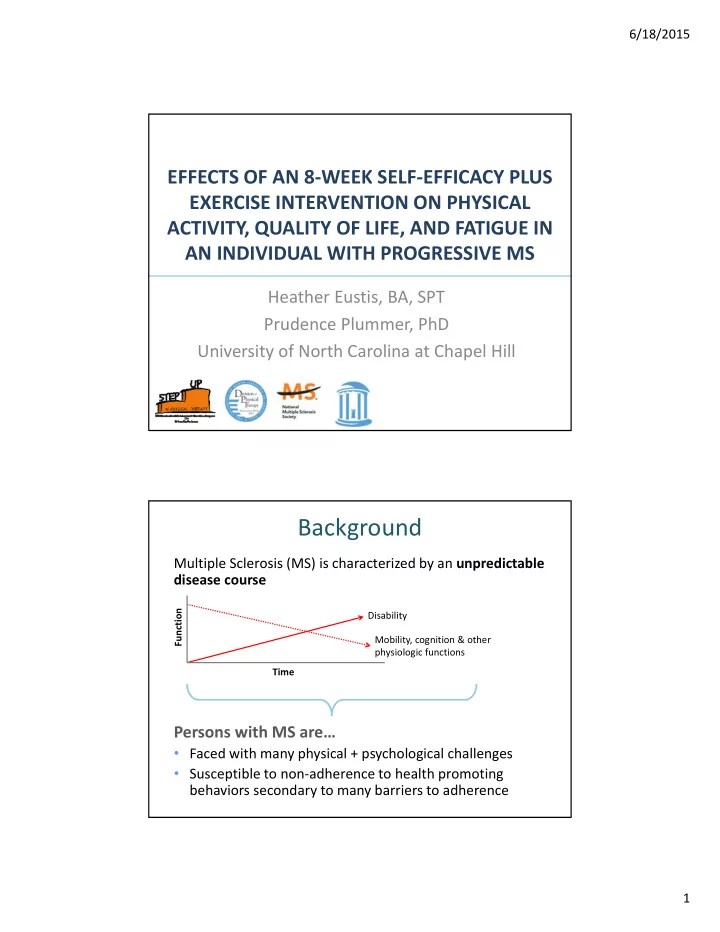
Multiple Sclerosis (MS) is characterized by an unpredictable disease course

Persons with MS are…

  • Faced with many physical + psychological challenges
  • Susceptible to non‐adherence to health promoting

behaviors secondary to many barriers to adherence

Disability Mobility, cognition & other physiologic functions Time Function

slide-2
SLIDE 2

6/18/2015 2

Background ‐ Role of Exercise in MS

  • Better cardiovascular fitness
  • ↑ strength
  • Better bowel function
  • ↓ fague & depression
  • Positive attitude
  • ↑ parcipaon in social acvies
  • ↑ in cognitive function + mood

enhancement

Background ‐ Physical Activity

Diseased Populations Non‐ Diseased Populations

Physical Activity

  • Persons with MS are less physically active

than diseased & non‐diseased populations

  • <20% are meeting minimal physical activity

guidelines

  • General Population is relatively inactive
  • Starting at a low baseline

Persons with MS

?

Identify factors that correlate with physical activity & are modifiable by an intervention

slide-3
SLIDE 3

6/18/2015 3

Decides to start exercising Helps with symptom management Increased motivation and perception of ability to exercise Improved Quality

  • f life
  • ↑ Symptoms
  • MS Exacerbation
  • Injury

Exercise becomes harder to do

A Viscous Cycle…

Symptoms get worse Decreased motivation and perception of ability to exercise Decreased Quality

  • f life

Stops Exercising

Self‐Efficacy

  • Extent or strength of one’s belief in one’s own

ability to complete tasks & reach goals (Bandura, 2004)

  • Persons with MS with high self‐efficacy report

higher levels of physical activity (Motl, McAuley, Doerksen, Hu, &

Morris, 2009)

  • Emerging research on self‐efficacy promoting

interventions to increase physical activity in MS

(Jongen & Ruimschotel, 2014; McAuley et al., 2007; Motl, Dlugonski, Wójcicki, McAuley, & Mohr, 2011; Motl et al., 2006; Motl & Snook, 2008; Suh, Joshi, Olsen, & Motl, 2014)

  • Little research has examined a self‐efficacy

promoting intervention on persons with more advanced MS and/or high disability severity

slide-4
SLIDE 4

6/18/2015 4 Behavior/ Performance

Modeling by Others Performance Accomplishments (Past Experience) Social Persuasion (coaching & evaluative feedback) Psychological & Emotional States

Sources of Self‐Efficacy Information

Self‐ Efficacy

(Bandura, 2004)

Objective

Analyze the effects of a self‐efficacy + exercise intervention in a middle‐aged individual with advanced MS & low self‐reported self‐efficacy on:

  • Self‐Efficacy
  • Physical activity
  • Quality of life
  • Fatigue
slide-5
SLIDE 5

6/18/2015 5

Functional Baseline/Characteristics

  • 60 year old Caucasian female with SPMS
  • 21 years since diagnosis of MS
  • EDSS score: >7
  • Most disabling symptoms:
  • Cerebellar ataxia
  • Increased muscle tone in upper & lower extremities
  • Bilateral hip flexor & dorsiflexor contractures
  • Usual Exercise Routine:
  • Daily: Stretches in the morning
  • 3‐4 times per week:
  • Walking down hallway (usually cannot make it entire way)
  • Upper extremity exercises w/o weight
  • “Dancing” by pulling up on grab bars (unable to “dance” through

entire 3‐4 min song)

  • 10‐15 mins on personal NuStep

Study Design

  • Self‐efficacy Component
  • 1x per week education sessions
  • 4 one‐on‐one mentor sessions
  • Exercise Component
  • Review of current exercise routine
  • Modifications to maximize adherence

2 Month Follow‐up 8 week self‐efficacy + exercise Intervention

slide-6
SLIDE 6

6/18/2015 6

Educational Presentations + Discussion Sessions Reflections in Daily Journal MS Mentor Session Daily Journal + Discussion Sessions

Self‐Efficacy

Self‐Efficacy Component

Modelling by Others Performance Accomplishments (Past Experience) Social Persuasion (coaching & evaluative feedback) Psychological & Emotional States

Intervention

Daily Journal MS “Mentor” Sessions Educational & Discussion Sessions

  • Sleep Quality
  • Morning & Evening

Fatigue

  • Day Quality
  • Activity Log
  • General reflection

notes 4 one‐on‐one sessions with volunteer with high self‐reported self‐efficacy & advanced MS Discussion topics

  • Medical journey through

MS

  • Exercise
  • Support systems
  • Medications

PowerPoint presentations about topics that were selected by the subject Educational topics:

  • Introduction
  • Assistive devices for spasticity &

tremors

  • Online resources for MS
  • Exercise interventions for

progressive MS

  • Stem cell research in MS
  • Identification of challenges related to topic
  • Strategies to overcome these challenges
  • What worked & what did not work
  • Utilization of resources

How did you sleep last night? – rate your sleep quality from the night before

Fantastic Pretty Good Just OK Not Great Terrible

1 2 3 4 5 6 7 8 9 10

Why: ____________________________________________________________________________________________

Fatigue Level – rate your fatigue level for the morning and evening

MORNING – rate when you first get up in the morning Energetic, No Fatigue Mild Fatigue Moderate Fatigue Severe Fatigue Worst Possible Fatigue

1 2 3 4 5 6 7 8 9 10

EVENING – rate just before you go to bed Energetic, No Fatigue Mild Fatigue Moderate Fatigue Severe Fatigue Worst Possible Fatigue

1 2 3 4 5 6 7 8 9 10 Was today a “Good” or “Bad” day? – circle one at the end of the day It was a GOOD day It was a BAD day

Why: ____________________________________________________________________________________________

Activity Log – list what you did for physical activity today (should include exercises, community outings, etc.)

Activity Duration, Intensity, Sets, Distance, etc.

Notes – please use this space to reflect on progress, jot down questions, and any other thoughts. You may use

the back of the page if needed.

slide-7
SLIDE 7

6/18/2015 7

Outcome Measures

Primary Secondary

Exercise Self‐ Efficacy

Exercise Self‐Efficacy Scale (ESES)

Quality of Life

  • MS Impact Scale 29 (MSIS‐

29)

  • Patient Health

Questionnaire 9 (PHQ‐9)

Self‐Efficacy to

  • vercome MS‐

related Barriers

MS Self‐Efficacy Scale (MS‐SES)

Fatigue

  • Modified Fatigue Impact

Scale (MFIS)

  • Daily Journal Fatigue ratings

Exercise Tolerance

5 Meter Walk Test (5MWT)

Physical Activity

  • Daily activity log
  • Accelerometer

Ongoing Data

  • Accelerometer
  • Daily journal

Wk 0 Baseline Wk 8 Post‐Intervention Wk 16 Follow‐up

8 week Intervention

  • Weekly discussions
  • MS‐related educational presentations via PowerPoint
  • 4 one‐on‐one sessions with a MS “mentor”
  • Current exercise routine modifications & recommendations
  • MSIS‐29
  • ESES
  • MFIS
  • MS‐SES
  • PHQ‐9
  • MSIS‐29
  • ESES
  • MFIS
  • MS‐SES
  • PHQ‐9
  • MSIS‐29
  • ESES
  • MFIS
  • MS‐SES
  • PHQ‐9

5MWT 5MWT 5MWT 5MWT

Methods ‐ Overview

Wk 4 Mid‐point

slide-8
SLIDE 8

6/18/2015 8

Results – Daily Journal

1 2 3 4 5 6 7 8 9 10 1 2 3 4 5 6 7 8 9 10 11 12 13 14 15 16

Weekly Average Rating Week

Intervention Follow‐Up

Results – Daily Journal

1 2 3 4 5 6 7 8 9 10 1 2 3 4 5 6 7 8 9 10 11 12 13 14 15 16

Weekly Average Rating Week

Intervention Follow‐Up

slide-9
SLIDE 9

6/18/2015 9

Results – Daily Journal

1 2 3 4 5 6 7 8 9 10 1 2 3 4 5 6 7 8 9 10 11 12 13 14 15 16

Weekly Average Rating Week

Intervention Follow‐Up

Results – Daily Journal

1 2 3 4 5 6 7 8 9 10 1 2 3 4 5 6 7 8 9 10 11 12 13 14 15 16

Weekly Average Rating Week

Intervention Follow‐Up

slide-10
SLIDE 10

6/18/2015 10

Results ‐ Questionnaires

Questionnaire Week 0 Week 8 Week 16

ESES – Exercise Self‐Efficacy

50 90 90

MSIS‐29 ‐ QOL

4.17 3.62 3.62

MFIS ‐ Fatigue

48 33 39

MS‐SES – Disease Self‐Efficacy

Function 17.78% 21.11% 18.89% Control 37.78% 34.44% 37.78% Total 27.78% 27.78% 28.33%

PHQ‐9 – Depression (QOL)

15 8 10

Improved self‐efficacy to exercise, perceived fatigue + decreased depression

Results – 5MWT

Week 0 Week 4 Week 8 Week 16

Pre‐walk BP (SBP/DBP) 144/70 137/81 137/81 145/83 Post‐walk BP (SBP/DBP) 142.5/83 116/72 155/95 140/84 Pre‐walk HR (bpm) 73 80 75 70 Post‐walk HR (bpm) 73 71 72 72 Gait Speed (inches/sec) 0.098 0.123 0.173 0.180 Total Time (mm:ss.00) 17:10.50 22:22.09 18:58.00 18:16.20 Distance (meters) 2.65 4.19 5 5 Number of seated rest breaks 6 6 10 5 Assistive Device Rollator Rollator Rollator Rollator

slide-11
SLIDE 11

6/18/2015 11

Physical Activity Data

10 20 30 40 50 60 70 80 90 100

1 2 3 4 5 6 7 8

Percent Duration of week Week

% Duration lying % Duration of walking % Duration of standing % Duration of sitting

Steps Per Week

100 200 300 400 500 600 700 800 1 2 3 4 5 6 7 8

Total Number of Steps Per Week

Week

slide-12
SLIDE 12

6/18/2015 12

Interview Findings

  • Most Useful: Educational & Discussion sessions + MS

“mentor” sessions

  • Least Useful: Daily journal
  • Overall: enjoyed intervention
  • Reports walking better with increased tolerance to

exercise

  • Was able to “dance” for an entire 3‐4 minute song

(has not been able to do that in a long time)

Some Limitations

  • Single‐subject study design
  • Missing data from daily journal / burden of

daily reporting

  • Lack of follow up data regarding daily physical

activity

  • Possible floor effect on some outcome

measures

  • Proxy reporting
slide-13
SLIDE 13

6/18/2015 13

Conclusion

  • Results suggest that an 8‐week self‐efficacy

intervention may:

  • Improve self‐efficacy to exercise
  • Improve quality of life
  • Reduce perceived fatigue
  • Future research should examine a self‐efficacy

intervention in a larger sample size of persons with progressive MS and severe disability

  • Peer mentoring appears to be a very effective

method for helping improve self‐efficacy

Acknowledgements

slide-14
SLIDE 14

6/18/2015 14

References

  • Bandura, A. (2004). Health promotion by social cognitive means. Health Education & Behavior : The Official

Publication of the Society for Public Health Education, 31(2), 143–64. doi:10.1177/1090198104263660

  • Gist, M. E., Mitchell, T. R., & Mitchell, R. (1992). Self‐Efficacy: A Theoretical Analysis of its Determinants and
  • Malleability. Academy of Management Review, 17(2), 183–211.
  • Jongen, P., & Ruimschotel, R. (2014). Improved self‐efficacy in persons with relapsing remitting multiple

sclerosis after an intensive social cognitive wellness program with participation of support partners: a 6‐ months observational study. Health and Quality of …, 12(1), 40. doi:10.1186/1477‐7525‐12‐40

  • Lee, L.‐L., Arthur, A., & Avis, M. (2008). Using self‐efficacy theory to develop interventions that help older

people overcome psychological barriers to physical activity: a discussion paper. International Journal of Nursing Studies, 45(11), 1690–9. doi:10.1016/j.ijnurstu.2008.02.012

  • McAuley, E., Motl, R. W., Morris, K. S., Hu, L., Doerksen, S. E., Elavsky, S., & Konopack, J. F. (2007). Enhancing

physical activity adherence and well‐being in multiple sclerosis: a randomised controlled trial. Multiple Sclerosis (Houndmills, Basingstoke, England), 13(5), 652–9. doi:10.1177/1352458506072188

  • Mitchell, A. J., Benito‐león, J., González, J. M., & Rivera‐navarro, J. (2005). Quality of life and its assessment

in multiple sclerosis : integrating physical and psychological components of wellbeing, 4(September).

  • Mitchell, A. J., Benito‐León, J., González, J. M., & Rivera‐Navarro, J. (2005). Quality of life and its assessment

in multiple sclerosis: integrating physical and psychological components of wellbeing. Lancet Neurology, 4(September), 556–566. doi:10.1016/S1474‐4422(05)70166‐6

  • Motl, R. W., Dlugonski, D., Pilutti, L., Sandroff, B., & McAuley, E. (2012). Premorbid physical activity predicts

disability progression in relapsing‐remitting multiple sclerosis. Journal of the Neurological Sciences, 323(1‐2), 123–7. doi:10.1016/j.jns.2012.08.033

References

  • Motl, R. W., Dlugonski, D., Wójcicki, T. R., McAuley, E., & Mohr, D. C. (2011). Internet intervention for

increasing physical activity in persons with multiple sclerosis. Multiple Sclerosis (Houndmills, Basingstoke, England), 17(1), 116–28. doi:10.1177/1352458510383148

  • Motl, R. W., McAuley, E., Doerksen, S., Hu, L., & Morris, K. S. (2009). Preliminary evidence that self‐efficacy

predicts physical activity in multiple sclerosis. International Journal of Rehabilitation Research, 32(3), 260–

  • 263. doi:10.1097/MRR.0b013e328325a5ed
  • Motl, R. W., McAuley, E., & Sandroff, B. M. (2013). Longitudinal change in physical activity and its correlates in

relapsing‐remitting multiple sclerosis. Physical Therapy, 93, 1037–48. doi:10.2522/ptj.20120479

  • Motl, R. W., & Snook, E. M. (2008). Physical activity, self‐efficacy, and quality of life in multiple sclerosis.

Annals of Behavioral Medicine : A Publication of the Society of Behavioral Medicine, 35(1), 111–5. doi:10.1007/s12160‐007‐9006‐7

  • Motl, R. W., Snook, E. M., McAuley, E., Scott, J. a, & Douglass, M. L. (2006). Correlates of physical activity

among individuals with multiple sclerosis. Annals of Behavioral Medicine : A Publication of the Society of Behavioral Medicine, 32(2), 154–61. doi:10.1207/s15324796abm3202_13

  • Riazi, A., & Riazi, A. (2004). Self‐effcacy predicts self‐reported health status in multiple sclerosis. Multiple

Sclerosis.

  • Schmitt, M. M., Goverover, Y., Deluca, J., & Chiaravalloti, N. (2014). Self‐efficacy as a predictor of self‐reported

physical, cognitive, and social functioning in multiple sclerosis. Rehabilitation Psychology, 59(1), 27–34. doi:10.1037/a0035288

  • Suh, Y., Joshi, I., Olsen, C., & Motl, R. W. (2014). Social Cognitive Predictors of Physical Activity in Relapsing‐

Remitting Multiple Sclerosis. International Journal of Behavioral Medicine. doi:10.1007/s12529‐013‐9382‐2