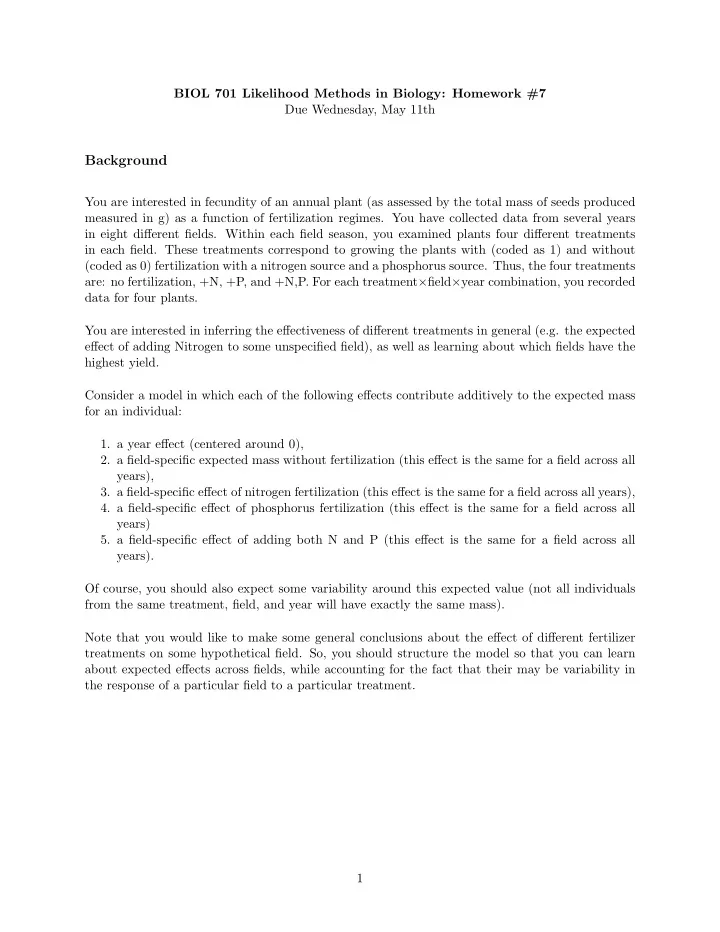
Background You are interested in fecundity of an annual plant (as - - PDF document

background
SMART_READER_LITE
LIVE PREVIEW

Background You are interested in fecundity of an annual plant (as - - PDF document

BIOL 701 Likelihood Methods in Biology: Homework #7 Due Wednesday, May 11th Background You are interested in fecundity of an annual plant (as assessed by the total mass of seeds produced measured in g) as a function of fertilization regimes. You


slide-1
SLIDE 1

BIOL 701 Likelihood Methods in Biology: Homework #7 Due Wednesday, May 11th

Background

You are interested in fecundity of an annual plant (as assessed by the total mass of seeds produced measured in g) as a function of fertilization regimes. You have collected data from several years in eight different fields. Within each field season, you examined plants four different treatments in each field. These treatments correspond to growing the plants with (coded as 1) and without (coded as 0) fertilization with a nitrogen source and a phosphorus source. Thus, the four treatments are: no fertilization, +N, +P, and +N,P. For each treatment×field×year combination, you recorded data for four plants. You are interested in inferring the effectiveness of different treatments in general (e.g. the expected effect of adding Nitrogen to some unspecified field), as well as learning about which fields have the highest yield. Consider a model in which each of the following effects contribute additively to the expected mass for an individual:

  • 1. a year effect (centered around 0),
  • 2. a field-specific expected mass without fertilization (this effect is the same for a field across all

years),

  • 3. a field-specific effect of nitrogen fertilization (this effect is the same for a field across all years),
  • 4. a field-specific effect of phosphorus fertilization (this effect is the same for a field across all

years)

  • 5. a field-specific effect of adding both N and P (this effect is the same for a field across all

years). Of course, you should also expect some variability around this expected value (not all individuals from the same treatment, field, and year will have exactly the same mass). Note that you would like to make some general conclusions about the effect of different fertilizer treatments on some hypothetical field. So, you should structure the model so that you can learn about expected effects across fields, while accounting for the fact that their may be variability in the response of a particular field to a particular treatment. 1

slide-2
SLIDE 2
  • 1. Write down the likelihood for your model.

Begin Answer: i indexes the year. j indexes the field. k indexes the Nitrogen (0= no Nitrogen, 1 = Nitrogen). m indexes the Phosphorus (0= no Phosphorus, 1 = Phosphorus). q indexes the individual in that year×field×treatment. yijkmq ∼ N(αi + βj + kγj + mδj + kmρj, σ2

e)

a is the number of years b is the number of fields nijkm is the number of individuals in the specified year×field×treatment f(yijkmq|αi, βj, γj, δj, ρj, σe) = 1

  • 2πσ2

e

e

−(yijkmq−αi−βj−kγj−mδj−kmρj)2 2σ2 e

f(Y |α, β, γ, δ, ρ, σe) =

a

  • i=1

b

  • j=1

1

  • k=0

1

  • m=0

nijkm

  • q=1

f(yijkmq|αi, βj, γj, δj, ρj, σe) Using the priors introduced below (next section), we can write the likelihood in terms of the “highest level” parameters:

f(Y |σα, µβ, σβ, µγ, σγ, µδ, σδ, µρ, σρ, σe) = Z Z Z Z Z f(Y |α, β, γ, δ, ρ, σe) Pr(α|σα) Pr(β|µβ, σβ) Pr(γ|µγ, σγ) Pr(δ|µδ, σδ) Pr(ρ|µρ, σρ)dαdβdγdδdρ

(if we take the integration symbol over a vector of latent variables to mean that we perform the integration with respect to each variable in the vector, and we calculate the definite integral from −∞ to ∞). Where Pr(α|σα) =

a

  • i

1

  • 2πσ2

α

e

−α2 i 2σ2 α

Pr(β|µβ, σβ) =

a

  • i

1

  • 2πσ2

β

e

−(βi−µβ)2 2σ2 β

Pr(γ|µγ, σγ) =

a

  • i

1

  • 2πσ2

γ

e

−(γi−µγ)2 2σ2 γ

Pr(δ|µδ, σδ) =

a

  • i

1

  • 2πσ2

δ

e

−(δi−µδ)2 2σ2 δ

Pr(ρ|µρ, σρ) =

a

  • i

1

  • 2πσ2

ρ

e

−(ρi−µρ)2 2σ2 ρ

2

slide-3
SLIDE 3

End Answer. 3

slide-4
SLIDE 4

2 List each parameter and the prior distribution that you have chosen to use for the parameter. Begin Answer: (there are lots of possible ways to answer - priors are up to the person analyzing the data!) a year effects (latent variables) αi ∼ Normal(0, σ2

α)

The variance of the year effects σ2

α ∼ Exponential(λ = .1)

b field effects (latent variables) βj ∼ Normal(µβ, σ2

β)

The expected value of the field effects (no fert) µβ ∼ Gamma(mean = 250, variance = 50) The variance of the field effects(no fert) σ2

β ∼ Exponential(λ = .05)

b field×nitrogen effects (latent variables) γj ∼ Normal(µγ, σ2

γ)

The expected value of the nitrogen effects µγ ∼ Normal(mean = 5, variance = 10) The variance of the nitrogen effects σ2

γ ∼ Exponential(λ = .1)

b field×phosphorus effects (latent variables) δj ∼ Normal(µδ, σ2

δ)

The expected value of the phosphorus effects µδ ∼ Normal(mean = 5, variance = 10) The variance of the phosphorus effects σ2

δ ∼ Exponential(λ = .1)

b field×nitrogen×phosphorus interaction effects (la- tent variables) ρj ∼ Normal(µρ, σ2

ρ)

The expected value of the nitrogen×phosphorus inter- action effect µρ ∼ Normal(mean = 0, variance = 10) The variance of the nitrogen×phosphorus interaction effects σ2

ρ ∼ Exponential(λ = .1)

The environmental/error standard deviation σ2

e ∼ Exponential(λ = .1)

End Answer. 4