BACKGROUND This is the largest Ebola outbreak in history The - - PDF document

background
SMART_READER_LITE
LIVE PREVIEW

BACKGROUND This is the largest Ebola outbreak in history The - - PDF document

4/20/2015 EBOLA PREPAREDNESS AND PROCEDURES University of Toledo Medical Center And University of Toledo Main Campus BACKGROUND This is the largest Ebola outbreak in history The disease has infected and killed people in four West


slide-1
SLIDE 1

4/20/2015 1

EBOLA PREPAREDNESS AND PROCEDURES

University of Toledo Medical Center And University of Toledo Main Campus

BACKGROUND

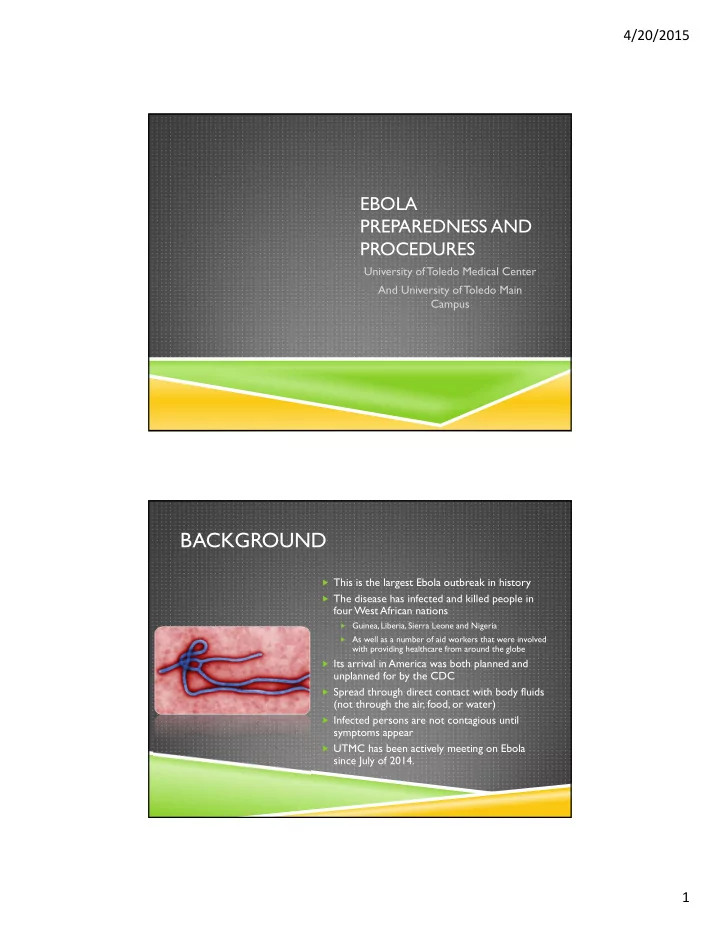
 This is the largest Ebola outbreak in history  The disease has infected and killed people in

four West African nations

 Guinea, Liberia, Sierra Leone and Nigeria  As well as a number of aid workers that were involved

with providing healthcare from around the globe

 Its arrival in America was both planned and

unplanned for by the CDC

 Spread through direct contact with body fluids

(not through the air, food, or water)

 Infected persons are not contagious until

symptoms appear

 UTMC has been actively meeting on Ebola

since July of 2014.

slide-2
SLIDE 2

4/20/2015 2

INITIAL SCREENING IN LATE JULY

 International students were

screened via questionnaire

 The screening revealed no students

returning from endemic areas and having contact with EVD patients

TRAVEL REGISTRY

 Student, faculty and staff travelling outside of

the U.S. are currently being asked to complete and online travel registry

 http://www.utoledo.edu/cisp/alerts.html  In addition the Transportation Security

Administration (TSA) is also updating local health authorities regarding travel to endemic areas.

 ODH has implement a “strengthened

quarantine” strategy

 Web Page for Ebola  http://www.utoledo.edu/depts/infectioncontr

  • l/CurrentHotTopics.html
slide-3
SLIDE 3

4/20/2015 3

SCREENING IN THE ED AND CLINICS CODE ORANGE

 Upon notification of EVD patient, a Code Orange will be called  Code orange procedures will be followed (w/Ebola additions)  Triage personnel will put PPE (located in triage room) on themselves and

the patient.

 Patient must remain in the triage room until relocation.  Holding of patient takes place in Room #21 of ED for ~48hours  Long term holding will be on 6CD

slide-4
SLIDE 4

4/20/2015 4

SO WHO HAS BEEN TRAINED AND WHY?

 The ED staff nurse and doctors have been trained a number of times on

PPE procedures in Simulation Center

 ED residents and others have also been trained but will not care for a

confirmed EVD patient.

 We have a core team of ED docs and nurses that will care for the patient in

the short term in the ED

 Attending faculty and nurses (mainly the ED) have volunteered to care for

patients that may be held for an extended period on 6CD.

 Volunteers will continually be accepted and training will continue for this

core group on a on-going basis.

 We have plans to extend our response if a more aggressive outbreak

  • ccurs in the region.

 Drills and simulations have been conducted and will continue to be

performed to test our response capabilities.

CHANGES TO PPE BASED ON CDC AND OTHER GUIDANCE

 Addition of blue booties

 These are placed on after Tyvek suit  Attach strap to prevent bootie from

slipping down

 Addition of pull over hood

slide-5
SLIDE 5

4/20/2015 5

CHANGES TO N-95 KITS

 Addition of unattached hood

 The Tyvek’s attached hood must

now be rolled and tucked into suit

 Unattached hood is placed over

head and shoulders and tied in back

 Yellow gown goes overtop shroud

  • f hood

 When removing hood, grasps top

  • f hood, pulling upward and away

from face

slide-6
SLIDE 6

4/20/2015 6

OPTION OF PAPR GEAR

 The option of PAPR gear has been added  It will be used with a blue outer gown  It has a hood with built in face shield  Used during prolonged periods in patient

room

 N-95 PPE kits are still primary option when

potential EVD patient presents as they are staged in triage

slide-7
SLIDE 7

4/20/2015 7

slide-8
SLIDE 8

4/20/2015 8

  • Room 1300 will be

the hot zone for the patient

  • Putting on PPE will
  • ccur in 1261
  • Taking off PPE will
  • ccur in 1260,

removing all PPE

  • Crocs will be

removed in 1262, and scrubs removed in 1261

Emergency Department Zones and barriers

  • Patient

movement starts in 1300

  • Patient travels

to patient elevators following red dotted line

Movement of Patient from ed 1300 to 6cd

slide-9
SLIDE 9

4/20/2015 9

  • Patient moves

from elevator to 6190 or 6186 if multiple patients

Movement of Patient from ed 1300 to 6cd (Cont)

  • 6190 and/or 6186

will be patient rooms

  • Putting on PPE will
  • ccur in 6182
  • Taking off PPE will
  • ccur on red half
  • f 6183
  • Crocs and scrubs

will be removed in 6183D

6cd Zones and barriers