Background Using Information Technology, 18-20 August 2003 - - PDF document

background
SMART_READER_LITE
LIVE PREVIEW

Background Using Information Technology, 18-20 August 2003 - - PDF document

Ad Hoc Expert Group Meeting on Poverty Mapping and Monitoring Background Using Information Technology, 18-20 August 2003 Background Demand request from countries for technical assistance on POVERTY MAPPING AND MONITORING POVERTY MAPPING


slide-1
SLIDE 1

1

POVERTY MAPPING AND MONITORING POVERTY MAPPING AND MONITORING USING INFORMATION TECHNOLOGY: USING INFORMATION TECHNOLOGY: AN OVERVIEW AN OVERVIEW

Hiren Sarkar and Edgar Dante Poverty and Development Division

Ad Hoc Expert Group Meeting on Poverty Mapping and Monitoring Using Information Technology, 18-20 August 2003

Background Background

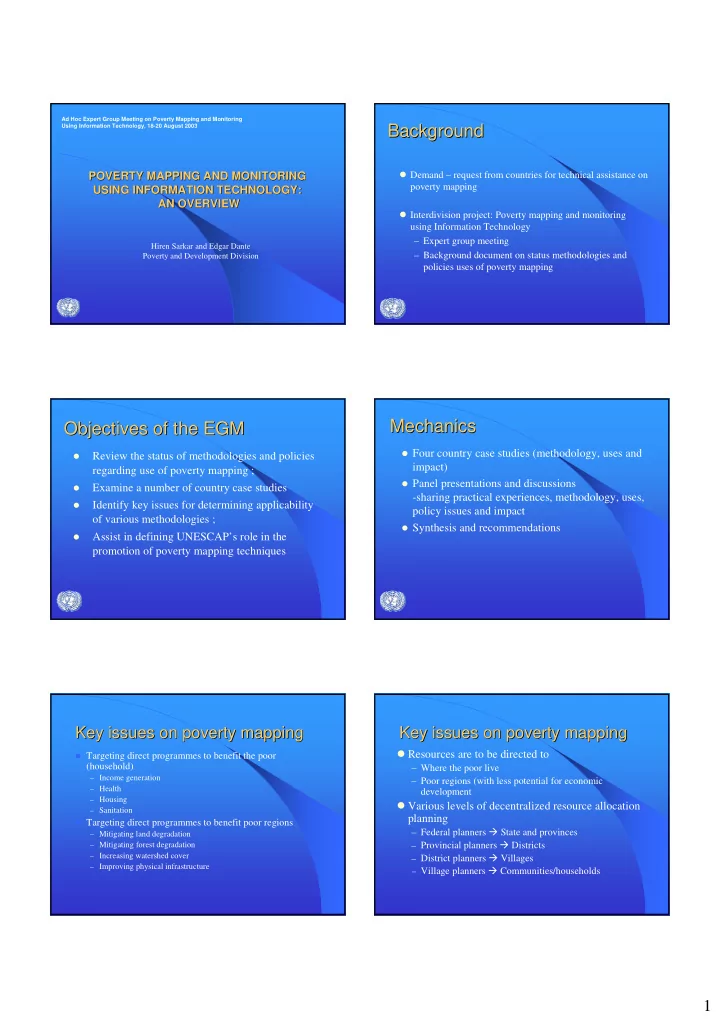
 Demand – request from countries for technical assistance on poverty mapping  Interdivision project: Poverty mapping and monitoring using Information Technology – Expert group meeting – Background document on status methodologies and policies uses of poverty mapping

Objectives of the EGM Objectives of the EGM

Review the status of methodologies and policies regarding use of poverty mapping ;

Examine a number of country case studies

Identify key issues for determining applicability

  • f various methodologies ;

Assist in defining UNESCAP’s role in the promotion of poverty mapping techniques

Mechanics Mechanics

 Four country case studies (methodology, uses and

impact)

 Panel presentations and discussions

  • sharing practical experiences, methodology, uses,

policy issues and impact

 Synthesis and recommendations

Key issues on poverty mapping Key issues on poverty mapping

 Targeting direct programmes to benefit the poor

(household)

– Income generation – Health – Housing – Sanitation  Targeting direct programmes to benefit poor regions – Mitigating land degradation – Mitigating forest degradation – Increasing watershed cover – Improving physical infrastructure

Key issues on poverty mapping Key issues on poverty mapping

 Resources are to be directed to

– Where the poor live – Poor regions (with less potential for economic development

 Various levels of decentralized resource allocation planning

– Federal planners  State and provinces

– Provincial planners  Districts – District planners  Villages – Village planners  Communities/households

slide-2
SLIDE 2

2

Production and use of poverty maps Production and use of poverty maps

Production issues

 Poverty maps uses small area distribution of

economic welfare estimated from statistical data which are normally available for a country (combination of household survey and population census)

Production issues Production issues

 How to combine the two data sets  Data – household survey / census  Estimation of the income/consumption model  Simulation of income/consumption of all

household in population census

 Poor-nonpoor classification by using poverty lines  Aggregation of poverty for small areas; districts,

sub-districts, villages

Geographic Information System (GIS) Geographic Information System (GIS)

 Spatial representation of income poverty as well as

attributes/indicators of poverty, such as ecological dimension of poverty, watershed atlas, vulnerability atlas, food security and natural resources

 Stand alone maps could identify poor region but not ‘poor

region housing large number of poor people’

 Maps of transport information, public service centers and

urbanization

 Superimposing ‘attributes’ with ‘poverty status’ maps

Issues regarding use of poverty maps Issues regarding use of poverty maps

 Who will use the maps?  What will be the use: – Locating where there is a concentration of the income

poor and resources should be allocated

– Locating where there is a concentration of ‘poverty

attributes’ (degraded land and forest cover, lock of watershed, etc.) and resources should be allocated

– Resource allocation planning and monitoring impact

  • f policies

– Reliability of poverty and other maps for allocating

resources and monitor impacts

What do we expect from this meeting? What do we expect from this meeting?  Identification of priority constraints and recommendations for alleviating those

– Creation and adoption of appropriate and reliable methodology – Human resources for production, interpretation and use of poverty maps (national capacities) – Financial resources – Institutions (multidisciplinary?)

Possible role of UNESCAP Possible role of UNESCAP

 Technical assistance in organizing poverty

mapping exercises

 Technical assistance in providing training  Providing forums for experience sharing

(expected results?)

 Advocacy

slide-3
SLIDE 3

3 Poverty Mapping Poverty Mapping – – An Overview An Overview

1.

Recent interest in poverty mapping

2.

Policy applications

3.

Methods of poverty mapping

4.

Key issues: methods and use poverty maps

Poverty mapping Poverty mapping – – not new! not new!

Involves measuring or estimating the extent of poverty

  • r food security for geographic areas

Recent Interest in Poverty Mapping Recent Interest in Poverty Mapping

Global agenda on poverty reduction

Millennium Development Goals (MDGs)

Challenge – inequality!

“In many countries, the letter of the Goals may be achieved if efforts focus on people already doing the best in society. But the spirit of the Goals is not met if countries that cross the finish line leave behind many poor people” (Human Development Report 2003)

Needs effective targeting, including geographic

Promotion by World Bank, UN agencies, etc.

 Advancement in Information and Communication

Technology (computers, GIS, Remote Sensing)

 GIS is a computer software that links geographic

information (where things are) with descriptive information (what things are)

 GIS produces digital maps. Unlike a flat paper map,

a GIS digital map can present many layers of different information of the map

 Most types of poverty mapping increasingly depend

  • n GIS generated data.

Recent Interest in Poverty Mapping Recent Interest in Poverty Mapping Recent Interest in Poverty Mapping Recent Interest in Poverty Mapping

 Advancement in statistical modeling

techniques

– Small area estimation – Use of available data (household surveys and

census to estimate poverty indicators)

Poverty mapping Poverty mapping – – high resolution high resolution

slide-4
SLIDE 4

4 Policy applications of poverty maps Policy applications of poverty maps

  • Targeting of emergency food aid and poverty

reduction programmes

  • Planning of health services
  • Development of early warning system
  • Distribution of scholarship programme
  • Planning and targeting infrastructure projects
  • Targeting of livestock research
  • Environmental assessment

Increasing number of applications!

Targeting of poverty reduction Targeting of poverty reduction

 Viet Nam’s Comprehensive Poverty

Reduction and Growth Strategy will use district level poverty maps to improve targeting of poverty reduction programmes

– Provide new jobs to 1.4-1.5 million people per year – Improve quality of education – Provide clean water to 85% of population – Upgrade irrigation systems

Planning health services Planning health services

 Maps of poverty, sanitation, water supply

and cholera incidence were heavily used to help contain a cholera outbreak in South Africa in 2001

Assessment of food security Assessment of food security

 Cambodia, WFP has used commune level

poverty maps since 1995 to help identify the most food-insecure communes, especially for the “food for work” programme

– Allocating US$ 50 million in WFP food aid

(2001-03)

Planning infrastructure projects Planning infrastructure projects

 The World Bank is using Guatemala’s

poverty map in conjunction with other data to help develop a road strategy. This will influence the allocation of US$ 100 million for road improvement

Education Education

 Poverty map was used in Guatemala to

verify whether scholarships had been allocated to the poorest municipalities

slide-5
SLIDE 5

5

Methods of poverty mapping Methods of poverty mapping

  • 1. Small area estimation

 Household-level data  Community-level data

– Advantages

– Use available datasets (census and household survey) – Proven feasible in many countries

  • Nicaragua, Ecuador, Panama, South Africa, Indonesia,

Thailand, Viet Nam, Cambodia, Guatemala, Madagascar, Malawi, Mozambique, etc.

– Reliability of estimates can be checked easily – Institutional and technical backing of the World Bank

Disadvantages

– presents a number of computational and econometric challenges – Large size datasets – Timing of data sources – High level of technical expertise Household survey data Model of household expenditure Apply model to census Aggregate by area

Methods of poverty mapping Methods of poverty mapping

  • 2. Composite indexes

Community-level data

Variables are selected (typically > 3 variables)

Weighting schemes (equal weights, use statistical techniques)

Transform several variables into one index

Rely of population census dataset

Examples:

Marginality index (Mexico) – Literary, access to water, drainage, electricity, household size, floor,

  • ccupation

Human Development Index (HDI), UNDP – Life expectancy, literacy, Income –

Advantages:

Less data requirements than small area estimation

Requires community-level averages from census –

Disadvantages

High level of technical expertise

Accuracy of estimates unclear

Methods of poverty mapping Methods of poverty mapping

  • 3. Combination of qualitative information and secondary

data

Rapid rural appraisal techniques

Semi structured group interviews

Supplemented with secondary data

Examples: FAO, WFP for food security assessment

Advantages:

 Permits incorporation of qualitative information  Less data requirement  Requires lower level of expertise and instead more field experience

Disadvantages:

 Subjective  Unclear how use of qualitative information effects outcomes and precision of

estimates

 Procedure undeveloped

Key issues and challenges Key issues and challenges

 Selection of method

  • different methods could lead to different results

 Precision of estimates, statistical error  Local demand  Applicability and limitations  Costs  Availability of local technical expertise  Risk of misinformation  Availability, access and quality of input data  Sustainability – like other tools, there is risk of being abandoned once donor’s funds and support have waned – Difficulty in sustaining costly information system

Poverty mapping Poverty mapping – – is a tool! is a tool!

 Powerful tool for information and analysis  Clear objectives in mind to guide interpretation of the

maps and determine the appropriate methodology to utilize

 It can lead to misinterpretation and to serious policy and

analytical mistakes.