Background Julie A. Moran, D.O. Consultant, Intellectual and - - PDF document

background
SMART_READER_LITE
LIVE PREVIEW

Background Julie A. Moran, D.O. Consultant, Intellectual and - - PDF document

9/30/2014 Practical Evaluation of the Adult with Intellectual/Developmental Disability and Suspected Dementia Background Julie A. Moran, D.O. Consultant, Intellectual and Developmental Disabilities, Geriatrics, Tewksbury Hospital, Mass Dept.


slide-1
SLIDE 1

9/30/2014 1

Practical Evaluation of the Adult with Intellectual/Developmental Disability and Suspected Dementia

  • Julie A. Moran, D.O.

Consultant, Intellectual and Developmental Disabilities, Geriatrics, Tewksbury Hospital, Mass Dept. of Dev. Services Clinical Instructor of Medicine, Harvard Medical School

Background

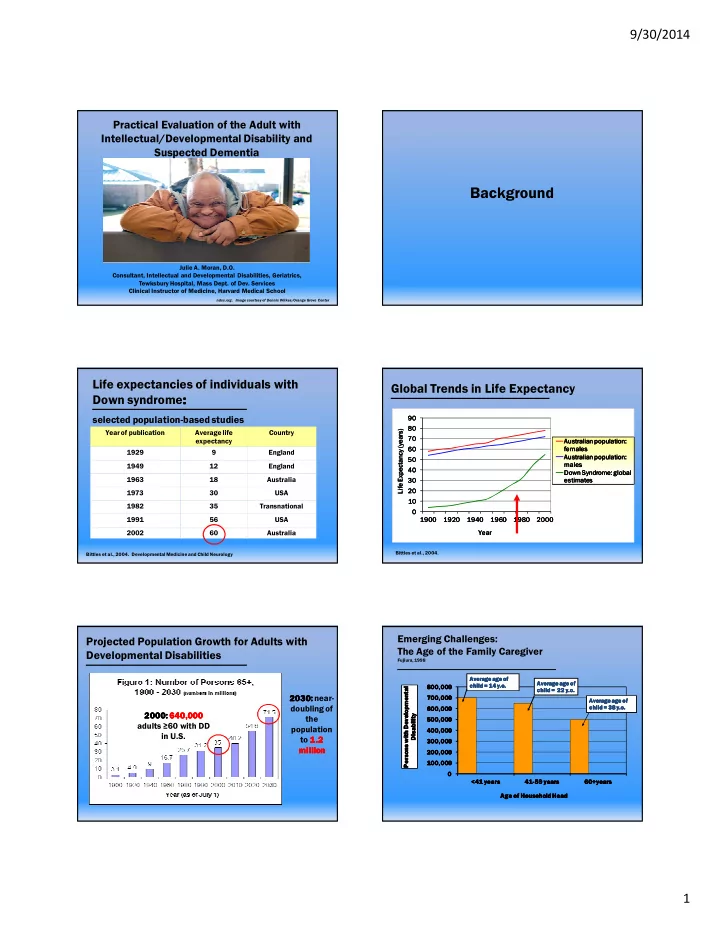
Year of publication Average life expectancy Country 1929 9 England 1949 12 England 1963 18 Australia 1973 30 USA 1982 35 Transnational 1991 56 USA 2002 60 Australia

Life expectancies of individuals with Down syndrome: : : :

selected population8based studies

Bittles et al., 2004. Developmental Medicine and Child Neurology

  • !

! ! ! " " " " ! ! ! ! " " " " # $%& "!' ( # $%& "!' ( # $%& "!' ( # $%& "!' ( " " " "

Global Trends in Life Expectancy

Bittles et al., 2004

Projected Population Growth for Adults with Developmental Disabilities

2000 2000 2000 2000: : : : 640,000 640,000 640,000 640,000 adults ≥60 with DD in U.S. 2030 2030 2030 2030: : : : near8 doubling of the population to 1.2 1.2 1.2 1.2 million million million million

Emerging Challenges: The Age of the Family Caregiver

Fujiura, 1998

100,000 100,000 100,000 100,000 200,000 200,000 200,000 200,000 300,000 300,000 300,000 300,000 400,000 400,000 400,000 400,000 500,000 500,000 500,000 500,000 600,000 600,000 600,000 600,000 700,000 700,000 700,000 700,000 800,000 800,000 800,000 800,000 <41 years <41 years <41 years <41 years 41 41 41 418 8 8 859 years 59 years 59 years 59 years 60+years 60+years 60+years 60+years Persons with Developmental Persons with Developmental Persons with Developmental Persons with Developmental Disability Disability Disability Disability Age of Household Head Age of Household Head Age of Household Head Age of Household Head Average age of Average age of Average age of Average age of child = 22 child = 22 child = 22 child = 22 y.o y.o y.o y.o. . . . Average age of Average age of Average age of Average age of child = 38 child = 38 child = 38 child = 38 y.o y.o y.o y.o. . . . Average age of Average age of Average age of Average age of child = 14 child = 14 child = 14 child = 14 y.o y.o y.o y.o. . . .

slide-2
SLIDE 2

9/30/2014 2

How well8prepared is the medical community to care for older adults with I/DD?

“For People With Down Syndrome, Longer Life “For People With Down Syndrome, Longer Life “For People With Down Syndrome, Longer Life “For People With Down Syndrome, Longer Life Has Complications Has Complications Has Complications Has Complications”

Published: June 1, 2008 Published: June 1, 2008 Published: June 1, 2008 Published: June 1, 2008 By Sally Sara

“Seeking Grown “Seeking Grown “Seeking Grown “Seeking Grown8 8 8 8up Care” up Care” up Care” up Care”

Published: February 2, 2009 Published: February 2, 2009 Published: February 2, 2009 Published: February 2, 2009 By Patricia Wen

Accelerated Aging in Down syndrome

Alzheimer’s disease Hypothyroidism Sensory deficits

Early/aggressive cataracts Sensorineural hearing loss

Early menopause Atlantoaxialinstability Obstructive sleep apnea Osteoarthritis Decrease in functional ability Osteoporosis

  • Common Conditions in Older Adults

with CP

Contractures and worsened spasticity Neurogenic bowel and bladder Osteoarthritis Osteoporosis GERD Poor dental hygiene PAIN

http://www.teamhoyt.com/gallery/

But what about everything else??

– Sturge Weber? – Congenital hydrocephalus? – Prader Willi? – Autism??

What is normative aging in I/DD? What is normative aging in I/DD? What is normative aging in I/DD? What is normative aging in I/DD?

slide-3
SLIDE 3

9/30/2014 3

Additional lifespan considerations for this current aging generation

State institutionalization Early and prolonged exposure to psychoactive medications Lack of formal, expert diagnosis Poor medical record8keeping Lack of longitudinal historians Lack of ongoing family contact Fear of support services

Challenge unique to adults with I/DD:

OVERdiagnosis

  • Failing to recognize changes

Failing to recognize changes Failing to recognize changes Failing to recognize changes or attributing them to the patient’s intellectual disability UNDERdiagnosis by either:

  • Over

Over Over Over8 8 8 8calling calling calling calling the diagnosis the diagnosis the diagnosis the diagnosiswithout exploring all other possibilities

Risk of Dementia

Prevalence of dementia in I/DD

  • Historically conflicting data
  • In adults with I/DD not due to Down

syndrome:

– Longitudinal study from 20041 concluded rates of dementia were ≤ rates in the general population – Epidemiologic survey of 281 adults from 20092 found that dementia was 283 times more common in the non8DS ID/DD population

  • 1. Zigman et al. Am Journal of MR, 2004.
  • 2. Strydom et al. Psych Med, 2009.

Prevalence of AD in adults with DS

Prasher, VP. Alzheimer’s Disease and Dementia in Down Syndrome and Intellectual Disabilities, 2005.

Genetic link between DS and AD

3 copies of chromosome 21 in DS (trisomy) Gene coding for APP

  • verexpressed on

chromosome 21 Other genes on 21 also likely associated with changes of premature AD as well as accelerated aging

slide-4
SLIDE 4

9/30/2014 4

The Diagnostic Dilemma: Risk stratification

Adults with Down syndrome Everyone else?? Certain key factors to consider:

– Severity of intellectual disability – Family history – History of stroke or cerebrovascular disease – History of head injury – Psychiatric comorbidity/exposure to psychoactive medication – Epilepsy

Risk Factors to Consider in DS

Family history of Alzheimer’s disease in a first degree relative (esp early onset) Known vascular pathology or cerebrovascular risk Karyotype of trisomy 21 Head trauma Severity of intellectual disability Estrogen deficiency (earlier age of onset of menopause)

What is dementia?

DSM8IV criteria for dementia DSM85 criteria for major neurocognitive disorder (previously dementia) A1. A1. A1.

  • A1. Memory impairment

A. A. A.

  • A. Evidence of significant cognitive decline from a

previous level of performance in one or more cognitive domains*: 8 Learning and memory 8 Language 8 Executive function 8 Complex attention 8 Perceptual8motor 8 Social cognition A2. A2. A2.

  • A2. At least one of the following:

8 Aphasia 8 Apraxia 8 Agnosia 8 Disturbance in executive functioning B. B. B.

  • B. The cognitive deficits in A1 and A2 each cause

significant impairment in social or occupational functioning and represent a significant decline from a previous level of functioning B. B. B.

  • B. The cognitive deficits interfere with

independence in everyday activities. At a minimum, assistance should be required with complex instrumental activities of daily living, such as paying bills or managing medications. C. C. C.

  • C. The cognitive deficits do not occur exclusively

during the course of delirium C. C. C.

  • C. The cognitive deficits do not occur exclusively in

the context of a delirium D. D. D.

  • D. The cognitive deficits are not better explained by

another mental disorder (eg, major depressive disorder, schizophrenia)

References: American Psychiatric Association Diagnostic and Statistical Manual, 4th ed, APA Press, Washington, DC, 1994. American Psychiatric Association. Diagnostic and Statistical Manual of Mental Disorders, Fifth Edition (DSM85), American Psychiatric Association, Arlington, VA 2013.

Mayo Clin Proc. August 2013;88(8):8318840

Chief Complaint:

“Something’s different” Or, in the words of your patient….

slide-5
SLIDE 5

9/30/2014 5

Assessing Change over Time Point “A” Point “B”

? ? ? ?

Evaluating Change in Adults with I/DD

  • History, history, history
  • Specific challenges to history taking:

– Who’s the historian? – High staff turnover – Lack of longitudinal relationships over the lifespan – Medical record keeping is inconsistent – Lack of accuracy of underlying I/DD diagnosis

General Approach to Assessing Change

Establish a historic baseline

Basic function: self care skills Skills: academic achievements, employment, household chores, talents Memory Behavior Language Abilities Personality Mood

Assessing Change

  • Once Point “A” is established (baseline),

generate a description of the same domains observed currently

  • Then compare and contrast the

differences…

Function

Independent in all self care Needs assistance with bathing and dressing

Skills

Worked competitively, could read, write Work is declining, considering transfer to day hab

Memory

Excellent memory for names, birthdays, phone numbers Forgetful of daily schedule, unable to learn new names of staff

slide-6
SLIDE 6

9/30/2014 6

Behavior

Occasional acting out when didn’t get what he wanted Aggressive at times of self care, attempting to hit staff

Language

Very good expressive and receptive skills Word finding difficulties, speaks in phrases

Personality

Charming, loves people, loves social activities Less outgoing, prefers to spend time in his room

Mood

Generally happy, upbeat, easygoing Moody, more quick to anger

Point “A” in picture format…

Additional importance having an accurate baseline…

Each individual is normed against him/herself ONLY….

Applying a general geriatric principle:

As we age, we become increasingly more unique… Pediatric growth charts No geriatric equivalent!

Key Review of Systems

  • Vision
  • Hearing
  • Dental issues
  • Seizures
  • Weight/appetite
  • Swallowing
  • Incontinence
  • Sleep
  • Snoring
  • Gait
  • Falls
  • Pain
  • H/o head injury

Medications, medications….

  • Rampant polypharmacy
  • Multiple psychoactive medications
  • Longstanding antiepileptic

medications

  • Anticholinergic medications
  • Underutilization of non8

pharmacologic interventions for behavioral issues

slide-7
SLIDE 7

9/30/2014 7

Psychosocial issues: Living into old age has new implications

child young adult older adult child young adult older adult child young adult older adult child young adult older adult

Move out of the family Move out of the family Move out of the family Move out of the family home home home home Transition to group Transition to group Transition to group Transition to group home home home home Changes in Changes in Changes in Changes in parents’ parents’ parents’ parents’ health health health health Personal or peer Personal or peer Personal or peer Personal or peer experience with experience with experience with experience with illness illness illness illness Loss of parent or other Loss of parent or other Loss of parent or other Loss of parent or other close family members close family members close family members close family members Loss of peers or Loss of peers or Loss of peers or Loss of peers or housemates housemates housemates housemates

Unpredictable life stressors

Emotional support is critical for coping with changes related to aging.

Memory Testing

No single universally accepted test or tool Direct testing should aim to test the main domains of memory and cognitive function Typically a combination of

  • Standardized tests
  • Office testing (provider8specific)

Gathering additional information

  • Laboratory tests:
  • n everyone: extended lytes, BUN/Cr, TSH, B12,

folate, CBC, AST/ALT

  • selected cases: TTG8IgA, total IgA, serum drug levels,

RPR/HIV

  • Sleep study: if sleep apnea or other sleep disorder

is suspected

  • CT/MRI of brain
  • **Request of additional information from other

caregivers or providers

Consider all possible coexisting conditions

What undetected, untreated (or undertreated) conditions are potentially modifiable or improvable?

Hypothyroidism or other metabolic derangements? Sensory deficits? Obstructive sleep apnea? Osteoarthritis? Pain? Celiac disease? Mood disorder?

Just a handful of real examples of coexisting contributors:

– Undetected daily hypoglycemia – Hyponatremia related to medications – Cervical radiculopathy and myelopathy – Untreated pain in 65 y.o. w/ CP – Undetected sleep apnea – Grief re: loss of mother and close housemate within the past 6 months – Dilantin toxicity

slide-8
SLIDE 8

9/30/2014 8

DSM8IV criteria for dementia DSM85 criteria for major neurocognitive disorder (previously dementia) A1. A1. A1.

  • A1. Memory impairment

A. A. A.

  • A. Evidence of significant cognitive decline from a

previous level of performance in one or more cognitive domains*: 8 Learning and memory 8 Language 8 Executive function 8 Complex attention 8 Perceptual8motor 8 Social cognition A2. A2. A2.

  • A2. At least one of the following:

8 Aphasia 8 Apraxia 8 Agnosia 8 Disturbance in executive functioning B. B. B.

  • B. The cognitive deficits in A1 and A2 each cause

significant impairment in social or occupational functioning and represent a significant decline from a previous level of functioning B. B. B.

  • B. The cognitive deficits interfere with

independence in everyday activities. At a minimum, assistance should be required with complex instrumental activities of daily living, such as paying bills or managing medications. C. C. C.

  • C. The cognitive deficits do not occur exclusively

during the course of delirium C. C. C.

  • C. The cognitive deficits do not occur exclusively in

the context of a delirium D. D. D.

  • D. The cognitive deficits are not better explained by

another mental disorder (eg, major depressive disorder, schizophrenia)

References: American Psychiatric Association Diagnostic and Statistical Manual, 4th ed, APA Press, Washington, DC, 1994. American Psychiatric Association. Diagnostic and Statistical Manual of Mental Disorders, Fifth Edition (DSM85), American Psychiatric Association, Arlington, VA 2013.

Making the diagnosis

  • Diagnosis of inclusion AND exclusion
  • Identify coexisting conditions and endeavor to

treat/improve all as feasible

  • Consider overshadowing features of new or

concurrent psychiatric illness

  • Review all supporting data
  • Keep careful records to follow performance over

time

  • Diagnosis doesn’t have to be given at the first

visit

Staging in Alzheimer’s disease

  • The importance of expectation8setting
  • Early Stage
  • Mid Stage
  • Advanced or End Stage Dementia
  • Profound memory loss
  • Full functional dependence
  • Full incontinence (bladder and bowel)
  • Loss of meaningful speech

Final thoughts about common pitfalls

Dementia is a “sticky” diagnosis

On problem lists, diagnosis is frequently inaccurate or never formally worked up Today’s “cut and paste” culture allows for rampant propagation of bad information Often used as the explanation for any changes observed once diagnosis is obtained

Common pitfalls…

  • Inadequate “hand8off” to new caregivers
  • Presumption that features are consistent

with their underlying disability

  • Presumption that abnormalities observed

are an expected component of aging

  • Presumption that changes or

abnormalities are behavioral without proper exploration of other possibilities

slide-9
SLIDE 9

9/30/2014 9

Common pitfalls…

  • Presumption that everyone with I/DD

eventually develops dementia

  • Multiple prescribers that communicate

poorly with one another

  • Polypharmacy

Beware of….

  • Dementia diagnoses made while acutely

hospitalized

  • Dementia diagnoses made off of brain

imaging

  • H/o past reactions to Aricept or other

memory enhancing medications (probe deeper to get the full story)

Additional Resources

www.aadmd.org/ntg www.alz.org

www.ndss.org

Be curious. Stay curious. Thank you!