Background Background Total ankle replacement has become a viable - - PowerPoint PPT Presentation

background background
SMART_READER_LITE
LIVE PREVIEW

Background Background Total ankle replacement has become a viable - - PowerPoint PPT Presentation

5/8/2014 Total Ankle Replacement with Total Ankle Replacement with Pre-existing Bone Defects Pre-existing Bone Defects Andrew Haskell, MD I have no conflicts associated with this presentation Braden Criswell, MD Todd Kim, MD President


slide-1
SLIDE 1

5/8/2014 1

Total Ankle Replacement with Pre-existing Bone Defects

Andrew Haskell, MD

Braden Criswell, MD Todd Kim, MD Ken Hunt, MD Loretta Chou, MD

Total Ankle Replacement with Pre-existing Bone Defects

I have no conflicts associated with this presentation

President – OrthoHub, Inc Consultant – Articulinx, Moximed

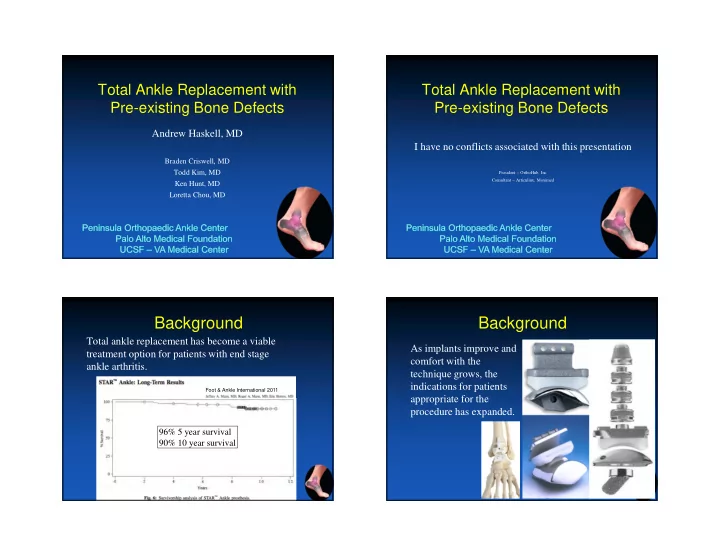
Background

Total ankle replacement has become a viable treatment option for patients with end stage ankle arthritis.

Foot & Ankle International 2011

96% 5 year survival 90% 10 year survival

Background

As implants improve and comfort with the technique grows, the indications for patients appropriate for the procedure has expanded.

slide-2
SLIDE 2

5/8/2014 2

Background

One area that has not received attention is the management of preexisting tibial and talar bone defects during primary total ankle replacement.

Goals

  • Describes the prevalence of bone defects in a

cohort of patients undergoing total ankle replacement

  • Compare complication rates of those

with and without bone defects

  • Hypothesis: The presence of bone defects at

the time of total ankle surgery will effect the rate of early complications.

Methods

  • Retrospective study approved by PAMF IRB
  • Consecutive series of 124 patients undergoing

total ankle replacement between 2007 and 2013

  • Demographic and case specific data were

collected from medical records and PACS system

  • Chi-square

Demographics

Demographics Age 67±10 BMI 30.25±4.04 DM 14/124 11% Smoking 2/124 2% Post-traumatic/instability 87/124 70% Revision 11/124 8%

slide-3
SLIDE 3

5/8/2014 3

Overall Complications

  • ver the first year

No Complication Complication Any Complications No 92/124 74%

Yes 32/124 26%

Complication Type

Wound 15/124 12%

Other 8/124 7%

Fractur e 6/124 5%

Osteolysis 3/124 2%

Wound problems Other Fracture Osteolysis

Bone Loss

  • Low bar set to define bone loss
  • Location
  • Tibia, Talus
  • Classification
  • Contained vs Uncontained
  • Surgical Accommodation
  • observe or cut out, bone graft, change implant

Contained Uncontained

Bone Loss

No Bone Loss Bone Loss Any Bone Loss No Bone Loss 39/115 34%

Bone Loss 76/115 66% 66%

Bone Loss Location Tibia 67/76 88% Talus 37/76 49%

10 20 30 40 50 60 70 80

Tibia Talus

Bone Loss - Tibia

Contained Uncontained Tibia Containment Contained 34/67 51% Uncontained 33/67 49% Contained Observe 22/34 65% Bone Graft 12/34 35%

  • bserve

bone graft Uncontained Observe 25/33 76% Change Implant 8/33 24%

  • bserve

change implant

Surgical Strategies

slide-4
SLIDE 4

5/8/2014 4

Tibial bone loss - contained

Rim-fit implant and bone graft defect

Tibial bone loss - uncontained

Bypass defect with stem

Bone Loss – Talus

Talus Containment Contained 22/37 59% Uncontained 15/37 41% Contained Uncontained Contained Observe 16/22 73% Bone Graft 6/22 27%

  • bserve

bone graft

Uncontained Observe 9/15 60% Change Implant 6/15 40%

  • bserve

change implant

Surgical Strategies Talus bone loss - contained

Rim-fit implant and bone graft defect

slide-5
SLIDE 5

5/8/2014 5

Talus bone loss - uncontained

Consider Reconstruction

No Association of Bone Loss and Complications

No Complication Complication Complication Rate No Bone Loss 26 13 33% Bone Loss 58 18 24%

p=0.27

No Complication Complication Complication Rate No Bone Grafting 81 29 26% Bone Grafting 11 3 21%

p=0.69

No Association of Bone Grafting and Complications Is there an association of Bone Loss and Complications?

Discussion/Summary

  • Unable to demonstrate an association between bone

loss and early complications

  • We offer a new classification system to organize

future research in this area and outline strategies for maintaining implant stability in this challenging population

  • Possibly biases
  • surgeon experience
  • short follow-up
  • non-randomized

Thank You

  • Primary Total Ankle?