Back River (Hannigayok) Gold Project Community Update June 2015 - - PowerPoint PPT Presentation

back river hannigayok gold project
SMART_READER_LITE
LIVE PREVIEW

Back River (Hannigayok) Gold Project Community Update June 2015 - - PowerPoint PPT Presentation

Back River (Hannigayok) Gold Project Community Update June 2015 Forward Looking Information Statements relating to our belief as to the timing of completion of the feasibility study, the EIS and the environmental assessment, the timing of


slide-1
SLIDE 1

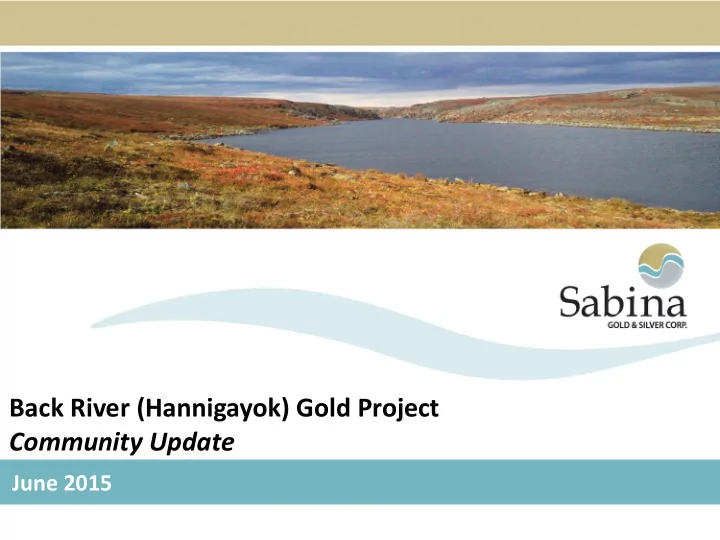
Back River (Hannigayok) Gold Project Community Update

June 2015
slide-2
SLIDE 2

Forward Looking Information

Statements relating to our belief as to the timing of completion of the feasibility study, the EIS and the environmental assessment, the timing of receipt of a project certificate and permits and the timing of the start of construction and the first gold pour, and the results of the feasibility study, the potential tonnage and grades and contents of deposits and the potential production from and viability of Sabina’s properties are forward looking information within the meaning

  • f securities legislation of certain Provinces in Canada. Forward looking information are statements that are not

historical facts and are generally, but not always identified by the words “expects,” “plans,” “anticipates,” “believes,” “intends,” “estimates,” “projects,” “potential,” “opportunities,” and similar expressions, or that events or conditions “will,” “would.” “may,” “could,” or should occur. The forward looking information is made of the date of this

  • presentation. This forward looking information is subject to a variety of risks and uncertainties which could cause actual

events or results to differ materially from those reflected in the forward looking information, including, without limitation: the effects of general economic conditions; changing foreign exchange rates; risks associated with exploration and project development; the calculation of mineral resources and reserves; risks related to fluctuations in metal prices; uncertainties related to raising sufficient financing to fund the planned work in a timely manner and on acceptable terms; changes in planned work arising from weather, logistical, technical or other factors; the possibility that results of work will not fulfill expectations and realize the perceived potential of the Company’s properties; risk of accidents, equipment breakdowns and labour disputes; access to project funding or other unanticipated difficulties or interruptions; the possibility of cost overruns or unanticipated expenses in the work program; title matters; government regulation; obtaining and receiving necessary licences and permits; the risk of environmental contamination or damage resulting from Sabina’s operations and other risks and uncertainties including those described in Sabina’s annual information form for the year ended December 31, 2014 available at www.sedar.com Forward looking information is based on the beliefs, estimates and opinions of Sabina’s management on the date the statements are made. Sabina undertakes no obligation to update the forward looking information should management’s beliefs, estimates or opinions, or other factors, change, except as required by applicable law

slide-3
SLIDE 3

Who is Sabina Gold & Silver Corp?

  • Sabina is a Vancouver, Canada based precious metals company on

track to become a mid-tier gold producer

  • Listed on the Toronto Stock Exchange (TSX: SBB)
  • Skilled staff with extensive northern experience
  • The Company is committed to sustainable northern development

and acknowledges the need for effective community engagement

  • Projects in Nunavut
  • Back River Gold Project, Nunavut
  • Wishbone Greenstone Belt, Nunavut
  • A significant silver royalty on the Hackett River Project, Nunavut
slide-4
SLIDE 4

Back River Project

  • A proposed gold mine in the western Kitikmeot

Region of Nunavut, 100% owned by Sabina Gold & Silver Corp.

  • Exploration commenced in 1982. Project has had

a number of different owners since. Sabina acquired the Project in 2009.

  • Mineral resources of 5.3 M oz. gold (measured

and indicated) and 1.9 M oz. gold (inferred)

  • Small 2015 field program:
  • Environmental baseline data collection
  • Geotechnical and geophysical studies
  • Resource expansion drilling
  • Feasibility Study press release issued in May 2015
  • Continuation of the environmental assessment

and permitting processes

Goose Property (Summer 2014)

slide-5
SLIDE 5

LSA Map

Traditional Knowledge Study Introduction - August 2013

slide-6
SLIDE 6

Back River Project – Goose Property

Goose Property (Summer 2014)

slide-7
SLIDE 7

Back River Project – Marine Laydown Area

Marine Laydown Area (Summer 2014)

slide-8
SLIDE 8

Project Timeline

slide-9
SLIDE 9

Back River - Feasibility Study May 2015 Results

Summary Results @US $1,200.00/oz. Gold / 0.87 Exchange Pre-Tax NPV(5%) & IRR $M / % $826 / 26.4% After-Tax NPV(5%) & IRR $M / % $539 / 21.7% Payback Years 2.2 Mill Throughput tpd 6,000

  • Avg. Grade Processed

diluted g/t Au 5.70g/t Gold Recovery % 93.3% Mine Life Years 10

  • Avg. Production (Y1-4)
  • z./year

413,000

  • Avg. LOM Production
  • z./year

350,000 On-Site Op. Costs $/t milled $96.28 Total Cash Cost $US/oz. $535 All-In Sustaining Cost $US/oz. $671 LOM All-In Cash Cost* $US/oz. $850 Pre-Production Capital $M $695 Sustaining Capital (incl. closure) $M $529 QA/QP ALL C$ unless otherwise specified. *LOM All-In Case Cost includes initial and sustaining capital

slide-10
SLIDE 10

Key Changes Between the DEIS and FEIS

Draft EIS Final EIS Properties Goose, George, MLA Goose and MLA Extraction of Deposits at Goose O/P: Umwelt, Llama, Goose Main; U/G: Umwelt O/P: Umwelt, Llama, Goose Main, Echo; U/G: Umwelt, Llama, Goose Main, Echo Water Management Zero-discharge facility Water treatment Tailings Storage One containment area for tailings Tailings Storage Facility (TSF) plus two mined out open pits (Tailings Facilities or TFs) Tailings Storage Facility Located centrally in PDA and on IOL Located south of Goose Main and off IOL Processing Rate 5,000 tpd 6,000 tpd

slide-11
SLIDE 11

What are we proposing to build?

  • Open pit and underground mining operations
  • 4 mining areas (Umwelt, Llama, Goose Main, Echo)
  • 10 years + of production
  • ~350,000 ounces of gold annually
  • Supplied via some combination of seasonal shipping, year-round

aircraft, and winter roads

  • Remote, fly in/fly out mine site
  • Gold produced at the mine will be shipped by air as doré bars
  • Accommodations (not all occupied at the same time):
  • Goose: up to 465 person camp
  • Marine Laydown Area: up to 75 person camp
  • Processing plant at Goose Property (up to 6,000 tonnes/day)
  • Crushing and grinding, gravity separation, cyanide leaching, carbon

recovery

  • Tailings storage at Goose Property
  • Waste rock storage areas
slide-12
SLIDE 12

What are we proposing to build? (Continued)

  • Marine Laydown Area (MLA) at Bathurst Inlet
  • Open water shipping only
  • Ocean-going barges (DWT: 16,000 tonne; draft 5.9 m) and ships

(DWT: 17,000 tonne; draft 9.7 m)

  • Approximately 3-5 ships/year during construction
  • Approximately 4-5 ships/year during operations
  • Short all-weather roads within each property
  • Seasonal winter roads to connect the properties
  • Approximately 800-1200 truck loads/year during construction
  • Approximately 1600-2100 truck loads/year during operations
slide-13
SLIDE 13

What are we proposing to build? (Continued)

  • All-weather airstrip at Goose, seasonal airstrip at the MLA
  • Approximately 2-4 flights/week at the MLA (only when the MLA is
  • perational)
  • Approximately 2-4 flights/week at Goose
  • Other buildings (e.g. administrative complex, maintenance facilities,

warehousing)

  • Fuel and bulk storage areas
  • Water and waste management facilities
  • Power generation facilities
  • Explosives storage
slide-14
SLIDE 14

LSA Map

Traditional Knowledge Study Introduction - August 2013

slide-15
SLIDE 15

LSA Map

Traditional Knowledge Study Introduction - August 2013

slide-16
SLIDE 16

LSA Map

Traditional Knowledge Study Introduction - August 2013

slide-17
SLIDE 17

LSA Map

Traditional Knowledge Study Introduction - August 2013

slide-18
SLIDE 18

Construction Activities

Year Key Construction Activities 2016 (Year -4) MLA initial sea lift 2017 (Year -3) Project certificate issued; initial sealift; mobilization; long lead item procurement; expand airstrip and construct first fuel tank at Goose; construct port facilities at MLA; initial winter ice road from MLA to Goose 2018 (Year -2) Type A water licence issued; construct port facilities at MLA; initial winter ice road from MLA to Goose; install construction camp at Goose; commence open pit mining and TSF construction at Goose; construct site infrastructure at Goose 2019 (Year -1) Construct site infrastructure at Goose; commission process plant at Goose

  • Construction is expected to begin in 2016, operations are expected to begin in

2020 (pending Project approval)

  • Construction will occur over a 4 year period and involve a number of activities
slide-19
SLIDE 19

Major Alternatives that were Considered

  • Project Go/No-Go decision
  • Access and transportation alternatives for year round access
  • Selection of the deposits included in the Project development
  • Plant processing throughput
  • Selection of the unit process operations for extracting gold
  • Tailings and waste rock management
  • Water management
  • Location of the major Tailing Storage Facility infrastructure
  • Power generation
  • Remote integrated operations
  • Site reclamation and closure alternatives
slide-20
SLIDE 20

Opportunities from the Back River Project

  • Hiring preference for those located

in nearby Kitikmeot communities

  • Training programs for northern hires

to be established

  • Contracting and business

development opportunities will be made available

  • Contracting preference for

Kitikmeot and Nunavut companies

  • Taxes, royalties, Inuit Impact and

Benefit Agreement (IIBA)

slide-21
SLIDE 21

Existing Inuit Employment at the Back River Project

2013 Employment:

  • 58 Inuit employees (30% of approx. 200 total employees)
  • $1,654,590.00 gross payroll value

2014 Employment:

  • 15 Inuit employees (50% of approx. 30 total employees)
  • $339,201.00 gross payroll value
slide-22
SLIDE 22

22

Construction & Operations Employment

Employment Estimates Construction

  • Average employment of approximately 650
  • Maximum employment (during busy periods) of approximately 1,000

Operations

  • Average employment of approximately 800
  • Maximum employment (during busy periods) of approximately 1,150

Positions will be needed in:

  • Open pit mining
  • Underground mining
  • Site services
  • Freight
  • Construction
  • General & administrative
  • Shared services
  • Processing
  • Ore hauling and heavy

equipment operation

slide-23
SLIDE 23

Working with Local Communities

  • Community newsletters and informational

materials (e.g. fact sheets, posters, maps)

  • Social media (e.g. website, Twitter)
  • Donations
  • Public meetings
  • Community Liaison Officer and office in

Cambridge Bay

  • Community advisory groups
  • Meetings with key stakeholder groups (e.g.

HTOs, Hamlets, youth)

  • Radio shows and information booths
  • TK studies
  • Bernard Harbour restoration project
slide-24
SLIDE 24

LSA Map

Traditional Knowledge Study Introduction - August 2013

slide-25
SLIDE 25

Number of Meetings Number of Major Correspondences TOTAL Cambridge Bay 46 7 53 Kugluktuk 37 7 44 Bathurst Inlet & Bay Chimo 8 5 13 Gjoa Haven 15 2 17 Taloyoak 15 2 17 Kugaaruk 13 2 15 Other (e.g. northern trade shows & conferences, SEMCs, newsletters) 25 10 35 Yellowknife / Other Locations in the NWT 10 16 26 TOTAL 169 51 220

Meetings and Major Correspondence with Community and Stakeholder Groups

  • n the Back River Project as of June 1, 2015
slide-26
SLIDE 26

Environmental Assessment

  • A process used to evaluate the potential environmental and socio-

economic effects of a proposed project

  • Overseen by the Nunavut Impact Review Board (NIRB)
  • Sabina’s EA officially began in June 2012
  • Regulators, governments, Aboriginal organizations, and communities are

involved in EA through reviewing Sabina’s submissions, participating in commenting periods, hearings, etc.

  • DEIS hearings in Cambridge Bay in November 2014
  • FEIS submission expected in second half of 2015, hearings and review to

follow

  • NIRB will recommend to the Minister of Aboriginal Affairs and Northern

Development Canada whether the Project should proceed and under which conditions.

slide-27
SLIDE 27

Environmental Assessment

  • Sabina’s FEIS will describe the Project,

the various studies that have been conducted (scientific and TK), potential Project effects, and proposed mitigation in detail.

  • An EA cannot study everything.

Instead, we study only the most important environmental and socio- economic features (VECs and VSECs).

  • Comments made on the DEIS are

helping Sabina produce a Final EIS. There are still many opportunities for public participation available.

slide-28
SLIDE 28

Valued Ecosystem Components (VECs)

Atmospheric

  • Air quality
  • Noise and vibration

Terrestrial

  • Special landscape

features

  • Vegetation
  • Caribou
  • Muskox
  • Wolverines and

furbearers

  • Grizzly bears
  • Raptors
  • Migratory birds

Freshwater

  • Water quality
  • Water quantity
  • Sediment quality
  • Fish habitat
  • Arctic grayling
  • Lake trout

Marine

  • Water quality
  • Sediment quality
  • Fish habitat
  • Arctic char
  • Marine seabirds
  • Ringed seal
slide-29
SLIDE 29

Valued Socio-Economic Components (VSECs)

Human Environment

  • Archeology
  • Employment
  • Education and training
  • Health and community well being
  • Economic development
  • Business opportunities
  • Subsistence economy and land use
  • Non-traditional land & resource use
  • Country foods and human health
slide-30
SLIDE 30

NIRB Technical Meeting and Pre-Hearing Conference

  • Held in Cambridge Bay in November 2014
  • Purpose of the meetings was to review

Sabina's DEIS

  • Representatives from Sabina, Kitikmeot

communities, KIA, Government of Nunavut, Government of Canada, Government of NWT, and NWT Aboriginal organizations attended

  • Productive discussions were held and a

number of suggestions were made for Sabina to include in their FEIS

  • Key areas of concern for local

communities were identified in NIRB’s PHC report

slide-31
SLIDE 31

Area of Concern - Caribou

  • Area of concern:
  • Potential for direct, indirect, and

cumulative effects to caribou and important caribou habitat

  • How Sabina has addressed the concern:
  • 20 aerial surveys, habitat mapping,

resource selection function, 60 remote cameras, traditional knowledge

  • Avoidance of high-value caribou habitat

(from TK and baseline)

  • Helicopter management
  • Use of winter roads only to connect

Project areas

  • Road management: speed limits, wildlife

right of way, timing

  • Work suspension protocols for when large

herds of caribou present

  • Ongoing monitoring
slide-32
SLIDE 32

Caribou Migration Video

slide-33
SLIDE 33

Area of Concern - Tailings

  • Area of concern:
  • The location and method of containment of mine tailings
  • How Sabina has addressed the concern:
  • Detailed engineering studies
  • Relocation of Tailings Storage Facility (TSF) off of Inuit Owned Land

and on to Crown Land, due to Inuit requests

  • Additional use of mined-out open pits (i.e. Umwelt and Goose

Main) as safe storage options for tailings

  • Frozen foundation rockfill dam with a geosynthetic liner for TSF
  • Progressive reclamation (e.g. use of waste rock on top of TSF, 5m

closure cover)

  • Water treatment and monitoring
slide-34
SLIDE 34

Area of Concern – Waste and Water Management

  • Area of concern:
  • Protection of local water systems and

wildlife from exposure to wastes and

  • ther contaminants
  • How Sabina has addressed the concern:
  • 4 freshwater water quality baseline

studies and freshwater water quality effects assessment

  • Water Monitoring and Management Plan;

Aquatic Effects Monitoring Plan; Mine Waste Rock and Tailings Management Plan; Risk Management and Emergency Response Plan; Land, Water and Ice Based Spill Contingency Plan; Landfill and Waste Management Plan; Hazardous Materials Management Plan; and other plans.

  • Federal and territorial regulations
slide-35
SLIDE 35

Area of Concern – Shipping and the Marine Environment

  • Area of concern:
  • Potential for impacts to the marine environment, including

impacts within Bathurst Inlet, as well as upon marine mammals, birds and fish from shipping, including potential fuel spill and emergency response roles, responsibilities, and capabilities

  • How Sabina has addressed the concern:
  • Marine baseline studies and effects assessments, spill modelling
  • Shipping activities are highly regulated within Canada (e.g. with

regards to shipboard operation and navigation, transport of fuel and other hazardous materials, spill response). Sabina will follow all Canadian laws.

  • Various spill contingency plans have been developed (e.g. OPEP,

SOPEP)

  • Shipping will occur only in open water and all ships will be

Canadian vessels

  • Shipping schedules will be communicated to local communities
slide-36
SLIDE 36

Area of Concern – Support for Communities and Youth

  • Area of concern:
  • Support for communities, education and

training for youth

  • How Sabina has addressed the concern:
  • Comprehensive community engagement

program and database, economic impact modelling, socio-economic baseline study

  • Commitment to preferential Inuit hiring

and employment, annual post-secondary scholarship

  • IIBA to be negotiated
  • Donations policy focused on ‘youth and

education’ and ‘community wellness and traditional lifestyles’

  • Community Involvement Plan, Human

Resources Plan, Employee and Family Assistance Program, training programs to be developed, continued support of KIA training initiatives

slide-37
SLIDE 37

Area of Concern – Wildlife

  • Area of concern:
  • Impacts to wildlife and wildlife

harvesting from Project activities, including caribou, grizzly bears, fish, birds, and other animals

  • How Sabina has addressed the concern:
  • Baseline studies and effects assessments

for a number of VECs

  • Mapping workshops with land users,

interviews, TK, public consultation, other data

  • Extensive mitigation and management

measures to protect wildlife, air, water, vegetation, and soil quality

  • Providing land user access to camps; no

employee hunting

slide-38
SLIDE 38

Area of Concern – Transportation

  • Area of concern:
  • Navigability of Bathurst Inlet,

placement of dock infrastructure and the alignment of winter roads for the Project

  • How Sabina has addressed the

concern:

  • Bathymetric studies
  • Detailed engineering studies,

marine effects assessments

  • Re-routing of winter road as a

result of Inuit concerns

Marine Laydown Area (Summer 2014)

slide-39
SLIDE 39

Final Environmental Impact Statement (FEIS)

  • The FEIS will be the final

comprehensive report.

  • The DEIS was approximately 5,000

pages long (10,300 pages when all digital files were included)

  • The Project is expected to have no

significant negative effects

  • The Project is expected to have

various significant positive socio- economic effects

  • Numerous mitigation and

management commitments have been made

FEIS Volumes Volume 1 Main Volume Volume 2 Project Description & Alternatives Volume 3 Public Consultation, Government Engagement & Traditional Knowledge Volume 4 Atmospheric Environment Volume 5 Terrestrial Environment Volume 6 Freshwater Environment Volume 7 Marine Environment Volume 8 Human Environment Volume 9 Assessment Methodology Volume 10 Management Plans Volume 11 Other Approvals

slide-40
SLIDE 40

Next Steps

  • Continued engagement with communities, the Kitikmeot Inuit

Association (KIA), and government/regulatory agencies

  • Completion of 2015 field program
  • Issuance of the FEIS (second half of 2015)
  • FEIS hearings (early 2016, likely)
  • Following issuance of a Project Certificate, a water licence and
  • ther permits will also be required
  • Project financing and construction (pending Project approval)
slide-41
SLIDE 41

Contact Information

John Kaiyogana Community Liaison Officer 10 Omilik Road Box 2239 Cambridge Bay, NU XOB 0C0 Phone: (867) 983-3033 Cell: (867) 446-2501 Fax: (867) 983-3133 jkaiyogana@sabinagoldsilver.com Jason Prno Community Relations Advisor (519) 983-8483 jprno@sabinagoldsilver.com Matthew Pickard Vice President, Environment & Sustainability Phone (Toronto): (604) 484-8967 / (416) 848-1184 Phone (Vancouver): (604) 998-4190 / (888) 648-4218 Cell: (416) 605-7881 mpickard@sabinagoldsilver.com

slide-42
SLIDE 42

www.backriverproject.com