Bachlga P R E S E N T A T I O N N O R T H E A S T P R O V I N C E - - PDF document

bachl ga
SMART_READER_LITE
LIVE PREVIEW

Bachlga P R E S E N T A T I O N N O R T H E A S T P R O V I N C E - - PDF document

Bachlga P R E S E N T A T I O N N O R T H E A S T P R O V I N C E I N S I D E T H I S I S S U E : S P R I N G - S U M M E R 2 0 1 7 Three Drives V O L U M E 1 , I S S U E 3 Family Resource Centre Project Mercy


slide-1
SLIDE 1

P R E S E N T A T I O N N O R T H E A S T P R O V I N C E

Bachlóga

S P R I N G - S U M M E R 2 0 1 7 V O L U M E 1 , I S S U E 3 I N S I D E T H I S I S S U E :  Three Drives Family Resource Centre  Project Mercy  Challenge to Change 2017  Food Justice Fact
  • r Fiction—Our
Call?  Athenry Community Council honours the work of Sr. Leo Hackett  Thurles—200 years on  Reading Nano’s Letters  The Nano Nagle Centre - Slovakia  Show Mercy to
  • ur Common
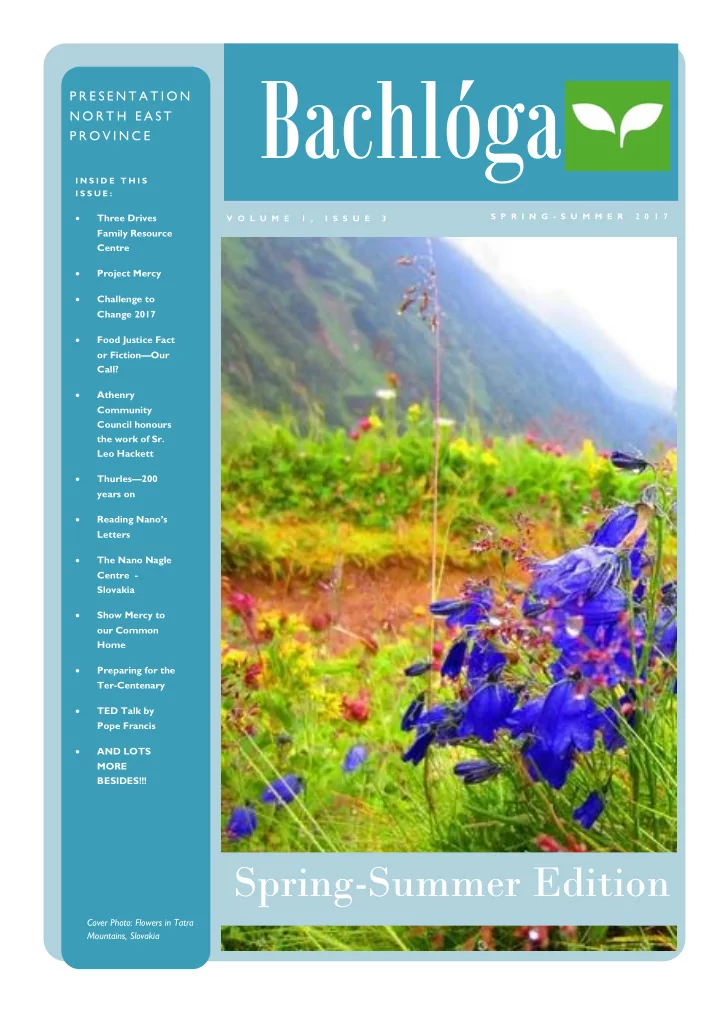
Home  Preparing for the Ter-Centenary  TED Talk by Pope Francis  AND LOTS MORE BESIDES!!! Cover Photo: Flowers in Tatra Mountains, Slovakia

Spring-Summer Edition

slide-2
SLIDE 2 P A G E 2

Contents

Contents Page

B A C H L Ó G A

INSIDE THIS ISSUE: Front Cover Cover Picture——Flowers in the Tatra Mountains, Slovakia Foreword …………………………………………………………... Liturgy of the streets — Sr. Bernadette Flanagan 03 Living Locally ……………………………………………………... Pride of Place: Three Drives FRC (Sr. Catherine Mulcahy & Terry O’Connor) 04 Project Mercy —Presentation Sec. School Wexford (Ms. Gráinne Power & the Mercy Monday 6th Yrs) 07 Challenge to Change (Sr. Margaret Mary Healy) 08

  • Sr. Leo Hackett honoured by Athenry Community Council

09 Vocation Promotion 09 Way of Life Office…………………………………………………. Food Justice Fact or Fiction—Our Call? ( Sr. Ann Marie Quinn) 10 Friends of Nano & Associates ………………………………….. Thurles Associate on 200 years of Presentation Life (Miriam Healy) 12 Newsflash!! Mini-Sabbatical Programme 2017 (Sr. Anne McDermott) 13 Who is Nano? Dear Nano, thank you for your letters—(Sr. Assumpta O’Neill) 14 Who is Nano? 15 Soul Food …………………………………………………………... Pilgrim paths 16 TED Talk—Pope Francis (April 2017) 17 In Preparation for Tercentenary of Birth of Nano Nagle 18 Nano Nagle—An Evolving Charism 18 #Mercy2Earth Campaign 19 Back Page: Want to Know More? …………………………... 20

slide-3
SLIDE 3 P A G E 3

Foreword

Liturgy of the streets

We have arrived in May and the sun is beginning to cast its warm and bright rays over our landscape. Everything looks brighter and fresher under its invigorating rays. In a message for Vocations Sunday, the first Sunday in May, Pope Francis is inviting religious to reclaim the invigorating energy of the Gospels for the work of Vocation Promotion. In particular he high- lights how the Emmaus encounter with the disciples provides a template for Vocation Promotion. In the Emmaus story he illustrates how a "Liturgy of the Streets" precedes the Liturgy of the Word and Breaking of the Bread. Similarly Sr. Lynne Baron FCJ (see page 2 of North East News—January 2017) speaks of the important work of "making contact" prior to any talks or literature on vocations. Making contact is embedded in conversation, coming close to people, listening to the stories of their hopes and fears, as Jesus did with the disciples on the road to Emmaus. Pope Francis recently became the first Pope to give a TED talk www.ted.com/ talks/pope_francis (see Page 17). Nearly two million people have watched this talk where his key message is "the revolution of tenderness". By this he is referring to a way of living the Gospel and religious life that "comes close and becomes real"....a movement that starts from the heart and reaches the eyes, the ears and the

  • hands. "Tenderness means to use our hands and our heart to comfort the other, to

take care of those in need. This is tenderness: being on the same level as the other". In Vocation Promotion then the call is to listen to the search for authentic Gospel living which is already taking place - this can be taking place through involvement in volunteering; in choirs; in justice groups; in ecology initiatives, etc. Can we come close to such seekers, hear their story over a cup of tea; attend their events; LIKE their Facebook posts? There is a “Liturgy of the Streets” which Vocation Promotion requires, and there are infinite ways in which we can participate. Side by side with this “Liturgy of the Street”, Pope Francis also reminds us that "There can be no promotion of vocations, without constant contemplative prayer". Emboldened by his vision we too pray for the transformation of vision which the disciples on the road to Emmaus experienced. On behalf of the PLT.

B A C H L Ó G A
slide-4
SLIDE 4 P A G E 4

Living Locally

Pride of Place—Three Drives FRC

B A C H L Ó G A

“We try to live as good neighbours, lead authentic lives and be there for the people”. This is how Sr. Catherine Mulcahy describes the core of how she lives, together with Sr. Rosemary McCarthy, in and among the community that contribute, support and participate in the activities and space offered by the Three Drive Family Resource Centre in Tipperary town. We all know of challenged neighbourhoods and communities that have struggled since that landmark tideline of the 2007-2008 finan- cial ‘tsunami’ hit especially hard in areas where infrastructure and local circumstances were totally insufficient to support survival, never mind a certain quality of life, that would have enabled families, individuals, older people and children to come ‘out the other side’ unscathed. However, this is a communi- ty unlike any other. It is unique, special and gifted precisely because of the people who live there and the choices they have made and the challenges they overcome on a regular basis. I first got to know about the Three Drives Family Resource Centre from a video I watched at the end of last year that showed them receiving the prestigious IPB Pride of Place Award in November 2016. The Pride

  • f Place Award is run by Co-operation

Ireland in conjunction with local authorities. It is known by many as “The Community Oscars” due to the fact that it celebrates the best in Community Development at a national level. The Award In May of 2016 Tipperary County Council selected the Three Drives FRC to represent the county in the competition. So roll on to Saturday night, 26th of November 2016. A date and a moment in time that the Volun- tary Board of Management and Staff of the Three Drives FRC will not forget in a hurry. As they described it, “….it was a Cinderella moment”. When the result of the Category 9: Housing Estates under which they were entered was being delivered. The compére for the evening, Claire McCollum delivered the following as part of her citation: “This is a huge story of perseverance, innovation and significant collaboration down the years”. The extract from a local newspaper article written afterwards sums up much of what can be said about being proud of ‘your place’ and ‘of your place in it’: “….the realisation of many years of plan- ning, wishing and hard work was recognised as being worthy of a national award. We had been privileged to be selected as the representative for County Tipperary, let alone win first prize, but we were also privileged to receive the award

  • n behalf of the Three Drives Community,

especially the founding members of the Family

slide-5
SLIDE 5 P A G E 5 V O L U M E 1 , I S S U E 3

Pride of Place –Three Drives FRC ctd…/

Resource Centre who laid the groundwork for the project that exists today”. How it started Ten years ago there was one house available when the present Project Co-ordinator Terry O’ Connor arrived. The first meeting was held in one room with a cement floor, one table and one chair with the rest of the chairs borrowed from Srs. Catherine, Rosarii and Rosemary’s home. You can sense that there was never any doubt among those working and participating to realise their vision, despite very many practical and financial challenges and setbacks. It is the time-worn story of a committed team of people- believing and knowing deep down in, that this is the answer for their community. They took on the huge challenge of persuading others to join them and contribute to making it happen. Now there are five council houses that form the core structure of the Centre and this is no longer large enough. When you listen to Catherine describing this life unfold- ing you realise that she speaks about it without any sense

  • f individual ownership. This is a community story woven

in and out and through the shared dreams, challenges, despair, sufferings, joy and achievements of so many. It is embedded in the hopes and dreams of those using the facilities and those who are bit by bit discovering that there is a place for them within it. A Vision for the Centre To do this requires a very particular team of people. Catherine alluded to this so often in our conversation: ‘….many of the staff are young women with their own children so they ‘get it’. ‘People here are just good people who would just down tools to help anyone in diffs’. ‘Sometimes the less you have the more you give’. ‘The commitment of Staff and the Voluntary Board of Management to the total well-being of the people is incredible’. At the outset, the first priority was to work with the children in the community and to be able to support them through their schooling, while recognising that education was not just about book learning but that there was a great deal more for the children to gain. They wanted to provide an after school programme where they would also receive a warm healthy meal before the planned activities would begin. From May 2007 the Voluntary Board of Management of the ‘Three Drives’ sought to secure funding to provide this programme while at the same time trying to attract funding to develop the premises. They pursued all the usual avenues only to realise that while they were assured of support once the project was up and running, they were told repeatedly that there was no funding available at that time. But they did not give up, and by 2012 the refurbishment was completed and the addition- al space opened up. It was then that they were encour- aged to apply for funding to the Presentation Sisters to

L to R: Alison Dowling (Judge – Pride of Place), Deirdre Cox, Pride of Place Co-ordinator (Tipperary County Council), Tom Dowling (Judge – Pride of Place), Kitty O’Donovan (Chairperson, Three Drives FRC), Martina Roarke (Three Drives Residents Association), Terry O’Connor (Project Co-ordinator, Three Drives FRC), Margaret McNamara (Voluntary Board of Management, Three Drives), Catriona Crowe, Tenant Liaison Officer (Tipperary County Council), Michael Larby (Voluntary Board of Management, Three Drives) & Sr. Catherine Mulcahy (Secretary).
slide-6
SLIDE 6 P A G E 6 V O L U M E 1 , I S S U E 3

Pride of Place –Three Drives FRC ctd…/

help meet the needs of the children in the community. This resulted in a positive and supportive response from the Provinicial Leadership Team (NEP) followed by confirmation of multi-annual funding. With this secure tranche of money so much was possible. There was a real sense in the Centre that this (alongside the near comple- tion of the extension) meant that at last they were about to make inroads into making life better for many people. Terry O’Connor the Project Co-ordinator wrote at the time: ‘We are very aware of and grateful for the continued support we receive from Rosarii, Rosemary and Catherine in all that we do. They always find ways of putting the needs of this community first and encouraging people to move forward. Together we make a good team’, and “In her time Nano saw that education of the young people was the most effective way

  • f providing them ‘with a powerful means of helping them-

selves...’. We too see that providing structures to support the welfare of children and young people through education in the local area is vital”. “The After School Programme has become a beacon of hope here”. The reach of the Centre The impact of the work undertaken with the children through this programme has attracted support from other agencies such as the Education and Training Boards Ireland (ETB) who have funded tutor hours to facilitate the cook- ery programme for the parents and children, as well as for the allocation of tutor hours for drama classes for some of the children who are no longer eligible to attend the After School Programme. Through their networking at a regional and local level the Centre Management are able to exchange ideas with different agencies and receive advice and supports e.g.

 they were able to bring to the attention of the

Children and Young People’s Services Committees (CYPSC) a new way of working with the children which had been instigated by a Youth Worker who received an Arts Bursary from the Irish Arts

  • Council. It is known as the “Hedge School

approach” and it allows the children to have a say in the direction of how they learn.

 Tipperary Town was identified for the roll out of the

HSE Disability Gold Star Project with respect to accessibility and equality for people with disabilities in the community. As there are a number of children attending the After School Programme with a range of disabilities Anne Bradshaw, HSE Disability Services was invited to come and talk to them. After that meeting a pilot project was developed in the ‘Three Drives’ which will be co-facilitated by a member of the childcare staff with Anne Bradshaw and which will then be rolled out to schools not only in Tipperary town but throughout the county. Today in the Centre there are Community Education Courses, an Independent Living Programme, Art Therapy & Counselling Sessions, a Bio-Diversity Project (transforming what was once a dumping black spot to an area full of plants and colour—see photos left), the After Schools Programme, a Breast Feeding Support Group, a Parent & Toddler Group and a Women’s Group. Par- ticipation in community activities outside of the Centre also gets a lot of positive comment, especially in relation to the number and ethnic mix of the children availing of this support.

  • Sr. Catherine said something to me almost at the end
  • ur conversation (having previously lived forty-three

years of Presentation Life in New Zealand before com- ing to live in Tipperary): “I could not see myself \ living anywhere else but here”. In conversation with

  • Sr. Catherine Mulcahy & Terry O’Connor
See: Three-Drives-Family-Resource-Centre Facebook
slide-7
SLIDE 7 P A G E 7

Living Locally

B A C H L Ó G A

Project Mercy: Presentation Sec. Wexford

One door closes and another opens. The door to awareness of the quality of mercy

  • pened in the hearts of seven Presentation

sixth years. Inviting sixth year students to participate in a project on mercy was greeted with polite but audible yawns but once an action project was decided on, spirits lifted and eventually even soared. A little research lead us to the ‘corporal acts of mercy’. We applied a simple formula to our work, which took place over approximately twelve

  • weeks. Every Monday we discussed an Act
  • f Mercy and thought of ways to fulfil it. We

did whatever preparatory work was needed and on the following Monday we executed

  • ur plan.

We visited the graves of the deceased members of the Presentation Convent Wexford and prayed for the dead and gave a letter of thanks to the congrega- tion for their work over the last 199 years.

We collected clothes for the local Vincent de Paul and delivered them with a letter of thanks for the volunteers who work there.

We called to Ozaman House to deliver a gift of toiletries to one of the homeless men who lives there and delivered a letter of thanks to the Chapter Volun- teers there.

We patrolled our school corridors at break times giving fresh water to those unwell students awaiting family members to collect them. We also researched the world’s water shortages.

We visited an unwell member of our school community, bringing a gift and good wishes and we did some work for her in advance of her return to school.

 We visited St. Bridget's Day Care

Centre for the elderly and brought with us pictures of Wexford down through the years and sang and played fiddle for a group there.

 We wrote letters to thirty tutors raising

awareness of our Vincent de Paul Food appeal so that it too would be better than ever. Afterwards we wrote thank you letters to thirty classes for their gen- erosity which resulted in the collection of twenty-six full hampers in December. Our shared experiences revealed that small acts of mercy brought great light to the givers and receivers. All of us came to real- ise the needs of our community. Most uplifting of all, we realised how many wonderful, deeply committed people live among us. For these people, mercy is part

  • f their daily lives. They work year in year
  • ut, making others’ lives better. We

thanked them for what they do and we understood how grateful they were for that simple thanks. This whole experience opened our eyes to the concept of mercy and how keeping that concept to the forefront of our minds seemed to supercharge the smallest of our good deeds. Winning the group section was the icing on the cake. However the cherry, on that icing, was the fact that post project, these Sixth Years are headed back to the Day Care Centre to run a little quiz before finishing their school year.

  • Ms. Gráinne Power & the ‘Mercy

Monday 6th Yr. Students’, Presenta- tion Sec. School, Wexford

Pope Francis invited us all to ‘become directly involved in living out the Year of Mercy as an extraordinary moment of grace’. On the invita- tion of the Diocesan Pastoral Council Ferns to Post Primary Students, seven Sixth Years in the Presentation Secondary School Wexford completed a project in March 2017 which incorporated the Year of Mercy into their lives and work in the con- text of their own school and community. See website: http://www.preswex.ie/
slide-8
SLIDE 8 P A G E 8 V O L U M E 1 , I S S U E 3 B A C H L Ó G A

Challenge to Change (C2C)

‘ It grew out of a firm belief in young people in their enthusiasm, their goodwill and in the innate goodness of young people. We said, ‘let’s harness that’. - Liam Kilbride

Challenge to Change is a development education project run by the Presentation Education Office and funded by the Presentation Trustees, North East province. The project seeks to raise awareness of global inequality and understanding of the impact of a changing global

  • environment. Through the project work students drawn

from the Presentation Schools Network explore ways in which their actions at local level can be an influence for the better on global issues such as justice, human rights, fair trade, racism, exploitation and sustainability. It all started fourteen years ago with six schools, and has grown to a record number of 29 schools this year who are all taking up the challenge to change our world for the

  • better. It was a really insightful and courageous thing for
  • Sr. Margaret Mary Healy and Liam Kilbride to start a

project with this title, and it has never been more needed than in today’s world. It enables local actions to impact positively on global and local inequalities. “I suppose when a school begins their first question is, what is development education and how do I get a handle on this? So we visit the schools each year and talk with the co-ordinator. We encourage them to take a whole school approach and to parental involvement as well. We also encourage them to link with schools abroad – we have Presentation schools in Africa, India, Pakistan and Australia. Indeed, if we have Sisters who spent time in a particular country and they are home on holidays they are very happy to visit a school to talk about their experiences.” says Sr. Margaret Mary from the Presentation Education Office. The vision of Challenge to Change is inspired by the Presentation charism and ethos which embraces the challenge of working with people in practical ways to address issues they are living with on a daily basis around justice, human rights, social justice, promoting right rela- tionships and sustainability. These are themes which are central to the project. Liam Kilbride and Sr. Evelyn Byrne have been actively involved in the ‘school visits’ to support the 2017 programme. C2C does what it says. It challenges those who have courage to challenge systems, to challenge others, to challenge those in ‘high places’ to change their way of doing things but perhaps more importantly it challenges each of us to look at where we are, to see things differ- ently and how best to act with others to bring about change in challenging situations of day to day life encountered by our ‘brothers and sisters’.

“In my opinion this project has been one of the highlights of Transition Year for me. I’ve greatly enjoyed raising awareness and funds for our project. I love how as a class we all came to- gether…”. War and Displaced Persons – Transition Year Killina “We decided that we would explore energy and look at how we could experience it. The whole school took part in an energy free morning and you’ll never guess we survived it very well. ..Surprisingly enough we were able to complete our work at school using our own energy. … We didn’t need to be “plugged in” or “hooked up”. Our Energy Experience—Scoil Mhuire Clondalkin 2017 C2C Seminars & presentation of Certificates is on 9th May in Tullamore & 11th May in Kilkenny. See: Challenge to Change Website Here
slide-9
SLIDE 9 V O L U M E 1 , I S S U E 3

Vocation Promotion

P A G E 9

Honoured by Athenry Community Council

  • Sr. Leo Hackett first came to Athenry in July 1988, and
since that time, in addition to teaching in the local schools,
  • Sr. Leo has dedicated many years to working with Athenry
Social Services helping the elderly, delivering meals on wheels and bringing Holy Communion on a weekly basis to the sick and housebound of the parish. She has also been active in the local Soilse group which she joined in 1998 and where, along with other members of the community, she has befriended those with special needs.
  • Sr. Leo taught for some years in both the primary and
secondary schools in Athenry and in the Primary School in
  • Tuam. She has also been a member of the Boards of
Management of both Scoil Chroi Naofa and Presentation College and taught Religion class in the College which kept her in touch with the education scene during her ministry in
  • Athenry. It is therefore very apt that Athenry Community
Council chose to honour Sr. Leo at their 2017 St. Patrick’s Day parade for her outstanding contribution to commu- nity life and services, and for ‘her good work and kind- ness’ - to paraphrase the Athenry News who recorded the
  • event. Congratulations to Sr. Leo and to the Athenry
community. Photo: L-R (Back Row): Sr. Margarita Ryan (Provincial NEP) with Srs. Anne Keating, Bernadette Purcell, Anne McDermott, Riona McHugh, Mary Hanrahan, Mary Rossiter, (Middle Row L-R): Srs. Josephine James, Maura Murphy, Concepta O’Brien, Ann Marie Quinn, Riffat Sadiq, (Front Row): Srs. Breeda Walshe, Bernadette Flanagan and Angela Dolan. Photo: RH side—Sr. Lynne Baron, FCJ Vocation Director.

A Vocation Promotion Working Group gathered for a day with members of the Provincial Leadership Team (PLT) to do some planning for the future, led by Sr. Lynne Baron, FCJ Vocation Director. New brochures, banners and posters will soon be circulated for your local church. Sunday, 7th May is Vocations Sunday.

slide-10
SLIDE 10 P A G E 1 0 B A C H L Ó G A

Way of Life Office

Food Justice Fact or Fiction—Our Call?

Sustainable Development Goal 2: Zero Hunger

The Food Justice Day on 4th February 2017 organised by the Justice Peace and Integrity
  • f Creation (JPIC) Commission was held in Mount St. Anne’s Retreat and Conference Centre
and managed to bring together in one place the experience, energy and commitment of almost 70 participants and the enthusiasm, knowledge and passion of a wonderful line up of
  • presenters. This was an invaluable opportunity to explore and understand UN Sustainable
Development Goal 2: Zero Hunger in the context of the other 16 Sustainable Develop- ment Goals (SDG’s). An objective of the Food Justice Day was : ‘that it would empower each person present to find a way to contribute to Food Justice and to begin to network with others on this issue’. We all have a part to pay in implementing the SDG’s by recognising how the work we do on a daily basis in our local communities can feed into these Goals. It is important to realise that the Goals are not a technical exercise but that by each of us joining the dots these can become practical.
  • Sr. Veronica Casey (JPIC Commission Chairper-
son) welcomed everyone and set the scene for the day ahead. Sr. Agnes Byrne led the morning reflection starting with the hymn ‘Everyone Born—A Place at the Table’. The centre- piece for the day had been created on the altar table and showed both the beauty and colour of creation as well as the central and nourishing part that food plays in all of our lives. Everyone present was invited to take some of this food from the table with them when the day was over. The core programme was made up of five quite diverse and totally engaging presentations followed by a short time after each input to enable those present to absorb, reflect and respond briefly if they wished. In the afternoon there was the opportunity to break into Focus Groups and then to share back with everyone. The rhythm and progress of the day was facilitat- ed by Rory Halpan who had worked closely in advance with the Direc- tor of the Way of Life Office and the Commis- sion. From the outset it was clear that this was going to be a very special event as it seemed to echo immediately the call of Nano Nagle to understand well the ‘needs of people today’ and how to act
  • accordingly. Many of those present repre-
sented in a tangible way the reality of ‘person to person’ engagement with ‘those made poor’. The inter-weaving of spirituality and action, and the clear interconnectedness of all things were key elements that made the shar- ing and contributions very valuable, almost like contemplative signposts to understand well future actions on Food Justice. (See over the page for some brief extracts from the presenta- tions with some key facts relating to Food Justice).
  • Sr. Bernadette Flanagan (the JPIC PLT link
person) closed the day thanking everyone for their presence and contribution and acknowl- edging the presence of Sr. Fatima Rodrigo (CLT Justice Link), Sr. Maureen O’Connell Co-
  • rdinator of the Congregational Co-ordinating
Team for Justice (CCT_J) and Sr. Antonia Murphy, South West Province Co-ordinator of Interprovincial Collaboration (CIC), as well as introducing Brian O’Toole, the Director of the Interprovincial Justice Desk. L-R: The JPIC Commission pictured with: Srs. Breeda Walshe & Ann Pender (JPIC Commission Members) , Sr. Ann Marie Quinn (Director of WOL Offjce), Cathriona Russell, Sr. Veronica Casey (JPIC), Alf Monaghan (JPIC), Rory Halpan, David Moriarty, Bobby McCormack , Niamh Brennan (JPIC) and Srs. Agnes Byrne (JPIC) and Bernadetue Flanagan (JPIC PLT Link).
slide-11
SLIDE 11 P A G E 1 1

Food Justice Fact or Fiction—Our Call? Ctd./

Ctd...from previous page/ Bernadette highlighted the important place of sharing food and hosting an open table in the spirituality of Nano Nagle from the time of the first dinner she served to the home- less on Christmas Day 1777. In this context the Second Development Goal (Food Justice) has a special meaning for Presentation Sisters. Photo: Srs. Anne Pender & Fatjma Rodrigo

Some short extracts

Food Security: “when all people at all times have access to sufficient, safe, nutritious food to maintain a healthy and active life”. “An integral ecology included taking time to recover a serene harmony with creation, reflecting on our lifestyles and our ideals, and contemplating the Creator who lives among us and surrounds us, whose presence ‘must not be contrived, but found, uncovered’. “Our cosmic history, the history of the Universe is also my own personal history. It shows us how deeply interrelated we are”. “Think about Food as a relationship we establish with the world, a way in which we relate to the world and a way in which we relate to others, but also a way in which the world relates to us”. L-R: Sr. Maura Casey, Miriam Healy (Development Offjcer, Friends of Nano & Associates) & Sr. Maureen O’Connell The Current Reality  800 million people go hungry every day  Between 33% and 40% of all food produced (1.3 – 1.36 billion tonnes) is wasted each year during the production, manufac- turing and consumption process  If all ports in Ireland were closed we would run out of food in 24 hrs  The fact that we export food but that we import much more for our own use.  1 million tonnes of food is thrown out by Irish con- sumers and businesses every year  1 in 8 people in Ireland experience Food Poverty  Irish households every year throw away €700 worth
  • f food
Direct Provision Experiences It is not the type of food I am used to Manager provides the same school lunch every day There is no dignity in forcing an adult to sit down and be fed by someone else Coalition 2030 is an alliance of civil society organisations committed to and working towards upholding Ireland’s commitment to achieving the Sustainable Development Goals (SDGs) at home in Ireland and in over 50 countries by 2030. It comprises over 100 organisatjons. For more informatjon, see HERE About the Presenters: Cathriona Russell is Assistant Professor in Theology & Ethics, TCD & UCD ( and Lucan Past Student), Niamh Brennan is a Writer & Workshop Facilitator in the area of Cosmology & Spirituali- ty, David Moriarty (Jesuit Refugee Services), Bobby McCormack (Director of Development Perspec- tives) & Aisling Kirwan (FoodCloud Hubs). (See photo
  • n previous page).
Websites: Jesuit Refugee Services: www.jrs.ie/ Development Perspectives: www.developmentperspectives.ie/ Food Cloud: https://food.cloud/
slide-12
SLIDE 12 P A G E 1 2

Thurles Associate on 200 years of Pres. Life

For this edition of Bachlóga, I had a conversation with Anne Lanigan, an Associate in the Thurles group, and the author of a newly written history of the Presentation Sisters there. Miriam: Anne, what was the best part of writing this book? Anne: It was clarifying what I always knew about the achievements of the Presentation Sisters in Thurles, but hadn't fully realised until I did the research. All that they undertook and accomplished became very real to me. Going back to Nano Nagle, her story came alive in a new way, with all the vision and courage she displayed in such difficult
  • times. I was aware of documenting a really important aspect
  • f the history of Thurles and what a debt of gratitude the
people of Thurles owe the Presentation Sisters. I was both proud and privileged to write it. Miriam: What surprised you the most? Anne: For most of the two hundred years, the Sisters lived hidden lives, enclosed behind walls, probably never quite anticipating the transformation of society that education would produce. At a time when women in general had so little control over their own lives or destinies it was revolution-
  • ary. Nano Nagle's Order was the first to take on the mass schooling of ordinary children in
  • Ireland. Where Nano led, others followed. I was also stunned by how much the Presentations did
to help the people of Thurles during the Famine years, providing both food and craft employment in a diseased and semi-starving town. Miriam: Do you think we are losing this history – this way of life? Anne: It is important that we don't lose the history. It must be celebrated, just as we are doing in
  • Thurles. The Sisters can be very proud of all they have achieved since Nano's time. Nano Nagle's
Tercentenary is coming up next year and it will be a great opportunity to honour her life and legacy. Miriam: They were and are extraordinary entrepreneurs aren’t they? Anne: Absolutely. Nano and the first Sisters were hugely courageous women who defied the times and overcame terrible obstacles to establish their first schools in Cork. From 1830 onwards, Thurles convent sent out Sisters in small groups to found new communities at home and
  • abroad. Wherever they went, these extraordinary women responded to whatever needs they met,
educationally and socially. Miriam: We straddle a wonderful era really don’t we? Those of us who have benefited from the life time commitment of so many Sisters to the education of Irish children for
  • generations. What is being lost Anne as this changing of purpose is taking place?
Anne: The Sisters brought their mission, their theology, and their vocation to the schools, along with a selflessness and a living example of service to others. In their lives dedicated to the practical worship of God, they were role models for generations of pupils. As intelligent, purposeful women who were strong mentally and spiritually, they set high standards for all those who came in contact with them. [In this connection, we cannot but think of women like our own Sr. Bridget Keogh who just recently was called home to God.] B A C H L Ó G A

Friends of Nano & Associates

L-R: Anne Lanigan with Srs. Fidelus Purcell and Evelyn Russell.
slide-13
SLIDE 13 P A G E 1 3

Thurles Associate on 200 years of Pres. Life ctd/

Miriam: Do you think the modern Irish citizen today can be inspired by Nano Nagle’s life – a woman who saw the needs around her and responded selflessly? Anne: Of course. Nano's courage and altruism are highly motivational. The sense of drift and aimlessness that so many people experience in the modern world might be overcome by finding a purpose such as that identified and acted upon by Nano Nagle. The challenges faced by Nano in the eighteenth century are different to those of the twenty-first century, but are no less real, or no less critical. Thank you Anne. I was completely inspired that night in Thurles and felt there was history to be made yet from this great tradition the Presentation Sisters have lived for over two hundred years.

Miriam Healy—Development Officer (Friends of Nano & Associates)

For further information on Friends of Nano and Associates contact Miriam@presprone.com as well as visiting this link on the Presentation Sisters NE Province website: Friends of Nano web link. B A C H L Ó G A Background to this interview: The Presentation Sisters are celebrating two hundred years of Life within the town of Thurles and surrounding areas. They invited Anne Lanigan, a former pupil, teacher and principal of the local primary school to research and to write down this two hundred year
  • history. The impact of distilling and detailing
this degree of commitment and service to an area over generations, was profound. Helping to launch the programme of celebrations on the night was the former Senator and Minister, Mary Hanafin, Sister Anne Codd of the North East Province Leadership Team, Local Histori- an, Jimmy Duggan alongside Anne Lanigan joined by students, friends, and Sisters who told each in their own way this substantive story in both Irish, English and song (some even just by their presence there on the night). This history is a testimony to a time when Irish people suffered poverty, illiteracy and disease alleviated by the actions of Nano Nagle and her Sisters. Thurles is a community remembering and celebrating this heritage, drawing from this experience and like Nano acting to meet the ever changing needs of society today. L-R: Sr. Anne O’Leary (CLT), Anne Lanigan, Kieran O’Reilly (Archbishop of Cashel & Emly ) and Sr. Margarita Ryan, (Provincial, NE Province).

Newsflash!! - Mini Sabbatical Programme 2017

The first Mini Sabbatical Programme took place at Mount St. Anne's Retreat and Conference Centre in Portarlington, Co. Laois from 16th March to 16 April 2017. Initially, the five school principals attending from Melbourne, Australia wondered what they had let themselves in for. But once the programme started and they got to know the rest of the group who would be their companions for the month, they settled in and loved the experience. All the participants loved the natural beauty, peace and tranquillity of their surroundings at Mount St. Anne's and thoroughly enjoyed the wonder- ful hospitality and care received from the staff there. The quiet, reflective start to each day was appreciated by
  • all. Two of the highlights of the
month were the 'pilgrimage' days. One in Solas Bhride, Kildare with the Brigidine Sisters and the other walking with Michael Rogers in Glen-
  • dalough. A few of the comments
shared by the participants gives a sense of the experience: 'Just when I thought it couldn't get any better, along comes another awesome presenter'. 'If anyone told me I'd go to Morning Prayer every morning for thirty days, I'd not have believed them, but I did and I loved it'.
  • Sr. Anne McDermott
slide-14
SLIDE 14 P A G E 1 4

Dear Nano, thank you for your letters..

Many people would like to read Nano’s letters but somehow when they look at the first page, there is something difficult and
  • bscure about the language and even the content. However,
because reading the letters is so rewarding in the end, Sr. Assumpta O’Neill offers the following suggestions about making a start and then hopefully keeping going! First of all, it is a good idea to list the letters by date with the names of the recipients, (there are only two—Teresa Mulally and Nellie Fitzsimons). Also note the time-span between the
  • letters. Now you are ready to look at the first letter. It is a
very long letter and covers a variety of topics. Here we can read Nano’s very own description of how she began her work. She is so practical and down-to-earth. She is also very well able to tell a story. Read her description of her brother Joseph’s reaction to the revelation that his sister was “in the situation of a school-mistress”. A Nagle forced to earn a living in such a lowly way was so unthinkable as to be hilarious! She describes so well the change in Joseph from amusement to anger – an anger based on fear of very serious consequences. Nano’s atti- tude seems to have been, “He’ll have to get over it” and so, of course, he did. Read on now (still the first letter) about how the schools grew in number and how the day was
  • rganised, and be amazed at the things Nano says about her hopes and plans. At the time she
wrote it, the big plan was the Ursuline foundation in Cork. She really opens her heart to Nellie Fitzsimons, the first of the four young women who volunteered to do their noviciate at the Rue St Jacques in Paris. This letter was written in 1769 so we can expect that Nano’s use of English is a bit different from ours. It must have meant a lot to Nellie to receive this letter. She had been in the noviciate since November 1767 and was still awaiting the arrival of any companions. They were to have gone before Nano wrote, but in those days, times and dates of sailing could be very unpredictable and there was some delay. This is what Nano is talking about at the very beginning of the letter. Remember Nellie had neither landline nor mobile and no email and had no way of knowing why they did not arrive when expected! In all, we have seven of Nano’s letters to Nellie. When you have become really familiar with this first one, it would be good to turn the pages to the letter that Nellie herself wrote to Teresa Mulally a month after Nano’s death. It is usually printed immediately after Nano’s own
  • letters. It clearly shows that the friendship between Nano and Nellie survived all the changes
  • f the intervening years. It is also our only source of the details of Nano’s last illness and
death. Now if you have got this far, you will be well able to continue and read all the other letters, provided of course that you really want to. It is the only way to get to know the real Nano and appreciate all that she did and suffered. It also answers questions about Nano’s evenings after schools closed at 6 pm. You will see her at recreation with the others and you can catch some of their conversation if you read her letter to Teresa Mulally written on 31st October
  • 1778. In the letter just before that, we learn that she had sent for copies of the Office of Our
Lady in Latin, which she could not get in Ireland. (Those of us who were around before B A C H L Ó G A Historical significance of the letters These letters also provide an insight into the political, social, and economic environment of Ireland in the late eighteenth century as well as a unique insight into the development of Catholicism in the late eight- eenth century. Since these were among the first female institutes to operate in Ireland since the reformation, these letters are also of particular importance to those concerned in the study of gender and the role of women. [*] The duties these women exercised as administrators, financiers and advisors, granted them a level of responsibility outside of traditional norms. *Paula Coonerty, ‘The Presentation Sisters and the education of poor female children in Limerick, 1837-1870’, in The Old Limerick Journal, no. 33 (Winter 1996), p. 36.] Image of Nano from ‘Heart Aflame Centre Mural, Mt. St. Anne’s.

Who is Nano ?

slide-15
SLIDE 15 P A G E 1 5 V O L U M E 1 , I S S U E 3 Crosshaven, Co Cork, will be made into a pop-up
  • banner. The logo and pop-up banner will be used
for all official Tercentenary Communications and Events during the coming year. (The members of the Congregational Co-ordinating Commit- tee for Nano 300 are: Sr. Bernadette Flanagan and Ms. Anne Breen, Ireland: North East Unit, Sr. Pauline Casey and Ms Kayren Hayes, Ireland: South West Unit, Sr. Emer Madigan, Nano Nagle Place, Cork, Sr. Mary Hoare and Mr. Noel Brosnan, Nano Nagle Birth Place, Ballygriffin, Sr. Julie Watson, CLT and Ms. Carolanne Henry, Congregational Communications Director).

Dear Nano, thank you for your letters..Ctd../ Who is Nano?

Vatican II used it every day for community prayer). In an age when people retired much earlier than we do now, the evening hours must have been quite full, with an evening meal, community and personal prayer and night recreation. You will find some surprises if you go slowly and continue to re-read. ‘After all, these are our very own “scriptures” and the most authentic way to get in touch with what we call the ‘Charism of our Foundress’ and, like the Bible itself, the more you read, the more interesting the story becomes’.
  • Sr. Assumpta O’Neill
SELECT READING LIST T.J. Walsh, Nano Nagle and the Presentation Sisters (Dublin: M.H. Gill & Son, Ltd), 1959. Letters are included in the Appendix. The Collected Letters of Nano Nagle (Presentation Sisters, Aberdeen, South Dakota), 1990. Paperback.
  • Sr. Mary Pius O'Farrell pbvm, Nano Nagle, Woman
  • f the Gospel (Presentation Generalate,
Monasterevin), 1996.
  • Sr. Raphael Consedine pbvm, Listening Journey
(Presentation Sisters, Victoria, Australia), 1993.
  • Sr. Raphael Consedine pbvm, Fire on the Earth
(Presentation Sisters, Victoria, Australia),1998
  • Sr. Kieran Hartnett pbvm, Nano Nagle, Woman of
Vision (1st Edition, Dublin: Messenger Office)1975. Reflecting with Nano ( Presentation Sisters), 2009.
  • Sr. Noela Fox pbvm, A Dream Unfolds (Dublin:
Columba), 2016. In the search by the Congregational Leadership Team for a logo to mark the Tercentenary of Nano’s birth, logos and images were received from the following Units: Africa, Ireland: North East, Ireland: South West, India: South. The final decision on the choice of the official Congrega- tional Logo for the Tercentenary Year was made by the Congregational Coordinating Committee at their recent meeting. We congratulate Niamh Rigby, Art Teacher, Christ the King Secondary School, Turners Cross, Cork for this very beauti- ful logo which she designed. A second image, designed by Rosie O Mahoney and Charlotte May, 5th Year Students from Coláiste Muire, If you wish to contribute to this ‘slot’ or to share material for articles, ideas for features, photographs or comment to help make this magazine the best it can be, plea se sen d to Ma rga- ret@presprone.com
  • r
by mail to: Margaret Agnew, Digital Communications Assistant, Acorn Centre, Warrenmount, Blackpitts, Dublin 8. Click here for:Link to the Letters of Nano Nagle on the Presentation Sisters NE Province Website.
slide-16
SLIDE 16 P A G E 1 6

Pilgrim paths

B A C H L Ó G A

Soul Food

As Spring unfolds into Summer and the light- filled days get longer, this offers us the

  • pportunity to take inspiration from all that

we hear and see happening organically around us. Walking pilgrim paths is a rather special way to go about it. Sometimes such inspiration is more easily caught than at

  • thers, and any sign posts along the way can

be very welcome indeed. I like the idea too that somehow as we follow along these pilgrim paths we honour and follow in the timeworn footsteps of those who have gone before, while moving forward in renewed discoveries for our times accompanied by that rich ‘tread’ from the past. Pilgrimage has been defined as “a meaningful journey to a place of spiritual significance” and the practice is almost as old as recorded

  • history. In Ireland the pilgrim journey has a

strong historic resonance with early Christian scholars coming to Clonmacnoise; medieval penitents journeying to Lough Derg, and Glendalough, while still others sought heightened spirituality by visiting Skellig Michael or climbing Croagh Patrick. Easter Saturday, April 19th 2014 was desig- nated National Pilgrim Paths Day. However, this event has proved to be so successful that in 2017 it has now become a Pilgrim Paths Week Festival. This year it ran from April 11th to 17th inclusive. (See http://www.pilgrimpath.ie/). This website contains lots of information including an interactive map of eleven Pilgrim Paths. The Pilgrim Paths of Ireland are a collection of ancient religious routes around the country which have document- ed claims to having been used by pilgrims since ancient times. Walking these ancient ways not only offers the opportunity for spiritual renewal but also provides us with a link to our past, and an inspiration for

  • ur life journey here and now, while at

the same time contributing to sustainable tourism and community development in each area. Passports for Ireland’s pilgrim paths are available from the Camino In- formation Ctr., Ballintubber Abbey and Top of the Rock, Drimoleague, Bantry, Co

  • Cork. (Full details also on the website). At

the end of the Irish pilgrim journey the Teastas Oilithreachta (Irish pilgrim paths completion certificate) can be obtained by detaching the fully stamped panel page from your passport, and forwarding it along with a small charge, to Ballintubber Abbey.

(See also the recent- ly revised edition of: Pilgrim Paths in Ireland – From Slieve Mish to Skellig Michael by John G. O’Dwyer published by The Collins Press)
slide-17
SLIDE 17

Why the only future worth building includes everyone

Pope Francis recently surprised the annual TED conference in Vancouver with a pre-recorded TED Talk in which he called for a “revolution of tenderness”, warning political leaders they will only “end up hurting yourself and those around you if you don’t connect your power with humility and tenderness”. “Tenderness is the path of choice for the strongest, most courageous men and women”, Francis said, speaking in Italian with English subtitles, “tenderness is not weakness; it is

  • fortitude. It is the path of solidarity, the path of humility”.

The theme for the TED conference was “The Future You”, and Pope Francis said he liked it “because, while looking at tomorrow, it invites us to open a dialogue today, to look at the future through a ‘you’. The video was recorded in the Casa Santa Marta, the Vatican guesthouse in which the Pope has lived since being elected in 2013. He also said: “Quite a few years of life have strengthened my conviction that each and everyone’s existence is deeply tied to that of

  • thers. Life is not time merely passing by, life is about interactions”. For Christians, hope

is the door which opens onto the future - but he explained hope does not mean “to be

  • ptimistically naïve and ignore the tragedy humanity is facing”.

“As I meet, or lend an ear, to those who are sick, to the migrants who face terrible hardships in search of a brighter future, to prison inmates who carry a hell of pain inside their hearts, and to those, many of them young, who cannot find a job, I often find myself wondering: Why them and not me?” He said this was especially true when looking at the migrant crisis, since his father and grandparents were immigrants to Argentina, and “I could have very well ended up among today’s ‘discarded’ people”. “Yes, love does require a creative, concrete and ingenious attitude”, the pope said, “good intentions and conventional formulas, so often used to appease our conscience, are not

  • enough. Let us help each other, all together, to remember that the other is not a statistic or

a number. The other has a face. The ‘you’ is always a real presence, a person to take care

  • f”.

See link to full video here: Why the only future worth building includes everyone - Pope Francis “As I meet, or lend an ear, to those who are sick, to the migrants who face terrible hardships in search of a brighter future, to prison inmates who carry a hell of pain inside their hearts, and to those, many of them young, who cannot find a job, I

  • ften find my-

self wondering: Why them and not me?”—Pope Francis

P A G E 1 7 About TED Talks Since 2006, TED (which stands for Technology, Educa- tion, and Design) has been offering free educational videos online cover- ing thousands of
  • topics. Francis said
that he was aware the organisation brings together creative people, but he challenged them to do more.
slide-18
SLIDE 18

New Recipe

For the filling: 600g apple, cut into chunks 1 tbsp plain flour 60g brown sugar Cinnamon optional Juice of 1/2 lemon P A G E 1 8

Soul Food

In Preparation for Tercentenary of the Birth of Nano Nagle 2018

  • A. Three day Reflective Workshop
Religious Life: A School for Mystics & Prophets (beginning 6.00 pm Sunday, 4 June to 4.00 pm on Wednesday 7 June). Thursday, 8 June: Day of Quiet
  • B. Friday 9 June: Open Day Seminar for all
Religious: 10.30 - 3.30 pm: Religious Life in a Time of Change
  • C. Friday 9 June : Book Launch of Collection of Essays entitled:
4.00 pm: Nano Nagle: An Evolving Charism A O’Leary pbvm / M O’Brien pbvm /B. Flanagan pbvm (Editors) B A C H L Ó G A Further informatjon regarding Bookings / Fees for Refmectjve Workshop / Public Seminar / Book Launch Contact: Mount St. Anne’s, Retreat and Conference Centre, Killenard, Portarlington, Co. Laois. Tel: +353 (0)57 8626153 E-Mail: msannes@eircom.net

A R e m i n d e r

slide-19
SLIDE 19 P A G E 1 9 V O L U M E 1 , I S S U E 3 #Mercy2Earth is a global campaign to encourage Catholics to reflect on Pope Francis’ important “Show Mercy to our Common Home” message and put it into action. #MERCY2EARTH WEEKEND is from (April 22-23): A TIME OF ACTION. The website link provides a lot of information and useful resources for use all of the year round—not just on these dates. See: Mercy 2 Earth Website
  • link. Listed below these are 30 possible ways you
can show mercy to our common home.
  • I will join a local climate march.
  • I will begin a group for the "care of creation" in
my parish, community or institution.
  • I will organize a workshop or educational talk
about the care of creation.
  • I will incorporate #Mercy2Earth into the Sunday
liturgy.
  • I will organize a Divine Mercy Chaplet that
incorporates care for creation in my family, parish or community.
  • I will advocate for local and national policies
that promote the transition to renewable energy.
  • I will buy from companies that support the
switch to a low-carbon future.
  • I will reduce my consumption of meat.
  • I will calculate my carbon footprint.
(www.carbonfootprint.com/calculator.aspx)
  • I will divest my personal investments from fossil
fuels.
  • I will encourage my organization to divest their
funds from fossil fuels.
  • I will avoid flying whenever possible, fly less
frequently, fly shorter distances, and fly economy class.
  • I will reduce the use of my car by carpooling or
taking public transport, bicycling or walking.
  • I will watch my driving habits: Speeding and
unnecessary acceleration waste gas and money and increase your carbon footprint.
  • I will buy local fruit and vegetables, or even try
growing my own.
  • I will plant a native plant or tree.
  • I will buy foods that are in season locally.
When we mistreat nature, we also mistreat human beings. At the same time, each creature has its own intrinsic value that must be respected. Let us hear “both the cry of the earth and the cry
  • f the
poor” (Laudato Si’, 49), and do
  • ur best to ensure
an appropriate and timely
  • response. - Pope
Francis (from his Message for the Celebration of the World Day of Prayer for the Care of Creation— 1st Sept 2016). B A C H L Ó G A
  • I will begin a recycling campaign in my
family, community or parish.
  • I will compost my food waste.
  • I will hang out the washing instead of
tumble drying.
  • I will use my own bag for all purchases.
  • I will turn down the heating by 1⁰C.
  • I will purchase less things.
  • I will add solar panels to the roof of my
home.
  • I will not buy bottled water if my tap
water is safe to drink.
  • I will look for ways to better insulate my
home.
  • I will only fill the kettle & boil the amount
  • f water needed.
  • I will spend less time in the shower.
  • I will turn electrical equipment off when
not in use.
  • When necessary, I will replace my
appliances with energy efficient ones. The beauty is that any of these simple ideas can be done anytjme.
slide-20
SLIDE 20

presentation north east province

Acorn Centre Warrenmount Blackpitts Dublin 8. We are a community of women rooted in stillness and con- templation committed to developing caring and meaningful relationships in education, community outreach, charity and international missions. We are committed to living sustainably and we promote justice, peace and equality. We live out the vision of Nano Nagle, the distinguished Irish woman who started our congregation, by responding creatively to ever changing social challenges. Our daily work involves creating innovative responses to unmet needs, participating in diverse educational services and making a difference in many small ways to people’s lives especially the poor and marginalised. We are an international group of Sisters who aim to be mystics and prophets in today’s world. If you wish to contribute articles, ideas for features, photographs or comment to help make this magazine the best it can be, please send to Margaret@presprone.com or by mail to: Margaret Agnew, Acorn Centre, Warrenmount, Blackpitts, Dublin 8. D08 W2 X8. We look forward to hearing from you. Contributors to this issue: Ann Marie Quinn, Assumpta O’Neill, Terry O’Connor, Grainne Power & the Monday Mercy 6th Yr. Students, Catherine Mulcahy, Anne McNamara, Anne McDermott, Anne Lanigan, Miriam Healy, Margaret Mary Healy, Bernadette Flanagan, Anne Codd, Margaret Agnew

Bachlóga contact & production details Want to know more?

If you have read this magazine and have enjoyed it or have comments or ideas to share that would help make it better — please let us know, as the ‘little shoots’ are all ready and determined to grow? Also feel free to pass your copy on to someone else who may not yet be familiar with the ‘world of Presentation’. As a new reader—if this is your first contact with Presentation North East Province or if you just want to know more, please contact us at any of the links given below or throughout the magazine

  • r visit our website, follow us on Facebook or Twitter or make contact with someone directly at

local level. We are not hard to find 

T: 01 416 6010 F: 01 416 5787 E-mail: secretary@presprone.com Website: www.presentationsistersne.ie