
SLIDE 1
WHAT’S TRENDING IN TRAVEL?
¡ RAFAT ALI Founder/CEO Skift
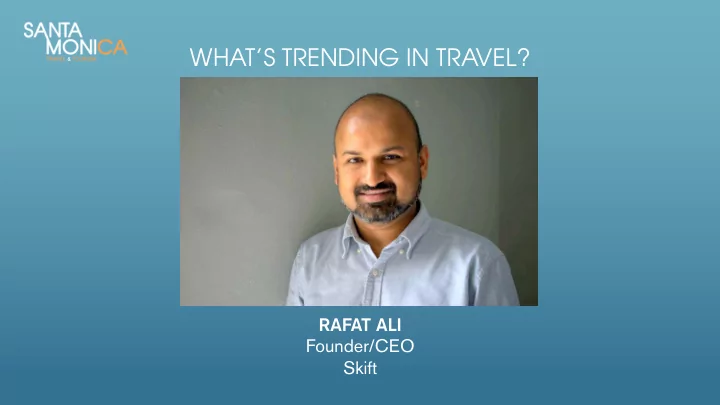
WHATS TRENDING IN TRAVEL? RAFAT ALI Founder/CEO Skift SKIFT IS - - PowerPoint PPT Presentation
WHATS TRENDING IN TRAVEL? RAFAT ALI Founder/CEO Skift SKIFT IS The largest intelligence platform in travel, providing Media, Insights and Marketing to all sectors of the worlds largest industry. skift travel iq SKIFT does
WHAT’S TRENDING IN TRAVEL?
¡ RAFAT ALI Founder/CEO Skift
skift
travel iq
skift
travel iq
skift
travel iq
Skift Trends reports: Bi-monthly deep industry dives skift.com: Daily news and insights skift global forum: Thought-leadership event skift X: Branded content studio
skift
travel iq
skift
travel iq
Big hospitality is in turmoil with consolidation as the popular model. The personal is geopolitical in tourism today. Traditional online travel is consolidated between Priceline and Expedia after acquisitions.
skift
travel iq
Data has the potential to make businesses smarter and turn all marketing communication into
This torrent of change will engulf the travel industry. Travel companies have traditionally helped consumers go on a journey. Now, the industry is mining the customer’s journey to do a better job. The speed with which solutions providers are rushing to tap into the increasing amount of available consumer data, and evolving technology means that in the coming year, marketers will approach an all-encompassing view into customer behavior and preferences.
With this comprehensive view into the traveler’s journey, the industry is poised to elevate and personalize the travel experience further than ever.
skift take:
The Travel Industry Is Now Ready for a 360-Degree View of the Traveler
skift
travel iq
Continued demand growth and record occupancy levels matched with modest supply growth will also foster 2016’s frenzy. M&A’s can also greatly shift the OTA landscape. Marriott’s deal created the world’s largest hotelier, rich in a portfolio of 30 brands. Such a powerhouse yields tremendous influence when negotiating with OTAs. Growth is everything for hotels; it keeps shareholders happy, and it also expands their global
Mergers, killing brands, globalization and an ongoing fear of Airbnb and its ilk will keep 2016 interesting and prepare the industry for a bit of needed evolution.
skift take:
The Big Turmoil in Big Hospitality
skift
travel iq
Food has an unmatched ability to communicate a unique sense of place. Local cuisine provides a direct connection to the history of a region, the soul of its people and the rhythm of daily life. Food app Reserve’s CEO Greg Hong put it very well, speaking at Skift Global Forum in October 2015: “Dining will be the last form of live entertainment. As we start to digitize experiences, we are going to yearn for authentic experiences where we can break bread together.” Hospitality, cruising and aviation brands across every budget tier are also providing context around native cuisine by incorporating local products and producers into their marketing and strategy.
Food tourism is nothing new, but its exponential growth is remaking how destinations position themselves in the global tourism marketplace.
skift take:
The Bourdain Effect: Food is Now the Leading Hook in Travel
skift
travel iq
Hotel chain website and mobile share globally seemed to be “trending up” in 2015. Hotels and online travel agencies have long been locked in a perennial battle for travelers’
they will likely make an even more concerted effort this year. In 2016, Marriott and Starwood, as well as Hilton Worldwide, and InterContinental Hotels Group, are all expanding options for loyalty program members to bypass front desks and use smartphones for keyless room entry, and this feature won’t be available for travelers who book their stays on Expedia, Booking.com, and TripAdvisor.
It’s a great time to be a consumer as brands will do what they can to get you to be loyal to them first, even if it means foregoing some fees on the process.
skift take:
The Direct Booking Wars Are in Full Bloom
skift
travel iq
If you're a U.S. citizen with disposable income, your odds of having a stellar year of travel are higher now than they've been in at least two decades. The dollar is now at a 10-year high against the euro, the Brazilian real, Japanese yen, Turkish lira, and many other currencies in desirable places. Domestically, oil prices are so low — already down 25 percent year over year — you can get two road trips for the price of one. We can even go to Cuba now, too.
It may be a bit messy considering geo-politics and the coming divisive election, but U.S. travelers are still in an excellent position to travel with fatter wallets and broader horizons than they have in a decade.
skift take:
THIS IS THE YEAR OF THE AMERICAN TRAVELER
skift
travel iq
Airlines like Finnair send well-timed emails to Economy ticket holders offering limited-time upgrades to business class. This is an effective work around to premium ‘sticker shock’ at the time of booking. Airlines are also beginning to use apps to sell products and services at the right time, during the journey, when passengers are less price sensitive. If what airlines offer their customers solves a problem, and enhances the flying experience, passengers will dig into their wallets.
BYO doesn’t have to be a bad thing and the best airlines will convince passengers it’s even better than old-school frills.
skift take:
Build Your Own Passenger Experience is the Future of Flying
skift
travel iq
With mobile taking up more than 50 percent of consumers’ time, messaging is the new social
Snapchat, WhatsApp, WeChat, Facebook Messenger, Viber and many other messaging platforms dominate much of how the modern world communicates. Travel brands that haven’t jumped on those platforms yet are missing out on the future of how people prefer to communicate both at work and at leisure, around the globe. Messaging has been the fastest-growing online behavior within the social landscape over the past five years, surpassing social networks. Messaging is how you break out of the tyranny of the online travel search box.
Messaging gives brands a direct, intimate relationship with consumers that social media only hinted at. What will be the long-term effect on marketing when a hotel or airline can contact customers like their loved ones do?
skift take:
Messaging Is the New Language of the Globe
skift
travel iq
The concept of fast and casual within the hospitality industry is a throwback to recent progress in the restaurant space. It's a reaction to a decade of overdesign and superdesign. It's unbundling with a purpose: Element and Aloft use self-serve meal kiosks while Ryanair and Spirit cut out everything but the seat -- and now Delta is copying. Travel providers will benefit by creating more efficient products that are less expensive to
Consumers like the simplicity of a la carte and only paying for the things that demonstrate clear value. Let's get rid of the clutter.
skift take:
The Rise of Fast-Casual Design
skift
travel iq
2016 will be the year when cities start leveraging their exponentially growing volume of open data to provide new services for travelers. While long anticipated, it’s only now where the “City As Platform” concept is evolving into a functional urban operating system to support the hype around smart cities. Travelers are sharing more information than ever across a multitude of platforms, giving advisors an opportunity to synthesize actionable information on-the-fly. They are helping travelers discover new and interesting experiences unfounded otherwise.
Cities often tell us more than we know what to do with, but with the right thinking this surfeit of intelligence can be turned into an exceptional opportunity to distinguish destinations.
skift take:
Smart Cities Are Now Platforms
skift
travel iq
NEW PROJECTS & CONCEPTS ARE WHAT MAKE US HAPPY.
RAFAT ALIFOUNDER & CEO @rafat ra@skift.com 212-564-5830