What Investors Really Want Lessons from Behavioral Finance Meir - - PDF document

what investors really want
SMART_READER_LITE
LIVE PREVIEW

What Investors Really Want Lessons from Behavioral Finance Meir - - PDF document

What Investors Really Want Lessons from Behavioral Finance Meir Statman Glenn Klimek Professor of Finance Santa Clara University and Visiting Professor Tilburg University The Netherlands What Investors Really Want Utilitarian,


slide-1
SLIDE 1
  • What Investors Really Want

Lessons from Behavioral Finance

Meir Statman Glenn Klimek Professor of Finance Santa Clara University and Visiting Professor Tilburg University – The Netherlands

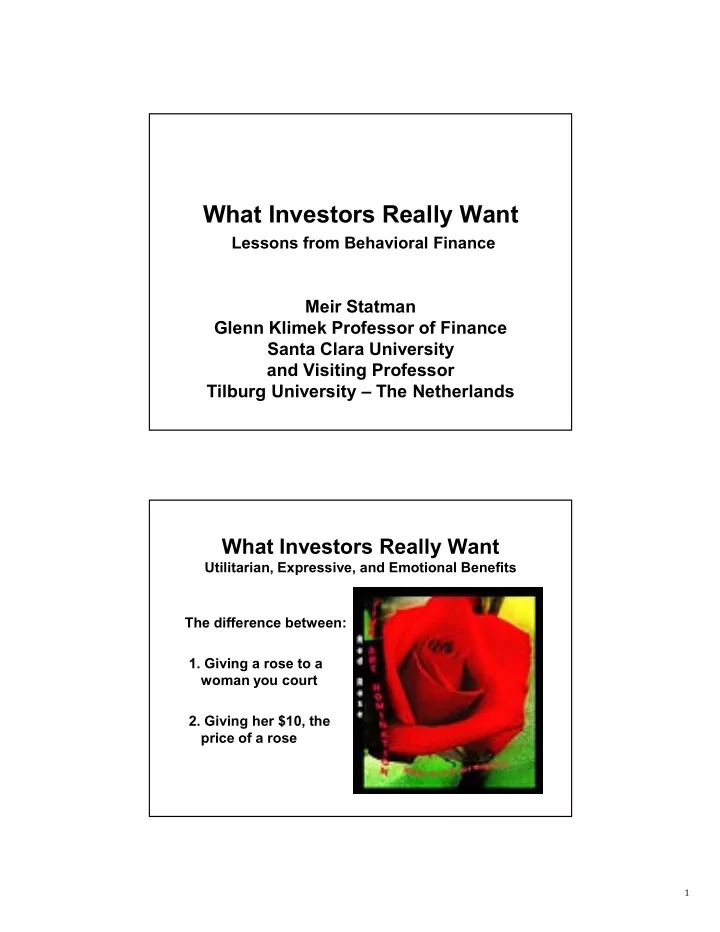
What Investors Really Want

Utilitarian, Expressive, and Emotional Benefits The difference between:

  • 1. Giving a rose to a

woman you court

  • 2. Giving her $10, the

price of a rose

slide-2
SLIDE 2
  • What watch2buyers really want

Why do I pay $10,000 for an IWC watch?

Utilitarian benefits

What does it do for me and my pocketbook?

  • Expressive benefits

What does it say about me (to me and to

  • thers)?
  • Emotional benefits

How does it make me feel?

  • What Investors Really Want

We want to stay true to our values Socially responsible investments

Utilitarian benefits

  • Expressive benefits
  • Emotional benefits
slide-3
SLIDE 3
  • What Investors Really Want

We want high status and proper respect

Hedge funds

Fifty million, sadly, leaves one flying

  • commercial. Hedge2fund money can put

you into exhilarating conversations about the virtues of Gulfstreams versus Falcons Utilitarian benefits

  • Expressive benefits
  • Emotional benefit
  • What Investors Really Want

We want great beauty and high status

  • !"

#$$"$% !

slide-4
SLIDE 4
  • What Investors Really Want

We want to play and win

Benefits to ‘active’ investors

Utilitarian benefits

  • Expressive benefits
  • Emotional benefits
  • What Investors Really Want

Standard Finance and Behavioral Finance Standard Finance Finance with people in it Computer2like people Behavioral Finance Finance with people in it Sometimes normal2

  • sometimes normal2
slide-5
SLIDE 5
  • First Lesson

Know Yourself Know Your Clients Know Your Competitors

Know their wants Know their goals Know their cognitive errors Know their emotions

What Investors Really Want

Wants and cognitive errors What do we want?

To get high returns To play the beat2the2market game and win To be socially responsible To gain high status

slide-6
SLIDE 6
  • What Investors Really Want

What Institutional Investors Really Want

To get high alpha? To play the beat2the2market game and win? To be socially responsible? To gain high status?

Second Lesson Know Science Teach science to your clients

Teach the science of financial markets Teach the science of human behavior Knowledge and applications of science distinguish institutional investors from individual investors

slide-7
SLIDE 7
  • Second Lesson

Know Science and teach science

The tools of science

Science makes us aware of our cognitive errors and emotions Science gives us tools to correct them Logic and empirical evidence Second Lesson Know Science and teach science The tools of science

“System 1” is the system

System 1 is automatic, effortless, rapid, and skilled (An American in the US, driving on the right)

“System 2” is the system

System 2 is controlled, effortful, slow, and rule2 following (An American in the UK, driving on the left) Note: Not all effortful and slow systems apply the tools of science=

slide-8
SLIDE 8
  • Know the science of human behavior

and teach it

Why is it hard to resist intuition, even when it is wrong? John Nash 2 A Beautiful Mind

We were afraid= We are still afraid

slide-9
SLIDE 9
  • Know science and teach science

Emotions: Fear and Exuberance

Do you think that now is a good time to invest in the financial markets? Percentage of investors who said Yes

  • Source: UBS Index of

Investor Optimism

  • Know science and teach science
slide-10
SLIDE 10
  • Is Markowitz wrong?

Did diversification fail?

Question for participants

Correlation between US Stocks and International Stocks 0.90 In a typical year, what is the gap between the returns of US stocks and international stocks? More than 6 percentage points? 4 to 6 percentage points? 2 to 4 percentage points? Less than 2 percentage points?

slide-11
SLIDE 11
  • Know the science of financial markets and teach it

Is Markowitz wrong?

  • Know the science of financial markets

and teach it ! ! ! !

"#$"%!&' "#$"%!&' "#$"%!&' "#$"%!&'

slide-12
SLIDE 12
  • Know the science of financial markets

and teach it

Suppose that Markowitz is wrong What is the substitute for diversification?

Market Timing!

High P/E ratios tend to be followed by low stock returns Sell stocks when P/E ratios are high

Know the science of financial markets and teach it

Market timing in regressions and reality

()* ()* ()* ()*+ + + + *, *, *, *,

  • !. !
  • !. !
  • !. !
  • !. !
  • )*

)* )* )* "!!/)* "!!/)* "!!/)* "!!/)*

0/ 0/ 0/ 0/

  • 12!3
  • 12!3
  • 12!3
  • 12!3
  • 1. Relationship between P/E ratios at the beginning of a year and annualized stock returns over following two

(non2overlapping). Years: 187221999. Fisher & Statman (2000)

slide-13
SLIDE 13
  • Know the science of financial markets and teach it

Market timing with P/E trading rules1

$0 $10,000 $20,000 $30,000 $40,000 $50,000 $60,000 $70,000

Stock Buy & Hold Full period median = 14.4 Preceding period median 10 15 20 25 26 30 35 P/E2based trading rules Accumulations $14,518 $67,672 $8,513 $60,628 *-#1%!44#56 !%4* *-#1%!44#56 !%4* *-#1%!44#56 !%4* *-#1%!44#56 !%4*

%$"#&' %$"#&' %$"#&' %$"#&'

Know the science of human behavior and teach it Cognitive errors in market timing

Why do we believe that market timing is easy? Framing errors Overconfidence errors Hindsight errors Confirmation errors Herding errors

slide-14
SLIDE 14
  • Know Science

Framing errors

I sell my stocks because stocks are sure to go down! Who is the idiot who is buying my stocks? Framing the trading game as tennis against Roger Federer

(or Goldman Sachs, or high frequency traders,

  • r Raj Rajaratnam)

Overconfidence errors

On average, we are above average

  • "789":!,4:6 ;# #

"789":!,4:6 ;# # "789":!,4:6 ;# # "789":!,4:6 ;# #

Return investors expect from their own portfolio Return investors expect from the stock market Return End of 62month moving average

slide-15
SLIDE 15
  • Hindsight errors and

the emotion of regret

Clients lost money invested in stocks Clients are fooled by hindsight and feel the pain of regret Clients overcome the pain of regret by shifting responsibility I am not stupid My investment advisor is stupid

Hindsight errors and the emotion of regret

Investment advisors are tempted to strike back “If we’re being honest, it was your decision to follow my recommendation that cost you money”

slide-16
SLIDE 16
  • We look for evidence that

confirms our claims and beliefs We overlook evidence that disconfirms them Confirmation errors

slide-17
SLIDE 17
  • Confirmation errors

Claim: ‘The severity of the current crisis was

  • bvious to anyone who cared to look’

Confirming evidence: Nouriel Roubini saw it Disconfirming evidence: Ben Bernanke and countless other equally good experts did not

Confirmation errors

!"#" $$"%&" '()

The S&P 500 was at 677 Roubini said: “My main scenario is that it’s highly likely it goes to 600 or below” A level of “500 is less likely, but there is some possibility you get there”

slide-18
SLIDE 18
  • Herding errors

Herding can be beneficial Herding can be harmful

How can we tell the difference?

What information drives this herd? What benefit or harm can come from joining this herd?

Restaurant Herd

slide-19
SLIDE 19
  • What Investors Really Want

Why do we put money in our portfolios? What will we do with it? Utilitarian benefits

I have money for retirement

Expressive benefits

I am financially independent

Emotional benefits

I have freedom from fear (Downside protection) I have hope for riches (Upside potential)

Question for participants If you could increase your chances of having a more comfortable retirement by taking more risk, would you:

  • a. Be wiling to take a more with

your money?

  • b. Be willing to take a more with
  • f your money?
slide-20
SLIDE 20
  • If you could increase you chances of

improving your returns by taking more risk, would you:

&

'

" #

  • $$

" #

Risk Money

&

'

"$ $ " # " #

a. b. What do investors want?

Freedom from fear – Downside protection Hope – Upside potential

Goal2based portfolios We want to be rich (20% chance to be rich) We don’t want to be poor (Almost 100% chance not to be poor)

slide-21
SLIDE 21
  • Combining elements of

mean2variance portfolio theory and behavioral portfolio theory into a mental2accounting portfolio framework Portfolio Optimization With Mental Accounts,

  • Portfolios for investors who want to reach their

goals while staying on the mean2variance efficient frontier

  • Das, Markowitz, Scheid, and Statman

The overall portfolio and mental account (goals) sub2portfolios are all on the mean variance efficient frontier

slide-22
SLIDE 22
  • Risk tolerance

Question for participants

Think about switching your portfolio You have a 50250 chance to increase your standard of living by 50% throughout your life You have a 50250 chance to decrease your standard of living by X% throughout your life What is the maximum X% you are willing to accept?

  • 1. 10% or less

2. 11220% 3. 21230% 4. More than 30%

Risk tolerance

Question for participants Who (on average) are more risk tolerant?

  • 1. Italians
  • 2. Vietnamese
slide-23
SLIDE 23
  • Risk Tolerance
  • !"

# $% &'(" # )*#'! # +

The cultures of risk tolerance

Individualism 2 Collectivism

Why are there differences in risk tolerance among people of different countries? Risk tolerance is relatively high in relatively collectivistic countries

slide-24
SLIDE 24
  • The cultures of risk tolerance

The individualism2collectivism line (by Hofstede) What do we owe our adult children, parents, brothers, uncles, aunts and grandparents? What do they owe us? Individualistic societies

Ties between individuals are loose .

Collectivistic societies

People are integrated into strong, cohesive in2groups

Risk tolerance is relatively low in countries that are relatively individualistic

  • !"

# $% &'(" # )*#'! # +

Individualism (IDV)

slide-25
SLIDE 25
  • Risk tolerance is relatively in countries with

relatively strong safety nets

Public safety nets substitute for family safety nets

  • ,#

,- !" " $% & #+ &'(" .'# .'/* ( # 0/1 " #)*#'! # +

Safety net: Social Spending relative to GDP

Risk tolerance is relatively high in countries with relatively low income2per2capita (I might as well gamble)

2 2 2 2 2 2 2 2 2 2 2

  • !"

# $% &'(" # )*#'! # +

Income per Capita (in thousands(

slide-26
SLIDE 26
  • Risk tolerance is relatively low where

uncertainty avoidance is relatively high

  • !"

# $% &'(" # )*#'! # +

Uncertainty Avoidance (UAI)

Risk tolerance, age, and gender

Older People are less risk tolerant than younger people Women are less risk tolerant than men

slide-27
SLIDE 27
  • Conclusion

First Lesson

Know yourself Know your clients Utilitarian, expressive and emotional benefits

Second Lesson

Know Science Teach science to your clients

slide-28
SLIDE 28
  • References
  • M. Statman, “What Investors Really Want,” McGraw2Hill, 2011
  • K. Fisher and M. Statman, “Cognitive errors in market forecasts,” !"

#, 2000

  • K. Fisher and M. Statman, “Market timing in regressions and reality,” !$

%, 2006

  • M. Statman and J. Scheid, “Correlations, return gaps, and the benefits of diversification,”

!"#, 2008

  • S. Das, H. Markowitz, J. Scheid, and M. Statman, &Portfolio optimization with mental

accounts,” !$'()*+*

  • S. Das, H. Markowitz, J. Scheid, and M. Statman, “Portfolios for investors who want to

reach their goals while staying on the mean2variance efficient frontier,” ! ,, 2011

  • M. Statman and D. Glushkov, “The Wages of Social Responsibility,” Financial Analysts

Journal, 2009

Meir Statman

Contact Information

Meir Statman Glenn Klimek Professor of Finance, Santa Clara University and Visiting Professor of Finance, Tilburg University – the Netherlands 500 El Camino Real, Santa Clara, CA 95053, USA Tel 408 554 4147 mstatman@scu.edu http://www.scu.edu/business/finance/faculty/statman.cfm http://whatinvestorswant.wordpress.com/