
SLIDE 1
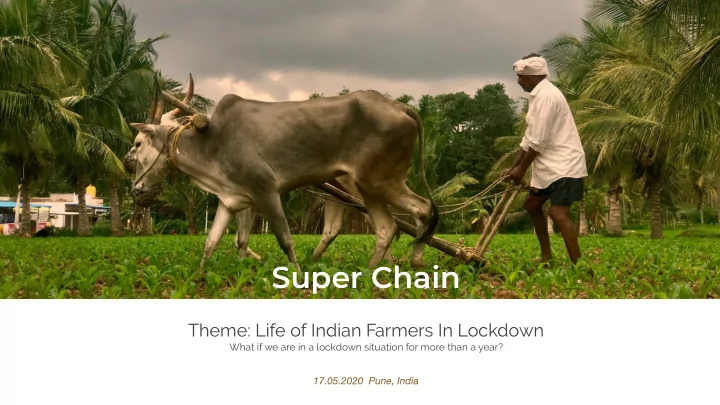
Super Chain
Theme: Life of Indian Farmers In Lockdown
What if we are in a lockdown situation for more than a year? 17.05.2020 Pune, India
Super Chain Theme: Life of Indian Farmers In Lockdown What if we - - PowerPoint PPT Presentation
Super Chain Theme: Life of Indian Farmers In Lockdown What if we are in a lockdown situation for more than a year? 17.05.2020 Pune, India Team Adarsh G Kunal Jagtap Chetan Patil Profile Profile Profile Photo Photo Photo Product
What if we are in a lockdown situation for more than a year? 17.05.2020 Pune, India
Adarsh G Industrial Designer
Profile Photo
Shashank Sahay Product Designer Kunal Jagtap UX Designer
Profile Photo
Chetan Patil Product Experience Designer
Profile Photo
“In my 21 years as a farmer I have never faced a crisis like this”
says A. Suresh Kumar, a watermelon farmer in Chitharkadu village, Tamil Nadu.
Source: www.ruralindiaonline.org
“The only reason I’m agreeing to such bad offers is because I don’t want such good fruits to just rot away. This has already put me at a great loss.”
says M. Murugavel, 41, watermelon farmer in Kokkaranthangal village
Source: www.ruralindiaonline.org
Loses of grape Farmers in Maharashtra
Cumulative market yard loss in Andhra Pradesh
Farm produce industry facing losses
Of fruits & vegetables sale dropped by March
Agri and agri allied workers not working currently
Reduction in per quintal rate of mangos
logistics, experiencing these uncertainties will deter her/him from attempting to grow produce for next year or cycle in his farm.
national food shortage, unable to feed everyone in our country
a sustainable market.
farmer?
Rajaram Shinde 1.5 acre
Location - Talegaon Dabhade, (35 km away from city)
Ganesh Harak 3.5 acre
Location - Dhindori, Nashik (42 km away from city)
Hari K 9 acre
Location - Adaguru,Mysore (50.1 km away from city)
Ravi Awate 30 acre
Location - Baramati (106 km away from city)
Shanti Pillai 2.2 acre
Location -Belaguli, Tumkur (71 km away from city)
Primary school
Rajaram is a marginal farmer. Owns around 1.5 acres of land & chooses to grow mostly vegetables in 50% of land & one cash crop/fruit in the remaining 50%. He is the decision-maker of the house and farm. Rajaram is social & well connected in his community & is curious when learning about new farming methods from his peers. He has enormous tacit knowledge but lacks knowledge about the new
college but equally worried about the future of his farm & commodities
community
Drops his children to school & goes to farm Monitor crop health & performs tasks as per the stage of crop cycle Attends village gatherings/meetings/discussions Reads newspaper & posts in Whatsapp about farming related issues
price/information for commodities
to take his commodities to market
cycle which is heavily dependent upon the current status of the crop sales
COVID-19 effect
where to take his produce as the market is closed and that’s the only
the future and his farm’s future
“When I face problems in crops, my daughter helps me using her smartphone, I do not know how to use
B.Sc Agri
Hari studied B.Sc agriculture from National University. He works on a farm with his
implement in his farm & always looks for collaboration to get the best of price & reach maximum consumers. Fairly tech-savvy & aspires to upgrade to latest phone and internet plans. He often tries to experiment with the crops & tries to pitch them to nearby FPO & factories to get reviews. He loves spending quality time watching movies, keeping updated about current scenario (health, food & money) & watching youtube videos
Attend remote meeting/exhibitions with his father and friends Buys new equipment and gadgets frequently Studying different business models and
Video calls with friends and family
and other factors impacting their income and health of crops
results of his small experiments
ways to sell his produce and reaching to Consumers directly on social media
farmer community aware on how to sail through the current crisis and also convincing them to sell their produce as a community
“I want to make my parents and community proud by bringing innovation in agricultural processes”
COVID - 19 effect
12th Pass
Ganesh is a marginal flower farmer who owns one TATA pickup. He uses this vehicle to transport his flower commodities to the market. TATA pickup is his secondary source of income as he uses it to transport labors, and commodities of
harvest’s quantity. He does not prefer taking out his vehicle unless it’s 70% full. For him, today farming business is a total loss as his major earnings go into buying fertilizers, seeds, labour, etc and does not earn much profit for the next cycle. He has attempted to sell his goods directly to consumers but has not succeeded significantly because of no proper information & planning
Call /post updates to multiple farmers before going to market Schedule visits of FPO officials to his farm collaborate with them. Gets farm related materials (tools, fertilizers, etc) from city to his village Enquire the availability of
Equipments from the nearby villages
preparation season
loan
to collection of commodities of fellow farmers
and earn more profit
COVID-19 effect
current crisis, the pickup lies idle.
there is no market demand for flowers
“I’ve worked hard all my life to enable my children to get quality education so that they can lead a better life ”
B.Sc Agri
He is well-reputed, looked upto & influential in his community. He has been very successful in trying & implementing new irrigation techniques & models on his
his life events at his farm. He likes documenting his farm & farm-related activities
generation to follow his methods for various problems & ideas. He is looking for a safe environment where he can collaborate & share & post anything without getting
career option for today’s generation
Meets different people (villagers, local gov.
Inspects the status of his crop growth & experiments Keeping updated with nationwide scenarios Using Whatsapp & Facebook messenger for all his updates and interacting with friends and family
1.Young generations moving out of village and selling their lands 2.Farmers struggling and still using traditional models for farming and selling 3.Not able to reach desired number of people & help them earn right price 4.Fellow farmers getting cheated and not earning the fair price for their crops
COVID-19 effects
distancing is a must due to which people have spread out he is finding it difficult to find help to harvest his produce
the virus and misconceptions among his fellow and how fast misinformation spreads
“I wish to make my village a model village in farming, using scientific methodologies and technology ”
Secondary school
Shanti is the head of her household and mother of two. She plant beans, peanuts, sweet potatoes & other vegetables in her 2.2-acre land. Her husband committed suicide 4 years back due to the overburden of a bank loan which he couldn’t
track for her family. She is dependent upon various people (vehicle service providers, equipment providers, bank, etc) for the farming tasks, & equally helps whoever is in need.
She gathers water every morning and returns back home to cook meal Sends her younger son to school When she is not farming, she socializes and enjoys gossip She sells some of the produce locally on the highway
conditions, affecting her produce
new farming methods and techniques
markets
COVID-19 effects
due to the lockdown, she does not have enough money to buy seeds and fertilizers for her next cycle of crops.
survive this pandemic.
“Though my husband left us but I’ll make sure I run the farm like he did & have a better future to my children ”
Brightly coloured roses, chrysanthemums, lilies, marigold and other flowers that might normally have been destined for marriage decoration and temples -- are now being destroyed by growers in unprecedented manner as the rapidly spreading coronavirus brings demand to a standstill.
(marriages, temples, exports and other celebrations closed)
gulkan, craft objects etc
knowledge on how to grow them.
while, the future demand forecast of flower produce looks bleak.
high possibility of food crisis, it is best advised for flower farmers to shift to food crops.
Intelligent Crop Recommendations, Sell and Learn
Connect farmers directly to people who are buying flowers:
Intelligent recommendation
flower farmers, based on data model + domain expert human suggestions.
Knowledge portal
Access to verified information about processing flowers into
information related to growing of food crops
Verified Learning information
into other articles which can be stored
Long term scenario
Empowering the farmer survive the pandemic by providing intelligent crop recommendation shifting to food crops instead of flowers in the pandemic
Instant Relief
Helping flower farmers directly sell already harvested produce
Mobile Application and a Whatsapp Helpline:
(COVID-19 has increased reverse migration)
information, which helps us provide better service
Whatsapp, enables wider reach for the service.
Data set from markets Data set from agriculture universities Input from farmers like, soil type, past history
availability, land etc
Simplified representation of recommendation engine
Domain expert Recommendation model Intelligent food crop recommendation to grow in the next cycle
Technological breakthroughs in Machine learning and Artificial intelligence help us provide Intelligent crop recommendation for the user’s next cycle/season of crop, providing tailored recommendation specific to the user.
Understanding & Empathise Synthesis & Insights Ideation Prototype
Gathering information about farmers distress due to COVID-19 from
domain experts Creating Indian farmer personas Figuring out the root cause of the systemic collapse? What kind of farmers have been affected the most. Who will remain vulnerable in the future? How might we usher farmers in financial distress into financial stability/security? Building a mobile app with conversational UI which is easy to use and enables farmers to sell their produce directly, get intelligent crop recommendations for next crop cycle and has a knowledge portal to learn.
CSR division, etc)
modal/early adopters group by co-creation workshop)
and onboard the farmers and information providers
As of 2015 - 16 India has about 2,49,000 hectares area under cultivation in floriculture If we reach about 50% of those farmers & enable them to grow food crops, We can prevent the plight of lakhs of people by creating more consumable food in the market & helping farmers adapt & thrive in the current condition.
Intelligent Crop Recommendations, Sell and Learn