B. Panel Presentation 1. Local Governance Reforms that Have Been - - PowerPoint PPT Presentation

b panel presentation 1 local governance
SMART_READER_LITE
LIVE PREVIEW

B. Panel Presentation 1. Local Governance Reforms that Have Been - - PowerPoint PPT Presentation

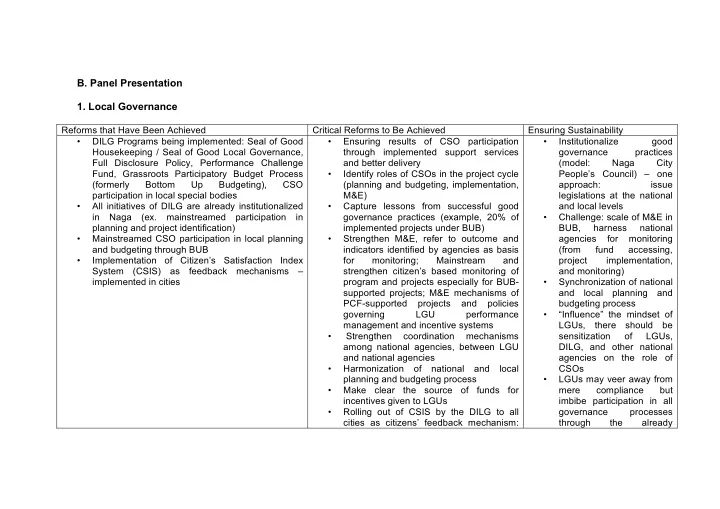
B. Panel Presentation 1. Local Governance Reforms that Have Been Achieved Critical Reforms to Be Achieved Ensuring Sustainability DILG Programs being implemented: Seal of Good Ensuring results of CSO participation


slide-1
SLIDE 1
  • B. Panel Presentation
  • 1. Local Governance

Reforms that Have Been Achieved Critical Reforms to Be Achieved Ensuring Sustainability

  • DILG Programs being implemented: Seal of Good

Housekeeping / Seal of Good Local Governance, Full Disclosure Policy, Performance Challenge Fund, Grassroots Participatory Budget Process (formerly Bottom Up Budgeting), CSO participation in local special bodies

  • All initiatives of DILG are already institutionalized

in Naga (ex. mainstreamed participation in planning and project identification)

  • Mainstreamed CSO participation in local planning

and budgeting through BUB

  • Implementation of Citizen’s Satisfaction Index

System (CSIS) as feedback mechanisms – implemented in cities

  • Ensuring results of CSO participation

through implemented support services and better delivery

  • Identify roles of CSOs in the project cycle

(planning and budgeting, implementation, M&E)

  • Capture lessons from successful good

governance practices (example, 20% of implemented projects under BUB)

  • Strengthen M&E, refer to outcome and

indicators identified by agencies as basis for monitoring; Mainstream and strengthen citizen’s based monitoring of program and projects especially for BUB- supported projects; M&E mechanisms of PCF-supported projects and policies governing LGU performance management and incentive systems

  • Strengthen

coordination mechanisms among national agencies, between LGU and national agencies

  • Harmonization of national and local

planning and budgeting process

  • Make clear the source of funds for

incentives given to LGUs

  • Rolling out of CSIS by the DILG to all

cities as citizens’ feedback mechanism:

  • Institutionalize

good governance practices (model: Naga City People’s Council) – one approach: issue legislations at the national and local levels

  • Challenge: scale of M&E in

BUB, harness national agencies for monitoring (from fund accessing, project implementation, and monitoring)

  • Synchronization of national

and local planning and budgeting process

  • “Influence” the mindset of

LGUs, there should be sensitization

  • f

LGUs, DILG, and other national agencies on the role of CSOs

  • LGUs may veer away from

mere compliance but imbibe participation in all governance processes through the already

slide-2
SLIDE 2

Issues

  • f

sustainability and complementation with

  • ther

citizen’s based feedback initiatives

  • Enforcement of existing mandates and

legal issuances that institutionalize expanded CSO participation in local planning and budgeting, and M&E

  • Formalize and institutionalize citizen’s

role in enhanced LGU Performance Assessment/Measurement Systems (ex. SGLG) existing bodies

  • Continuous joint capacity

building among CSOs, LGUs, and national government agencies (on focused areas: sensitization, partnership building)

  • Leverage

technology in monitoring LGU project implementation (ex. geo- tagging, e-Gov project of DOST and DBM, knowledge sharing using teleconferences)

slide-3
SLIDE 3
  • 2. Justice, Peace and Human Rights

Reforms that Have Been Achieved Critical Reforms to Be Achieved Ensuring Sustainability

  • A. Justice
  • Appointment of reform-oriented personalities to

ensure sustainability of the reforms in the judiciary – Maria Lourdes Sereno as Supreme Court Chief Justice and Marvic Leonen as Associate Justice – Leila de Lima as Justice Secretary – Conchita Carpio-Morales as Ombudsmad – Amparo Cabotaje-Tang as Sandiganbayan Presiding Justice – Promoting speedy resolution of cases and providing easier access to the courts and judicial processes – SC issuance of an order for the guidelines on the use of judicial affidavits in court; Increase of salary of Public Attorneys; better perception towards Public Attorneys (relative to Public Prosecutors) – Improving the Witness Protection Program – Increase in the budget allocation for the program (Php 175M in 2012)

  • Improving the jail security, upgrade the living

conditions and intensifying development programs

  • f the inmates

– Allotment of Php 4.9B for the implementation

  • f

the Jail Management and Penology Program of the Bureau of Jail Management

  • A. Justice

On the witness protection program (WPP): – Review of the WPP and increase its budgetary allocation – Passage

  • f

the Whistle Blower Protection Program On improving jail security: – still to be allocated with larger budget in order to effectively address security concerns On providing support to the DOJ (Cybercrime Office) – still to be allocated with larger budget to effectively enforce the law and take

  • n its extensive responsibility

On access to legal services:

  • the government to also provide legal services

not just for the usual criminal cases; strengthening the PAO

  • B. Peace and Security

Complete the FAB before the expiration

  • f the Aquino administration (BBL by 2014),

and address challenges to inclusivity For the Bangsamoro: prepare/capacitate the bureaucracy, the MILF and their allies to govern/lead the new entity Maximize the openness of the government to engage the broadest range of stakeholders

slide-4
SLIDE 4

and Penology

  • Providing support to the DOJ

– Allotment of Php 9.7B for the passing of final resolutions

  • n

various cases under its jurisdiction to be fast-tracked – Setting –up of the National Justice Information System

  • a knowledge-based and knowledge –driven

database portal that will solve information gaps and address collaboration issues in the criminal justice system – Creation of a cybercrime office with provision

  • f Php 5M as its budget

– Allotment of funds for salary differential of justices, signing a MoA restoring the Special Allowances of the Judiciary and raised their salaries as per the Salary Standardization Law III – Php 2B has also been set aside under the MISCELLANEOUS PERSONNEL BENEFITS FUND to fill in vacant positions in the judiciary

  • 2. Peace and Security

Winning the Peace – pursuing a negotiated political settlement of all internal armed conflicts – actions towards completion and implementation of the Comprehensive Peace Agreement with the MILF leading to the enactment of the Bangsamoro Basic Law

  • The process to be also subjected to the

limits of the Constitution and other legal limitations

  • Contingency legislative support from

the Congress to expedite the process

  • f transformation

Convergence (tripartite review completion + ARMM governance reform + Bangsamoro) Resume the peace talks between the CPP-NPA-NDF and GPH that is time bound and agenda-based On dealing with security issues involving foreign states: – Provide clear foreign policies; and – Provide clear/standard approach in resolving issues involving foreign states Realization of the reform agenda on the regulation of small arms and the existence of private armed groups in the regions, specifically in Mindanao. Review/revisit the amnesty program

  • C. Human Rights

Improvement

  • f

the performance in combating extra judicial killings (politically motivated killings of activists and journalists)

slide-5
SLIDE 5

– resumption of the talks with the CPP-NPA- NDF that is time bound and agenda-based – steps towards the final completion of the Tripartite Implementation Review Process and ensuring the inclusion of the MNLF legislative agenda into the Bangsamoro Basic Law – signed final closure agreements with CPLA and RPM-P/RPA/ABB now being completed (including normalization) Community resilience against armed violence now being built – PAMANA implementation (9.85B for 408 municipalities; 2010-2013) – Transition Investment Support Program – ARMM (8.5B) Governance reforms in ARMM Strengthening the security sector:

  • Enacted the Modernization of AFP
  • Acquiring of naval ships and patrol

fleet to increase the presence of the government in territorial seas The use of diplomatic means in resolving territorial claims / defending the country’s sovereignty.

  • c. Human Rights

Signing of the Anti-Enforced Disappearance act in 2012 Human rights engenderment trainings for the military and and enforced disappearances Strengthen the Commission on Human Rights through the provision

  • f

its charter/enabling statutory basis An interagency effort for general human rights Empowerment of the Presidential Human Rights Committee Establish the Human Rights Compensation Board to start the process

  • f

giving compensation to the ML victims; pass the IRR of the compensation law

slide-6
SLIDE 6

the police as arranged by the Commission on Human Rights Passage of the compensation law for the victims of human rights violations during Martial Law AO 5 creating a high-level interagency committee tasked to assist in the speedy resolution of cases involving EJKs, EDs and torture Joint Operational Guidelines between the DOK and PNP

  • n the investigation and case build-up of EJKs

Monitoring, Reporting and Response System (MRRS) to protect children from different child rights violations in situations of armed conflict –EO 138, s.2013 AFP Guidelines on the Conduct of Activities inside or within the Premises of Schools and Hospitals ARMM Regional Human Rights Commission established

slide-7
SLIDE 7
  • 3. Anti-Corruption

Reforms that Have Been Achieved Critical Reforms to Be Achieved Ensuring Sustainability

  • Reforms showing openness of Government
  • OGP (Open Government Partnership)
  • Seal of Transparency
  • Citizens’ Charter & Workflow Process in

NGAs

  • Simplified accreditations of CSOs
  • Anti-corruption in revenue generation
  • RATE: Run After Tax Evaders
  • RATS: Run After the Smugglers
  • RIPS

: Revenue Integrity Protection Service

  • Budget and Procurement Reform
  • Removing of PDAF and Lump Sum
  • Pera ng Bayan Website
  • Posting to PhilGeps required by DBM in

budget release

  • Lowering of ABC, especially in PNP
  • Accountability mechanisms
  • DOJ

Reforms (ICT, Automations, Streamlining of Processes)

  • Cleaning House of Different Agencies
  • Transparency
  • FOI
  • SALN full disclosure and new

format

  • Accountability
  • Filling of Cases and Prosecution
  • Whistle Blowers’ Protection Bill
  • Enhanced

Witness Protection Program w/ Budget for Support Groups

  • Strengthen

Capacity

  • f

the judiciary

  • UNCAC should be incorporated in

the PDP

  • Participation
  • Capacity building of both CSOs

and LGUs in Participatory Governance and constructive engagement

  • Information drive to guide CSOs in

BUB

  • Financing of CSO participation

with clear guidelines, especially on capacity building

  • Integrity of Government and Citizens
  • Education on Good Governance

and Anti-Corruption in School Curriculum etc. NSTP

  • Bill on Increasing Standards for
  • BUB Bill or if not possible,

mainstreaming participatory budgeting in the budget system (DBM’s budget call requirements)

  • Expand the mandate of

IAGCC to include oversight functions on integrity of government agencies

  • Institutionalize reforms in

the CSOs via NAPC

  • Appointment and election
  • f credible reform oriented

individuals

  • Strengthen information and

communication to popularize the agreed upon standards, reforms and rules of the game.

  • Reform

Political Party System to facilitate succession

  • f

political managers and the reform agenda

slide-8
SLIDE 8

Appointments Reform in CSO Side

  • CSO network building to make citizens’

participation more inclusive and efficient

  • Proper Feedback and Reporting

Mechanism among CSO network

slide-9
SLIDE 9
  • 4. Human Development

Reforms that Have Been Achieved Critical Reforms to Be Achieved Ensuring Sustainability

  • A. Economic
  • On the protection of labor:

– Passage of the RA 10524 – hire 1% of qualified PWDs

  • Agrarian Reform

– DAR distributed 235,383 has under land acquisition and distribution (LAD) from 2011-2012, vs target of 440,274 has – LAD completion target by 2014 requires around 200,000 has distributed per year

  • Delineation of municipal waters

– Out

  • f

900 coastal cities and municipalities, 271 have certified municipal waters by the National Mapping Resource and Information Authority (NAMRIA), and

  • nly 29 LGUs have passed ordinances for

municipal water delineation

  • Ancestral Land/ Domain

– Only 3 Certificates of Ancestral Domain Titles (CADT) were awarded in 2011. – Progress remains slow on processing and issuance of the pending claims for an estimated 5 million has of ancestral domain

  • For 2011-2012, housing agencies achieved 67%

– Farm to market roads – Access roads to schools – Accessible Tourism (PWDs) – In-city relocation

  • B. Education
  • Education

– Consultation on the curriculum development (substantive participation of the civil society

  • rganizations)

for K+12 (integration of issues – Gender Equality etc) – Improvement of the scholarship program of the government – Special Education to Inclusive education

  • C. Health

Realization of the following reform agenda for health: – Development

  • f

local health industry

  • Local
  • pportunities

for health care professions such as doctors and nurses

  • Substantive participation
  • f the civil society in the

critical processes of the financial management cycle – Possible focus is

  • n

monitoring through the use

  • f tools to ensure

evidence based evaluation/assess ment – Identification

  • f

priorities/focus and forming allies that could implement complementing activities to ensure sustainability

slide-10
SLIDE 10
  • f their direct housing provision targets.
  • Need to increase national housing target of

1.475M to at least 50% of total housing need of 5.732M housing units

  • Increasing budget for social housing, including

P50B for informal settler families in danger zones in Metro Manila, but difficult to access and low utilization rate

  • Ensure appropriateness and quality of social

housing through participation and partnership

  • B. Education

Program for the Out of School Youth

  • a. Abot Alam Program (inter-agency program
  • f the Department of Education and

Department

  • f

Interior and Local Government) Education system for the Indigenous People

  • C. Health

Universal Health Care – Increase in the enrollment of members of PhilHealth, including the 5.2M poorest Filipino families identified by the NHTS – PR

  • ZMORPH Package

– Rehabilitation and upgrading 4,518 health facilities – Provision

  • f

health workers to the unserved and underseved communities – Public Health Investment – Passage of the Sin Tax Reform Law

  • Full

implementation

  • f

Magna Carte for Public Health Workers – Full implementation

  • f

the Reproductive Health Law

  • Address gaps in the MDG
  • n

maternal and child health

  • D. Social Services

Expansion of the coverage of the CCT in terms of the household beneficiaries – Strengthening the Self- Employment Assistance Kaunlaran and the Guaranteed Employment

  • Linking the CCT program

with livelihood assistance programs including asset reform, local economic development and employment programs

  • CCT inclusive on children with disabilities

Across all the areas under the human development sector – inclusivity | access

  • f

the marginalized sectors | availability/appropriateness of all human development interventions

slide-11
SLIDE 11

– Various public-private partnerships with donors on programs addressing maternal and child health, family planning, tuberculosis, HIV-AIDS, malaria, lymphatic filaria (elephantiasis) and other neglected tropical diseases – Passage of the Reproductive Health Law

  • D. Social Services

Expansion of the coverage of the CCT in terms of the household beneficiaries – DSWD received Php 32.3B in 2011 for the implementation of the CCT

  • Continuous increase in the budget

allocation for expansion

  • f

coverage in terms of beneficiaries and possible impact (ES to HS) – In 2012, 3.8M household-beneficiaries were reported to be registered under the program – Use of the National Household Targeting System (NHTS) in order to ensure that the program is targeted to the poor by the government – Substantive participation of the CSOs in the financial management cycle of the services

slide-12
SLIDE 12
  • 5. Political and Electoral Reforms

Reforms that Have Been Achieved Critical Reforms to Be Achieved Ensuring Sustainability

  • Clean up voters’ list for ARMM Elections
  • General and continuing voters’ registration
  • Effective enforcement of some election laws

– Disqualification of Gov. Ejercito by the COMELEC – Strict enforcement

  • f

non-partisan baranggay elections

  • COMELEC institutional reforms

– Appointment of reform-oriented officials in the Commission – Comelec more open to collaboration with stakeholders

  • Passage of the following laws:

– Anti-Dynasty Law – Political Party Act – Strengthening Local Autonomies

  • Abolition of the Pork Barrel
  • Further strengthening of the COMELEC
  • Institutional

mechanism for people’s participation in enforcement of election laws

  • Inclusion
  • f

voters’ education in the curriculum

  • Active

citizens’ participation in the selection

  • f

the next Comelec Chairman and two Commissioners

slide-13
SLIDE 13
  • 6. Environment

Reforms that Have Been Achieved Critical Reforms to Be Achieved Ensuring Sustainability

KEY ACHIEVEMENTS

  • Inclusion of environmental agenda in the Social

Contract with the Filipino people and in the Philippine Development Plan

  • We agree on the results of the audit (efforts in climate

change, forest management and renewable energy) but we also recognize that there are gaps and challenges to address

  • In NGP implementation, CSOs had meaningful

participation through the partnership with FPE and PTFCF WAYS FORWARD (OVERARCHING)

  • Tap and strengthen LGUs in the implementation
  • f environmental

laws and projects

  • Develop

system for public to access environmental information

  • Formulate a national industrialization plan that

protects the environment and encourage government to invest in ‘green development projects’

  • Enactment of National Land Use Act, Forest

Resources Bill and Alternative Minerals Management Bill

  • Environmental protection and conservation as a

cross-cutting principle in PDP WAYS FORWARD (FOREST AND WATERSHED MANAGEMENT)

  • Provide more efforts to cover more Mangrove

Forest in the NGP (provide an action plan)

  • Check and formulate management plan of

planting sites in the NGP

  • Ensure CSO participation and use of native

species of trees in the NGP The BATTLE for ENVIRONMENTAL REFORMS is waged in the MINDSET Incorporate ENVIRONMENT PROTECTION AND CONSERVATION in the other reform agenda

slide-14
SLIDE 14
  • Continue the promotion of ‘ridge to reef’ and

community-based approaches

  • Ensure qualified technical staff are employed as

MENROs

  • Review the present structure and strategies of

EO 23 (log ban) WAYS FORWARD (CLIMATE CHANGE & RENEWABLE ENERGY)

  • Include biodiversity assessment during disaster

impact study

  • Check plans for ‘drought’ season as part of

climate change efforts

  • Redirect subsidies in ‘coal’ to renewable energy
  • Stronger policies that will protect genetic

resources

  • Institutionalize participatory monitoring and

evaluation with CSOs engagement (DENR programs)

  • Proposed bills/legislations in the original PDP

should be retained, for example the GMO labeling bill and the ratification of Basel Ban amendment

  • President to meet with the green CSOs to

discuss alternative paradigms in environmental protection and conservation like concepts of ‘green’ economic

slide-15
SLIDE 15

development