ORIGINAL ARTICLE A Study on Clinical Presentation of Primary Lung - - PDF document

original article a study on clinical presentation of
SMART_READER_LITE
LIVE PREVIEW

ORIGINAL ARTICLE A Study on Clinical Presentation of Primary Lung - - PDF document

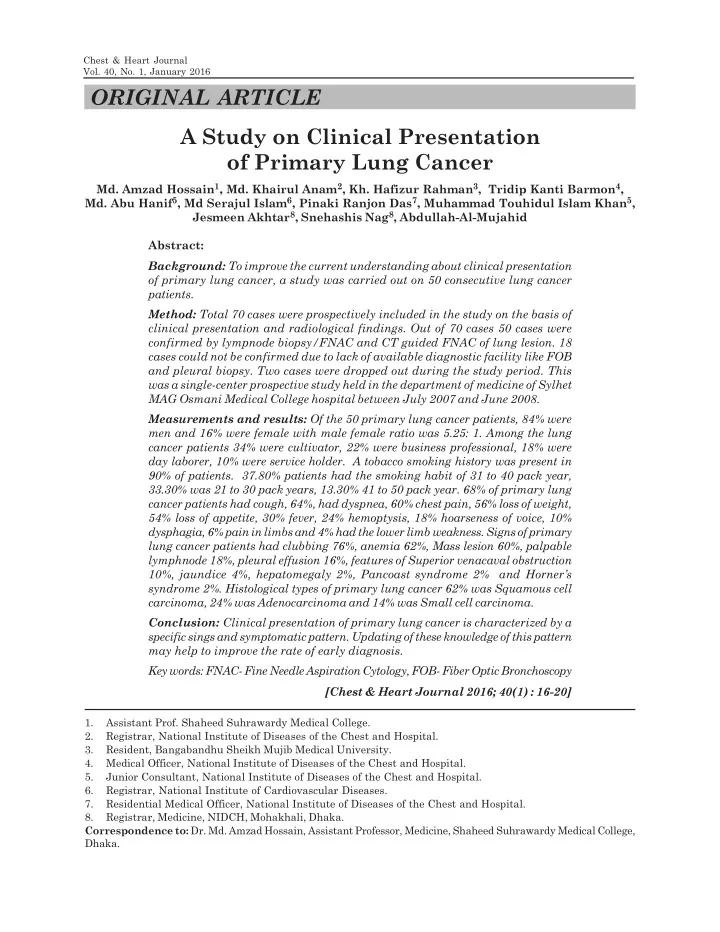
Chest & Heart Journal Vol. 40, No. 1, January 2016 ORIGINAL ARTICLE A Study on Clinical Presentation of Primary Lung Cancer Md. Amzad Hossain 1 , Md. Khairul Anam 2 , Kh. Hafizur Rahman 3 , Tridip Kanti Barmon 4 , Md. Abu Hanif 5 , Md


slide-1
SLIDE 1

1. Assistant Prof. Shaheed Suhrawardy Medical College. 2. Registrar, National Institute of Diseases of the Chest and Hospital. 3. Resident, Bangabandhu Sheikh Mujib Medical University. 4. Medical Officer, National Institute of Diseases of the Chest and Hospital. 5. Junior Consultant, National Institute of Diseases of the Chest and Hospital. 6. Registrar, National Institute of Cardiovascular Diseases. 7. Residential Medical Officer, National Institute of Diseases of the Chest and Hospital. 8. Registrar, Medicine, NIDCH, Mohakhali, Dhaka. Correspondence to: Dr. Md. Amzad Hossain, Assistant Professor, Medicine, Shaheed Suhrawardy Medical College, Dhaka.

A Study on Clinical Presentation

  • f Primary Lung Cancer
  • Md. Amzad Hossain1, Md. Khairul Anam2, Kh. Hafizur Rahman3, Tridip Kanti Barmon4,
  • Md. Abu Hanif5, Md Serajul Islam6, Pinaki Ranjon Das7, Muhammad Touhidul Islam Khan5,

Jesmeen Akhtar8, Snehashis Nag8, Abdullah-Al-Mujahid Abstract: Background: To improve the current understanding about clinical presentation

  • f primary lung cancer, a study was carried out on 50 consecutive lung cancer

patients. Method: Total 70 cases were prospectively included in the study on the basis of clinical presentation and radiological findings. Out of 70 cases 50 cases were confirmed by lympnode biopsy/FNAC and CT guided FNAC of lung lesion. 18 cases could not be confirmed due to lack of available diagnostic facility like FOB and pleural biopsy. Two cases were dropped out during the study period. This was a single-center prospective study held in the department of medicine of Sylhet MAG Osmani Medical College hospital between July 2007 and June 2008. Measurements and results: Of the 50 primary lung cancer patients, 84% were men and 16% were female with male female ratio was 5.25: 1. Among the lung cancer patients 34% were cultivator, 22% were business professional, 18% were day laborer, 10% were service holder. A tobacco smoking history was present in 90% of patients. 37.80% patients had the smoking habit of 31 to 40 pack year, 33.30% was 21 to 30 pack years, 13.30% 41 to 50 pack year. 68% of primary lung cancer patients had cough, 64%, had dyspnea, 60% chest pain, 56% loss of weight, 54% loss of appetite, 30% fever, 24% hemoptysis, 18% hoarseness of voice, 10% dysphagia, 6% pain in limbs and 4% had the lower limb weakness. Signs of primary lung cancer patients had clubbing 76%, anemia 62%, Mass lesion 60%, palpable lymphnode 18%, pleural effusion 16%, features of Superior venacaval obstruction 10%, jaundice 4%, hepatomegaly 2%, Pancoast syndrome 2% and Horner’s syndrome 2%. Histological types of primary lung cancer 62% was Squamous cell carcinoma, 24% was Adenocarcinoma and 14% was Small cell carcinoma. Conclusion: Clinical presentation of primary lung cancer is characterized by a specific sings and symptomatic pattern. Updating of these knowledge of this pattern may help to improve the rate of early diagnosis. Key words: FNAC- Fine Needle Aspiration Cytology, FOB- Fiber Optic Bronchoscopy [Chest & Heart Journal 2016; 40(1) : 16-20]

Chest & Heart Journal

  • Vol. 40, No. 1, January 2016

ORIGINAL ARTICLE

slide-2
SLIDE 2

Introduction: Lung cancer is the leading cause of cancer deaths

  • worldwide1. Also it’s the leading cause of cancer-

related death in the United States. In 2006, the disease caused over 158,000 deaths—more than colorectal, breast, and prostate cancers combined2. Approximately 85% of all lung cancers occur in current or former cigarette smokers3. Although death rates have begun to decline among men in the United States, the lung recently surpassed the breast as the most common origin of fatal cancer in women.4 Because one fourth of adults smoke, lung cancer will remain a problem for many years.4 Despite advances in lung cancer therapy, the average five-year survival rate is only 15 percent.5 Adenocarcinoma has surpassed squamous cell carcinoma as the most common histologic type of lung carcinoma,6,7 and early metastasis has become increasingly common. Like many other countries in the world cancer in Bangladesh is one of the major killer diseases. The National Institute of Cancer Research and Hospital (NICRH), Dhaka, started a cancer registry in 2005 for the first time in Bangladesh with technical assistance from the World Health Organization (WHO). Confirmed diagnosis of cancer could be made available for 18829 cases. Among them 10.847 (57.6%) were male. Lung cancer was the leading cancer (17.3%), followed by cancers of breast (12.3%) for sexes combined in all ages. 25.5% males were diagnosed lung cancer among them8. Methods: Study design: A total 70 cases were prospectively included in the study as per inclusion criteria on the basis of clinical presentation and radiological findings. Out

  • f 70 cases 50 cases were confirmed by lympnode

biopsy/FNAC and CT guided FNAC of lung lesion. 18 cases could not be confirmed due to lack of available diagnostic facility like FOB and pleural

  • biopsy. Two cases were dropped out during the

study period. This was a single-center prospective study held in the Department of Medicine of Sylhet MAG Osmani Medical College Hospital between July 2007 and June 2008. The study was approved by the Ethical committee of the institution and the informed consent were taken from every prospective patient. Data collection: The patients who had been admitted in the department of medicine on basis of clinical presentation and radiological findings suggestive

  • f primary lung cancer were included. During the

study clinical data including age, gender, smoking history, signs-symptoms, co morbidities, radiological findings, results of histopathological report of lymphnodes and of lung lesions were compiled and analyzed. Result: Patient characteristics: During the study period, 50 patients with lung cancer who presented with pulmonary radiological findings and confirmed by histopathology were

  • identified. Their age was ranging from 40-75 years.

Of the 50 primary lung cancer patients, 84% were male and 16% were female. The male female ratio was 5.25: 1. Table-I Demographic characteristics of the patients with lung cancer Characteristics Subject n Median (range) Frequency Percentage Age years 50 57(40-75) Male sex y/n 50 42/08 84%/ 16% Current smokers y/n 50 45/05 90%/10% History of other cancers y/n 50 0/50 0/100% Occupation 50 Cultivator 17 34% Businessman 11 22% Day laborer 09 18% Service 05 10% Housewife 04 08% Retired 02 04% Others 02 04% 17

A Study on Clinical Presentation of Primary Lung Cancer

  • Md. Amzad Hossain et al.
slide-3
SLIDE 3

They came from different occupational

  • background. Among the lung cancer patients 34%

were cultivator, 22% were business professional, 18% were day laborer, 10% were service holder, 8% was housewife, 4% were retired and 4% others. In 90% of patients had tobacco smoking history with different time span. In the only male patients were smokers. Highest (37.80%) number of patients had smoking habit of 31-40 pack years, 33.30% had 21 to 30 pack years, 13.30% had 41 to 50 pack years. Table-II Smoking habit of the patient with primary lung cancer (n=45) Smoking habit Frequency Percentage (%) 10-20 Pack years 04 8.9% 21-30 Pack years 15 33.3% 31-40 Pack years 17 37.8% 41-50 Pack years 06 13.3% 51-60 Pack years 03 6.6% All patients were presented with some signs and

  • symptoms. All of them had more than one

complaints or presentation at a time. 68% of primary lung cancer patients had cough, 64% , had dyspnea, 60% chest pain, 56% loss of weight, 54% loss of appetite, 30% fever, 24% hemoptysis, 18% horsness of voice, 10% dysphagia, 6% pain in limbs and 4% had the lower limb weakness. Signs of primary lung cancer patients had clubbing 76%, anemia 62%, Mass lesion 60%, palpable lymphnode 18%, pleural effusion 16%, features of Superior venacaval obstruction 10%, jaundice 4%, hepatomegaly 2%, Pancoast syndrome 2% and Horner’s syndrome 2%. All the case were confirmed by histopathological examination and were classified on the basis of

  • findings. Histopathological findings of primary lung

cancer 62% was Squamous cell carcinoma, 24% was Adenocarcinoma and 14% was Small cell carcinoma. Among the 50 primary lung cancer patients radiologically presented with more than one

  • findings. Collapse and Pleural effusion were found

more common presentation on the chest 54% and 23% whereas in CT scan raveled 62% and 29% respectively. Table-III Clinical presentation of the patients with primary lung cancer

Presentation Subject n Percentage Symptoms 50 Cough 68% Dyspnea 64% Chest pain 60% Loss of weight 56% Loss of appetite 54% Fever 30% Hemoptysis 24% Hoarseness of voice 18% Dysphagia 10% Limb pain 6% Lower limb weakness 4% Signs 50 Clubbing 76% Anemia 62% Mass lesion 60% Palpable lymphnode 18% Features of pleural Effusion 16% Features of SVC obstruction 10% Jaundice 4% Hepatomegaly 2% Pancoast Syndrome 2% Horner’s syndrome 2%

Table-IV Radiological findings primary lung cancer n =70 Presentation X Ray CT scan chest

  • f chest

Percentage Percentage Collapse 54% 62% Pleural Effusion 23% 29% Mass lesion 17% 21% Mediastinal widening 11% 17% Cavitary lesion 4% 9% Others 2% 5% Rib’s erosion Elevated hemidiaphragm Pericardial effusion 18

Chest & Heart Journal

  • Vol. 40, No. 1, January 2016
slide-4
SLIDE 4

Discussion: Among the primary lung cancer patients male were 84% and smoker were 90%. In socioeconomic background 34% were cultivator who were suffering from primary lung cancer. As in Bangladesh the cultivator comes off a low socioeconomic status most of them have got the smoking habit from very early age. So they got the history of smoking for long time. The incidence

  • f lung cancer has been increasing in parallel with

the increasing proportion of older persons. Long time smoking habit causes smoking associated respiratory diseases. Older persons may have serious comorbidities such as chronic obstructive pulmonary disease, pulmonary fibrosis, or cerebrovascular diseases and often develop pulmonary bacterial infections such as aspiration pneumonia.9 Eleven symptoms and ten signs were found associated with the primary lung cancer. All the symptoms shown to be associated with lung cancer. This reflects the high frequency of respiratory symptoms in the general population and illustrates the difficulty of doctors have in selecting which patients require investigation. Among those symptoms Cough, Dyspnea, Chest pain, Loss of weight, Loss of appetite, Fever, Hemoptysis, Hoarseness of voice were main features. Among the symptoms cough, dyspnea, chest pain and loss

  • f weight were found very common and most of

the patients were suffering from these complaints. Loss of appetite, loss of weight, dyspnoea, chest pain, fatigue and cough individually posed a low risk for lung cancer. However, as with haemoptysis, when more than one symptom was present the risk of cancer rose. This finding supports a retrospective study which reported that dyspnoea was the initial complaint in 17% of lung cancer patients10 and an interview study in which patients reported symptoms of their cancer for a median of 12 months before diagnosis.11 In the cases reported here, dyspnoea was rarely an isolated symptom. This accords with research from clinics for investigation of isolated dyspnoea which very rarely identified lung cancer.12 This suggests that investigation of isolated dyspnoea should concentrate on non-malignant causes such as heart failure, and only if a second symptom is reported should lung cancer become the focus of

  • investigation. Cough is the most common symptom

seen in primary care.13 It is also the most common symptom in lung cancer, occurring in 68% of cases in this study. Re-attendance with cough was also very common in cases. The risk of lung cancer increased with each attendance. However, cough is the first symptom of cancer in nearly a quarter

  • f patients, so it should not be readily dismissed

as a predictor of lung cancer.10 These symptoms were ignored due to lack of awareness and social

  • status. Among signs clubbing, anemia, mass lesion,

palpable lymphnode, features of pleural effusion, features of SVC obstruction etc. were the main

  • signs. Clubbing, anemia, mass lesion were

predominant among the lung cancer patients. These signs take time to cause any other problem and is nearly impossible to detect by the patient himself or herself. Because these signs can only be detected by the physicians. The patients were referred from primary and secondary level to tertiary level hospitals like this hospital. Only from low and lower-middle socioeconomic background peoples avail the service from Government health care facilities. Other economically solvent peoples avail the private healthcare facilities in our country and abroad. That’s why the people from low economic status suffer more and our findings also representing the similar scenario. Limitations of the study Small sample size is one of the limitations we faced along with limited time frame. Investigation facilities were not available like FOB and pleural biopsy during the study period. Table-V Histopathological types of primary lung cancer Type Subject (n=50) Frequency Percentage (%) Squamous cell carcinoma 31 62% Adenocarcinoma 12 24% Small cell carcinoma 07 14% 19

A Study on Clinical Presentation of Primary Lung Cancer

  • Md. Amzad Hossain et al.
slide-5
SLIDE 5

Conclusion: When a patient presents with cough, both doctor and patient can afford to wait a short time to allow the diagnosis to become clearer. It is highly unlikely that a delay of a few days in diagnosing lung cancer will have a material impact on the chance of

  • survival. It is therefore reasonable to suggest a

chest radiograph for a re-attendance with unexplained cough that has persisted for 3 weeks

  • r more. This guidance would help some patients

with a slow recovery from an upper respiratory infection would be clear. References: 1. Jemal A, Siegel R, Ward E, et al. Cancer statistics, 2007. CA Cancer J Clin 2007;57:43- 66. 2. American Cancer Society. Statistics for 2006. Accessed October 6, 2006, at: http:// www.cancer.org/docroot/stt/stt_0.asp. 3. Peto R, Darby S, Deo H, et al Smoking, smoking cessation, and lung cancer in the UK since 1950: Combination of national statistics with two case-control studies. BMJ 2000;321:323-329. 4. Centers for Disease Control and Prevention. Cigarette smoking among adults—United States, 1999 [Published correction appears in MMWR Morb Mortal Wkly Rep 2001;50:1066]. MMWR Morb Mortal Wkly

  • Rep. 2001;50:869–73.

5. American Cancer Society. Statistics for 2003. Accessed October 6, 2006, at: http:// www.cancer.org/docroot/stt/stt_0_2003.asp 6. Vaporciyan AA, Nesbitt JC, Lee J, Stevens C, Komaki R, Roth JA. Cancer of the lung. In: Cancer Medicine. 5th ed. Lewiston, N.Y.: Decker, 2000. 7. Vincent RG, Pickren JW, Lane WW, Bross I, Takita H, Houten L, et al. The changing histopathology of lung cancer: a review of 1,682 cases. Cancer. 1977;39:1647–55. 8. Cancer Registry Report 2005-2007, National Institute of Cancer Research and Hospital, Dhaka, December 2009. 9. Sauler M, Bucala R, Lee PJ. The role of Macrophage Migration Inhibitory Factor (MIF) in age-related lung disease. Am J Physiol Lung Cell Mol Physiol 10. Koyi H, Hillerdal G, Branden E. A prospective study of a total material of lung cancer from a county in Sweden 1997–1999: gender, symptoms, type, stage, and smoking habits. Lung Cancer 2002;36:9–14. 11. Corner J, Hopkinson J, Fitzsimmons D, et

  • al. Is late diagnosis of lung cancer inevitable?

Interview study of patients’ recollections of symptoms before diagnosis. Thorax 2005;60:314–9. 12. Nielsen LS, Svanegaard J, Wiggers P, et al. The yield of a diagnostic hospital dyspnoea clinic for the primary health care section. J Intern Med 2001;250:422–8. 13. Okkes IM, Oskam SK, Lamberts H. The probability of specific diagnoses for patients presenting with common symptoms to Dutch family physicians. J Fam Pract 2002;51:31–6. 20

Chest & Heart Journal

  • Vol. 40, No. 1, January 2016