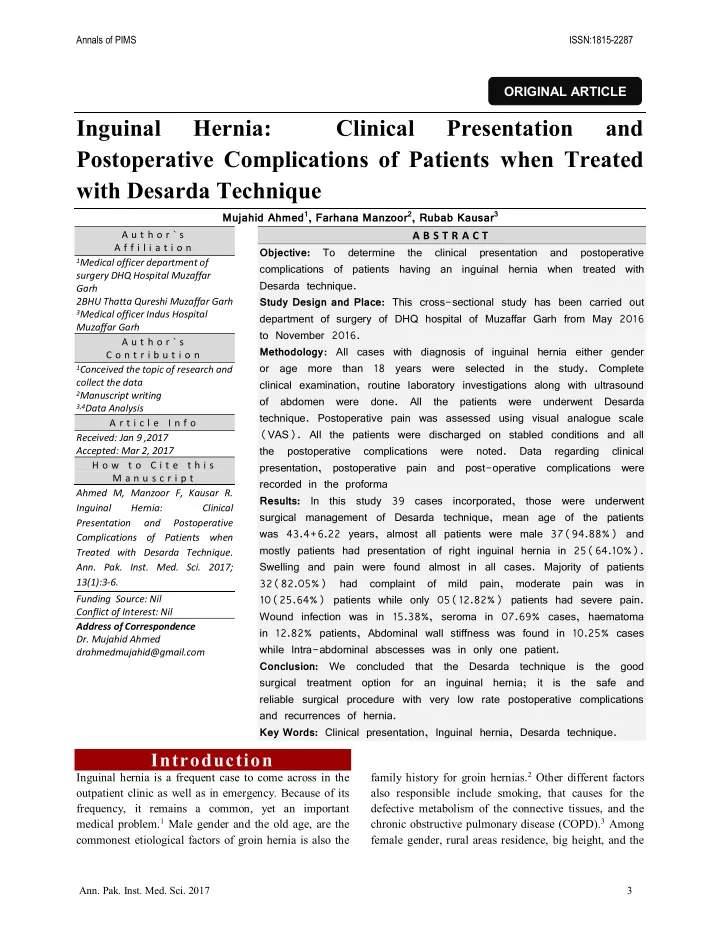
ORIGINAL ARTICLE Inguinal Hernia: Clinical Presentation and - - PDF document

original article inguinal hernia clinical presentation
SMART_READER_LITE
LIVE PREVIEW

ORIGINAL ARTICLE Inguinal Hernia: Clinical Presentation and - - PDF document

Annals of PIMS ISSN:1815-2287 ORIGINAL ARTICLE Inguinal Hernia: Clinical Presentation and Postoperative Complications of Patients when Treated with Desarda Technique Mujahid Ahmed 1 , Farhana Manzoor 2 , Rubab Kausar 3 A u t h o r ` s A B


slide-1
SLIDE 1

Annals of PIMS ISSN:1815-2287

  • Ann. Pak. Inst. Med. Sci. 2017

3

Inguinal Hernia: Clinical Presentation and Postoperative Complications of Patients when Treated with Desarda Technique

Mujahid Ahmed1, Farhana Manzoor2, Rubab Kausar3

A u t h o r ` s A f f i l i a t i o n

1Medical officer department of

surgery DHQ Hospital Muzaffar Garh 2BHU Thatta Qureshi Muzaffar Garh

3Medical officer Indus Hospital

Muzaffar Garh A u t h o r ` s C o n t r i b u t i o n

1Conceived the topic of research and

collect the data

2Manuscript writing 3,4Data Analysis

A r t i c l e I n f o Received: Jan 9 ,2017 Accepted: Mar 2, 2017 H o w t o C i t e t h i s M a n u s c r i p t Ahmed M, Manzoor F, Kausar R. Inguinal Hernia: Clinical Presentation and Postoperative Complications of Patients when Treated with Desarda Technique.

  • Ann. Pak. Inst. Med. Sci. 2017;

13(1):3-6. Funding Source: Nil Conflict of Interest: Nil Address of Correspondence

  • Dr. Mujahid Ahmed

drahmedmujahid@gmail.com

A B S T R A C T Objective: To determine the clinical presentation and postoperative complications of patients having an inguinal hernia when treated with Desarda technique. Study Design and Place: This cross-sectional study has been carried out department of surgery of DHQ hospital of Muzaffar Garh from May 2016 to November 2016. Methodology: All cases with diagnosis of inguinal hernia either gender

  • r age more than 18 years were selected in the study. Complete

clinical examination, routine laboratory investigations along with ultrasound

  • f abdomen were done. All the patients were underwent Desarda
  • technique. Postoperative pain was assessed using visual analogue scale

(VAS). All the patients were discharged on stabled conditions and all the postoperative complications were noted. Data regarding clinical presentation, postoperative pain and post-operative complications were recorded in the proforma Results: In this study 39 cases incorporated, those were underwent surgical management of Desarda technique, mean age of the patients was 43.4+6.22 years, almost all patients were male 37(94.88%) and mostly patients had presentation of right inguinal hernia in 25(64.10%). Swelling and pain were found almost in all cases. Majority of patients 32(82.05%) had complaint of mild pain, moderate pain was in 10(25.64%) patients while only 05(12.82%) patients had severe pain. Wound infection was in 15.38%, seroma in 07.69% cases, haematoma in 12.82% patients, Abdominal wall stiffness was found in 10.25% cases while Intra-abdominal abscesses was in only one patient. Conclusion: We concluded that the Desarda technique is the good surgical treatment option for an inguinal hernia; it is the safe and reliable surgical procedure with very low rate postoperative complications and recurrences of hernia. Key Words: Clinical presentation, Inguinal hernia, Desarda technique.

Introduction

Inguinal hernia is a frequent case to come across in the

  • utpatient clinic as well as in emergency. Because of its

frequency, it remains a common, yet an important medical problem.1 Male gender and the old age, are the commonest etiological factors of groin hernia is also the family history for groin hernias.2 Other different factors also responsible include smoking, that causes for the defective metabolism of the connective tissues, and the chronic obstructive pulmonary disease (COPD).3 Among female gender, rural areas residence, big height, and the

ORIGINAL ARTICLE

slide-2
SLIDE 2

Annals of PIMS ISSN:1815-2287

  • Ann. Pak. Inst. Med. Sci. 2017

4

hernia of the umbilicus were the additional etiological factors for the inguinal herniation.4 Lower BMI, collagen vascular disease, higher intra-abdominal pressure, thoracic or abdominal aortic aneurysm, processes virginals, open appendectomies, and the peritoneal dialysis were the common causes.3 Management of the inguinal hernia with the local anesthesia is extensively utilized all over the world.5,6 Local anesthesia with addition of the sedation utilized for this kind of the surgeries is the method with little influence on organs and systems physiology, and also safe and effective, easygoing to perform and having less rate of the side effects, like as CVD, nausea and vomiting or urinary retention, allowing mobilization rapidly and subsequent short post-operative Hospital stay.7 Still no medical recommendation regarding how to manage this disease, due to fact that the until, elective surgeries utilized to be recommended for the inguinal hernia. Reason behind these recommendations is feared complication’s risks like as; incarceration or the strangulations.3 Though in patients mostly, surgical repairs are not done for strangulation prevention, but in the cause of request of the patients, to relieve discomfort.8 Desarda technique is emerging suture-based procedure. This procedure is the tension-free, mesh-free, and pays attention to surgical physiology of the inguinal canal.9 The data available to assess the outcome of this technique is less due to centers conventionally using old and reliable techniques.1 Therefore purpose of this study was to determine the clinical presentation and postoperative complications of patients having inguinal hernia when treated with Desarda technique.

Methodology

This cross-sectional study has been carried out department of surgery of DHQ hospital of Muzaffar

  • Garh. Study duration was 7 months from May 2016 to

November 2016. All cases with diagnosis of inguinal hernia either gender or age more than 18 years were selected in the study. All cases with recurrent hernia and having severe comorbidities as; uncontrolled diabetes and chronic hepatitis etc, were excluded from the study. A written consent was taken from all the cases and their

  • attendants. Complete clinical examination, routine

laboratory investigations along with ultrasound of abdomen were done. Patients were underwent Desarda technique and surgeries were done by experienced and skilled surgeon. All the cases were explained regarding surgical this surgical technique. After surgeries complete postoperative treatment was started. Postoperative pain was assessed using visual analogue scale (VAS). All the patients were discharged on stabled conditions and all the postoperative complications were noted. All the data regarding clinical presentation, postoperative pain and post-operative complications were recorded in the

  • proforma. Data was entered in the SPSS version 16.0, for

the analysis. Mean and slandered deviation will be calculated for quantitative data as age, Simple frequency and percentage will be calculated for qualitative data as: gender, clinical presentation, postoperative pain and post-

  • perative complications.

Results

In this study 39 cases had incorporated, those were underwent surgical management of Desarda technique, mean age of the patients was 43.4+6.22 years, almost all patients were male 37(94.88%) and mostly patients had presentation of right inguinal hernia in 25(64.10%) and 12(35.90%) patients had left side while a bilateral hernia was not found in any case. (Table I) Swelling and pain were found almost in all cases, following by, tenderness, feeling heaviness, constipation, nausea and vomiting, dilated bowel loops with percentage

  • f 61.59%, 51.28%, 41.02%, 25.64%, 20.51% and

30.76% respectively. Figure:1 Majority of patients 32(82.05%) had complaint of mild pain, moderate pain was in 10(25.64%) patients while

  • nly 05(12.82%) patients had severe pain. according to
  • ther postoperative complications wound infection was in

15.38%, seroma in 07.69% cases, haematoma in 12.82% patients, Abdominal wall stiffness was found in 10.25% cases while Intra-abdominal abscesses was in only one

  • patient. (Table II)

Table I: Patients distribution according to demographic characteristics (n=39)

Demographic characteristics Frequency (%) Age (Mean+SD) 43.4+6.22 years Gender Male Female 37(94.88%) 02(03.12%) Site of Hernia Right Left 25(64.10%) 12(35.90%)

slide-3
SLIDE 3

Annals of PIMS ISSN:1815-2287

  • Ann. Pak. Inst. Med. Sci. 2017

5 100.00% 82.05% 61.53% 51.28% 41.02% 25.64% 20.51% 30.76%

0.0% 20.0% 40.0% 60.0% 80.0% 100.0% 120.0%

Figure 1. Patients distribution according to clinical presentation n=39 Table II: Post-operative complications (n=39) Complications Frequency (%) Pain Mild 32(82.05%) Moderate 10(25.64%) Severe 05(12.82%) Wound infection 06(15.38%) Seroma 03(07.69%) Intra-abdominal abscesses 01(02.56%) Abdominal wall stiffness 04(10.25%) Hematoma 05(12.82%)

Discussion

Inguinal hernia is among the most common problems encountered by the surgeons and has significant complications. The worldwide prevalence

  • f

strangulated inguinal hernia is 0.3-2.9% of all inguinal hernias in adults.10,11 In this study mostly adult patients were found with mean age of 43.4+6.22 years, almost all patients were male 37(94.88%). Similarly in the favor of this study Ahmad N et al12 reported that mean age of was 50 + 21.3 years of the all 50 cases with ranging 21-74 years and further he reported that almost all cases were male 49(98%) male while only case was female. Roy BC et al13 reported that mean age 45.42 years with range from 21to 65 years, and mostly patients had age group 41–50 years and male were more prevalent . In our study mostly patients had a presentation of right inguinal hernia in 25(64.10%) and 12(35.90%) patients had left side while a bilateral hernia was not found in any

  • case. As well as Ahmad N et al12 reported that right

inguinal hernia was commonest 72% cases and 28% had left an inguinal hernia. Roy BC et al13 68% patients had a diagnosis of an inguinal hernia at right-sided and very few cases were diagnosed with an inguinal hernia bilateral. In our study according to the clinical presentation swelling and pain were found almost in all cases, following by, tenderness, feeling heaviness, constipation, nausea and vomiting, dilated bowel loops with percentage

  • f 61.59%, 51.28%, 41.02%, 25.64%, 20.51% and

30.76% respectively. Ahmad N et al12 reported that irreducible inguinal swelling, absent cough impulse and localized tenderness were observed in 50(100%) and signs of intestinal obstruction in 33(66%) patients. In the study of Onuigbo WI et al14 it is discussed as a bulge in the area on either side of the pubic bone indicates an inguinal hernia. Tere may be a burning, gurgling or aching sensation at the bulge, or pain or discomfort in the groin, especially when bending over, coughing or lifting. Majority of patients 32(82.05%) had a complaint of mild pain, moderate pain was in 10(25.64%) patients while

  • nly 05(12.82%) patients had severe pain. Similarly,

Bashir S et al1 reported that 8% patients had chronic pain. In the present study according to other postoperative complications wound infection was in 15.38%, seroma in 07.69% cases, haematoma in 12.82% patients, Abdominal wall stiffness was found in 10.25% cases while Intra-abdominal abscesses was in only one patient. Abbas MH et al15 reported that twenty patients had developed some postoperative complication. These included pneumonia (lobar or bronchopneumonia) (20%) sepsis syndrome (14%) and local wound infection (6%). On other Roy BC et al13 also found comparable results, 184 cases were treated with Desarda technique, out of them 12 cases had postoperative complications, particularly as 7 cases had developed wound infection, seroma was in 3 cases and hematoma in 2 cases, further more he reported that one patient had developed recurrent inguinal hernia. While in this study no recurrences rate was found. Similarly in another study reported that with 6 months follow-up of the Desarda techniques no observed recurrence of inguinal hernia.16

Conclusion

We concluded that the Desarda technique is the good surgical treatment option for the inguinal hernia; it is the safe and reliable surgical procedure with very low rate postoperative complications and recurrences of hernia. Our study was containing on small sample size. More

slide-4
SLIDE 4

Annals of PIMS ISSN:1815-2287

  • Ann. Pak. Inst. Med. Sci. 2017

6

big sample size studies are required to assess the accurate efficacy of this technique.

References

  • 1. BASHIR S, AFZAL MO, RAFI Y. Desarda Technique for Inguinal

Hernia Repair, a multicenter experience. P J M H S 2015;9;1;311-13 2. Akbulut S, Cakabay B, Sezgin A. A familial tendency for developing inguinal hernias: study of a single family. Hernia 2010;14: 431-4. 3. Fitzgibbons RJ Jr, Giobbie-Hurder A, Gibbs JO, Dunlop DD, Reda DJ. Watchful waiting vs repair of inguinal hernia in minimally symptomatic men: a randomized clinical trial published correction appears in JAMA 2006;295: 285-92. 4. Franz MG. The Biology of Hernia Formation. Surg Clin North Am 2008;88: 1-15. 5. Zavadinack Netto, M., Prado Filho, O.R., Bandeira, C.O.P., Sales, K.P.F. and Camiloti, T.A. (2000) Herniorrafia Inguinal: Anestesia Local ou Regional? Acta Scientiarum 2000;22;621- 623. 6. Ribeiro, F.A.S. Cirurgia Ambulatorial. In: Saad Junior, R., Salles, R.O.R., Carvalho, W.R. and Maia, A.M.Eds., Tratado de Cirurgia do CBC, Atheneu, São Paulo 2009;1467-1481.

  • 7. Skinovsky, J., Sigwalt, M.F., Bertinato, L.P., Chibata, M., Moreira,

L.M.S. and Granzotto, P.C.D. Herniorrafia Inguinal Com Anestesia Locorregional (uso de ropivacaína). Revista do Colégio Brasileiro de Cirurgiões 2006;33;224-227

  • 8. Fitzgibbons RJR. Forse AR Groin Hernias in Adults. N Engl J

Med 2015;372: 756-63. 9. Desarda MP. Physiological repair of inguinal hernia: A new technique (study of 860 patients). Hernia 2005;10:143-6.

  • 10. Kurt N, Oncet M, Ozkan Z, et al: Risk and outcome of bowel

resection in patients with incarcerated groin hernias: retrospective study. World J Surg 2003; 27: 741-743.

  • 11. Primatesta P, Goldacre MJ: Inguinal hernia repair: incidence of

elective and emergency surgery; readmission and mortality. Int J Epidemiol 1996; 25:835-889.

  • 12. AHMAD N, KHAN SA, ABID KJ. Management of Strangulated

Inguinal Hernia in Adults. PJMS 2014;8;1;34-37

  • 13. Roy BC, Hanifa A, Naher S, Baset A, Sarkar P. Outcome of

Desarda repair in inguinal hernia: a study in northern part of

  • Bangladesh. International Journal of Medical Science and Public
  • Health. 2016 Mar 1;5(3):521-5.
  • 14. Onuigbo WI, Njeze GE. Inguinal Hernia. A Review. Journal of

Surgery and Operative Care. 2016 Jan 25;1(2):1.

  • 15. Abbas MH. Outcome of strangulated inguinal hernia. Pakistan

Journal of Medical Sciences. 2005 Oct;21(4):445.

  • 16. Mitura K, Romanczuk M. [Comparison between two methods of

inguinal hernia surgery—Lichtenstein and Desarda]. Pol Merkur

  • Lekarski. 2008;24(143):392–5.