Automatic Sorting of Mixed C&DW F. Hollstein, M. Wohllebe, I. - - PowerPoint PPT Presentation

automatic sorting of mixed c amp dw
SMART_READER_LITE
LIVE PREVIEW

Automatic Sorting of Mixed C&DW F. Hollstein, M. Wohllebe, I. - - PowerPoint PPT Presentation

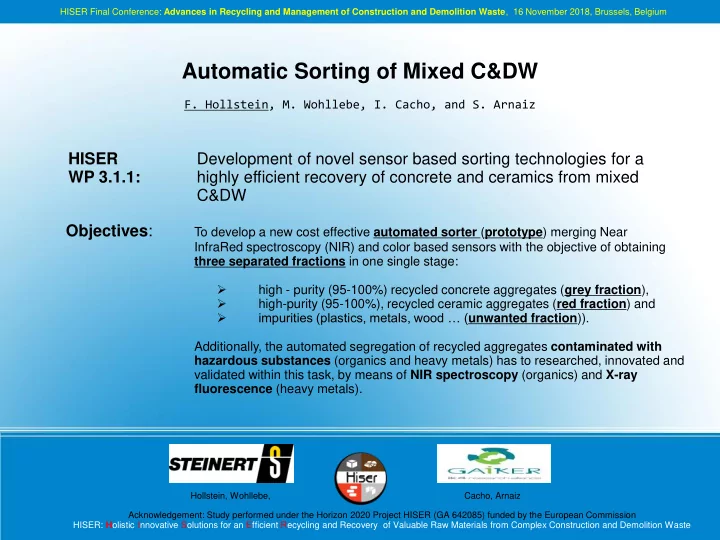
HISER Final Conference: Advances in Recycling and Management of Construction and Demolition Waste , 16 November 2018, Brussels, Belgium Automatic Sorting of Mixed C&DW F. Hollstein, M. Wohllebe, I. Cacho, and S. Arnaiz HISER Development of


slide-1
SLIDE 1

Automatic Sorting of Mixed C&DW

  • F. Hollstein, M. Wohllebe, I. Cacho, and S. Arnaiz

HISER Final Conference: Advances in Recycling and Management of Construction and Demolition Waste, 16 November 2018, Brussels, Belgium Acknowledgement: Study performed under the Horizon 2020 Project HISER (GA 642085) funded by the European Commission HISER: Holistic Innovative Solutions for an Efficient Recycling and Recovery of Valuable Raw Materials from Complex Construction and Demolition Waste Hollstein, Wohllebe, Cacho, Arnaiz

HISER Development of novel sensor based sorting technologies for a WP 3.1.1: highly efficient recovery of concrete and ceramics from mixed C&DW Objectives:

To develop a new cost effective automated sorter (prototype) merging Near InfraRed spectroscopy (NIR) and color based sensors with the objective of obtaining three separated fractions in one single stage:

  • high - purity (95-100%) recycled concrete aggregates (grey fraction),
  • high-purity (95-100%), recycled ceramic aggregates (red fraction) and
  • impurities (plastics, metals, wood … (unwanted fraction)).

Additionally, the automated segregation of recycled aggregates contaminated with hazardous substances (organics and heavy metals) has to researched, innovated and validated within this task, by means of NIR spectroscopy (organics) and X-ray fluorescence (heavy metals).

slide-2
SLIDE 2

Automatic Sorting of Mixed C&DW HISER Final Conference: Advances in Recycling and Management of Construction and Demolition Waste, 16 November 2018, Brussels, Belgium

CONFERENCE CONTRIBUTIONS (2016 - 2018): 1) Challenges in Automatic Sorting of Construction and Demolition Waste by Hyperspectral Imaging, Advanced Environmental, Chemical, and Biological Sensing Technologies XIII (SPIE-SI111-2016), 17 – 21 April 2016, Baltimore, Maryland, Proc. SPIE Vol. 9862, pp J01 – J10, 2016 Spectral Imaging supported Sorting of Construction and Demolition Waste, Conference on Hyperspectral Imaging for Industry (CHII-2016), 15 – 16 June 2016, Graz, Austria 2) Sorting of Construction and Demolition Waste (C&DW) by Hyperspectral Imaging, HISER-2017, 21 – 23 June 2017, Delft, The Netherlands, Proc. Advances in Recycling and Management of Construction and Demolition Waste - HISER International Conference, ISBN/EAN: 978-94-6186-826-8, pp 33 – 36 3) Automated Sorting of Construction and Demolition Waste by Advanced Spectral Imaging, 5th International Conference Progress of Recycling in the Built Environment (Recycle-2018), 11 – 12 October 2018, Lisbon, Portugal, to be published

slide-3
SLIDE 3

Automatic Sorting of Mixed C&DW HISER Final Conference: Advances in Recycling and Management of Construction and Demolition Waste, 16 November 2018, Brussels, Belgium

 automatic recognition of items to be sorted  mechanical ejection/separation of items into different bins

slide-4
SLIDE 4

Automatic Sorting of Mixed C&DW HISER Final Conference: Advances in Recycling and Management of Construction and Demolition Waste, 16 November 2018, Brussels, Belgium

 automatic recognition of items to be sorted by Colour (RGB) LIBS (Laser-Induced Breakdown Spectroscopy) X-ray (transmission (XRT) or fluorescence (XRF)) …

Spectral Imaging

slide-5
SLIDE 5

Automatic Sorting of Mixed C&DW HISER Final Conference: Advances in Recycling and Management of Construction and Demolition Waste, 16 November 2018, Brussels, Belgium

Spectral Imaging (SI) =

Spectroscopy + Image Processing

Source: inno-spec GmbH (Germany) Source: Spectral Imaging Ltd. (Finland)

( )

Source: LLA GmbH (Germany) Source: BUW, M. Landmann et al., Symposium R-Beton, Stuttgart, Germany, 03/2015

slide-6
SLIDE 6

Automatic Sorting of Mixed C&DW HISER Final Conference: Advances in Recycling and Management of Construction and Demolition Waste, 16 November 2018, Brussels, Belgium

Experimental Setup (real)

Three different Spectral Imager

Pushbroom scanning

slide-7
SLIDE 7

Automatic Sorting of Mixed C&DW HISER Final Conference: Advances in Recycling and Management of Construction and Demolition Waste, 16 November 2018, Brussels, Belgium

Experimental Setup (scheme)

Three Types of Spectral Imager:

RED-EYE 1.7 RED-EYE 2.2 BLACK-EYE wavelength rage: 0.9 – 1.7 µm 1.2 – 2.2 µm 3.15 – 3.65 µm pixels in full frame: 320 x 256 320 x 256 320 x 256 pixel resolution: 3.2 nm 4.4 nm 18 nm sensor: InGaAs InGaAs InSb frame rate: 330 Hz 330 Hz 384 Hz power consumption: 9 W 9 W 50 W

spectral imager (inno-spec GmbH, Germany)

“grey” stony patterns (64 pieces) “red” stony patterns (99 pieces) Mixed aggregates

Gray (concrete/plastering) Red (bricks/ceramics/tiles) Unwanted

sorting into three fractions

Sorting task

slide-8
SLIDE 8

Automatic Sorting of Mixed C&DW HISER Final Conference: Advances in Recycling and Management of Construction and Demolition Waste, 16 November 2018, Brussels, Belgium

Results for RED-EYE 1.7 and RED-EYE 2.2 (Ref. 1 + 2)

0.9 ... 1.7 µm 1.2 ... 2.2 µm

learn set prediction set

  • the necessary spectral

wavelength range should cover a full bandwidth from 1.2 … 2.2 µm

slide-9
SLIDE 9

Automatic Sorting of Mixed C&DW HISER Final Conference: Advances in Recycling and Management of Construction and Demolition Waste, 16 November 2018, Brussels, Belgium

without contamination with contami- nation (no plastics classifier) with contami- nation (with plastics classifier) zoom of left picture, grey = organic pollution

  • organic contaminants (oil, resin,

paint, tar …) influence spectral fingerprints slightly, the presence of organic contaminants can be detected by NIR/SWIR - HSI

slide-10
SLIDE 10

Automatic Sorting of Mixed C&DW HISER Final Conference: Advances in Recycling and Management of Construction and Demolition Waste, 16 November 2018, Brussels, Belgium

BlACK-EYE imager

10

Results for BLACK-EYE (MIR Spectral Imager, 3.15 – 3.65 µm) (Ref. 3)

slide-11
SLIDE 11

Automatic Sorting of Mixed C&DW HISER Final Conference: Advances in Recycling and Management of Construction and Demolition Waste, 16 November 2018, Brussels, Belgium

Results for BLACK-EYE (MIR Spectral Imager, 3.15 – 3.65 µm)

3.25 … 3.50 µm

BlACK-EYE imager

false classification

  • > at zero
slide-12
SLIDE 12

Automatic Sorting of Mixed C&DW HISER Final Conference: Advances in Recycling and Management of Construction and Demolition Waste, 16 November 2018, Brussels, Belgium

  • it has been demonstrated that MIR-SI (3.25 … 3.5 µm) outperforms all other

investigated wavelength ranges according to solid C&DW classification correctness

Results for BLACK-EYE (MIR Spectral Imager, 3.15 – 3.65 µm)

slide-13
SLIDE 13

Automatic Sorting of Mixed C&DW HISER Final Conference: Advances in Recycling and Management of Construction and Demolition Waste, 16 November 2018, Brussels, Belgium

Belt Design Free Fall Design

Advantage: just one HSI camera (price) top and back view Disadvantage: just top view two HSI cameras (price) more air pressure amount of data

Rough design of optical C&DW sorter (constructive) Options: Pick - Sorter (Roboter) Flake - Sorter

slide-14
SLIDE 14

Automatic Sorting of Mixed C&DW HISER Final Conference: Advances in Recycling and Management of Construction and Demolition Waste, 16 November 2018, Brussels, Belgium

Summary

  • the possibility of automatic separation of C&DW debris into three fractions (“grey”, “red”

and “unwanted/unknown”) has been shown on an industrial scale

  • the detection method was based on NIR/SWIR/MIR-Spectral-Imaging classification
  • the spectral differences in “grey” and “red” building wastes are large enough for automatic

sorting operations in on line mode

  • the necessary spectral wavelength range should cover a full bandwidth from 1.2 … 2.2 µm,

but at least the range from left to right of the water band at 1.9 µm (1.7 … 2.1 µm)

  • it has been demonstrated that MIR-SI (3.25 … 3.5 µm)
  • utperforms all other investigated wavelength ranges

according to solid C&DW classification correctness

slide-15
SLIDE 15

HISER Final Conference: Advances in Recycling and Management of Construction and Demolition Waste, 16 November 2018, Brussels, Belgium Study performed under the Horizon 2020 Project HISER (GA 642085) funded by the European Commission HISER: Holistic Innovative Solutions for an Efficient Recycling and Recovery of Valuable Raw Materials from Complex Construction and Demolition Waste

Acknowledgement

Hollstein, Wohllebe, Cacho, Arnaiz