Autofilet.pro: An Improved Method for Automated Removal of - - PDF document

autofilet pro an improved method for automated removal of
SMART_READER_LITE
LIVE PREVIEW

Autofilet.pro: An Improved Method for Automated Removal of - - PDF document

2002 HST Calibration Workshop Space Telescope Science Institute, 2002 S. Arribas, A. Koekemoer, and B. Whitmore, eds. Autofilet.pro: An Improved Method for Automated Removal of Herring-bone Pattern Noise from CCD Data Rolf A. Jansen Arizona

slide-1
SLIDE 1

2002 HST Calibration Workshop Space Telescope Science Institute, 2002

  • S. Arribas, A. Koekemoer, and B. Whitmore, eds.

Autofilet.pro: An Improved Method for Automated Removal of Herring-bone Pattern Noise from CCD Data

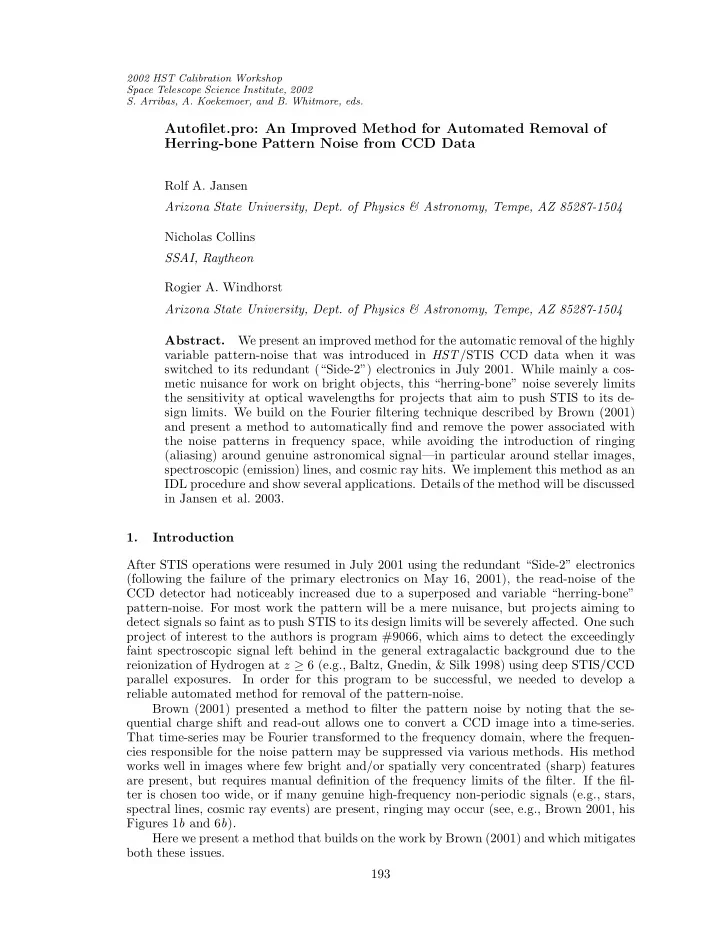
Rolf A. Jansen Arizona State University, Dept. of Physics & Astronomy, Tempe, AZ 85287-1504 Nicholas Collins SSAI, Raytheon Rogier A. Windhorst Arizona State University, Dept. of Physics & Astronomy, Tempe, AZ 85287-1504 Abstract. We present an improved method for the automatic removal of the highly variable pattern-noise that was introduced in HST/STIS CCD data when it was switched to its redundant (“Side-2”) electronics in July 2001. While mainly a cos- metic nuisance for work on bright objects, this “herring-bone” noise severely limits the sensitivity at optical wavelengths for projects that aim to push STIS to its de- sign limits. We build on the Fourier filtering technique described by Brown (2001) and present a method to automatically find and remove the power associated with the noise patterns in frequency space, while avoiding the introduction of ringing (aliasing) around genuine astronomical signal—in particular around stellar images, spectroscopic (emission) lines, and cosmic ray hits. We implement this method as an IDL procedure and show several applications. Details of the method will be discussed in Jansen et al. 2003. 1. Introduction After STIS operations were resumed in July 2001 using the redundant “Side-2” electronics (following the failure of the primary electronics on May 16, 2001), the read-noise of the CCD detector had noticeably increased due to a superposed and variable “herring-bone” pattern-noise. For most work the pattern will be a mere nuisance, but projects aiming to detect signals so faint as to push STIS to its design limits will be severely affected. One such project of interest to the authors is program #9066, which aims to detect the exceedingly faint spectroscopic signal left behind in the general extragalactic background due to the reionization of Hydrogen at z ≥ 6 (e.g., Baltz, Gnedin, & Silk 1998) using deep STIS/CCD parallel exposures. In order for this program to be successful, we needed to develop a reliable automated method for removal of the pattern-noise. Brown (2001) presented a method to filter the pattern noise by noting that the se- quential charge shift and read-out allows one to convert a CCD image into a time-series. That time-series may be Fourier transformed to the frequency domain, where the frequen- cies responsible for the noise pattern may be suppressed via various methods. His method works well in images where few bright and/or spatially very concentrated (sharp) features are present, but requires manual definition of the frequency limits of the filter. If the fil- ter is chosen too wide, or if many genuine high-frequency non-periodic signals (e.g., stars, spectral lines, cosmic ray events) are present, ringing may occur (see, e.g., Brown 2001, his Figures 1b and 6b). Here we present a method that builds on the work by Brown (2001) and which mitigates both these issues. 193

slide-2
SLIDE 2

194 Jansen, et al. 2. Strategy The problem of automatically and robustly finding the frequencies that correspond to the herring-bone pattern is greatly reduced if we first model and subtract the genuine science

  • signal. The residuals image, ideally, only contains shot-noise, read-noise and the herring-

bone pattern. In practice, there are systematic residuals of genuine features in the data as well, but the contrast of the herring-bone pattern is much higher than in the original science image. This means that in the frequency domain we will be able to blindly run a peak finding routine with much relaxed constraints on the frequency interval (or alternatively on much poorer data—e.g., very long spectroscopic exposures that are riddled with cosmic ray hits) and still correctly find, fit, and filter out the pattern frequencies. Also, since most of the genuine signal has been removed prior to constructing the power spectrum, the problem

  • f ringing has effectively been avoided.

Second, instead of setting the power at all frequencies corresponding to the noise- pattern to zero, or suppressing it using a multiplicative windowing function, we opt to substitute the power at the affected frequencies by white noise at a level and amplitude that matches the “background” power in two intervals that bracket the affected frequencies. This is less likely to introduce artefacts due to the absence of power at frequencies that should have some, or aliasing that may result when many adjacent frequencies have the same power. The resulting modified power spectrum may be inverse Fourier transformed and con- verted to a 2-D image, which by adding back in the fitted “data model” produces a pattern- subtracted science frame. 3. Autofilet.pro—Getting Rid of them Herring Bones The optimized Fourier filtering method briefly outlined above was implemented in an IDL procedure, Autofilet.pro, available from the authors. Details of the routine and results

  • f its application will be presented elsewhere (Jansen et al. 2003). Two real-valued (32-

bits per pixel) FITS format images are output for every science extension in a raw FITS image (usually 16-bits per pixel), one containing only the herring-bone pattern, the other containing the pattern-subtracted science image. To remove the herring-bone pattern from a science image that is part of a multi-layer image set (e.g., [SCI,ERR,DQ] for STIS CCD data), the herring-bone image may simply be subtracted from the appropriate science ex- tension, as long as both the arithmetic and the output pixel format are real-valued. An example clarifying the procedure and results is given in Figures 1 and 2. Although written for the removal of the variable pattern-noise in HST/STIS CCD data taken after July 2001, Autofilet contains place holders for adaptation to CCD data from

  • ther telescopes and instruments that display similar pick-up noise.

Acknowledgments. The data shown are from HST parallel program #9066, “Closing in on the Hydrogen Reionization Edge of the Universe at z < 7.2 with Deep STIS/CCD Parallels,” which aims to detect a signal so faint that it necessitated the project on which we report here. We acknowledge support from NASA grants GO-08260.* and GO-09066.*. We thank Bruce Woodgate for getting us started. We would not have had the same success without the work by Thomas M. Brown. References Baltz, E. A., Gnedin, N. Y., & Silk, J. 1998, ApJ, 493, L1 Brown, T. M. 2001, Instrument Science Report STIS 2001-005 (Baltimore: STScI) Jansen, R. A., Collins, N., & Windhorst, R. A. 2003, PASP (in prep.)

slide-3
SLIDE 3

Automated Removal of Pattern Noise from CCD Data 195 Figure 1. (a) Section of a raw CCD bias frame (‘o6dc9b040’), taken with HST/STIS on 2001 July 23, after operation of STIS had been resumed with its redundant (“Side-2”) electronics. This section displays different features: a herring-bone noise pattern is seen, as well as several (vertical) columns where the bias level and noise differ slightly from the mean, and three regions affected by cosmic ray hits; (b) a model of the image section shown in (a) containing most of the signal (as fit- ted to the image lines and columns) and also all pixels deviating from the mean by more than 3 σ or by more than 0.5 σ when adjacent to pixels deviating more than 3 σ. The difference of the original image section and this model, i.e., the residuals image, is converted to a time-series and Fourier transformed to frequency space; (c) image of the herring-bone pattern inferred from the peak in the power spec- trum of the residuals image (see also Figure 2). We fit the center and width of that peak, and replace all signal in the Fourier transformed time-series within ±3 σ of the peak by white noise matching the noise in the two intervals located 4–7 σ away from the peak. The result is inverse Fourier transformed and converted back into a 2-D image. The resulting pattern-subtracted bias image is shown in (d). The remaining noise closely resembles white noise with rms ∼4.2 e−. Note that there is no “ringing” around the bright regions affected by cosmic ray hits.

slide-4
SLIDE 4

196 Jansen, et al. Figure 2. (a) Portion of the power spectrum centered on the frequencies re- sponsible for the herring-bone pattern in the BIAS frame displayed in Figure 1(a). The power spectrum is generated by first converting the 2-D residuals image [Fig- ure 1(a) minus Figure 1(b)] into a time-series followed by Fourier transformation

  • f that time-series. After finding the peak frequency (for this image 16.155 kHz),

an estimate of the width of the peak is obtained by fitting a Gaussian function to the power spectrum. The finite width of the peak results from the (erratic) drift in frequency of the noise pattern during the time it takes to read the CCD. All power within ±3 σ of the peak frequency (solid, blue, vertical lines) is then replaced by white noise that matches the noise in the two bracketing regions in frequency located 4–7 σ away from the peak (dotted, blue, vertical lines). The resulting modified power spectrum is inverse Fourier transformed and converted to a 2-D image, which by adding back in the fitted “data model” [Figure 1(b)] produces the pattern-subtracted bias frame [Figure 1(d)]. (b) Distribution of pixel values in the raw BIAS frame of Figure 1(a) (dotted, green) and in the pattern subtracted BIAS frame of Figure 1(d) (solid, red). Whereas the noise in the raw BIAS frame is distinctly non-Gaussian near the mean pixel value and has a σ ∼ 5.5 e−, after subtraction of the inferred herring-bone pattern of Figure 1(c) the noise is well described by random Gaussian noise with a standard deviation σ = 4.20 e−. Autofilet therefore successfully reproduces—perhaps even slightly improves upon—the nominal “Side-1” CCD read noise observed prior to July 2001. The inferred amplitude of the herring-bone pattern (assuming Gaussian statistics) is √ 5.52 − 4.22 ∼ 3.6 e−.