August 29, 2019 CAC Meeting Agenda 12:00 12:10 Introductions & - - PowerPoint PPT Presentation

august 29 2019 cac meeting agenda
SMART_READER_LITE
LIVE PREVIEW

August 29, 2019 CAC Meeting Agenda 12:00 12:10 Introductions & - - PowerPoint PPT Presentation

August 29, 2019 CAC Meeting Agenda 12:00 12:10 Introductions & Updates ( Inform ) (Chris Hutchinson, Lindsay Ex, CAC Members) 12:10 12:30 Inventory & Projections Update ( Inform ) (Michael Authier) 12:30 1:40 Equity Lens


slide-1
SLIDE 1

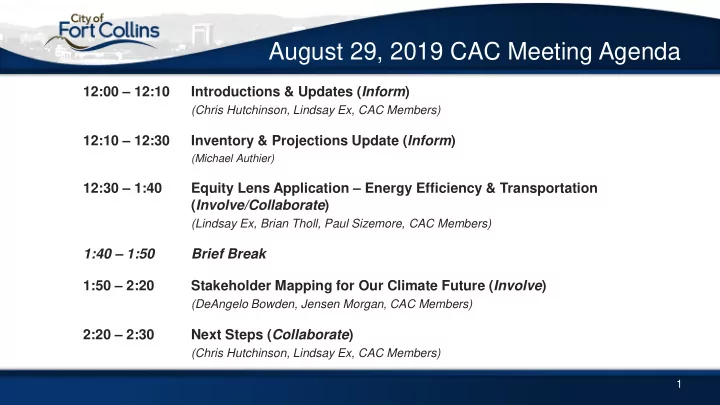
August 29, 2019 CAC Meeting Agenda

12:00 – 12:10 Introductions & Updates (Inform)

(Chris Hutchinson, Lindsay Ex, CAC Members)

12:10 – 12:30 Inventory & Projections Update (Inform)

(Michael Authier)

12:30 – 1:40 Equity Lens Application – Energy Efficiency & Transportation (Involve/Collaborate)

(Lindsay Ex, Brian Tholl, Paul Sizemore, CAC Members)

1:40 – 1:50 Brief Break 1:50 – 2:20 Stakeholder Mapping for Our Climate Future (Involve)

(DeAngelo Bowden, Jensen Morgan, CAC Members)

2:20 – 2:30 Next Steps (Collaborate)

(Chris Hutchinson, Lindsay Ex, CAC Members)

1

slide-2
SLIDE 2

2

Introductions and Grounding (Inform)

  • Introductions
  • Review of meeting agreements
  • CAC Impact
slide-3
SLIDE 3

Introductions & Ground Rules

3

Ground Rules

  • Everyone’s voice should be

heard (speak once, give space)

  • Be on time, use it wisely
  • Challenge ideas, not people
  • Respect
  • Celebrate accomplishments

along the way Proposed Additions for Today

  • Speak from personal

experiences

  • Lead with inquiry
  • Value diverse perspectives
  • Get comfortable with discomfort
  • Acknowledge the difference

between intent and impact

  • Maintain confidentiality
slide-4
SLIDE 4

2018 Accomplishments

4

Meeting What We Covered What this Impacted

Q1 2019 (January)

  • City Plan, TMP
  • CAP/EP/RTZW Engagement
  • Shift Campaign
  • Made connections, add in context/linkages
  • Basis for future engagement efforts/process design
  • Made more personal / fun; engaged Spanish-speaking

community Q2 2019 (May)

  • Equity and Inclusion Intro
  • Application of E&I to

CAP/EP/RTZW Updates

  • “Level set” amongst CAC members
  • Design of the CAP/EP/RTZW planning processes and
  • utcomes

Special Meeting

  • Draft Climate Emergency

Resolution

  • Clarified language Council adopted, in particular about

the review and about education

  • Will influence how staff releases future Resolutions

Q3 2019 (August)

  • Inventory & Forecast Update
  • Equity Lens Application
  • Stakeholder Mapping
  • Informed about the inventory; key questions
  • Whether this tool should be considered, inform future

applications

  • Help identify stakeholder groups

Q4 2019 (October)

  • Focus TBD
  • TBD

Thank you to Dawn and Jean for help on today’s meeting!

slide-5
SLIDE 5

August 29, 2019 CAC Meeting Agenda

12:00 – 12:10 Introductions & Updates (Inform)

(Chris Hutchinson, Lindsay Ex, CAC Members)

12:10 – 12:30 Inventory & Projections Update (Inform)

(Michael Authier)

12:30 – 1:40 Equity Lens Application – Energy Efficiency & Transportation (Involve/Collaborate)

(Lindsay Ex, Brian Tholl, Paul Sizemore, CAC Members)

1:40 – 1:50 Brief Break 1:50 – 2:20 Stakeholder Mapping for Our Climate Future (Involve)

(DeAngelo Bowden, Jensen Morgan, CAC Members)

2:20 – 2:30 Next Steps (Collaborate)

(Chris Hutchinson, Lindsay Ex, CAC Members)

5

slide-6
SLIDE 6

6

Inventory and Projections Update

  • Receive updated information on the 2018 community carbon inventory and the

implications for achieving the 2020 goals CAC Feedback will: Be useful in communications with individual stakeholder groups and guide the development of Our Climate Future strategies

*Assignment: N/A

slide-7
SLIDE 7

Climate Action Plan Goals

7

slide-8
SLIDE 8

8

Reported 2017 Inventory

2020 Goal: 20% below 2005 emissions

slide-9
SLIDE 9

9

Methodology Refinements

Continually improving data sources and methodology

  • Minor tweaks to other resources, but…
  • 2018 update was very Transportation focused

If interested in more detail, stay tuned for an upcoming Inventory “Deep Dive”

slide-10
SLIDE 10

10

Methodology Refinements

For Example...

slide-11
SLIDE 11

11

Refined 2017 Inventory

2020 Goal: 20% below 2005 emissions

slide-12
SLIDE 12

12

2018 Inventory

2020 Goal: 20% below 2005 emissions

slide-13
SLIDE 13

13

2018 Inventory

2018 Inventory Impact by Resource Waste Electricity Natural Gas Transportation Total vs 2005 per capita ↓ 8% ↓ 19% ↓ 2% ↓ 4% ↓ 33% vs 2005 ↓ 8% ↓ 9% ↑ 2% ↑ 1% ↓ 14% vs 2017 ↓ 0.2% ↑ 0.5% ↑ 1.2% ↑ 0.5% ↑ 2%

*all percentages in terms of the entire inventory

2017 emissions went up in all sectors except for Waste

slide-14
SLIDE 14

14

2018 Inventory

Inventory Drivers

  • f Change

(electricity)

Without local investments, electricity emissions would be 16% higher

*all percentages in terms of only electricity emissions, not overall inventory Emissions MTCO2e

  • 16%

net

slide-15
SLIDE 15

15

Looking Forward

25% 32% 19% 29% 14%

10% 15% 20% 25% 30% 35%

2017 2018 2019 2020 2021 2022

Community Inventory Emissions

% Progress from 2005 MTCO2e

2020 Goal: 20% below 2005 emissions

2020 Projections 19-25% below 2021 Projections 29-32% below

slide-16
SLIDE 16

August 29, 2019 CAC Meeting Agenda

12:00 – 12:10 Introductions & Updates (Inform)

(Chris Hutchinson, Lindsay Ex, CAC Members)

12:10 – 12:30 Inventory & Projections Update (Inform)

(Michael Authier)

12:30 – 1:40 Equity Lens Application – Energy Efficiency & Transportation (Involve/Collaborate)

(Lindsay Ex, Brian Tholl, Paul Sizemore, CAC Members)

1:40 – 1:50 Brief Break 1:50 – 2:20 Stakeholder Mapping for Our Climate Future (Involve)

(DeAngelo Bowden, Jensen Morgan, CAC Members)

2:20 – 2:30 Next Steps (Collaborate)

(Chris Hutchinson, Lindsay Ex, CAC Members)

16

slide-17
SLIDE 17

17

Equity Lens Application

  • Re-ground on the equity work that was completed in May and the CAC’s feedback
  • Share best practices for how cities evaluate climate action strategies from an equity lens
  • Test one tool on two separate CAP initiatives – Efficiency Works Homes and

Transportation Demand Management – to provide feedback on the tool itself, the individual initiatives, and longer-term implications for Our Climate Future (strategy development, metrics, etc.) CAC Feedback will: Support staff’s evaluation of the tool, inform strategy selection and design for Our Climate Future, inform future applications of the tool

*Assignment 1: Review best practices, select one initiative to test the tool and respond to the questions

slide-18
SLIDE 18

May meeting

  • Overall introduction to equity and

inclusion

  • Long history, current work began

in 2015

  • Individual, institutional, and

structural racism

  • Grounded in the City’s Strategic

Plan and Council Priority

  • Best practices for centering equity
  • Current state/future state

18

CAC Feedback

  • Reinforced “equity for all, leading with

race”

  • How can equity be truly integrated?
  • Consider our own representation
  • Tell more stories – help make this

relevant

  • Close the loop on this topic/keep it

coming

  • How can we test tools to assess

existing efforts?

slide-19
SLIDE 19

19

Where do these plans fit?

Long-Term Short- & Mid-Term Nature in the City Etc.

why what how / funding

Budgeting For Outcomes

Functional Plans Climate Action Plan Energy Policy Road to Zero Waste Plan

Community Engagement & Direction

Pedestrian Plan

slide-20
SLIDE 20

TRANSITION TO 2030

20

slide-21
SLIDE 21

Transition to 2030: Our Climate Future

21

INCLUDES UPDATES TO: Climate Action Plan Energy Policy Road to Zero Waste Plan

slide-22
SLIDE 22

Guiding Theme: Equity

23 Mitigation

  • Energy
  • Transportation
  • Waste

Resilience

  • Water
  • Air Quality
  • Extreme Heat
  • Wildfire Risk

Equity

  • Affordability
  • Workforce
  • All dimensions of

diversity, including race

Equity = Process and

  • utcome both

Process = ensures

  • pportunities for all to

co-create policies, tools and programs Outcome = everyone benefits from a carbon neutral Fort Collins

slide-23
SLIDE 23

GARE Tool

  • Today’s objective
  • Testing one aspect of the toolkit
  • Focusing on the tool while learning

about the initiatives

  • Brief initiative introduction by staff
  • Coming to you quite early
  • Small group discussions, facilitated by

staff members

  • Process
  • 12:40 – 1:20 – small group discussion
  • 1:20 – 1:40 – report out

24

slide-24
SLIDE 24

Racial Equity Toolkit

  • Racial equity tools are

designed to integrate racial equity in decision-making, including policies, practices, programs, and budgets.

  • Looks to address racial

inequities within institutions, e.g:

  • Education
  • Jobs
  • Housing
  • Criminal Justice

25

slide-25
SLIDE 25

Application of the Racial Equity Tool

Seattle, Washington

  • In 2009, Seattle City Council included the use of the

Racial Equity Tool during the budget, program and policy decisions process.

Multnomah County, Oregon

  • Equity and Empowerment Lens adaptation improved

planning, decision-making, and resource allocation leading to more racially equitable policies and programs.

Madison, Wisconsin

  • Adopted their 2015-2016 work plan, using their Racial

Equity and Social Justice Initiative, which led to a new mission, vision, workplan, and evaluation plan with racial equity goals. 26

slide-26
SLIDE 26

Equity Advisory Group Washington D.C.

1. Willingness to invest time in the process. 2. Building relationships between the committee members and with government. 3. Pride in their recommendation. 4. Benefiting from the substantive lessons learned during planning.

27

slide-27
SLIDE 27

Energy Efficiency Application

  • Efficiency Works - Homes
  • Program is an incentive-based home efficiency

program focusing on building envelope and HVAC upgrades

  • Outcomes:
  • Occupant health, safety and comfort
  • Energy savings

28

slide-28
SLIDE 28

Energy Efficiency Application

29

Efficiency portfolio savings rising to 2.5%

  • f community electricity

use in 2020 Equity in program

  • ffering based

customer segments and a range of end- uses Portfolio cost effectiveness (cost of saved energy less than blended wholesale) Energy Policy Goals Customer Service Goals Financial and Cost Effectiveness Goals

Optimize Portfolio

slide-29
SLIDE 29

Energy Efficiency Application

Approach:

  • Should we evaluate equity across portfolio of programs instead?
  • Building data and household income data used previously for

targeting, how do we include other dimensions of diversity, including race? Next Steps:

  • Initiated tenant / landlord engagement strategy
  • Existing / Revamped on-bill financing program
  • Portfolio based awareness messaging

30

slide-30
SLIDE 30

Transportation Demand Management (TDM)

  • TDM is a strategy for maximizing the use of

existing transportation infrastructure

  • The City’s Current TDM “toolbox” is incomplete
  • Many existing programs
  • Ie., ClimateWise, bike classes
  • Not formally structured
  • Responses to GARE considered info about

existing programs: “what if” TDM is implemented?

  • Currently working towards a study of gaps and
  • pportunities

31

slide-31
SLIDE 31

Group Discussion

32

What questions did you have about staff’s initial responses, knowing that staff hasn’t fully deployed the tool? How easy is it for you to understand the tool? What could have been improved? How would you respond to Step 4 of the tool? Report out

  • 12:40 – 1:20 – small group discussion
  • 1:20 – 1:40 – report out
slide-32
SLIDE 32

Group Discussion

33

i. Given what you have learned from research and stakeholder involvement, how will the proposal increase or decrease equity, and racial equity in particular? Who would benefit from or be burdened by your proposal? ii. What are potential unintended consequences? What are the ways in which your proposal could be modified to enhance positive impacts or reduce negative impacts? iii. Are there complementary strategies that you can implement? What are ways in which existing partnerships could be strengthened to maximize impact in the community? How will you partner with stakeholders for long-term positive change? iv. Are the impacts aligned with your community outcomes defined in Step #1?

slide-33
SLIDE 33

August 29, 2019 CAC Meeting Agenda

12:00 – 12:10 Introductions & Updates (Inform)

(Chris Hutchinson, Lindsay Ex, CAC Members)

12:10 – 12:30 Inventory & Projections Update (Inform)

(Michael Authier)

12:30 – 1:40 Equity Lens Application – Energy Efficiency & Transportation (Involve/Collaborate)

(Lindsay Ex, Brian Tholl, Paul Sizemore, CAC Members)

1:40 – 1:50 Brief Break 1:50 – 2:20 Stakeholder Mapping for Our Climate Future (Involve)

(DeAngelo Bowden, Jensen Morgan, CAC Members)

2:20 – 2:30 Next Steps (Collaborate)

(Chris Hutchinson, Lindsay Ex, CAC Members)

34

slide-34
SLIDE 34

35

Stakeholder Mapping for Our Climate Future

  • Share out of staff’s process to date for identifying stakeholder groups and provide

feedback on groups that staff has identified whose voices should be heard in the first phase of Our Climate Future CAC Feedback will: Help identify additional stakeholder groups that have not historically engaged in climate action planning efforts

*Assignment 2: Review the process to date and identified groups; respond to questions on page 10

slide-35
SLIDE 35

Phases for Update of Plan(s)

36 Notes: (1) Target timeline for adoption in Q4 2020; (2) Staff anticipates this timeline will shift, depending on findings at each stage

Summer - Fall 2019 Fall 2019 - Summer 2020 Fall - Winter 2020

slide-36
SLIDE 36

Phase 1: Understanding Community Priorities

37 Notes: a) This looks linear – it’s not b) Lots of concurrent work: Our City Website, Additional Trainings, Engagement tracking database, File structure and data sharing, etc. c) Compile best practices from mitigation/resilience lens and considering residents and businesses, all from an equity lens

slide-37
SLIDE 37

38

COMMUNITY PARTNERS AND PLAN AMBASSADORS COMMUNITY LISTENING SESSIONS POP-UP EVENTS OURCITY PLATFORM

Phase 1: Understanding Community Priorities

BOARDS & COMMISSIONS CAP CAC HISTORICALLY UNDERREPRESENTED ALL COMMUNITY MEMBERS DIVERSIFY RECRUITMENT

slide-38
SLIDE 38

GroupMap

39

  • Ex. Colorado State University
  • Ex. Communities of Color
  • Ex. Residents from surrounding communities
  • Ex. Realtors
slide-39
SLIDE 39

Group Map

40

slide-40
SLIDE 40

Excel Sheet

41

slide-41
SLIDE 41

GroupMap

42

  • Ex. Colorado State University
  • Ex. Communities of Color
  • Ex. Residents from surrounding communities
  • Ex. Realtors
slide-42
SLIDE 42

Stakeholder Review

  • Today’s objective
  • Review draft list of historically

underrepresented stakeholders

  • Small group discussions, facilitated by

staff members

  • Process
  • 1:55 – 2:10 – small group discussion
  • 2:10 – 2:20 – report out

43

slide-43
SLIDE 43

Group Discussion

44

What do you see as the strengths and limitations of this tool? Are there additional stakeholders staff might have missed?

  • Communities of Color
  • Historically underrepresented

businesses

  • Latinx Community
  • Asian Community
  • Eastern Indian Community
  • Local Indigenous Community
  • Middle Eastern Community

(Aware of Asian communities being listed)

  • Documented Immigrant

community

  • DACA Students
  • People Who Are

Undocumented

  • ESL Residents
  • Single Parent Households
  • Elderly/Senior
  • Faith Based Community
  • Muslim Community
  • International Community
  • K-12 Students
  • LGBTQIA+ Community
  • Low-income residents
  • People Experiencing Chronic

Health Conditions

  • People Experiencing

disabilities

  • People Experiencing

Homelessness

  • Transit Riders
  • Small Business Owners
  • College Students
  • Young Adults
  • Cultural Centers
slide-44
SLIDE 44

August 29, 2019 CAC Meeting Agenda

12:00 – 12:10 Introductions & Updates (Inform)

(Chris Hutchinson, Lindsay Ex, CAC Members)

12:10 – 12:30 Inventory & Projections Update (Inform)

(Michael Authier)

12:30 – 1:40 Equity Lens Application – Energy Efficiency & Transportation (Involve/Collaborate)

(Lindsay Ex, Brian Tholl, Paul Sizemore, CAC Members)

1:40 – 1:50 Brief Break 1:50 – 2:20 Stakeholder Mapping for Our Climate Future (Involve)

(DeAngelo Bowden, Jensen Morgan, CAC Members)

2:20 – 2:30 Next Steps (Collaborate)

(Chris Hutchinson, Lindsay Ex, CAC Members)

45

slide-45
SLIDE 45

46

Next Steps

  • Start, Stop, Continue
  • Q4 2019 Meeting Preview
  • Overall next steps
  • CAC Recruitment
  • Applications for plan ambassadors, community partners announced…more coming!

CAC Feedback will: Guide the CAP CAC activities and how meetings are designed

slide-46
SLIDE 46

47

Where We’re Heading: 2019 Topics

Notes: New members can share their interest with Lindsay; Will cover CAP/Energy Policy update at each meeting

# Interested Topic CAC Member Support Proposed Date 15 Equity/Inclusion and CAP Dawn, Jean, Steve K, Bruno May (tentative) 13 Climate Economy Ann, Fred 13 Climate Action Plan and Energy Policy Update (Our Climate Future) Stacey, Evelyn, Jean, Fred February, May, August, October 13 Renewable Energy Supply and Distribution Evelyn, Steve K, Fred, Dana V 11 Building Stock and Efficiency Todd D, Fred 9 Engaging with Larimer County Bruno 8 City Plan February 8 Strategic Electrification Scott D, Evelyn 8 Messaging and Engagement Molly, Scott D, Jean, Ben February (with more opportunities) 8 Adaptation and Resilience Rose, Jean 8 Performance Measurement Jean 7 Regional Wasteshed Planning 7 Futuring of Fort Collins Jean 6 Business participation and impact Ann H, Lisa 6 Progress on CAP Goals Stacey May 5 Electric Vehicles Scott D, Sheble 4 Transportation Overview 3 Municipal Goals 3 Water Constraints Dana, Molly

slide-47
SLIDE 47

48

Thank you CAC!