January 30, 2020 CAC Meeting Agenda 12:00 12:30 Introductions & - - PowerPoint PPT Presentation

january 30 2020 cac meeting agenda
SMART_READER_LITE
LIVE PREVIEW

January 30, 2020 CAC Meeting Agenda 12:00 12:30 Introductions & - - PowerPoint PPT Presentation

January 30, 2020 CAC Meeting Agenda 12:00 12:30 Introductions & Updates ( Inform ) (Chris Hutchinson, Lindsay Ex, Molly Saylor, CAC Members) 12:30 1:25 Our Climate Future Review Phase One ( Involve ) (Jensen Morgan, CAC Members)


slide-1
SLIDE 1

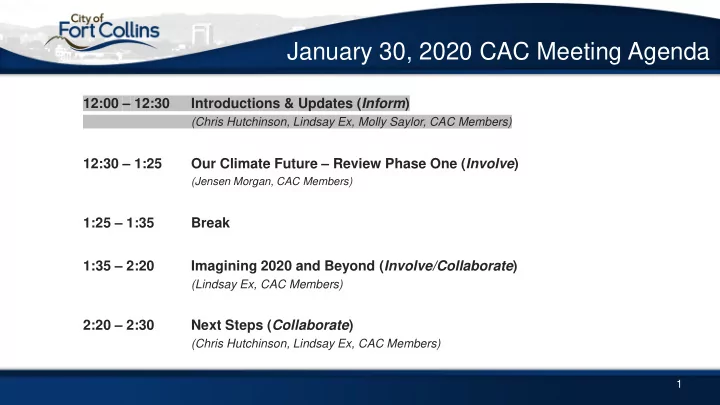
January 30, 2020 CAC Meeting Agenda

12:00 – 12:30 Introductions & Updates (Inform)

(Chris Hutchinson, Lindsay Ex, Molly Saylor, CAC Members)

12:30 – 1:25 Our Climate Future – Review Phase One (Involve)

(Jensen Morgan, CAC Members)

1:25 – 1:35 Break 1:35 – 2:20 Imagining 2020 and Beyond (Involve/Collaborate)

(Lindsay Ex, CAC Members)

2:20 – 2:30 Next Steps (Collaborate)

(Chris Hutchinson, Lindsay Ex, CAC Members)

1

slide-2
SLIDE 2

2

Introductions and Updates (Inform)

  • Meeting Agreements
  • 2019 Year in Review & 2020 Preview
  • Overview of Existing Conditions Document
  • Introductions
slide-3
SLIDE 3

3

LEADERSHIP AT EVERY LEVEL Council CAP Community Advisory Committee Community CAP Executive Team CAP Core Team CAP Strategic Initiative Teams

  • Purpose:
  • Short-term: Advise staff on

2020 implementation

  • Long-term: Overall feedback
  • n long-term strategies;

represent entire community in identifying opportunities & barriers as strategies are discussed, evaluated, and implemented

  • Meet quarterly
  • 20+ members
  • Diverse perspectives

What is CAC’s role?

slide-4
SLIDE 4

Introductions & Ground Rules

4

Ground Rules

  • Everyone’s voice should be

heard (speak once, give space)

  • Be on time, use it wisely
  • Challenge ideas, not people
  • Respect
  • Celebrate accomplishments

along the way Proposed Additions for Today

  • Speak from personal

experiences

  • Lead with inquiry
  • Value diverse perspectives
  • Get comfortable with discomfort
  • Acknowledge the difference

between intent and impact

  • Maintain confidentiality

Note: We should revisit these ground rules in 2020 to simplify (if needed) and align with other conversations

slide-5
SLIDE 5

TRANSITION TO 2030

5

slide-6
SLIDE 6

Transition to 2030: Our Climate Future

6

INCLUDES UPDATES TO: Climate Action Plan Energy Policy Road to Zero Waste Plan

slide-7
SLIDE 7

Phases for Update of Plan(s)

7 Notes: (1) Target timeline for adoption in Q4 2020; (2) Staff anticipates this timeline will shift, depending on findings at each stage

Summer - Fall 2019 Fall 2019 - Summer 2020 Fall - Winter 2020

slide-8
SLIDE 8

Guiding Theme: Equity

8 Mitigation

  • Energy
  • Transportation
  • Waste

Resilience

  • Water
  • Air Quality
  • Extreme Heat
  • Wildfire Risk

Equity

  • Affordability
  • Workforce
  • All dimensions of

diversity, including race

Equity = Process and

  • utcome both

Process = ensures

  • pportunities for all to

co-create policies, tools and programs Outcome = everyone benefits from a carbon neutral Fort Collins

slide-9
SLIDE 9

Equity in Process and Outcomes

Work to date:

  • USDN equity fellowship
  • USDN Innovation Fund Grant - Fort

Collins leading with 10 other cities

  • Targeted community engagement
  • Plan ambassador and community

partner program

  • Priority theme creation

9

slide-10
SLIDE 10

Existing Conditions Document

What is it?

  • Level-setting document for orienting to “existing conditions” and providing a

look to the future What does it cover?

  • Energy; water; waste; land use; air quality; leading by example; intro sections
  • n goals and TBL… now equity

Who is it for?

  • City staff; workshop attendees; consultants; community partners and plan

ambassadors; publicly available Question to ourselves: Would a reader correctly gauge our commitment to equity by reading this?

10

slide-11
SLIDE 11

Equity 3-pager

What is it? A three-pager (within Existing Conditions doc) to: a. Set context for centering equity (a look into the future) b. Provide examples of racial inequities (existing conditions) What are the key themes?

  • Staff’s knowledge of racial equity in FC, now and historically, is incomplete
  • Local & national historical context has left its mark… and it’s not all in the past
  • Working to move FC forward, together with community
  • Improving equitable outcomes and processes

11

slide-12
SLIDE 12

Excerpt from Providence Climate Justice Plan

“Providence’s economic success came at a human and environmental cost. It depended

  • n cheap cotton from the south, which was

grown and harvested by slave-labor; indigenous communities lost their access and rights to the land; and rivers were polluted with toxic chemicals as mills and other industries dumped untreated waste into them.”

slide-13
SLIDE 13

Excerpt from San Antonio Climate Ready SA

“Understanding the historical legacies, structures, and policies that have resulted in and continue to perpetuate racial and economic inequities in San Antonio can assist in understanding why some communities are more burdened by the effects of climate change than others. From policies in 1826 that codified racial segregation in housing by restricting where black residents could live to “redlining” in the 1930’s that categorized neighborhoods with high populations

  • f African American and Latino residents as

“definitely declining” or “hazardous“ as a means to deny home loans to people living in these communities, the result has been high concentrations of poverty, disinvestment, and a legacy of inequity that continues today.”

slide-14
SLIDE 14

Excerpt from OCF Existing Conditions Document

By putting racial equity at the center of our planning process, this work recognizes racial inequity is the most pervasive type of inequity in

  • ur country. This aligns with organization-wide

efforts to ensure equity for all, leading with race.

slide-15
SLIDE 15

Discussion and Introductions

15

Introductions

  • Name
  • Role
  • Length of time with CAC
  • A-ha or question you have about the Equity and Inclusion Section or the Overall

Document

slide-16
SLIDE 16

January 30, 2020 CAC Meeting Agenda

12:00 – 12:30 Introductions & Updates (Inform)

(Chris Hutchinson, Lindsay Ex, Molly Saylor, CAC Members)

12:30 – 1:25 Our Climate Future – Review Phase One (Involve)

(Jensen Morgan, CAC Members)

1:25 – 1:35 Break 1:35 – 2:20 Imagining 2020 and Beyond (Involve/Collaborate)

(Lindsay Ex, CAC Members)

2:20 – 2:30 Next Steps (Collaborate)

(Chris Hutchinson, Lindsay Ex, CAC Members)

16

slide-17
SLIDE 17

17

Our Climate Future: Phase One Themes (Involve)

  • Participated in the process in October
  • Review of the themes analyzed to date, how data were collected and

analyzed, and initial insights CAC Feedback Will: Offer feedback on how the draft themes resonate, identify what is missing, what surprised you, and how the information can be best presented so CAC members can share this back with their stakeholders

slide-18
SLIDE 18

How Did People Share Their Voice?

18

COMMUNITY PARTNERS AND PLAN AMBASSADORS COMMUNITY CONVERSATIONS POP UP EVENTS ONLINE ENGAGEMENT 14 OUTREACH EVENTS 12 OUTREACH EVENTS 12 OUTREACH EVENTS 2,000 PEOPLE REACHED

214 RESPONSES 245 RESPONSES 9 RESPONSES 108 RESPONSES

334+ Total Community Member Hours! 576 Total Responses

slide-19
SLIDE 19

19

Race Demographic Comparison

89% 1% 1% 3% 0% 2% 3% 81% 1% 4% 3% 1% 11% 0% 10% 20% 30% 40% 50% 60% 70% 80% 90% 100% White Black or African American American Indian and Alaska Native Asian Native Hawaiian and Other Pacific Islander Some other race Two or more races Fort Collins Race Demographics (2018 US Census) Our Climate Future Phase One Responses

In general, Our Climate Future heard from racial identities at a percentage that was quite close to Fort Collins overall demographics

slide-20
SLIDE 20

20

Ethnicity Demographic Comparison

87% 13% 80% 15% 4% 0% 10% 20% 30% 40% 50% 60% 70% 80% 90% 100%

Not Hispanic/Latinx Hispanic/Latinx Decline to Specify

Fort Collins Ethnicity Demographics (2018 US Census) Our Climate Future Phase One Responses

In general, Our Climate Future heard from ethnic identities at a percentage that was quite close to Fort Collins overall demographics

slide-21
SLIDE 21

21

White 79% People of Color 21%

Our Climate Future Race and Ethnicity Responses

People of Color

Our Climate Future engaged race and ethnicity demographics that are quite close to Fort Collins

  • verall demographics
slide-22
SLIDE 22

Ethnicity by Outreach Approach

22

0% 10% 20% 30% 40% 50% 60% 70% 80% 90% 100% Pop-up Plan Ambassador Community Partner Community Conversation

Decline to specify Hispanic/Latinx Non- Hispanic/Latinx Most people who identified as Hispanic/Latinx were engaged through Community Partners and Community Conversations

slide-23
SLIDE 23

Age

23 0% 5% 10% 15% 20% 25% 30% 35%

Under 15 years 15-19 years 20-29 years 30-39 years 40-49 years 50-59 years 60-69 years 70 years or older Decline to Specify

40% of responses were from people 29 or younger

slide-24
SLIDE 24

Housing

24

53% 44% 3%

Our Climate Future Housing Demographics

Own Rent Other

Fort Collins overall housing breakout is 50/50 rent vs. own so Our Climate Future engagement was quite close.

slide-25
SLIDE 25

0% 5% 10% 15% 20% 25% 30% 35% 40% 45% Less than 9th grade 9th to 12th grade High school graduate or equivalent Some college Associate's degree Bachelor's degree Graduate or professional degree Fort Collins Education Demographics (2018 US Census) Our Climate Future Phase One Responses

Education

25

In Phase Two we could improve connecting with community members who are high school graduates

slide-26
SLIDE 26

Income

26

0% 5% 10% 15% 20% 25% 30% 35% 40%

Less than $10,000 $10,000 to $14,999 $15,000 to $24,999 $25,000 to $34,999 $35,000 to $49,999 $50,000 - $74,999 $75,000 or more Decline to Specify Fort Collins Household Income Demographics (2018 US Census) Our Climate Future Phase One Responses

25% of Our Climate Future Responses

We did a good job of connecting with people making less than 25k AND we can do better!

slide-27
SLIDE 27

Data Process

27

People of Color Historically Underrepresented All Responses

slide-28
SLIDE 28

What We Heard

Community Priorities for a sustainable future

28

Big Barriers to a sustainable future Guiding Principles to achieve 2030 goals

slide-29
SLIDE 29

Community Priorities

  • Waste Reduction and Diversion
  • Healthy Air Quality
  • Renewable Energy
  • Reliable Water Quality & Quantity
  • Regional and Local Transit
  • Safe and Affordable Housing
  • Reliable Food Systems
  • Job Opportunities and Healthy

Economy

  • Healthy Nature and Ecology
  • Equity, Diversity, and Inclusion
  • Future Preparedness and Resilience

with Population Growth and Climate Change

29

slide-30
SLIDE 30

Big Barriers

  • Racism and inequitable access
  • Enough funding for infrastructure
  • People are struggling to afford to live

here

  • Fast population growth
  • Need for action at multiple levels

(individual, institutional, system)

  • Not enough education and

awareness on environmental and equity issues

  • Mistrust and poor communication

between community members, local institutions, and government.

30

slide-31
SLIDE 31

Guiding Principles

  • 1. Design for Inclusion and Access
  • 2. Affordable Cost of Living and

Doing Business

  • 3. Systems Level Solutions for

Waste, Energy and Transit

  • 4. Ensure People and Ecosystems

are Safe and Healthy

  • 5. Build a Resilient Future with

Climate Change and Population Growth in Mind

  • 6. Build Awareness and Remove

Barriers to Action

  • 7. Share Power and Leadership

within our Community

31

slide-32
SLIDE 32

What We Heard

Community Priorities for a sustainable future

32

Big Barriers to a sustainable future Guiding Principles to achieve 2030 goals

slide-33
SLIDE 33

33

Our Climate Future Phase One Themes (Involve/Collaborate)

  • Gallery Walk & Sticker Poll

CAC Feedback Will: Influence Phase One Theme wording

slide-34
SLIDE 34

34

slide-35
SLIDE 35

35

Phase Two: How do we get there? Affordable and reliable renewable electricity for everyone Everyone always has safe, clean water to drink and run their business Everyone has access to composting no matter where they live

slide-36
SLIDE 36

36

Big Move First Moves

slide-37
SLIDE 37

37

Big Move

100% Renewable Energy in Fort Collins

First Moves

slide-38
SLIDE 38

38

Big Move

100% Renewable Energy in Fort Collins Storage to ensure reliability 100% Electric Home Heating 100% Electric Transportation 100% Renewable Electricity Grid

First Moves

slide-39
SLIDE 39

Big Move

100% Renewable Energy in Fort Collins 100% Renewable Electricity Grid 100% Electric Home Heating 100% Electric Transportation Storage to ensure reliability

First Moves

Example: Incentives for retrofits of existing buildings

?

Example: Code changes to remove barriers for new buildings

slide-40
SLIDE 40

Phase One Themes Discussion

40

  • What didn’t make sense to you?
  • What did you find interesting?
  • How did the Guiding Principles,

Big Barriers, and Community Priorities resonate with you?

  • Is there anything you think is

missing? Guiding Principles to achieve 2030 goals

slide-41
SLIDE 41

January 30, 2020 CAC Meeting Agenda

12:00 – 12:30 Introductions & Updates (Inform)

(Chris Hutchinson, Lindsay Ex, Molly Saylor, CAC Members)

12:30 – 1:25 Our Climate Future – Review Phase One (Involve)

(Jensen Morgan, CAC Members)

1:25 – 1:35 Break 1:35 – 2:20 Imagining 2020 and Beyond (Involve/Collaborate)

(Lindsay Ex, CAC Members)

2:20 – 2:30 Next Steps (Collaborate)

(Chris Hutchinson, Lindsay Ex, CAC Members)

41

slide-42
SLIDE 42

42

Imagining 2020 and Beyond (Involve/Collaborate)

  • Small group discussions around three question

CAC Feedback Will: Influence 2020 meetings, CAC recruitment, and CAC long-term operations

slide-43
SLIDE 43

Three Questions

43

Questions to Consider

  • How would the CAC like to be involved

in the 2021-2022 budgeting process (BFO)? (John)

  • How can we address membership

duration (terms?) in the CAP CAC? (Jensen)

  • Where will the CAC be in 2021? 2025?

2030? Future visioning (Lindsay) Proposed Process

  • Small group discussion

1:35 – 2:10

  • Pick two of the groups to

attend

  • Staff will help with report
  • ut
slide-44
SLIDE 44

44

slide-45
SLIDE 45

Q1 2020 Q2 2020 Q3 2020 Q4 2020

Table 1: BFO

  • Strategic

Plan

  • BFO

Overview

  • BFO Offer

Pitch Session

45

  • “Offers”

Developed

  • Teams

Review

  • Initial Feedback
  • n CAP “Driven”

& “Accelerated”

  • ffers

BFO CAC

  • Budget Lead

Team

  • Initial Council

Discussions

  • Revised

Feedback

  • Council

Hearings and Adoption

  • Process Review
slide-46
SLIDE 46

Table 2: CAC and “Terms”

46

Elements to Consider

  • CAC has been in place since 2016
  • Initially 12-13 members, now up to

22-25

  • Members have rotated off
  • rganically
  • Mix of years of service on the CAC
  • MANY applicants each time
  • Typically 25-27 people apply

for 3-4 seats Consider

  • Should we continue to allow

people to rotate off organically?

  • Are “term limits” valuable?
  • Are there certain stakeholder

groups that should always be represented?

  • How to engage Plan

Ambassadors and Community Partners post OCF?

  • What else?
slide-47
SLIDE 47

Table 3: CAC and Future Visioning

47

Elements to Consider

  • CAC’s role is to advise staff / city

government

  • CAC members and the community have

expressed interest in more ownership

  • Other models:
  • Community-run, community-led

initiatives

  • City convenes, community-led

initiatives

  • What else?

Consider

  • Should the purpose of the

CAC continue?

  • How can all own the

initiatives and efforts?

  • What is the “right” role

for…

  • City?
  • Businesses?
  • Community Members?
  • Beyond?
slide-48
SLIDE 48

Three Questions

48

Questions to Consider

  • How would the CAC like to be involved

in the 2021-2022 budgeting process (BFO)? (John)

  • How can we address membership

durations (terms?) in the CAP CAC? (XX)

  • Where will the CAC be in 2021? 2025?

2030? Future visioning (Lindsay) Proposed Process

  • Small group discussion

1:35 – 2:10

  • Pick two of the groups to

attend

  • Staff will help with report
  • ut
slide-49
SLIDE 49

49

Next Steps

  • Start, Stop, Continue
  • 2020 Meetings – Dates set! Potential mid-way meeting
  • Overall next steps
  • Finalize Phase One Themes
  • Kick off phase two workshops
  • RFP for Support
  • Council Work Session on April 28, 2020

CAC Feedback will: Guide the CAP CAC activities and how meetings are designed

slide-50
SLIDE 50

50

Thank you CAC!