Assessment in Iraq Lawrence Okello and Dastan Muhammed May, 2019 - - PowerPoint PPT Presentation

assessment in
SMART_READER_LITE
LIVE PREVIEW

Assessment in Iraq Lawrence Okello and Dastan Muhammed May, 2019 - - PowerPoint PPT Presentation

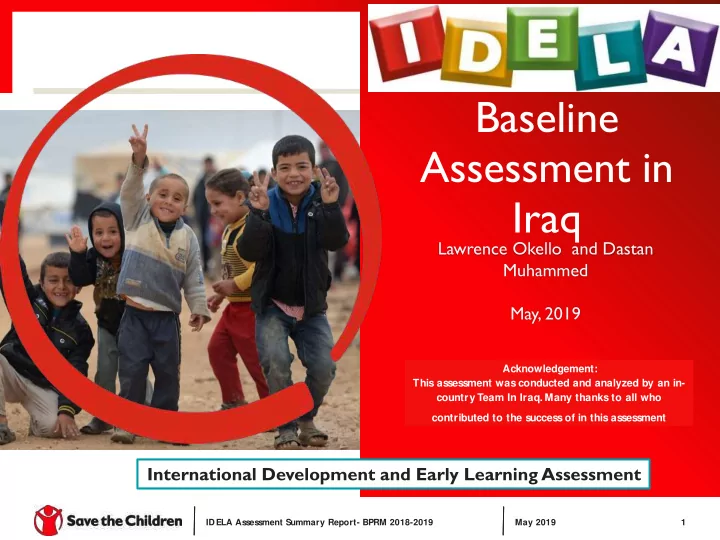
Baseline Assessment in Iraq Lawrence Okello and Dastan Muhammed May, 2019 Acknowledgement: This assessment was conducted and analyzed by an in- country Team In Iraq. Many thanks to all who contributed to the success of in this assessment


slide-1
SLIDE 1

1

Baseline Assessment in Iraq

May 2019 IDELA Assessment Summary Report- BPRM 2018-2019

Lawrence Okello and Dastan Muhammed May, 2019 International Development and Early Learning Assessment

Acknowledgement: This assessment was conducted and analyzed by an in- country Team In Iraq. Many thanks to all who contributed to the success of in this assessment

slide-2
SLIDE 2

Outline

 W hat Is IDELA and W hy is it Important for PRM  Assessment Domains and Tools  Methodology and Sampling Frame Used  Findings

  • Family and caregiver characteristics
  • Home learning environment
  • ECCD participation and expectations
  • -Attitudes about parenting
  • Developmental disability
  • Child development-IDELA for Child

 Conclusion  Recommendation to the Program Team

May 2019 IDELA Assessment Summary Report- BPRM 2018-2019 2

slide-3
SLIDE 3

May 2019 IDELA Assessment Summary Report- BPRM 2018-2019 3

Direct child assessment Intended for global use, feasible in low income countries Successfully adapted and used in varied contexts, 40+ countries to date Monitors/tracks progress on a population/community level Tracks impact of interventions; compares effectiveness of approaches Intended to improve programs, policy, and practice and inspire investment

What is IDELA

The international Development and Early Learning Assessment (IDELA) is an easy to use,

slide-4
SLIDE 4

IDELA in brief

  • Target age group: 3.5 - 6.5
  • years. ( 4-7 is acceptable)
  • # Items: 22 core items that

cover 4 domains

  • + 2 executive function items

and observed approaches to learning

  • Average administration time:

30-35 minutes per child

  • Emphasizes continuous

scoring over yes/no responses

  • Play based
slide-5
SLIDE 5

W hat does IDELA measure?

5

Motor Development

Fine and gross motor skills: Hopping; Copying shape; Folding paper; Drawing

Emergent Literacy

Print Awareness; O ral Language; Letters; Phonological Awareness; Listening Comprehension

Emergent Numeracy

N umber Sense; Shapes & Spatial Relations; Sorting; Problem Solving; Measurement & Comparison

Social- Emotional Development

Perspective taking; Understanding feelings; Self awareness; Sharing; Peer interactions;

Learning Approaches Executive Function

slide-6
SLIDE 6

Motor Development Emergent Literacy Emergent Numeracy Social-emotional Development

Hopping on one foot Print awareness Measurement and comparison Peer relations Copying a shape Expressive vocabulary Classification/Sorting Emotional awareness Drawing a human figure Letter identification Number identification Empathy Folding Paper Emergent writing Shape identification Perspective taking Initial sound discrimination One-to-one correspondence Self-awareness Listening comprehension Simple operations Conflict resolution Simple problem solving Executive function: Short-term memory and inhibitory control Approaches to Learning: Persistence, motivation and engagement

May 2019 IDELA Assessment Summary Report- BPRM 2018-2019 6

IDELA ASSESSMENT DOMAINS

slide-7
SLIDE 7

METHODOLOGY FOR IDELA ASSESSMENT

Two Tools were primarily used for IDELA Assessment. O ne tool is for caregiver and

  • ne tool is for the child.

 Care giver Assessment Tool- Assesses learning environment provided by parents  Child Assessment Tool- Assesses the competency in the four domains  The tools are easy to be used by the community members and the teachers. For

example, only one training was provided to Iraqi team and they were able to train teachers to conduct this assessment. The final data was analyzed by the in country team

 Analysis of the findings can show gaps in quality that can be focused on in the Early

childhood development and education.

May 2019 IDELA Assessment Summary Report- BPRM 2018-2019 7

slide-8
SLIDE 8

SAMPLING DATA COLLECTION AND ANALYSIS

 In February 2019, Save the children sampled 252(118 boys, 134 girls)

children from the treatment and control groups in three Governorates. N amely:

 In Duhak, Domiz and Gawilan was sampled as a camp  N inewa (Suniune ) N on camp  Kalar ( Sadiya and J

alaula)

 O nly children 4-7 years were sampled.  249 parents and care givers were interviewed.  Composed of 156 Mothers, 81 Fathers, 4 Grand parents, 1 brother/sister

and 7 others.

 Data collection was done by Education Field Teams with support from

ECCD TA from SC US

 Data Analysis and Interpretation was done by the Country MEAL TEAM

May 2019 IDELA Assessment Summary Report- BPRM 2018-2019 8

slide-9
SLIDE 9

May 2019 IDELA Assessment Summary Report- BPRM 2018-2019 9 Mother 63% Father 32% Grand Parents 2% Brother / Sister 0.40% Others 3%

Family and caregiver characteristics

FINDINGS

slide-10
SLIDE 10

Demographic Characteristics of Caregivers

May 2019 IDELA Assessment Summary Report- BPRM 2018-2019 10 0% 5% 10% 15% 20% 25% 30% 35% 40% 45% 50% None Pre-School Primary Secondary Higher Edu

Caregiver’s Level of Education

Mothers Fathers

slide-11
SLIDE 11

Expectations of skills from ECCD

May 2019 IDELA Assessment Summary Report- BPRM 2018-2019 11 0% 10% 20% 30% 40% 50% 60% 70% 80% Hygine Letters Other Literacy Numbers Other Math Social Skills Others

Caregiver's Expectation from ECCD

slide-12
SLIDE 12

completion

May 2019 IDELA Assessment Summary Report- BPRM 2018-2019 12 92% 93% 94% 95% 96% 97% 98% 99% Expect primary completion Expect secondary completion

Caregiver's Expectation for Children Education Completion

slide-13
SLIDE 13

Reading Materials available at home for Children

May 2019 IDELA Assessment Summary Report- BPRM 2018-2019 13 1 Type 21% 2 Types 28% 3 Types 19% 4 Types 9% 5 Types 2% 6 Types 2% None 19%

Available Numbers of Learning Materials at Home Material Types :

  • Storybook
  • Textbook
  • Magazine
  • Religious
  • Coloring
  • Comics
slide-14
SLIDE 14

Playing Materials Available at home for Children

May 2019 IDELA Assessment Summary Report- BPRM 2018-2019 14 1 Type 4% 2 Types 19% 3 Types 24% 4 Types 16% 5 Types 10% 6 Types 12% 7 Types 7% 8 Types 3% 9 Types 3% 10 Types 1% None 1%

Available Numbers of T

  • y

Types at Home

T

  • y

Types :

  • Homemade toys
  • Shop toys
  • Household objects
  • Outside objects
  • Drawing toys
  • Puzzles T
  • y with 2-3

pieces

  • Color, shape, size toy
  • Number/ counting toys
  • Other toys
slide-15
SLIDE 15

Learning activities by Caregivers

May 2019 IDELA Assessment Summary Report- BPRM 2018-2019 15 0% 20% 40% 60% 80% 100% 120% Read books with child? Tell stories to the child? Sing songs to the child? Take the child

  • utside the

home Play simple games? Name objects

  • r draw things

Show or teach your child something new Teach alphabet

  • r encourage to

learn letters Play a counting game or teach numbers Hug or show affection to child

Learning Activities Caregivers do with Children

slide-16
SLIDE 16

May 2019 IDELA Assessment Summary Report- BPRM 2018-2019 16 0% 10% 20% 30% 40% 50% 60% 70% Spank child Hit child Yell at child

Negative Discipline Methods Used

Prevalence of Negative Discipline at Home

slide-17
SLIDE 17

Disability Prevalence among Children- views

May 2019 IDELA Assessment Summary Report- BPRM 2018-2019 17

Type of Disability Percentage Overall Disability Among Children 7% Communication/ language 17% Cognitive 11% Physical 33% Visual 17% Other 33% Worried about any aspect of child's cognitive or social development? 18% Worried about any aspect of child's physical development? 13%

Worries of Caregivers on Child Development Prevalence Rate and Type of Disability

slide-18
SLIDE 18

Education

May 2019 IDELA Assessment Summary Report- BPRM 2018-2019 18

Attitude Average Play a crucial role in my child’s development 3.7 Important to take a good care of child at an early age. 3.6 Make time for my child in order to take care of him/her. 3.0 Knowing how to read is important to have a good life. 3.3 Encourage my child to complete at least secondary school 3.2 I teach my child school readiness skills at home 3.3 I think my child can learn a lot of skills by playing games 3.3 Engage my child in games while I am doing my daily work 3.2

1=Strongly disagree 2=Disagree 3=Agree 4=Strongly agree

slide-19
SLIDE 19

Learning Development Scores

May 2019 IDELA Assessment Summary Report- BPRM 2018-2019 19 0% 10% 20% 30% 40% 50% 60% 70% 80% Motor Total Weighted Early Literacy Total Weighted Early Numeracy Total Weighted Social-emotional Total Weighted IDELA Total Weighted Executive Function Total Weighted Approaches to learning Weighted

Average learning and development scores in IDELA domains Treatment Group

Boys Girls

slide-20
SLIDE 20

Average Learning and Development Scores

May 2019 IDELA Assessment Summary Report- BPRM 2018-2019 20 0% 10% 20% 30% 40% 50% 60% 70% 80% Motor Total Weighted Early Literacy Total Weighted Early Numeracy Total Weighted Social-emotional Total Weighted IDELA Total Weighted Executive Function Total Weighted Approaches to learning Weighted

Average learning and development scores in IDELA domains

Treatment Group Boys Treatment Group Girls Control Group Boys Control Group Girls

slide-21
SLIDE 21

May 2019 IDELA Assessment Summary Report- BPRM 2018-2019 21

Child’s Age Motor Total Weighted Early Literacy Total Weighted Early Numeracy Total Weighted Social- emotional Total Weighted IDELA Total Weighted 4 Yrs. 44% 29% 24% 28% 31% 5 Yrs. 54% 33% 39% 34% 40% 6 Yrs. 68% 47% 54% 52% 55% 7 Yrs. 79% 44% 60% 56% 60%

Average IDELA scores by child’s age (Treatment Group )

slide-22
SLIDE 22

May 2019 IDELA Assessment Summary Report- BPRM 2018-2019 22

Child’s Age Motor Total Weighted Early Literacy Total Weighted Early Numeracy Total Weighted Social- emotional Total Weighted IDELA Total Weighted 4 Yrs. 27% 14% 17% 26% 21% 5 Yrs. 40% 24% 28% 29% 30% 6 Yrs. 52% 37% 42% 26% 39% 7 Yrs. 64% 55% 52% 26% 49%

Average IDELA scores by child’s age (Control Group )

slide-23
SLIDE 23

May 2019 IDELA Assessment Summary Report- BPRM 2018-2019 23 0% 10% 20% 30% 40% 50% 60% 70% 80% 90% 4 Yrs 5 Yrs 6 Yrs 7 Yrs

Average IDELA scores by child’s age

Motor Total Weighted Early Literacy Total Weighted Early Numeracy Total Weighted Social-emotional Total Weighted IDELA Total Weighted

slide-24
SLIDE 24

Conclusions

 Home Learning Environment: Fewer caregivers(40%) were able to provide conducive

learning environment at home. Children have fewer toys and learning materials at home and this affects their performance in emotional, literacy and numeracy skills.

 ECCD Participation:

O n average, only 4/10 of caregivers are undertaking learning activities with children at home.

 Attitude on Parenting: Caregivers demonstrated an average scores across the control

and treatment group. There was wider use of negative discipline approaches

 Child Development: 

Boys are struggling to learn: Girls in the treatment group attained better scores in all IDELA domains compared to boys. It would be good to understand the contextual reasoning behind this scores.

 Treatment group shows better results:

Boys and girls in the treatment groups performed better than their peers in the control group. This could be attributed to structures, process and systems set up in the treatment centers (ECCD Interventions started prior to BPRM, so the children were already accessing standardized ECCD packages with

  • ther projects)

 Areas of Struggle:

Socio emotional skills, literacy and numeracy are a challenge in both the treatment and the control groups

May 2019 IDELA Assessment Summary Report- BPRM 2018-2019 24
slide-25
SLIDE 25

Recommendations

 Promote Parental Engagement in Early Learning: Improve awareness on

the importance of play and learning materials. The project team should further strengthen mechanism for parents participation in learning activities.

 Provide play materials and reading materials to boost all skill sets e.g Library borrowing can be utilized for this purpose. 

Effort should be undertaken to understand the reasons behind e.g Are all teachers females

 Deepen sensitization campaign to end violence against children- Positive discipline approaches should be promoted.

May 2019 O FDA LL W orkshop 25

slide-26
SLIDE 26