Asias remarkable transformation and rise: Lessons for latecomers to, - - PowerPoint PPT Presentation

asia s remarkable transformation
SMART_READER_LITE
LIVE PREVIEW

Asias remarkable transformation and rise: Lessons for latecomers to, - - PowerPoint PPT Presentation

Deepak Nayyar, Jawaharlal Nehru University, New Delhi | SIDA, Stockholm | 14 November 2019 Asias remarkable transformation and rise: Lessons for latecomers to, and laggards in, Development 1. Overview About the book Contours of


slide-1
SLIDE 1

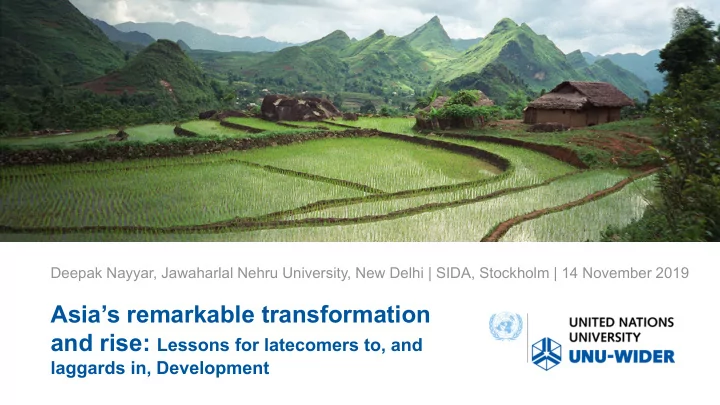
Asia’s remarkable transformation and rise: Lessons for latecomers to, and

laggards in, Development

Deepak Nayyar, Jawaharlal Nehru University, New Delhi | SIDA, Stockholm | 14 November 2019
slide-2
SLIDE 2
  • 1. Overview
  • About the book
  • Contours of change in Asia
  • Analytical conclusions and policy implications
  • Findings
  • Recommendations
slide-3
SLIDE 3
  • 2. Contours of change in Asia
  • Decline and fall of Asia: 1820-1962
  • Rise of Asia: 1970-2016

– Share in world GDP – GDP per capita: from divergence towards convergence – Share of world manufacturing and trade

  • Social development and poverty

reduction

  • Unequal outcomes in development

– Between people – Among countries

  • Enormous diversity, yet discernible

patterns

slide-4
SLIDE 4

Figure 1 : The Decline and Fall of Asia : 1820-1962

0.0 10.0 20.0 30.0 40.0 50.0 60.0 70.0 0.0 10.0 20.0 30.0 40.0 50.0 60.0 70.0 1820 1870 1900 1913 1940 1950 1962 Percentage of World GDP Percentage of World population Asia : Population Asia : GDP 20 40 60 80 100 120 1820 1870 1900 1913 1940 1950 1962 Percentage of GDP per capita in WE+WO Asia Western Europe & Western Offshoots

slide-5
SLIDE 5

Figure 2: Rising Significance of Asia in the World Economy: 1970-2016 (in percentages)

10 20 30 40 50 60 70 1970 1972 1974 1976 1978 1980 1982 1984 1986 1988 1990 1992 1994 1996 1998 2000 2002 2004 2006 2008 2010 2012 2014 2016 Asia/World GDP Asia/World Population 20 40 60 80 100 120 1970 1972 1974 1976 1978 1980 1982 1984 1986 1988 1990 1992 1994 1996 1998 2000 2002 2004 2006 2008 2010 2012 2014 2016 Asia/World GDP per capita Asia/Developing Countries GDP per capita Asia/Industrialised Countries GDP per capita

  • a. World Population and GDP
  • b. GDP per capita

Source: United Nations, National Accounts Statistics and Population Statistics. Note: The percentages have been calculated.

slide-6
SLIDE 6

Figure 3: Distribution of World Manufacturing Value Added and Manufactured Exports: 1970-2016

(in percentages)

  • a. World manufacturing value added
  • b. World manufactured exports

20 40 60 80 100 1970 1972 1974 1976 1978 1980 1982 1984 1986 1988 1990 1992 1994 1996 1998 2000 2002 2004 2006 2008 2010 2012 2014 2016 Industrialized Countries Developing Countries Asia 20 40 60 80 100 1970 1980 1990 2000 2010 2016 Asia Developing Countries Industrialized Countries Source: Nayyar (2019)

slide-7
SLIDE 7
  • 3. Analytical conclusions and policy

implications

  • Political independence as a turning point
  • Reshaping of initial conditions
  • Stunning economic growth

– Drivers of growth: supply-side and demand-side – Macroeconomic objectives and policies

  • Structural transformation: significant but uneven and incomplete
slide-8
SLIDE 8
  • Economic openness

– Necessary but not sufficient – Strategic integration rather than passive insertion – Conducive to industrialization only when combine with industrial policy

  • Critical role of governments

– States and markets: significance of the relationship – Developmental States in East Asia: the special case – Countries without developmental states: the norm – Role of institutionalized checks-and-balances

  • Wellbeing of people and development of nations
slide-9
SLIDE 9

Figure 4: Growth Rates of GDP and GDP per capita in Asia compared with Country-groups in the World Economy

1971-2016: per cent per annum

3.0 1.10 2.5 1.86 4.5 2.72 2.8 0.21 3.3 1.57 5.8 4.10 1 2 3 4 5 6 7 GDP GDP per capita World Industrialized Countries Developing Countries Latin America Africa Asia

Source: Nayyar (2019). Source: Nayyar (2019).

slide-10
SLIDE 10
  • 4. Findings
  • Rapid economic growth led the development process in Asia and was responsible for its

spectacular rise in the world economy

  • Asia was characterized by significant diversity in paths to, and outcomes in, development,

which were shaped by the national context

  • Governments performed a critical role, ranging from leader to catalyst or supporter, in the

economic transformation of Asia

  • Success at industrialization in Asia was shaped by sensible industrial policy implemented by

effective governments

slide-11
SLIDE 11
  • 4. Findings (cont.)
  • Economic openness performed a critical supportive role wherever it was in the form of

strategic integration, rather than passive insertion, into the world economy

  • Inequality between people within countries rose rapidly almost everywhere, while the

wide gap between rich and poor countries remained awesome

  • There was a massive reduction in absolute poverty that could have been even greater but

for the rising inequality

slide-12
SLIDE 12
  • 5. Recommendations
  • Coordinate economic policies in pursuit of development objectives, while learning and unlearning

from experience, for policies are means not ends

  • For latecomers to development, heterodox or unorthodox economic policies – in trade, industry and

macro-management – are more effective than orthodox policies

  • Efficient markets and effective governments, together, adapting to each other as time and

circumstances change, provide the way forward in development

  • Economic openness, while necessary, is not sufficient, and is conducive to development only when

combined with industrial policy

slide-13
SLIDE 13
  • 5. Recommendations (cont.)
  • Social opportunities for people, through public provision of education and healthcare which

improve wellbeing, and economic development of countries reinforce each other in a virtuous circle

  • Employment matters, for it is the only effective means of eradicating poverty, reducing inequality,

and sustaining growth

  • Economic policies must be conducive to inclusive outcomes for growth to be sustainable and for

development to be transformative

slide-14
SLIDE 14

www.wider.unu.edu

Helsinki, Finland