As the World Development Report 2011, the Pathways for Peace report, - - PowerPoint PPT Presentation

as the world development report 2011 the pathways for
SMART_READER_LITE
LIVE PREVIEW

As the World Development Report 2011, the Pathways for Peace report, - - PowerPoint PPT Presentation

As the World Development Report 2011, the Pathways for Peace report, and other analytical work suggest, security is vitally important in addressing the development challenges of fragility, conflict, and violence. Although the Banks involvement


slide-1
SLIDE 1
slide-2
SLIDE 2

As the World Development Report 2011, the Pathways for Peace report, and other analytical work suggest, security is vitally important in addressing the development challenges of fragility, conflict, and violence. Although the Bank’s involvement with its member countries’ security sector has been limited, there is a growing recognition that the institution may deal with security and military actors in variety of ways while remaining consistent with its mandate, comparative advantage, and technical competence. Executive Directors have approved a number of projects in which the Bank financing has been used for non-security functions undertaken by military units, such as disaster relief. In 2017, as an exceptional case, the Bank financed the construction of a road in an active conflict zone in Cameroon using the Cameroon Army Corps of Engineers because there were no private contractors willing and able to undertake the work. The Cameroon Army Corps of Engineers were contracted by the implementing ministry through an output based designated force account

  • contract. This activity required extensive due diligence and appraisal and is the subject of

specific legal and operational arrangements to ensure that any social, safeguard, fiduciary,

  • perational, legal, and reputational risks are appropriately mitigated. Similarly, in post-conflict

Liberia for instance, the Bank partnered with the UN peacekeeping mission (UNMIL) and UNDP to support the newly elected government’s efforts in improving infrastructure as an input to local recovery through employment-intensive road repairs in targeted war-affected areas. Responding to requests from member countries, the Bank has, in collaboration with partners, carried out public expenditure reviews (PER) focusing on security in a number of countries including most recently in Guinea Bissau. As part of a whole-of-government approach, the Bank has provided public financial management (PFM) support to Somalia’s security sector agencies. To provide greater clarity, the Bank is currently reviewing its legal and policy framework for security and military engagements and has adopted a case-by-case approach which carefully identifies, manages, and mitigates risks while ensuring that all Bank engagements and activities with security actors are designed consistently with the institution’s development mandate under the Articles.

slide-3
SLIDE 3

As the World Development Report 2011, the Pathways for Peace report, and other analytical work suggest, security is vitally important in addressing the development challenges of fragility, conflict, and violence. Although the Bank’s involvement with its member countries’ security sector has been limited, there is a growing recognition that the institution may deal with security and military actors in variety of ways while remaining consistent with its mandate, comparative advantage, and technical competence. Executive Directors have approved a number of projects in which the Bank financing has been used for non-security functions undertaken by military units, such as disaster relief. In 2017, as an exceptional case, the Bank financed the construction of a road in an active conflict zone in Cameroon using the Cameroon Army Corps of Engineers because there were no private contractors willing and able to undertake the work. The Cameroon Army Corps of Engineers were contracted by the implementing ministry through an output based designated force account

  • contract. This activity required extensive due diligence and appraisal and is the subject of

specific legal and operational arrangements to ensure that any social, safeguard, fiduciary,

  • perational, legal, and reputational risks are appropriately mitigated. Similarly, in post-conflict

Liberia for instance, the Bank partnered with the UN peacekeeping mission (UNMIL) and UNDP to support the newly elected government’s efforts in improving infrastructure as an input to local recovery through employment-intensive road repairs in targeted war-affected areas. Responding to requests from member countries, the Bank has, in collaboration with partners, carried out public expenditure reviews (PER) focusing on security in a number of countries including most recently in Guinea Bissau. As part of a whole-of-government approach, the Bank has provided public financial management (PFM) support to Somalia’s security sector agencies. To provide greater clarity, the Bank is currently reviewing its legal and policy framework for security and military engagements and has adopted a case-by-case approach which carefully identifies, manages, and mitigates risks while ensuring that all Bank engagements and activities with security actors are designed consistently with the institution’s development mandate under the Articles.

slide-4
SLIDE 4

Cairo University

slide-5
SLIDE 5
slide-6
SLIDE 6
slide-7
SLIDE 7
slide-8
SLIDE 8

Harvard Law School Doctoral Dissertation 1964

slide-9
SLIDE 9

Ain Shams University Cairo, Egypt

slide-10
SLIDE 10

Kuwait Fund for International Development

slide-11
SLIDE 11
slide-12
SLIDE 12
slide-13
SLIDE 13
slide-14
SLIDE 14
slide-15
SLIDE 15

OPEC Fund for International Development

slide-16
SLIDE 16

OPEC Fund for International Development

slide-17
SLIDE 17

Refugees, Discussion with IG Patel, Robert McNamara India Country Files, Volume 3

Robert S. McNamara World Bank President April 1968-June 1981

slide-18
SLIDE 18

Aiden W. Clausen World Bank President July 1981- June 1986

slide-19
SLIDE 19
slide-20
SLIDE 20
slide-21
SLIDE 21

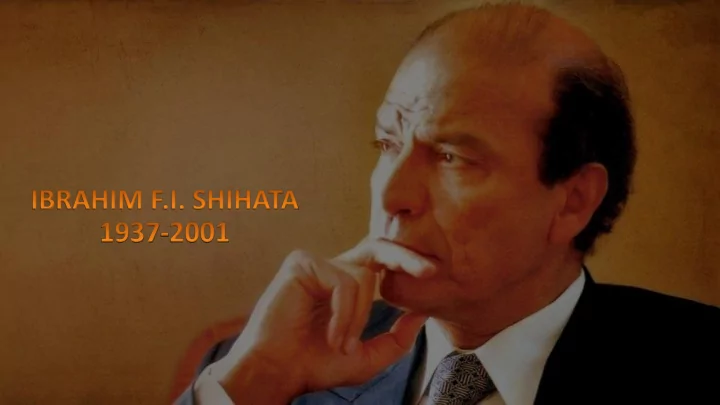
https://oralhistory.worldbank.or g/sites/oral/files/styles/person_ width_only/public/person_pictur e/Shihata_Ibrahim.jpg?itok= rLj WLcGC

slide-22
SLIDE 22

https://oralhistory.worldbank.or g/sites/oral/files/styles/person_ width_only/public/person_pictur e/Shihata_Ibrahim.jpg?itok= rLj WLcGC

slide-23
SLIDE 23

Cameroon Signs the MIGA Convention, 1988

slide-24
SLIDE 24
slide-25
SLIDE 25
slide-26
SLIDE 26
slide-27
SLIDE 27
slide-28
SLIDE 28
slide-29
SLIDE 29
slide-30
SLIDE 30
slide-31
SLIDE 31
slide-32
SLIDE 32
slide-33
SLIDE 33
slide-34
SLIDE 34
slide-35
SLIDE 35
slide-36
SLIDE 36
slide-37
SLIDE 37