
SLIDE 1
Area of a surface
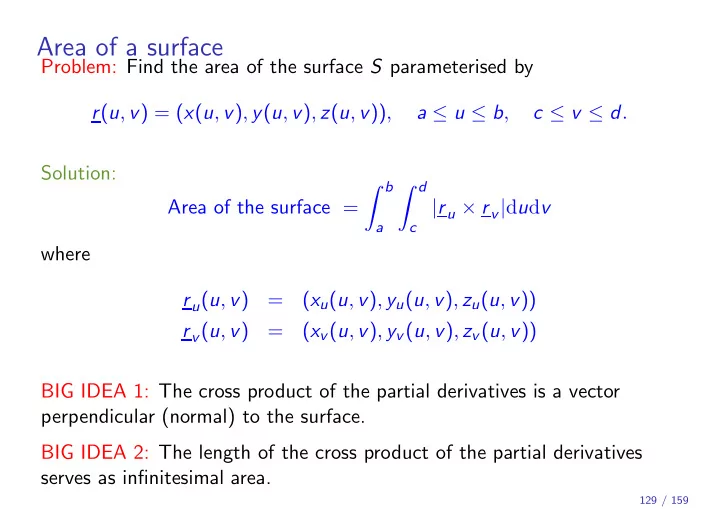
Problem: Find the area of the surface S parameterised by r(u, v) = (x(u, v), y(u, v), z(u, v)), a ≤ u ≤ b, c ≤ v ≤ d. Solution: Area of the surface = b
a
d
c
|ru × rv|dudv where ru(u, v) = (xu(u, v), yu(u, v), zu(u, v)) rv(u, v) = (xv(u, v), yv(u, v), zv(u, v)) BIG IDEA 1: The cross product of the partial derivatives is a vector perpendicular (normal) to the surface. BIG IDEA 2: The length of the cross product of the partial derivatives serves as infinitesimal area.
129 / 159