Architectural Engineering Sarah Miller 2014 senior thesis lighting - - PDF document

architectural engineering sarah miller
SMART_READER_LITE
LIVE PREVIEW

Architectural Engineering Sarah Miller 2014 senior thesis lighting - - PDF document

sarah miller | prince frederick hall | presentation handout Prince Frederick Hall university of maryland Architectural Engineering Sarah Miller 2014 senior thesis lighting + electrical i n t r o d u c t i o n | l i g h t i n g


slide-1
SLIDE 1

Prince Frederick Hall

university of maryland

Sarah Miller

lighting + electrical

Architectural Engineering

2014 senior thesis i n t r o d u c t i o n | l i g h t i n g | e l e c t r i c a l | b r e a d t h s | c o n c l u s i o n college park , MD

Key

residential academic

  • ffices
  • ther

Prince Frederick Hall

university of maryland i n t r o d u c t i o n | l i g h t i n g | e l e c t r i c a l | b r e a d t h s | c o n c l u s i o n

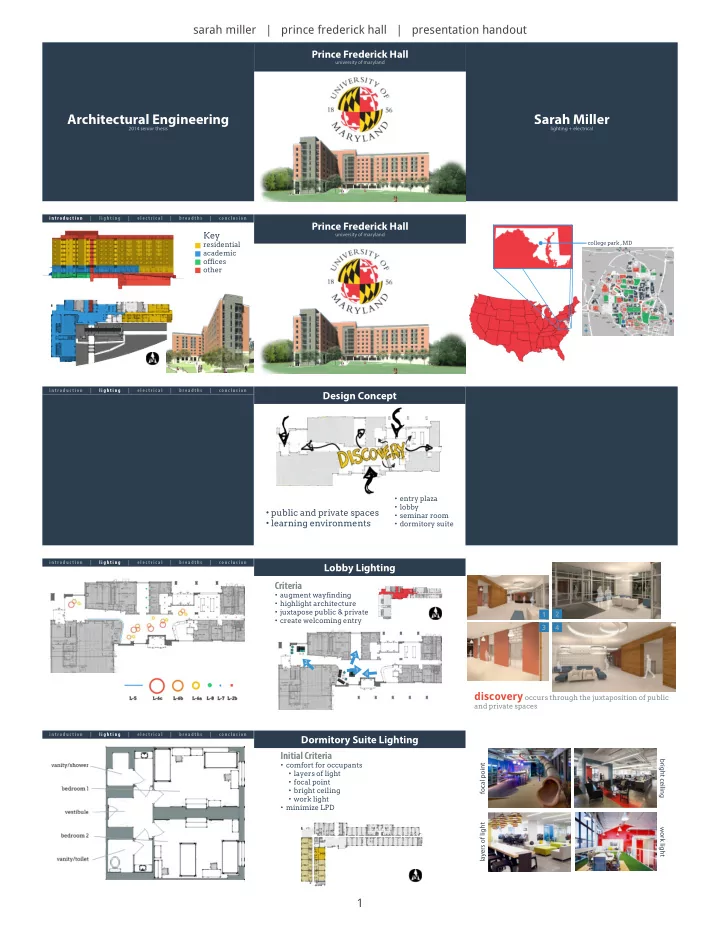
Design Concept

  • entry plaza
  • lobby
  • seminar room
  • dormitory suite
  • public and private spaces
  • learning environments

i n t r o d u c t i o n | l i g h t i n g | e l e c t r i c a l | b r e a d t h s | c o n c l u s i o n

Lobby Lighting Criteria

  • augment wayfinding
  • highlight architecture
  • juxtapose public & private
  • create welcoming entry

discovery occurs through the juxtaposition of public

and private spaces 4 2 1 3

3 4 1 2 i n t r o d u c t i o n | l i g h t i n g | e l e c t r i c a l | b r e a d t h s | c o n c l u s i o n

Dormitory Suite Lighting Initial Criteria

  • comfort for occupants
  • layers of light
  • focal point
  • bright ceiling
  • work light
  • minimize LPD

focal point layers of light bright ceiling work light

sarah miller | prince frederick hall | presentation handout 1

slide-2
SLIDE 2

i n t r o d u c t i o n | l i g h t i n g | e l e c t r i c a l | b r e a d t h s | c o n c l u s i o n

Dormitory Suite Lighting Criteria: focus on sustainability

  • minimize LPD
  • 42 dormitory suites
  • target: 0.34 W/ft2

(10% less than ASHRAE 90.1 2010)

  • maximize controllability
  • comfort for both roommates
  • different scenes

discovery of social life

1

1

i n t r o d u c t i o n | l i g h t i n g | e l e c t r i c a l | b r e a d t h s | c o n c l u s i o n

Dormitory Suite Lighting Achievements

  • minimize LPD
  • target: 0.34 W/ft2

(10% less than ASHRAE 90.1 2010)

  • achieved: 0.21 W/ft2
  • load reduction
  • multiplied across 42 suites
  • design uses 8.8 kW less
  • practical
  • coordinates with existing architecture
  • LED fixtures for durability & longevity
  • bright ceiling
  • 3-sided lens fixture
  • aesthetic improvement

1

1

discovery of social life

i n t r o d u c t i o n | l i g h t i n g | e l e c t r i c a l | b r e a d t h s | c o n c l u s i o n

Other Lighting Spaces

Entry Plaza Seminar Room

Achievements

  • IES Recommendations
  • occupants 25 years old
  • 200 lux on work plane
  • peripheral lighting
  • flexible controls
  • no upward-facing lights
  • trellis highlighted
  • social gathering space
  • established heirarchy

first step of discovery

discover education

i n t r o d u c t i o n | l i g h t i n g | e l e c t r i c a l | b r e a d t h s | c o n c l u s i o n

Electrical Depth Equipment Savings Wire Savings

Existing System

208Y-120V 2 risers 250 and 500 kcmil

no changes

the loads on these panels are unchanged; equipment is the same

$40,000

eliminated (2) 1600A switchboards and associated breakers

  • $950

distributed transformers are almost the same cost as centralized

$275

(2) 800A breakers were changed to several smaller ones

$72,000 $41,000 Redesigned System

480/277V 1 riser #1/0 and 250 kcmil for dormitory distribution system

Total Wire Cost Savings: $34,000

for dormitory distribution system

Total Equipment Cost Savings: $37,500 xmfr

branch panels switchboards draw-out breakers

(switchgear)

Existing System Redesigned System

i n t r o d u c t i o n | l i g h t i n g | e l e c t r i c a l | b r e a d t h s | c o n c l u s i o n

Electrical Depth Total Savings

Existing System Redesigned System

System Benefi ts

  • smaller transformers are needed at each floor
  • smaller wire sizes
  • less voltage drop
  • higher voltage distribution
  • this increases the overall efficiency
  • several pieces of equipment eliminated or resized

Total Equipment Cost Savings: $37,500 Total Wire Cost Savings: $34,000

Total Savings:

$71,000

sarah miller | prince frederick hall | presentation handout 2

slide-3
SLIDE 3

i n t r o d u c t i o n | l i g h t i n g | e l e c t r i c a l | b r e a d t h s | c o n c l u s i o n

Mechanical + Architectural Breadths Scope Shading Options Design Goal

36 East-facing Suites 18 West-facing Suites 66 South-facing Rooms 18 North-facing Rooms

maximize shading between June - August minimize shading between October - March

i n t r o d u c t i o n | l i g h t i n g | e l e c t r i c a l | b r e a d t h s | c o n c l u s i o n

Mechanical + Architectural Breadths Mechanical Achievements Shading Technique

Architectural Achievements

Existing Building

Calculation Method

  • Compute relevant solar angles (altitude, azimuth, angle of

incidence)

  • Use solar angles to fi

nd the unshaded area (ft2) of windows

  • Calculate direct beam solar heat gain
  • Calculate (ground and sky) diff

use solar heat gain Total Reduction: 83,570 BTUs

Reduction in Solar Heat Gain Energy Savings

BTU/window/day South East West North South East West North Number of Windows 66 36 48 18 June 21

  • 858.88
  • 2,630.91
  • 2,652.41
  • 444.66

Cooling Season Net BTUs

  • 239192
  • 165040
  • 204758
  • 8004

December 21

  • 2,494.79
  • 947.23
  • 91.49

0.00 Heating Season Net BTUs

  • 347163
  • 104428
  • 81834

September 21

  • 2,765.25
  • 1,953.55
  • 1,613.39

0.00 Net BTUs

  • 107970

60612 122924 8004 March 21

  • 2,765.25
  • 1,953.55
  • 1,613.39

0.00 Total 83570 BTUs

i n t r o d u c t i o n | l i g h t i n g | e l e c t r i c a l | b r e a d t h s | c o n c l u s i o n

Mechanical + Architectural Breadths Electrical Depth Lighting Depth

Total Reduction:

83,570 BTUs

Load Reduction:

11,400 Watts

Total Savings:

$71,000 Appendix: References Image Sources Tools

1 Brownson, Jeffrey R. S. Solar Energy Conversion Systems. 1st ed. Oxford, UK: Elsevier, 2014.

Print.

2 Charest, Adrian C. RSMeans Electrical Cost Data. Norwell, MA: Construction &

Consultants, 2014. Print.

3 Dilaura, David L., Kevin W. Houser, Richard G. Mistrick, and Gary R. Steffy, eds. The

Lighting Handbook: Reference and Application. 10th ed. N.p.: Illuminating Engineering, 2011. Print.

4 Duffie, John A., and William A. Beckman. Solar Engineering of Thermal Processes. 3rd ed.

Hoboken: Wiley, 2006. Print.

5 Grondzik, Walter T., Alison G. Kwok, Benjamin Stein, and John S. Reynolds. Mechanical

and Electrical Equipment for Buildings. 11th ed. Hoboken: J. Wiley & Sons, 2010. Print.

6 Haggard, Kenneth L., David A. Bainbridge, and Rachel Aljilani. Passive Solar Architecture

Pocket Reference. Ed. D. Yogi Goswami. London: Earthscan, 2009. Print.

7 National Fire Protection Association. NEC 2011. 2011 ed. Quincy, MA: NFPA, 2010. Print. 8 Perlin, John. Let It Shine : The 6,000-year Story of Solar Energy. Novato, CA: New World

Library, 2013. Print.

9 Spitler, Jeffrey D. Load Calculation Applications Manual. Atlanta, GA: American Society

  • f Heating, Refrigerating, and Air-Conditioning Engineers, 2009. Print.

Architect’s Renderings:

http://www.resnet.umd.edu/princefrederick/

Dormitory Suite Precedent Images:

http://blogs.edweek.org/edweek/LeaderTalk/2010/11/habits_and_habitats_rethinking.html http://designermag.org/40-real-creative-workspace-examples/ http://www.nbbj.com/work/russell-investments/ http://www.designboom.com/architecture/camenzind-evolutions-google-office-flourishes-in-dublin/

Shading Options Images:

photos by: Sarah Miller

revit autoCAD AGi32 inDesign photoshop sketchUp hand drawing

sarah miller | prince frederick hall | presentation handout 3

end of presentation end of presentation

Appendix: Abstract Building Statistics Project Team Lighting + Electrical Mechanical Structural Architecture

function: University Housing size: 185,522 GSF number of stories: 7 floors + ground floor construction dates: May 2012-August 2014 project cost: $66.8 million delivery method: design-build

daylighting: Provided to spaces through numerous glazed openings. The lobby and social areas feature large, glass curtain walls. Classrooms are equiped with blackout shades. lighting: Interior lighting is mostly fluorescent. Many troffers and recessed downlights are applied throughout the building. Exterior lighting is LED. electrical: Power feeds into the building from the north side. Two 3000 kVA transformers, outside the building, provide 480/277V to the main electrical

  • room. Power is transformed to 208Y-120V for all receptacles and lighting.

air distribution: Six air handling units and two roof top units circulate air throughout the building. central systems: Prince Frederick Hall is connected to the campus’ central steam distribution system. academic spaces: Variable air volume (VAV) boxes are located throughout the ground and first floors. Separate heating and cooling coils provide extra control to individual spaces. dormitory spaces: Each dormitory room is equipped with its own fan coil unit (FCU) that connects to the building’s chilled water and hot water systems. foundation: Concrete columns carry the load of the building below grade to footings. superstructure: The structure of the building is mostly steel-reinforced

  • concrete. Typical 18x30 columns carry 8” concrete decks. Cantelievers on the

2nd floor are supported by post-tensioned concrete beams. lateral system: Shear walls around stairwells and elevator cores resist lateral loads. trellis: Located at the north and south entrances, this feature of the building is constructed mainly of hollow steel sections. Prince Frederick Hall is a new building located on the University of Maryland

  • campus. The building programming provisions space for academic rooms on

the ground and first floors of the building. Part of the first floor and all of the second through seventh floors are used for dormitory rooms. A combination

  • f single, double occupant, and suites provide housing for a little over 450

students. Red brick dominates the most surface area of the building and is is laid in a traditional running bond pattern. The first floor of the building is wrapped in a limestone-colored, special finish masonry unit. Metal is also used on the facade; it is used primarily to accent the curtain walls.

architect: WDG Architecture, PLLC general contractor: Clark Construction structural engineer: Cagley & Associates, Inc. mep consulting: WFT Engineering, Inc. civil engineer: Site Resources Inc. landscape architect: Parker Rodriguez Inc.

slide-4
SLIDE 4

Luminiare Schedule Lobby Entry Plaza Appendix: Lighting Seminar Room Dormitory Suite

sarah miller | prince frederick hall | milestone 2 report

Appendix

Luminaire Schedule Type Mark Description Manufacturer Lamp Quantity Input Watts Lobby L-5 LED tape LED Linear LED (1.4 W/LF) 30 1.4 L-2b 4" Square Downlight; high output Lightolier LED 15 19.8 L-6a 36" cyliner pendant Eureka LED 5 40 L-6b 54" cyliner pendant Eureka LED 8 64 L-6c 72" cyliner pendant Eureka LED 4 87 L-7 2 cell downlight iGuzzini LED 15 4.2 L-8 Decorative pendant Eureka 2 - 18W CFL 3 37 Seminar Room L-3 Semi-recessed linear wall washer Architectural Lighting Works 1 - 28W T5 4 30 L-4 Linear pendant 4' direct/indirect Focal Point LED 12 98 L-5 LED tape LED Linear LED (1.4 W/LF) 33 1.4 Dormitory Suite L-1 Surface mounted linear with wrapped lens Architectural Lighting Works LED (7 W/LF) 8 15.8 L-2a 4" Square Downlight; low output Lightolier LED 4 8.7 Entry Plaza LE-1 Exterior 15' UMD Standard LED Pole LSI Industries LED 4 138 LE-2 LED tape; IP67 rated LED Linear LED 268 1.4 LE-3 Bollard Cooper LED 7 8.6 24

LPD & Criteria Light Levels & Criteria Appendix: Lighting

Entry Plaza

General Illumination Paths to Curb Seating Areas

Criteria Existing Thesis Criteria Existing Thesis Criteria Existing Thesis E (horizontal) 30 30 50 4 11 30 50 31 81 E (vertical) 15 15 3 31 Avg:Min 2:1 4:1 1.8:1 2.5:1

Ramps

Criteria Existing Thesis E (horizontal) 4 E (vertical) Avg:Min 5:1 Lobby

General Illumination Reception Desk Vestibules

Criteria Existing Thesis Criteria Existing Thesis Criteria Existing Thesis E (horizontal) 100 251 251 150 293 205 50 142 79 E (vertical) 30 121 177 30 98 41 Avg:Min 4:1 6:1 2.2:1 4:1 1.7:1 1.6:1 2:1 3.3:1 1.9:1

Elevator Lobby Reading/Work Area

Criteria Existing Thesis Criteria Existing Thesis E (horizontal) 50 173 60 150 237 244 E (vertical) 50 72 105 Avg:Min 2:1 2.2:1 3:1 Seminar Room

General Illumination, non-AV General Illumination, AV Whiteboard

Criteria Existing Thesis Criteria Existing Thesis Criteria Existing Thesis E (horizontal) 200 503 344 25 145 24 E (vertical) 75 353 304 15 57 14 300 258 295 Avg:Min 2:1 4.34:1 3:1 3:1 1.44:1 2.11:1 Dormitory Suite

General Illumination Desk Areas Bath Areas

Criteria Existing Thesis Criteria Existing Thesis Criteria Existing Thesis E (horizontal) 25 626 290 250 590 268 50 1066 550 E (vertical) Avg:Min 3:1 1.2:1 1.3:1 2:1 1.4:1 1.3:1

Vanities Foyer

Criteria Existing Thesis Criteria Existing Thesis E (horizontal) 150 960 627 50 732 423 E (vertical) 200 1022 628 Avg:Min 2:1 1.1:1 1.1:1 3:1 1.2:1 1.3:1 Entry Plaza

General Illumination Paths to Curb Seating Areas

Criteria Existing Thesis Criteria Existing Thesis Criteria Existing Thesis E (horizontal) 30 30 50 4 11 30 50 31 81 E (vertical) 15 15 3 31 Avg:Min 2:1 4:1 1.8:1 2.5:1

Ramps

Criteria Existing Thesis E (horizontal) 4 E (vertical) Avg:Min 5:1 Lobby

General Illumination Reception Desk Vestibules

Criteria Existing Thesis Criteria Existing Thesis Criteria Existing Thesis E (horizontal) 100 251 251 150 293 205 50 142 79 E (vertical) 30 121 177 30 98 41 Avg:Min 4:1 6:1 2.2:1 4:1 1.7:1 1.6:1 2:1 3.3:1 1.9:1

Elevator Lobby Reading/Work Area

Criteria Existing Thesis Criteria Existing Thesis E (horizontal) 50 173 60 150 237 244 E (vertical) 50 72 105 Avg:Min 2:1 2.2:1 3:1 Seminar Room

General Illumination, non-AV General Illumination, AV Whiteboard

Criteria Existing Thesis Criteria Existing Thesis Criteria Existing Thesis E (horizontal) 200 503 344 25 145 24 E (vertical) 75 353 304 15 57 14 300 258 295 Avg:Min 2:1 4.34:1 3:1 3:1 1.44:1 2.11:1 Dormitory Suite

General Illumination Desk Areas Bath Areas

Criteria Existing Thesis Criteria Existing Thesis Criteria Existing Thesis E (horizontal) 25 626 290 250 590 268 50 1066 550 E (vertical) Avg:Min 3:1 1.2:1 1.3:1 2:1 1.4:1 1.3:1

Vanities Foyer

Criteria Existing Thesis Criteria Existing Thesis E (horizontal) 150 960 627 50 732 423 E (vertical) 200 1022 628 Avg:Min 2:1 1.1:1 1.1:1 3:1 1.2:1 1.3:1 Entry Plaza

General Illumination Paths to Curb Seating Areas

Criteria Existing Thesis Criteria Existing Thesis Criteria Existing Thesis E (horizontal) 30 30 50 4 11 30 50 31 81 E (vertical) 15 15 3 31 Avg:Min 2:1 4:1 1.8:1 2.5:1

Ramps

Criteria Existing Thesis E (horizontal) 4 E (vertical) Avg:Min 5:1 Lobby

General Illumination Reception Desk Vestibules

Criteria Existing Thesis Criteria Existing Thesis Criteria Existing Thesis E (horizontal) 100 251 251 150 293 205 50 142 79 E (vertical) 30 121 177 30 98 41 Avg:Min 4:1 6:1 2.2:1 4:1 1.7:1 1.6:1 2:1 3.3:1 1.9:1

Elevator Lobby Reading/Work Area

Criteria Existing Thesis Criteria Existing Thesis E (horizontal) 50 173 60 150 237 244 E (vertical) 50 72 105 Avg:Min 2:1 2.2:1 3:1 Seminar Room

General Illumination, non-AV General Illumination, AV Whiteboard

Criteria Existing Thesis Criteria Existing Thesis Criteria Existing Thesis E (horizontal) 200 503 344 25 145 24 E (vertical) 75 353 304 15 57 14 300 258 295 Avg:Min 2:1 4.34:1 3:1 3:1 1.44:1 2.11:1 Dormitory Suite

General Illumination Desk Areas Bath Areas

Criteria Existing Thesis Criteria Existing Thesis Criteria Existing Thesis E (horizontal) 25 626 290 250 590 268 50 1066 550 E (vertical) Avg:Min 3:1 1.2:1 1.3:1 2:1 1.4:1 1.3:1

Vanities Foyer

Criteria Existing Thesis Criteria Existing Thesis E (horizontal) 150 960 627 50 732 423 E (vertical) 200 1022 628 Avg:Min 2:1 1.1:1 1.1:1 3:1 1.2:1 1.3:1

Entry Plaza Existing LPD Area (SF) Total Watts LPD Target LPD % Difference 0.09 12,300 987 0.08 0.09 10.80% Lobby Existing LPD Area (SF) Total Watts LPD Target LPD % Difference 0.70 5,152 1,418 0.28 0.90 69.42% Seminar Room Existing LPD Area (SF) Total Watts LPD Target LPD % Difference 0.74 1,750 1,342 0.77 1.24 38.15% Dormitory Suite Existing LPD Area (SF) Total Watts LPD Target LPD % Difference 0.45 777 161 0.21 0.38 45.40%

Entry Plaza

General Illumination Paths to Curb Seating Areas

Criteria Existing Thesis Criteria Existing Thesis Criteria Existing Thesis E (horizontal) 30 30 50 4 11 30 50 31 81 E (vertical) 15 15 3 31 Avg:Min 2:1 4:1 1.8:1 2.5:1

Ramps

Criteria Existing Thesis E (horizontal) 4 E (vertical) Avg:Min 5:1 Lobby

General Illumination Reception Desk Vestibules

Criteria Existing Thesis Criteria Existing Thesis Criteria Existing Thesis E (horizontal) 100 251 251 150 293 205 50 142 79 E (vertical) 30 121 177 30 98 41 Avg:Min 4:1 6:1 2.2:1 4:1 1.7:1 1.6:1 2:1 3.3:1 1.9:1

Elevator Lobby Reading/Work Area

Criteria Existing Thesis Criteria Existing Thesis E (horizontal) 50 173 60 150 237 244 E (vertical) 50 72 105 Avg:Min 2:1 2.2:1 3:1 Seminar Room

General Illumination, non-AV General Illumination, AV Whiteboard

Criteria Existing Thesis Criteria Existing Thesis Criteria Existing Thesis E (horizontal) 200 503 344 25 145 24 E (vertical) 75 353 304 15 57 14 300 258 295 Avg:Min 2:1 4.34:1 3:1 3:1 1.44:1 2.11:1 Dormitory Suite

General Illumination Desk Areas Bath Areas

Criteria Existing Thesis Criteria Existing Thesis Criteria Existing Thesis E (horizontal) 25 626 290 250 590 268 50 1066 550 E (vertical) Avg:Min 3:1 1.2:1 1.3:1 2:1 1.4:1 1.3:1

Vanities Foyer

Criteria Existing Thesis Criteria Existing Thesis E (horizontal) 150 960 627 50 732 423 E (vertical) 200 1022 628 Avg:Min 2:1 1.1:1 1.1:1 3:1 1.2:1 1.3:1

AGi32 Pseudo Color Plans Appendix: Lighting

lobby seminar rooom entry plaza

AGi32 Pseudo Color Plans Appendix: Lighting

dormitory suite

sarah miller | prince frederick hall | presentation handout 4

Transformer Locations Short Circuit Calculations Appendix: Electrical

1st Floor: T-N1 Location: Room 1229 Size: 225 kVA Dimensions: 44” x 36” T-N1 2nd - 7th Floors: T-N* Location: Room *228 Size: 112.5 kVA Dimensions: 28” x 23” where * is the floor number

T-N*

1440 lbs 930 lbs each

X1: Transformer (T-2) Secondary X2: at Switchgear X3: Switchgear X4: at Transformer (T-N2) Primary I sc sys RMS (A) 1.00E+30 I sc (A) from X1 62,757.30 Main Transformer Size 3000 I sc (A) from X3 54,569.28 Primary Voltage (V) 13200 Wire Length 105 Voltage at Switchgear (V) 480 Wire Length 52 Secondary Voltage (V) 480 Number of Wires per 8 Full Load Current (FLA) 3,608.55 Number of Wires per 1 Impedance 5.75% C Value 22185 I sc (A) from X2 55,342.95 C Value 7493 Transformer Size (kVA) 3000 Voltage (V) 480 % motors 25% Voltage (V) 480 100,000.00 f 0.1340 I motor contribution (A) 3,608.55 f 1.3665 f 4.38E+26 M 0.8819 I total sym sc RMS (A) 58,951.50 M 0.4226 M 0.0000 I sc sys RMS (A) 55,342.95 Wire Length 92 I sc sys RMS (A) 23,059.29 I sc sys RMS 62,757.30 % motors 0% Number of Wires per Phase 8 % motors 0% I motor contribution (A) C Value 26706 I motor contribution (A) I total sym sc RMS (A) 55,342.95 f 0.0860 I total sym sc RMS (A) 23,059.29 M 0.9208 I sc sys RMS (A) 50,960.74 I motor contribution (A) 3,608.55 I total sym sc RMS (A) 54,569.28 X5: Transformer (T-N2) Secondary X6: Panel NP2 X7: Panel NP2A I sc sys RMS (A) from X4 23,059.29 I sc sys RMS (A) from X5 10,817.30 I sc sys RMS (A) from X6 10,364.20 Primary Voltage (V) 480 Wire Length 8 Wire Length 8 Secondary Voltage (V) 208 Number of Wires per 1 Number of Wires per Phase 1 Impedance 2.30% C Value 16483 C Value 7293 Transformer Size (kVA) 112.5 Voltage (V) 208 Voltage (V) 208 100,000.00 f 0.0437 f 0.0947 f 3.9193 M 0.9581 M 0.9135 M 0.2033 I sc sys RMS (A) 10,364.20 I sc sys RMS (A) 9,467.90 I sc sys RMS 10,817.30 % motors 0% % motors 0% I motor contribution (A) I motor contribution (A) I total sym sc RMS (A) 10,364.20 I total sym sc RMS (A) 9,467.90

These calculations were conducted using the Cooper-Bussman method for finding available short circuit current.
slide-5
SLIDE 5

Lighting Branch Circuit Redesign Appendix: Electrical

Existing Lighting Circuits Entry Plaza Lighting Fixture Type Load (VA) Fixtures per Circuit HL-3 EL-1 EX-1 138 4 EX-3 45 3 EX-4 25 10 EX-5 24.5 9 Existing Load 1022.5 135 Lobby Lighting Fixture Type Load (VA) Fixtures per Circuit MP1A-1 MP1A-3 MP1A-4 MP1A-8 EMP1-3 EMP1-5 F-8 42 12 25 7 F-9 32 10 9 1 17 7 F-7E 225 3 F-7F 64 2 2 1 Existing Load 320 792 32 1722 1321 64 Seminar Room Lighting Fixture Type Load (VA) Fixtures per Circuit MP1A-7 F-10 32 21 F-B1 32 15 Existing Load 1152 Dormitory Suite Lighting Fixture Type Load (VA) Fixtures per Circuit MP*A-# F-1 52 4 F-2 32 2 F-3 18 1 F-4 24 2 FA 32 1 Existing Load 370

Redesigned Lighting Circuits Fixture Type Load (VA) Quantity Total Load (VA) Lobby Loads L-5 1.4 30 42 L-2b 19.8 15 297 L-6a 40 5 200 L-6b 64 8 512 L-6c 87 4 348 L-7 4.2 15 63 L-8 37 3 111 Total Lobby Load 1573 Seminar Room Loads L-3 30 4 120 L-4 98 12 1176 L-5 1.4 33 46.2 Total Seminar Room Load 1342.2 Dormitory Suite Loads L-1 15.8 8 126.4 L-2a 8.7 4 34.8 Total Dorm Suite Load 161.2 Entry Plaza Loads LE-1 138 4 552 LE-2 1.4 268 375.2 LE-3 8.6 7 60.2 Total Entry Plaza Load 987.4

Lighting Circuits Comparison Circuit Name Total Circuit Load (VA) Difference Existing Redesigned HL-3 1935 1764.9 -170.1 VA EL-1 670 670 same MP1A-1 482 360 -122 VA MP1A-3 1024 1000 -24 VA MP1A-4 800 0 combined with MP1A-3 MP1A-8 1806 1041 -765 VA EMP1-3 1739 831.8 -907.2 VA EMP1-5 777 717.2 -59.8 VA MP1A-7 1152 1342.2 +190.2 VA MP*A-# 370 322.4 reduce from 7 to 4 circuits per floor

Solar Heat Gain Calculation Method Shading Appendix: Breadths

  • First, find direct beam solar heat gain:

ED calculate (see below) Asunlit is the unshaded area of the window SHGC(θ) is the manufacturer's SHGC with an angle correction factor applied where the method to find ED is: A and B are both coefficients CN is the clearness number, a regional coefficient β is the solar altitude

Next, find diffuse solar heat gain: Ed calculate (see below) Er calculate (see below) A is the total area of the window SHGCdiffuse is the manufacturer's SHGC with a diffuse correction factor applied where Ed (for a vertical surface) is: EDN is known from above C is a listed coefficient Er is the ground-reflected diffuse irradiation: EDN is known from above C is a listed coefficient β is the solar altitude ρg is the albedo (ground reflectance) Σ is the surface tilt angle (90o for vertical surfaces) Last, combine diffuse and direct solar heat gain to find total solar heat gain:

Shaded Area Graphs Ideal: reduce the unshaded area of each window as much

as possible, particularly for peak loads

Ideal: these months posed a challenge because September

is considered to be a cooling month and March is considered to be a heating month, but the solar angles are identical for both days

Ideal: maximize the unshaded area of each window as

much as possible

Appendix: Breadths Solar Heat Gain Graphs Appendix: Breadths

sarah miller | prince frederick hall | presentation handout 5

Triple Bottom Line Appendix

Environmental Social Economic

Sustainable

  • n vernacular architecture

“building in response to actual needs, fitted into environment by people who knew no better than to fit them with native feeling [is] for us better worth study than all the highly self-conscious academic attempts at the beautiful throughout Europe.”

  • Frank Lloyd Wright
  • n solar design

“The house in which the owner can find a pleasant retreat in all seasons… is at once the most useful and the most beautiful.”

  • Socrates